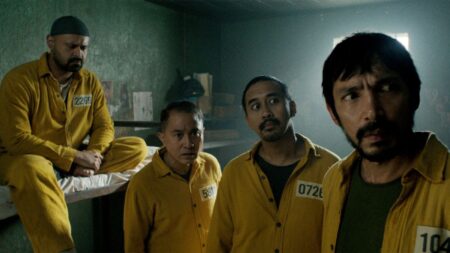

La Bola Negra, Javier Ambrossi and Javier Calvo’s imagined story of Federico García Lorca’s unfinished play by the same name and co-screenwriter Alberto Conejero’s play, La Piedra Oscura, is a stunningly beautiful triptych about buried queer history and modern queer living in early 20th-century and modern Spain. The film is built on three interwoven stories: Carlos’s (Milo Quifes) application to join the local casino in 1932 Granada, Sebastián’s (Guitarricadelafuente) military service in 1937 during the Spanish Civil War, and Alberto’s (Carlos González) research as a historian.
The first and foremost thing to note about La Bola Negra is just how gorgeous it looks. Shot on film, artifacts and grain and all, every image is like a painting. It’s a motif in the film’s opening, but there are shots of the horizon so stunning that they could be mistaken for matte paintings. It lends the film a slight sense of surrealism, which comes in handy both as the plot progresses and as the circumstances grow increasingly dire.
Each of La Bola Negra’s three eras is excellently acted.
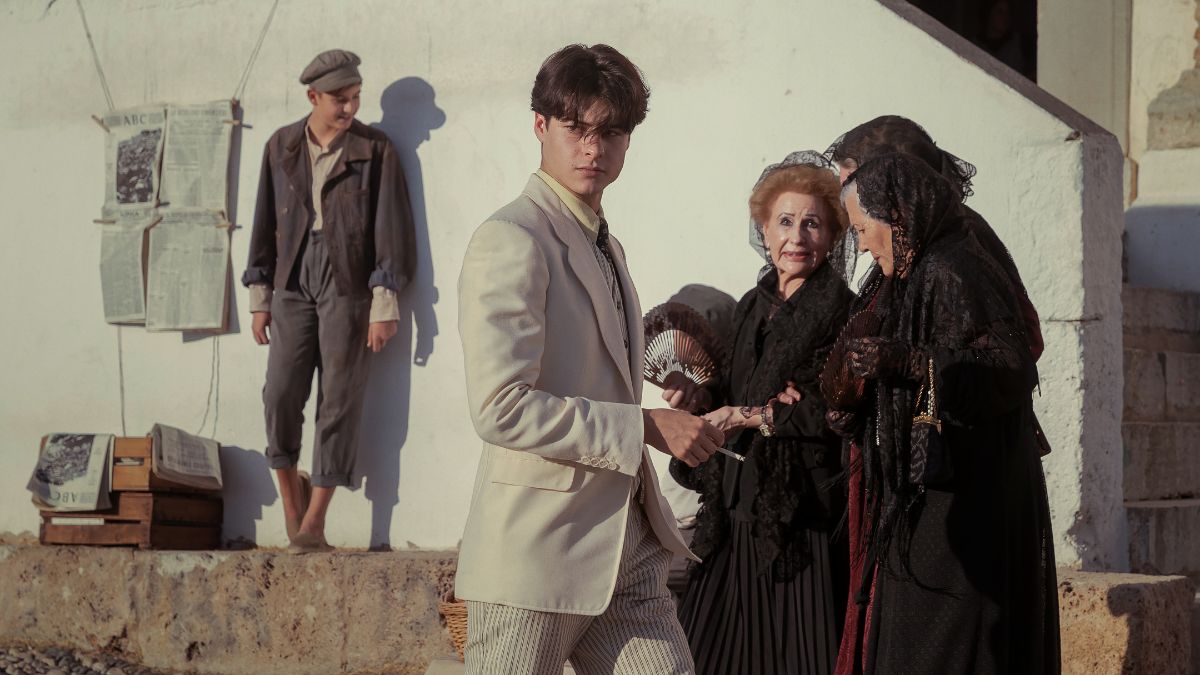
Milo Quifes perfectly plays the part of a beautiful boy in over his head. His third of the movie is the most sparse on character, but his stoic sadness tells you everything you could possibly need to know. A one-shot dance scene mid-movie offers one of the year’s best pieces of choreography, and Quifes’s drunken lament is a cannot-miss piece of cinema. It begs to be rewatched over and over.
In Alberto’s timeline, a mysterious call from the executor of his grandfather’s will sets up an excellent mystery. Alberto did not know he even had a living grandfather on his mother’s side, and much of his timeline is spent watching him argue with his semi-estranged mother, who refuses to open up about her father. Meanwhile, his inner life with his partner, Juan Pablo (Julio Torres), isn’t going particularly well either.
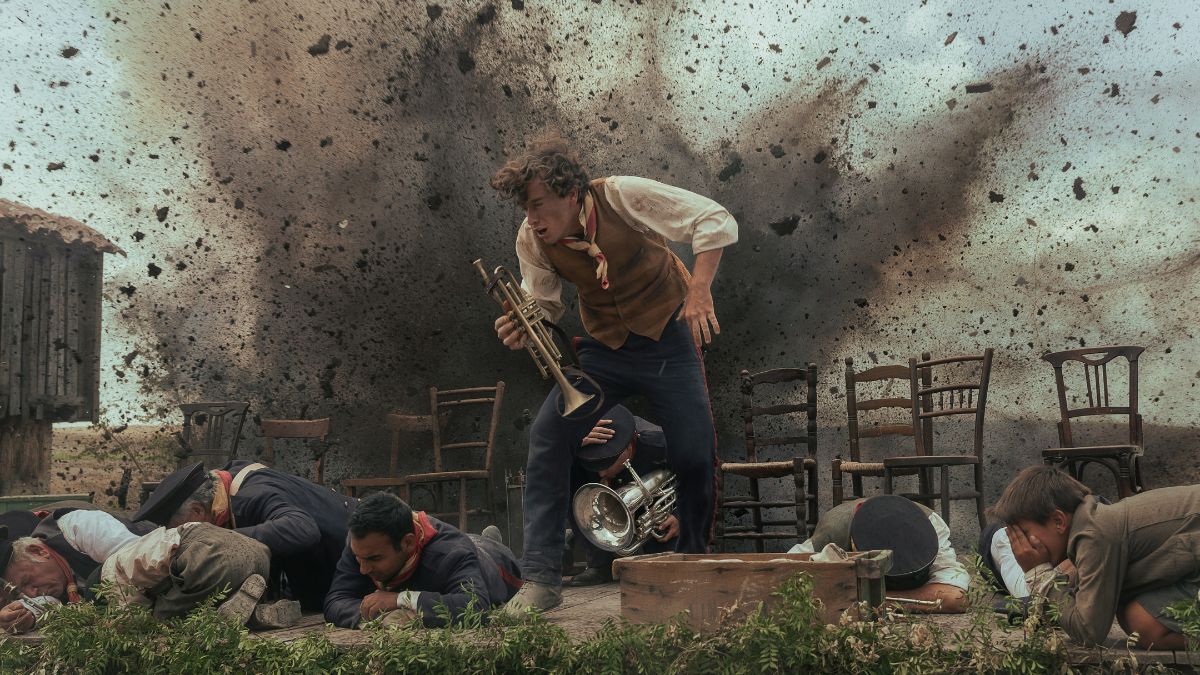
It’s the middle era where La Bola Negra spends most of its time, and where its grandest story is told. It opens with the horrific bombing of Sebastián’s village, killing everyone in it except for him. He narrowly escapes with his trumpet and later is subsumed into a medical company treating wounded Nationalist soldiers and Republican prisoners of war.
How the three parts of La Bola Negra connect is touching and includes some completely unique reveals.

There, Sebastián meets Rafael (Miguel Bernardeau), a captured Republican officer he quickly grows fond of. Through their budding relationship, every evil of war and fascism is drawn with intricate clarity. The message isn’t novel, necessarily, especially if you’ve seen your fair share of queer war films already. But the way it’s told certainly is. How the three parts of La Bola Negra connect is touching and includes some completely unique reveals.
Bolstering the already strong central performances is one of Penélope Cruz’s best performances in a long time. Her brief appearance as the singer Nené Romero carries immense pain and the slightest glimmer of liberation. She and Sebastián discuss everything and nothing. Which is beautiful in the moment, but it also contributes to the movie’s biggest deficit. It doesn’t get to go far enough.
The movie is about how terrible it was to be closeted and gay in early 20th-century Spain, and how those secret histories remain devastatingly buried even still today. But that shouldn’t keep it from having at least a moment of queer joy. Even in Alberto’s time, when he’s more than free to be gay at his leisure, he isn’t experiencing any sort of joy.
While La Bola Negra falls short of abject greatness, it is deeply beautiful.
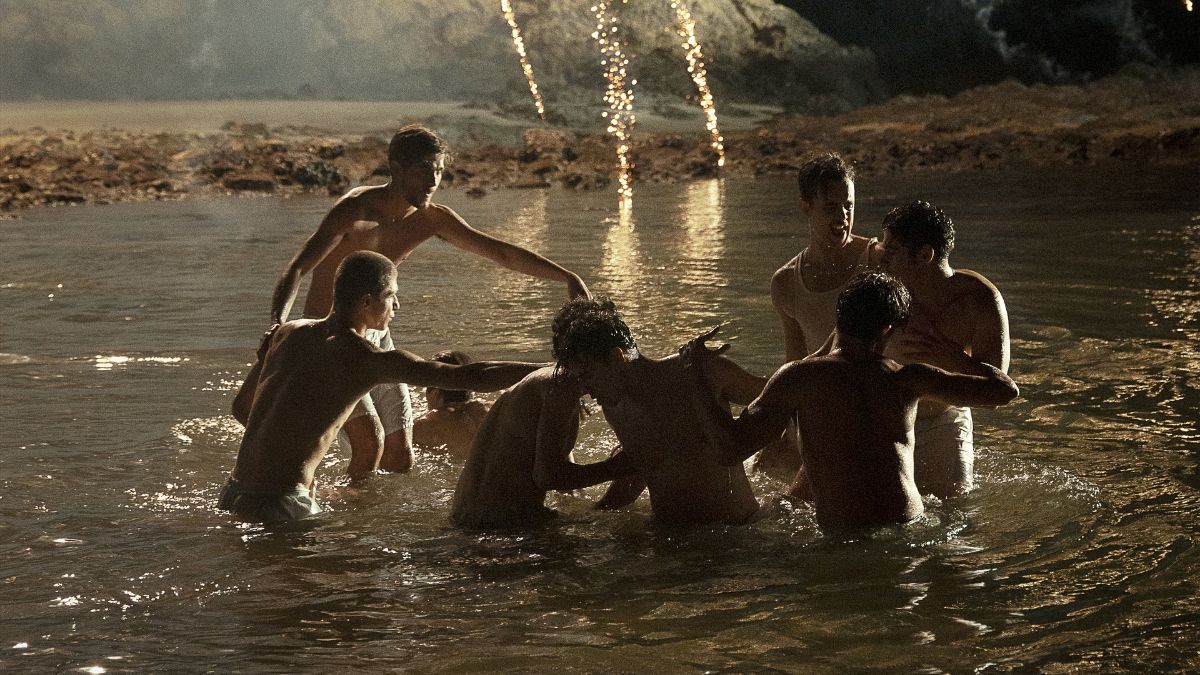
There’s a thread in the separate timelines about transness and how people have experienced it across time—even in times long before it was acceptable and little record of its existence remains. But the thread never gets tied off. La Bola Negra tees itself up for some kind of catharsis, whether it’s through transness or queerness more generally.
But it never comes to fruition. Instead, there are bittersweet relationships, homoerotic military outings, and outright tragedy. All of this makes for a pretty good movie, but a moment of release or recognition would have taken it even further. It’s not that queer creators owe us happy stories. It’s that La Bola Negra seems to be yearning for one so badly. There is some, though, and where it manifests is nice, but it’s from the straightforward kinds of places.
While La Bola Negra falls short of abject greatness, it is deeply beautiful. Its poetic and painterly qualities are lovely. Its shortcomings are made up for by great performances, an excellent score, and stunning cinematography.
La Bola Negra is now playing in theaters and streams on Netflix beginning December 2nd, 2026.
La Bola Negra
-
Rating - 7.5/107.5/10
Tl;DR
While La Bola Negra falls short of abject greatness, it is deeply beautiful. Its poetic and painterly qualities are so very lovely. Its shortcomings are made up for by great performances, an excellent score, and stunning cinematography.