
The Cat in the Hat has had a rough go in Hollywood. Before we get to The Cat in the Hat (2026) from Warner Bros. Animation, we should start at the beginning. The book found immediate critical and financial success upon its publication in 1957 and earned the high praise of Ted “Dr. Seuss” Geisel, who claimed it was the book he was the most proud of.
But his first animated television special came and went in 1971 with minimal fanfare, thanks in large part to its being an obvious attempt to cash in on the Grinch’s success with the format. Another animated special — a Marvel Comics-produced Grinch crossover — managed to nab an Emmy after its 1982 release but did little to pull the character out of his costar’s shadow.
And then came the big screen. The character once again rode the coattails of a more successful Grinch adaptation, making his first live-action appearance in 2003, with Mike Myers in the role. But Myers only took the role to fulfill a court settlement and had no real interest in cooperating, resulting in a notoriously tense production that flopped at the box office and did even worse with critics. Seuss’ widow, Audrey Geisel, vowed never again to allow a live-action Seuss adaptation, a commitment she has held firm to for more than twenty years.
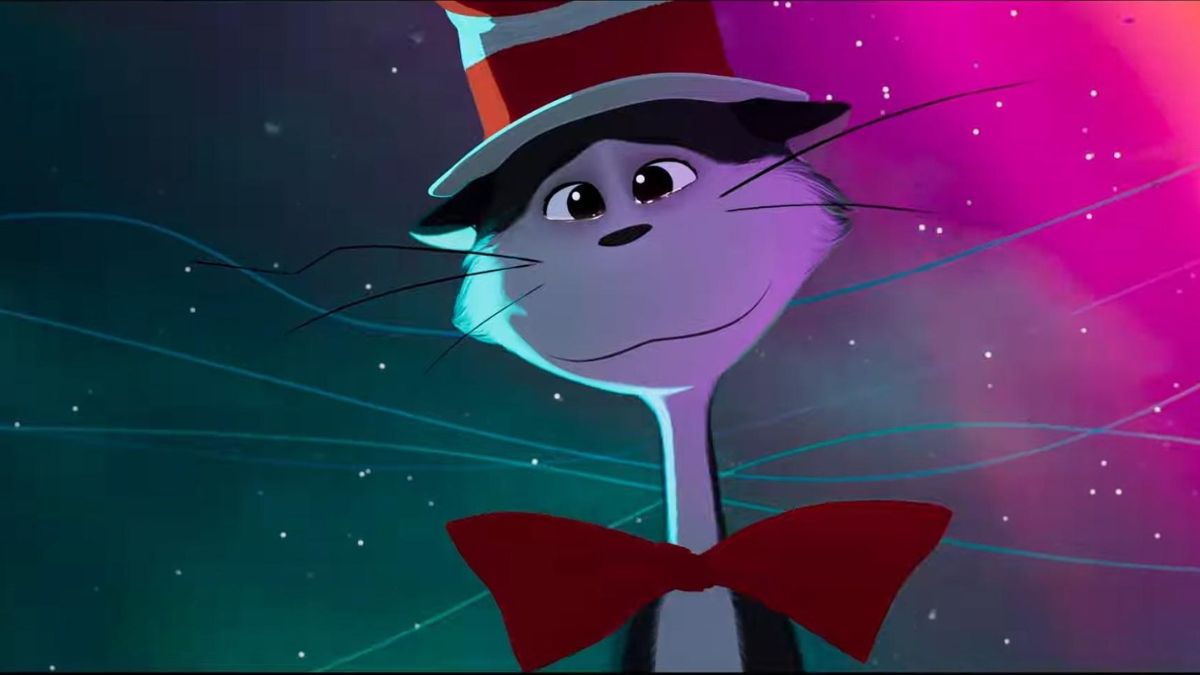
The Cat in the Hat (2026) stars Bill Hader as the title character, who faces an impossible job.
Now the Cat is back. This time around, he’s thoroughly out of the Grinch’s shadow (though the film initially began development at Illumination, which would also produce a Grinch adaptation), and he’s set to kick off the Seussiverse, Warner Bros.’ attempt at a Dr. Seuss cinematic universe. A film adaptation of Oh, the Places You’ll Go! is set to release in 2028, and a Thing One and Thing Two spinoff is in development.
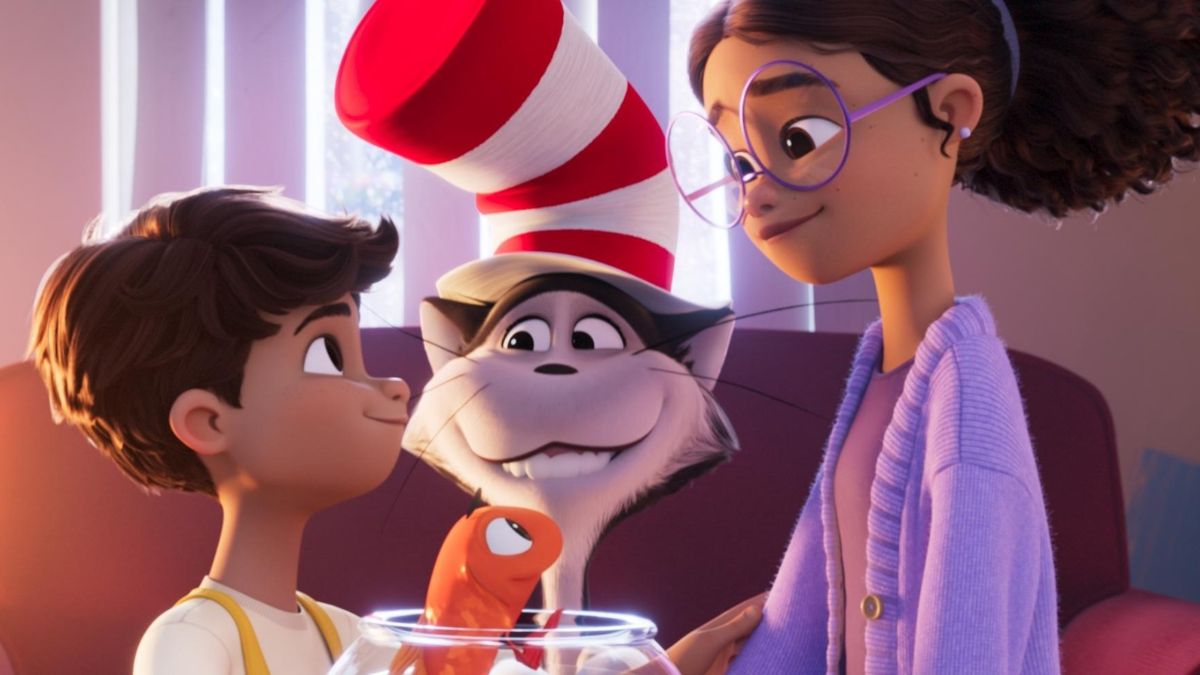
The Cat in the Hat (2026) stars Bill Hader as the title character, a feline employee at the Institute for the Institution of Imagination and Inspiration (IIII). He’s tasked with bringing joy and imagination to children on rainy days, a job he excels at in terms of child satisfaction but is dreadful at when considering property damage costs. His latest escapade would have gotten him fired, but his close friendship with Sherrie from HR (Quinta Brunson) has earned him one last chance. And his boss, Mr. Hoogeboom (Giancarlo Esposito), is going to make sure this final job is an impossible one.
The job in question in The Cat in the Hat (2026) is Gabby (Xochitl Gomez), who has just moved into a new apartment with her mother, Carmen (America Ferrera), brother, Sebastian (Tiago Martinez), and pet fish, Waffles (Matt Berry). Gabby is unhappy with the move and determined to make it everyone’s problem, which makes her particularly hostile towards The Cat in the Hat’s relentless enthusiasm. But she’s intrigued by the Go-Backer, a portable time machine the Cat hopes to use to avoid his normal level of destruction. To Gabby, it’s the chance to return to life before the move. But it also makes the group the target of Something, a menacing creature intent on consuming the device’s power.
The film’s best jokes actually come in the form of visual gags.
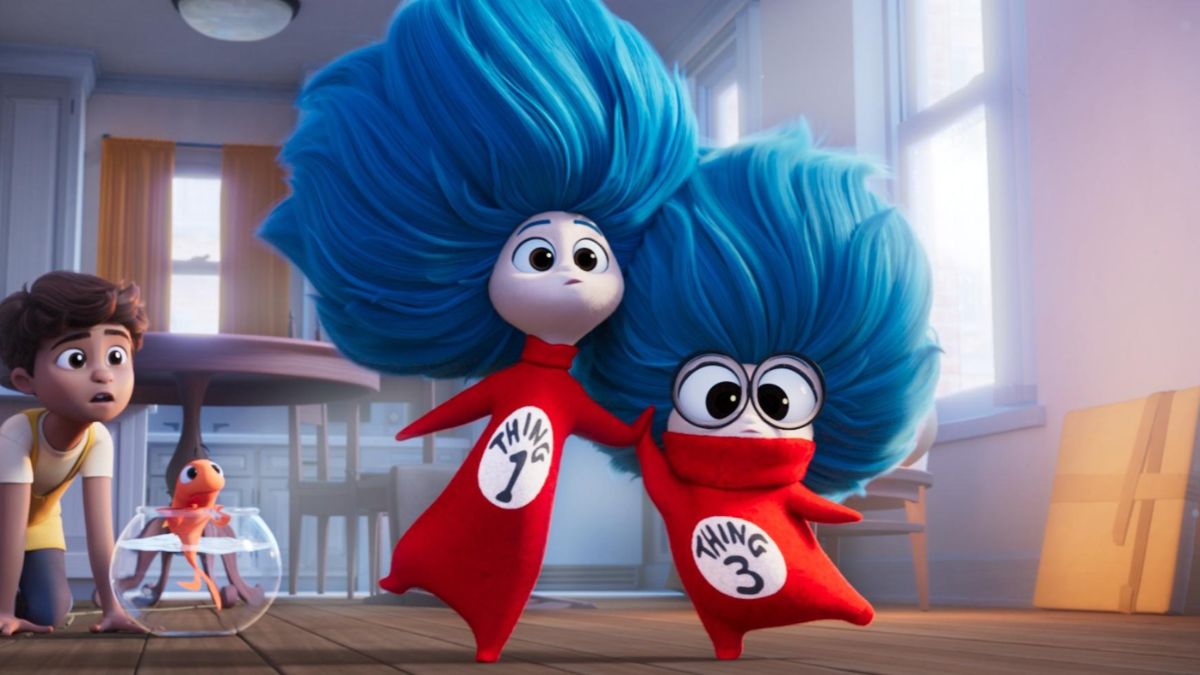
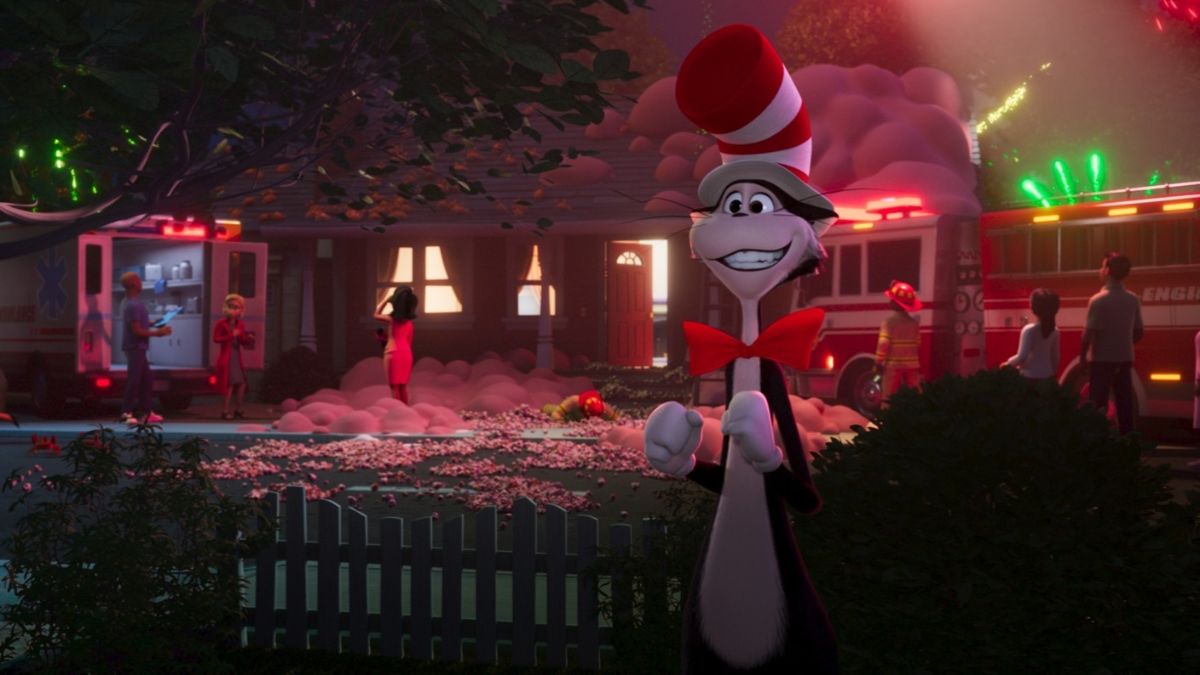
The main draw for parents to see The Cat in the Hat (2026) is likely to be the cast. There’s a good number of comedic heavy hitters here, including smaller but satisfying roles for Paula Pell (a snoopy landlady), Bowen Yang (an IIII nepotism hire), and Titus Burgess (a musical narwhal). Bill Hader is clearly having a fun time, and Giarcarlo Esposito delights as a scenery-chewing bureaucrat. But the film’s best jokes actually come in the form of visual gags, which begin almost immediately and continue rapidly for the rest of the production.
The Cat in the Hat (2026)’s credited writers include The Office and Arrested Development alum Caroline Williams and South Park and Clone High alumnus Erica Rivinoja (who also co-directed with Alessandro Carloni), so the successful gags shouldn’t exactly be a surprise, but the sheer pace of them is remarkable. These visual gags range in scope from dark humor (Cat juggling an urn with predictable results) to background gags (an amusing time travel bit involving bird poop) to match cuts. But most children will have the most fun with the Things, who speak in pantomime and body percussion animated in reference to an ensemble of dancers that includes Ahmed Best.
The story is also impressive, albeit in the same way that a high score on a math test is. The Cat in the Hat (2026) is one of the most meticulously plotted children’s films ever to exist. Nearly every moment is paying off something that happened earlier, to the point where potential connections going unacknowledged carry a bewildering effect. “What do you mean these two scenes involving shrimp aren’t connected in some way?” At first, this is a fun way for kids to notice the mechanics of storytelling. By the halfway point, everything has become so obvious that even younger children will have no problem predicting every little thing that comes next.
The Cat in the Hat (2026) has heart, but the message is generic.
The result is something akin to watching a dialogue-driven comedy with the subtitles on. The fun is still there in The Cat in the Hat (2026), but things tend to be spoiled the moment before they happen. That’s if they’re not figured out long before they’re relevant, as is the case with the film’s big twist. This minimizes the impact of the film’s attempted reveals, but it mostly undermines the sense of whimsy the script so desperately craves. It’s hard to be fanciful and fantastical when everyone knows what’s coming.
That’s a shame, as whimsy is desperately needed to elevate the rote themes. The Cat in the Hat (2026) has heart, but the message is generic, as is much of the animation when it’s not sneaking in a really good gag. Parents will think it’s nice to see a story encouraging children to make more of an effort to understand their mother, and then they’ll realize America Ferrera plays that mother and wonder why they didn’t just watch Barbie again. Kids will laugh at some jokes and grow tired of how obviously choreographed others are. In the end, most audiences will shrug their shoulders and declare the film to be fine.
Interestingly enough, “fine” is enough to make this a standout of The Cat in the Hat (2026)’s oeuvre of film and television specials. But that’s more an indication of the character’s bad luck than anything else. Barring a remarkable show from Oh, the Places You’ll Go!, one can likely expect the Seussiverse to be an early casualty of the Warner Bros. acquisition.
The Cat in the Hat (2026) is now playing in theaters everywhere.
The Cat in the Hat (2026)
-
Rating - 6/106/10
TL;DR
The Cat in the Hat (2026) has heart, but the message is generic, as is much of the animation when it’s not sneaking in a really good gag.