
The Cat in the Hat by American author Theodor “Dr. Seuss” Geisel is a beloved story for many people around the world, and across generations. Many of the book’s themes center on the balance between fun and responsibility, among other coming-of-age lessons. To me, it’s all about imagination and remembering to use it as much as I can.
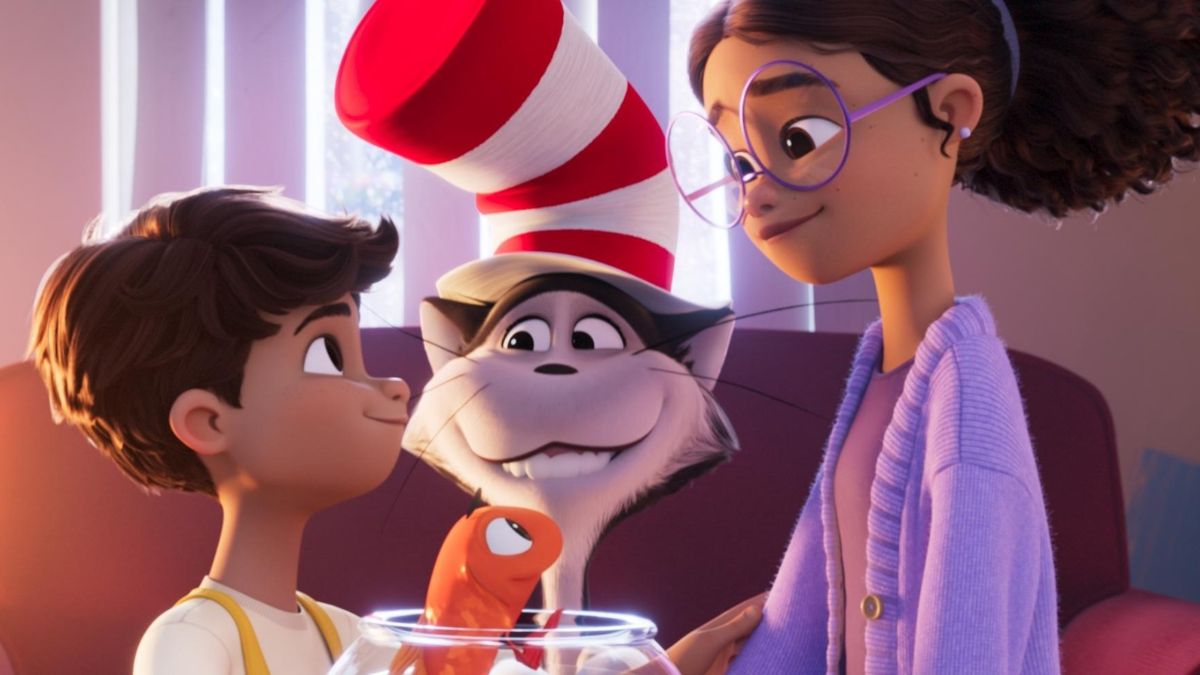
The story centers on a tall anthropomorphic cat who wears a red-and-white striped top hat and a red bow tie. The Cat shows up at Sally and her brother’s house one rainy day while their mother is away. Despite the children’s talking fish repeatedly objecting, the Cat shows them a few of his tricks in an attempt to entertain them. In the process, he and his companions, Thing One and Thing Two, take over the house.
While the live-action Mike Myers adaptation was a box-office flop, the animated feature The Cat in the Hat (2026) from Warner Bros. Animation hopes to revitalize interest in the 1957 children’s book.
The main difference is how directors and screenwriters Erica Rivinoja and Alessandro Carloni bring this story to life for modern families and audiences. Together with head of story, Ryan Gaffney, and art director, Amos Sussigan, we discuss how Dr. Seuss influenced all four of their lives, how they found the story and art direction for The Cat in the Hat (2026), what it meant to bring diversity into the story and the whole production, and whether we will see more of The Cat in future projects.
BUT WHY THO: What does the story of The Cat in the Hat mean to each of you?
Erica Rivinoja: My mom was a kindergarten teacher, so I grew up with a lot of Dr. Seuss in my house. I’ve been a big fan of Seuss since I was very, very little. I actually wound up going to the same college that Geisel went to, and we wrote for the same humor magazine many years apart, just for the record, but Seuss was such a part of Dartmouth culture as well. There were Seuss-themed things all the time, so it felt very much kismet to be involved in a Seuss project.
Alessandro Carloni: I grew up in Italy, and I came across the book when I was learning English. My dad bought me the book when I was 14 or 15. To me, it was much more of a character moment. My personal relationship with the book is because my dad had a very similar behavior [to the characters from the book]. My dad was working very late and only had a few minutes with me and my sister before we would fall asleep.
So he would make an effort to be reminded, and he would do very absurd, silly things, much like The Cat. This is why I hope we’ve done a good job of making people fall in love with [The Cat] again by making him cute, charming, wonderful, and absurd.
Ryan Gaffney: I have a nine-year-old daughter, and I think the [Dr. Seuss] story I’ve re-read the most is probably Horton Hatches the Egg. But I think with The Cat in the Hat [book] and the Mike Myers movie, this was an opportunity to really find a different voice for the cat, a different style, and bring out the charm with the Things.
Amos Sussigan: I had never heard of The Cat in the Hat. I’m originally from Switzerland, and growing up, we didn’t read The Cat in the Hat or Dr. Seuss. The only thing that I was aware of that was Dr. Seuss was [How the Grinch Stole Christmas]. I also wasn’t aware he was a big, prolific writer and everybody reads his books. This is funny because one of the first things I [worked on] as a professional in the animation industry was the Green Eggs and Ham series for Netflix. Even then, I still didn’t know about The Cat in the Hat.
Then, I went over to Warner Bros., and The Cat in the Hat (2026) popped up. I thought, ‘Okay, this is another Dr. Seuss property.’ And when I started working on it as an art director, that’s the first time that I read it. That’s the first time I saw the book in my life. So, here we are.
BUT WHY THO: We can blame AI, the education system, among so many other factors as to why the next generation is glued to devices and losing their imagination. But humans are still resilient. So, why did you, Alessandro and Erica, feel like this is the right time to bring The Cat in the Hat back in an animated format?
Alessandro Carloni: It was a bit of a studio decision along with us, of course, when we were offered the jobs. But hopefully, we made it ours. And you’re absolutely right. There’s something interesting about how much now there’s much more dependence on outside entertainment versus the internal one.
Our adventure [begins when] we meet our human characters and through their move. They’re arriving at a new home; they’re new to town with their moving boxes. Then, the Cat takes them on a fantastical journey, not through some faraway land but inside their own moving boxes. Basically, the journey of the movie becomes a journey inside their memories, inside their nostalgia, inside their past lives, and so, in a way, inside their imagination.
Luckily, our job still forces us to keep a very active imagination, because we literally have to imagine it and then work with an incredible team of artists and filmmakers who will take our ideas and expand them to heights we had never even imagined. Part of that job was that when you say, ‘Okay, I’m gonna enter a box that is full of documents; what does that even look like?’ And one amazing artist of ours designed this entire world that ends up looking like the line that Erica wrote in the movie, which is: ‘Is this adulthood?’ This is exactly the question.
When you see a world floating with the responsibilities, documents, and forms, it’s like, ‘Oh my gosh, is this what adulthood is like?’ But even that [world] was supposed to look boring, and yet it took so much effort from artists to imagine what this world would look like—and we had dozens of locations like that. I think this movie for me was one of the most difficult and expensive ones I’ve achieved, to be honest, because of the amount of locations that we ended up creating and traversing through with the story.
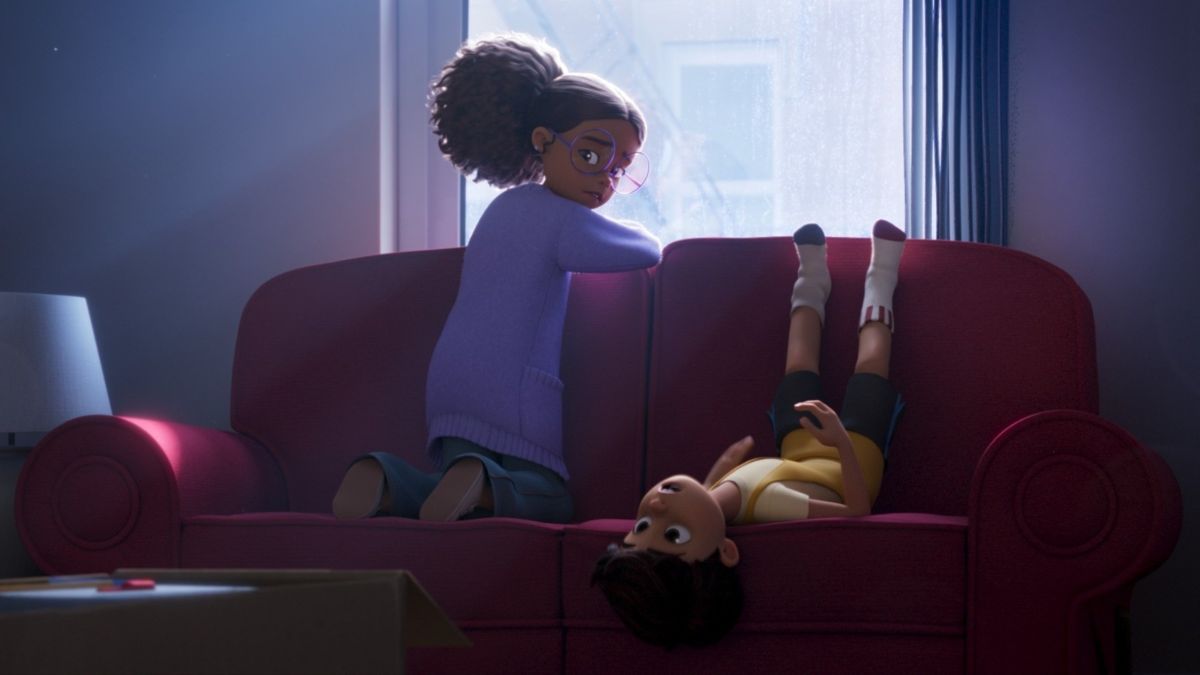
Erica Rivinoja: Just going back to kids and imagination and that idea: when my kids were little, and it was Christmas morning, there’d be tons of toys around, but the kids are playing with the boxes, or they’re playing on the couch. We use the couch [as] this crazy vehicle in the movie. And that’s the other thing: when you’re a kid, a couch is a plane, and it is a plane, so we’re leaning into kids’ organic imagination—and where they draw things and how they create things and come up with things. And so, we were trying to make it true-to-life. Kids love boxes and couches, and that’s all you should buy your children!
BUT WHY THO: And for Ryan and Amo, how did each of you find the right feel and look to this modern take of The Cat in the Hat?
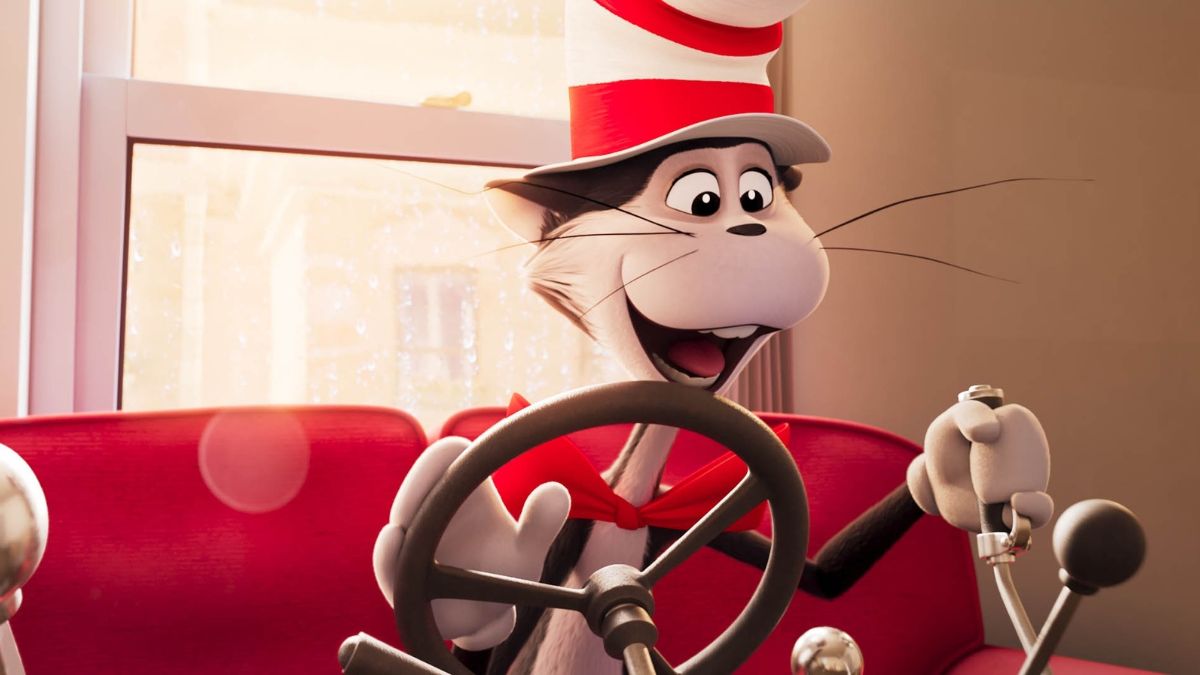
Ryan Gaffney: I think when Alessandro and Erica started talking about The Cat as this agent of chaos and kind of a wild card—and Bill Hader came up as the voice—I think that sort of for me was where the possibilities started to open up. I can imagine this voice for The Cat and as Amos and Aidan [Sugano] (Production Designer) refined the look of the movie, but especially The Cat and how he would look different compared to the book in previous versions, that it just started to really feel like a new version of the character.
Whether it’s him interacting with the kids, The Things, or his coworkers, it felt to me like there was so much comic potential to see him running around, going bonkers, and that kind of thing. But at the same time, Alessandro and Erica were great about finding the nuances to see, like, ‘Okay, this guy, there’s more to him than what you initially kind of see.’
Amos Sussigan: Aidan, the production designer, is the one who started the [visual] process. Dr. Seuss has been done before, and it’s been done very well, right? I’ve done Dr. Seuss pretty well with Green Eggs and Ham. So it’s like, how do you freshen that look up or modernize it to give it your own spin without betraying what made Dr. Seuss, Dr. Seuss?
So you think about the basics: how they use these wacky camera angles and the forced perspective. Even the use of negative space for modern-day animation cinema, there’s the tendency of packing the screens with so much stuff. It needs to be premium, fancy, and all-encompassing. Boiling it down to the basic concept of design, which Dr. Seuss did really well, was kind of freeing because you can’t allow yourself to have 80% of the screen to be entirely yellow. You could if you wanted to, but we had a reason [behind it all].
The first thing we were exploring early on about the nine different [animation] styles was that they were too close together to make a meaningful impact on the movie. You have three boxes, and each box has three layers. We were trying to do that and find cohesion throughout. The color part really helped with thinking of red as this color of connection.
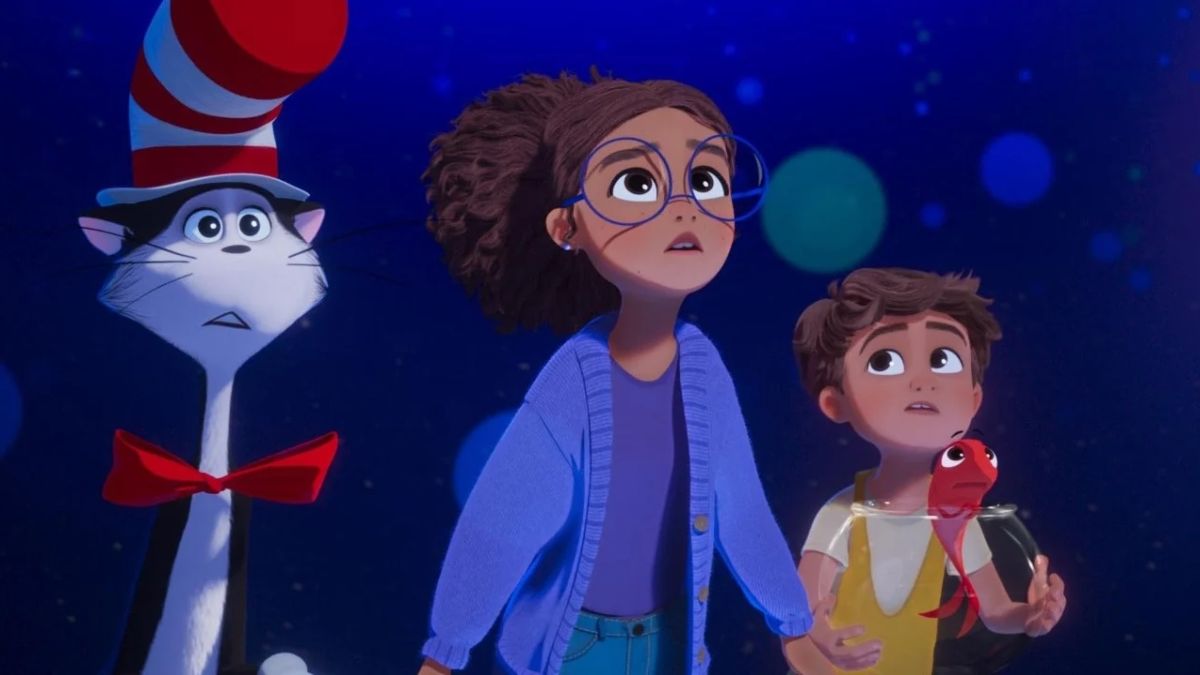
Connection is complex. Connection or disconnection: what does that mean? Even if you think about your friends and family, a mom can never be completely disconnected. We didn’t want to go from desaturated color to colorful moments [immediately]. As I mentioned in the panel, we started very simple with the idea that The Cat is bringing the color red to this world. Red is the color of connection.
We start in black-and-white, paying homage to the pages of the book, and then adding the colors that were limited to the book—there were five colors. That’s why the beginning of the movie is black-and-white; red comes in, and then the colors of the book come in. Then, in the real world, we used paintings from Jenny Yu, who painted desaturated colors, but there was so much color and how she combined them. Blue is our color of disconnection, so it always starts with blues, and then we go towards the red.
It was about differentiating each box, but at the same time, don’t make it feel episodic. Sebastian is a little bit younger [than Gabby] and more naive. So, his colors are very pure. We start with the bluest blues and only get to orange in this box. Gabby is a little bit more emotionally complex. We start with blue-purples, more purple, more red, and more fuchsia when The Cat enters. [Fuchsia] is one step removed from red, even on the color wheel.
[Gabby] never gets to full red because—I’m not going to spoil it—but in the other box, when we keep going, the idea is that only then, when the connection is here and now in the present, that’s when you get the full red. [This is] the true red of understanding connection in the present, and the meaning of The Cat and what The Cat does. I know it’s deeper than it should be, but a lot of thought goes into it!
BUT WHY THO: Amazing. And I heard Alessandro and Erica, you both were able to speak to the Seuss family or foundation? How was collaborating with them on this production?
Erica Rivinoja: The woman who runs [Dr. Seuss Enterprises], Susan Brandt, runs their foundation since I don’t believe any of the family members are alive. But it was awesome, and she knew [Audrey Geisel] (the second wife of Theodor Geisel). They were so excited about what we were doing, and I was so pleasantly surprised how they were into all our big ideas. They occasionally had notes about design, but they were really open and excited about this expansion that we were doing, about this whole world, so I loved it.
Alessandro Carloni: I’ve seen in the trailer that there’s Thing 1 and Thing 2 from the book, but there are 345, 1720, 307. That alone could have been something that’s like, ‘Whoa, whoa, people know that there’s Thing 1 and Thing 1; we don’t want to mess with the mythology of our book.’ But they were so excited about it all.
Erica Rivinoja: And we came up with all these other characters that have red and white striped things, like Mouse in a Blouse and Ox in a Box.
Alessandro Carloni: Yeah, they were excited about the fact that we literally opened up this world by adding characters that implied that they were always there and people just didn’t know about it. This could have stepped on the toes of like, ‘Oh no, no, no, this is what we created, and we cannot step on them. [But] they were really excited.
Erica Rivinoja: I feel like they’re really trying to take what people love about Dr. Seuss but opening it up [to reflect the modern day].
BUT WHY THO: And speaking about the modern take, it’s cool when we get to see kids of color in a Dr. Seuss story like The Cat in the Hat. Bringing the diversity to the screen and to the whole global production, as you mentioned the DNEG team in India, was the influence around ethnicity and culture baked into the initial story, or did it come along the way?
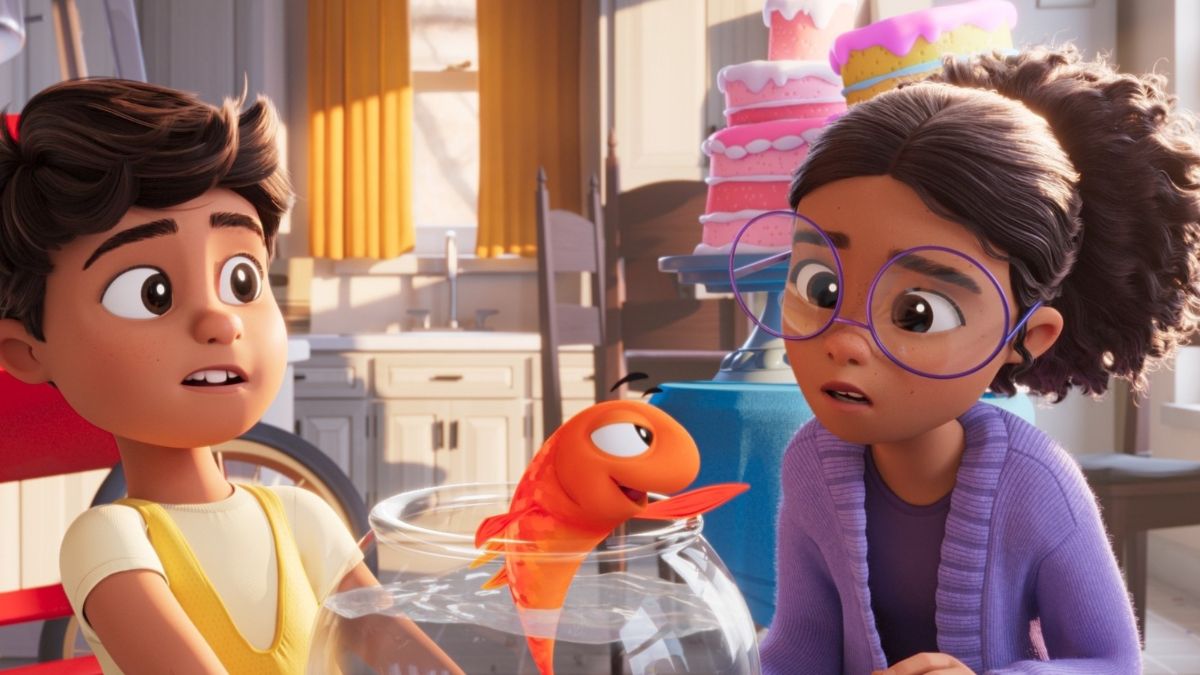
Ryan Gaffney: It’s always there that this family of three has a big move, and that is the challenge—especially for Gabby. This is what Alessandro and Erica baked in from the beginning. I’ve worked on movies that have changed a lot in terms of a core cast, but this was one that I felt had it figured out. Of course, plenty changed, and we iterated over various screenings, but as far as that goes, this was always the family.
Erica Rivinoja: Yes, we knew that the main character was Gabby, and so we sent out a huge casting call for who this person is going to be, and then it wound up being Xochitl Gomez. Then, we cast the other characters around her. We also have a bunch of Latino and Latina story artists and artists that helped us inform the world. So, we created things around her and built her family around her.
Going back to the team, the team was everywhere! We had Zoom [calls] with people all over the world. It was so awesome because we’d be like, ‘What day is it where you are in New Zealand?
Alessandro Carloni: I know DNEG, our partner studio, has a huge group in India. When we go to sleep, they start working, and they work through the day, and then we wake up, and they show us what they’ve done in the day.
Erica Rivinoja: We were very tired for a very long time.
Alessandro Carloni: Our movie was really tight. There are some movies where animation takes seven years. When we actually started production, because there was some development period, it took production for two and a half years—and we didn’t get to go to India. That’s how frustrating it was. We got to go to London and Montreal, but we didn’t get to go to India.
Usually, when you start the development phase, you have two years of pre-production to discuss the rigs of the characters. But the moment the studio was like, ‘Great!’ [It was] go, go, go, go, go, and it was quite intense. We’re happy that a lot of the Indian animators came to London, so we got to meet a lot of them there.
Amos Sussigan: The animation was across several continents, and we were in LA. I really love this aspect of animation in general, when we get to work with so many people. Everybody brings something different. There is so much art-wise, but even the different sensibilities that you get from people are different—like the ways of working. You have the Italians and the French. As an art director, it’s nice to be Swiss because we’re kind of—(gestures something like describing precision and accuracy) but it is truly nice to understand how everybody works and what they bring. You feel enriched at the end.
BUT WHY THO: That’s awesome. I like that. And I must ask: can we expect more of The Cat in the Hat in the future?
Erica Rivinoja: We know there’s a three-picture deal at Warner Brothers for Dr. Seuss movies, but the second one is Oh, the Places You’ll Go, which is in production right now. So, we don’t know what that third one is.
Alessandro Carloni: Of course, we’ll have to see. Will the audience love this movie enough to want to see more of The Cat? We’ll discover that when the movie comes out.
BUT WHY THO: That makes sense because three movies almost felt like this was going to set off a whole universe.
Alessandro Carloni: I can say that since the Seuss stories are not in the same universe, we’re not going to see The Cat in Oh, the Places You’ll Go or vice versa.
Erica Rivinoja: Yeah, I think Seuss would love to keep these narratives [separately].
Alessandro Carloni: So, if we do create something bigger in the world Erica and I created, it would be in The Cat in the Hat (2026) world.
The Cat in the Hat (2026) releases in theaters on November 6, 2026.