


Collision Course, directed by Daniel Sánchez Arévalo and written by Ramón Campos and Daniel Sánchez Arévalo, follows four bank robbers as they pull off a heist and try to cover their tracks. But one unexpected moment leads to a vastly different outcome than any of them could expect. And just how different largely depends on one crucial detail.
Most heist movies focus on the robbery itself. There is a build-up, an execution, and then, frequently, the credits roll shortly after with either success or failure as the verdict. With Collision Course, the heist almost feels like an afterthought. Playing out in the opening minutes of the film, the narrative comes to focus more on what comes after.
A surprising twist plays out that derails the group’s plans to escape cleanly, leaving them to improvise as they are forced to cover their tracks. This leads to a tight cat-and-mouse chase as the police close in on the fugitives. However, the resolution to the story comes far faster than any would suspect from the film’s close-to-two-hour runtime. This is due to the film’s unique structure.
The story keeps shifting as the narrative loops.

Once Collision Course reaches its conclusion, it jumps back to the twist moment and makes it play out with one crucial element changed. This alteration drastically affects the narrative, unpredictably shifting the outcome. The film repeats this loop three more times, each time altering the twist in a new way.
The narrative structure employed here is fascinating, and it’s easy to see why someone would want to build a story around it. Exploring how one critical moment can change a series of events is a compelling concept. An in-depth look at the classic “Butterfly Effect.” This leads to some engaging moments of narrative shifts as the film highlights its characters’ changing attitudes in the aftermath of the crucial moment’s alterations.
This cascading effect of change also works well because the characters are all connected. As the story reveals elements for the first time, you quickly see how these connections provide strengths and opportunities as the group prepares and executes their heist, as well as handicaps once the scenario begins to unravel.
Despite a fun angle, Collision Course struggles with its characters.
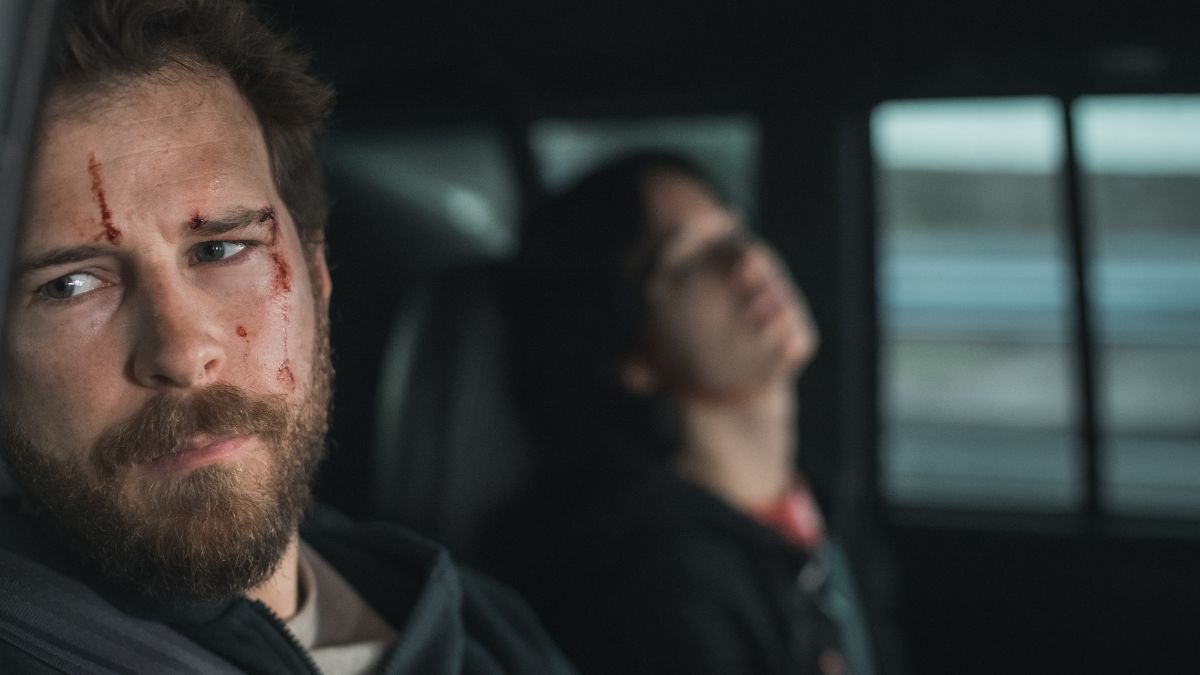
Each time Collision Course runs through its scenario, there are some moments of genuine tension and stress. As each iteration alters the flow of the narrative, the film does a great job of building up several key scenes. As the noose tightens in certain scenarios, the presentation uses elements like lighting and cinematography to create the right mood for a big moment.
While the ever-shifting timeline creates interesting story moments as the characters are put in a variety of situations, this shifting makes them hard to connect with. In some versions, a character comes across as awful; in another, they garner more sympathy. Between this character instability and the short time each path takes, it is hard to form a real opinion of any of the major personalities.
Another stumbling block is the choice to have a secondary alteration happen to events outside of the central pivot point. With only one particular exception, everything that isn’t directly altered by the change point plays out the same every time. This makes the one shift outside of it feel noticeable and jarring.
The performances also have strengths and weaknesses because of the story’s unique structure. It is genuinely impressive how the actors manage to present several different versions of their characters, while never making any feel like they aren’t the same person.
The Netflix film has interesting elements but struggles overall.

The way the myriad of feelings that get brought up by the shifting scenarios always feel like they are coming from the same individual, despite how altered some characters become through the variances that play out. This stability is also in part due to the solid writing that keeps the lines themselves feeling consistent throughout everything that happens.
The downside to Collision Course‘s cast’s resilience with the breadth of the personas they are asked to manage is that they’re unable to create enough depth. With so little time with each version of their characters, it feels like the cast is frequently still trying to come to grips with just how hard a moment is hitting them, causing them to be overly reserved in much of the delivery.
Collision Course attempts something different with mixed results. A compelling narrative hook and an ability to craft tension bring enough to engage, but the character-side struggles keep it from firing on all cylinders.
Collision Course is streaming now on Netflix.
Collision Course
-
Rating - 5.5/105.5/10
TL;DR
Collision Course attempts something different with mixed results. A compelling narrative hook and an ability to craft tension bring enough to engage, but the character-side struggles keep it from firing on all cylinders.