

I Love Boosters, with its anarchic tonal swings and Looney Tunes logic through a Wes Anderson-esque, zany aesthetic, fits into the recent glut of filmmakers taking on capitalism. In the vein of two 2025 films, No Other Choice and Mickey 17, the latest film from Boots Riley tackles class disparity, fast fashion, and corruption with the subtlety of a sledgehammer. Broad, gluttonous, and sonically abrasive, the film is visually clever with strong central performances, but it can aggravate quickly because its narrative tries to be too many things at once.
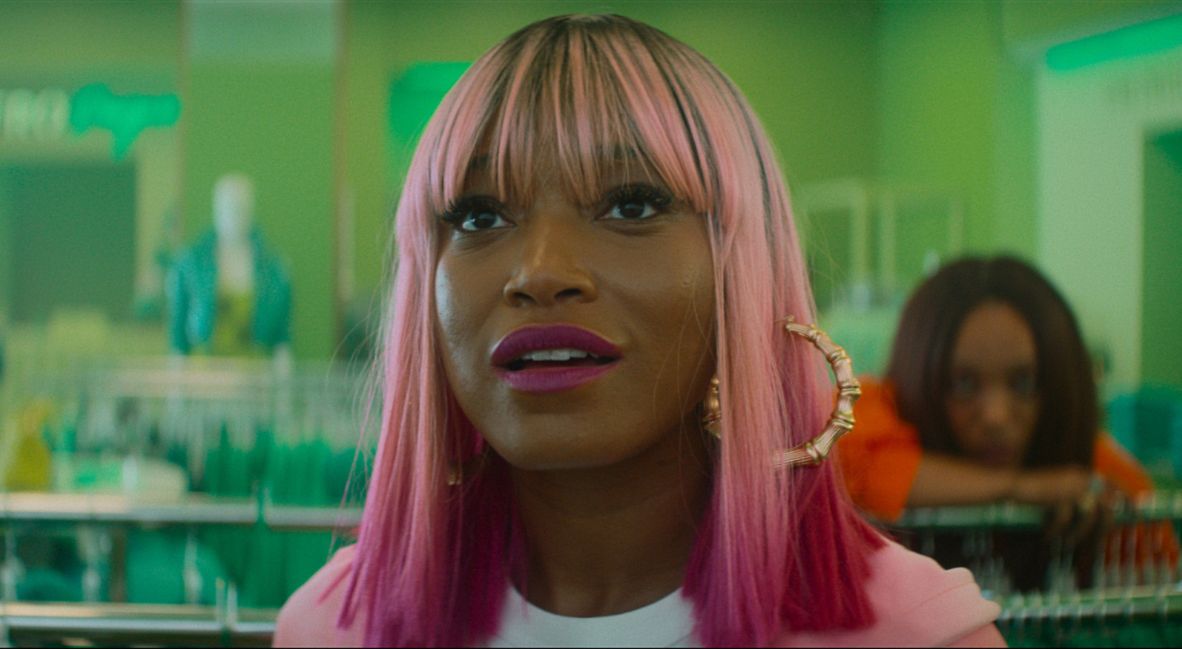
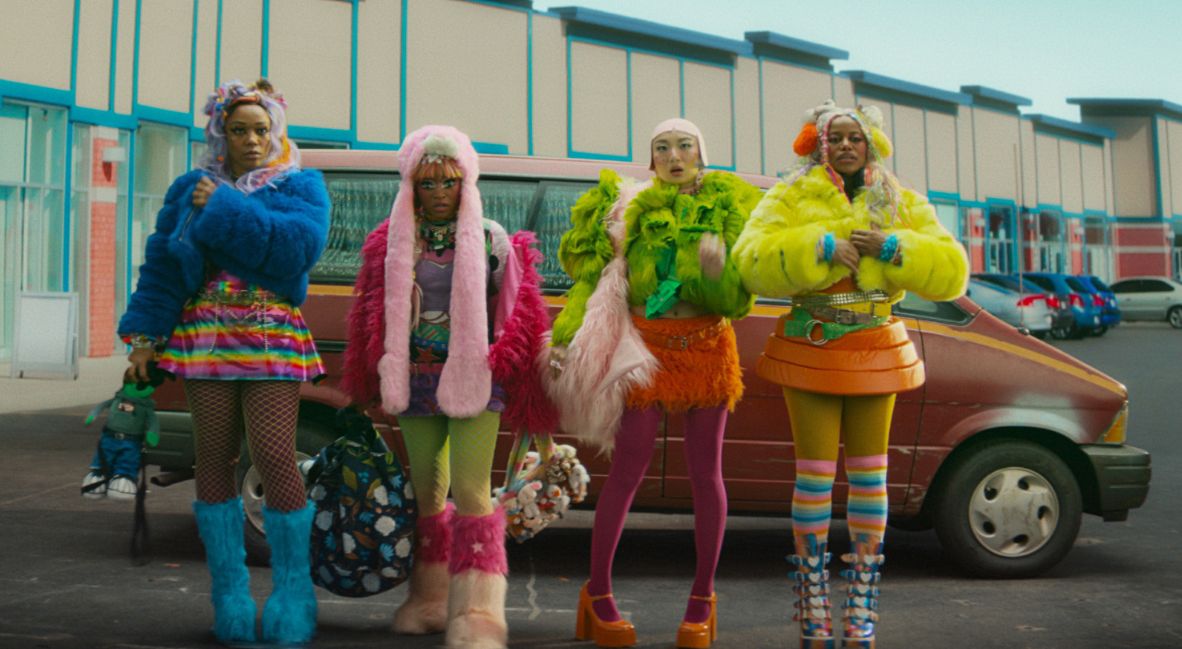
In many ways, that need for it all is depicted in the outfits the main characters wear during their heist montage. Technically coordinated but wildly over-styled. Keke Palmer (always a delightful screen presence) stars as Corvette, a “booster” with fashion dreams of her own. Boosters are groups of people who steal from high-end, fast-fashion chains to resell the clothing at one-third the price, making ends meet and supporting their community.
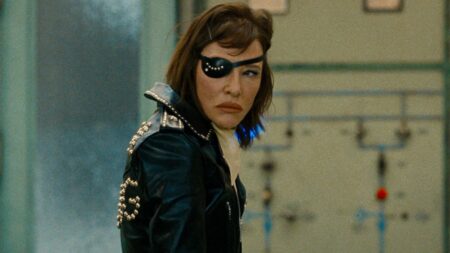
Corvette is a member of the “Velvet Gang,” which includes herself, Mariah (Taylor Paige), and Sade (Naomi Ackie). Their main target? Christie Smith (Demi Moore), who has made vengeance against these boosters her personal vendetta, claims that her work isn’t just about making clothes but about creating a tapestry of life, which begs the question of whether Riley is secretly a Kill la Kill fan.
I Love Boosters is more than just a heist film.
But I Love Boosters isn’t content to be a heist film. Not even a heist film powered by off-kilter comedy and strong conceptual foundations. Instead, the film begins to struggle under the weight of Riley’s big ideas a third of the way in, when major new plots are introduced with the arrival of Jianhu (Poppy Liu), who has her own objective. Add in a maybe-teleporter with increasingly ludicrous settings, an intense model played by LaKeith Stanfield, suits that are more than just suits, and an actual demon, and Riley makes it clear that absolutely no one asked him to refine and edit.
It’s been eight years since his debut feature film, Sorry to Bother You, which blueprints the format for I Love Boosters. It features a strong anti-capitalist premise about how the workday breaks you down, set against increasingly ludicrous backdrops, and then spins out into a cartoonish finale. However, while his debut was tightly written – regardless of where you fall on the ending – his follow-up lacks that same finesse. It’s undoubtedly a gorgeously made film, but it’s hard not to see it as overly style-over-substance.
Which is only noteworthy because, at times, Riley is clearly trying to inject the film with substance. It’s in the main messaging. From the dangers of fast-fashion to corrupt and dangerous work environments, how white people will steal from marginalized voices (evident here in how Christie Smith steals Corvette’s idea), to even, possibly, the threat of AI, this is a movie about big ideas. And it tries to be emotional, too, most notably in the relationship between Corvette and Sade, with Ackie delivering an unexpectedly powerful moment in a crucial conversation.
Boots Riley tries to do too much at once, with dizzying results.
But I Love Boosters doesn’t earn those emotional payoffs because, while it’s effective in its messages about corruption and the environmental threat posed by wealth, any character depth is an afterthought. Corvette, Sade, and Mariah aren’t real people. They’re meant to react to the world around them, rather than interact in it. They’re two-dimensional, seemingly purposefully, until Riley flips the script and asks the audience to start caring.
That said, it all looks amazing. It’s so refreshing to see such a mesh of styles and visual cues, from the use of miniatures to the stop-motion-style effects of a third-act chase. The costumes themselves are stunning, and not just in the over-the-top sequence where their outfits grow increasingly outlandish.
It’s the all-green (then yellow) decor of one of Christie Smith’s stores. The set designs are similarly effective, most notably in Smith’s office, which sits at a 90-degree angle, just another way to visualize how the upper class is always looking down on those they deem below them.
Keke Palmer and Naomi Ackie are tremendous despite the film’s bloat.

At just under two hours, I Love Boosters marginally overstays its welcome despite the visual splendor. And while Palmer and Ackie are tremendous, with Moore suited well to the harsh lines of Smith’s antagonist, their characters aren’t developed enough to make us care beyond what would’ve been a strong, tight 90 minutes. Eiza González and Will Poulter shine in their limited roles but also serve as reminders of the film’s bloat. The irony of the film’s excess is not lost.
Further hindered by the barrage of noise produced by the composers, Tune-Yards, I Love Boosters works best as an experiment. With an outlandish sense of style, gleeful refusal to adhere to any pre-approved structural whim, and Palmer’s stratospheric charisma, Riley delivers distinctive visuals energized by high-octane exuberance at the sheer wonder of making a film. And despite how much the writing lets those big ideas down, the enthusiasm makes it worth the trip regardless.
I Love Boosters is out now in theaters.
I Love Boosters
-
Rating - 6.5/106.5/10
TL;DR
I Love Boosters works best as an experiment. With an outlandish sense of style, gleeful refusal to adhere to any pre-approved structural whim, and Palmer’s stratospheric charisma, Riley delivers distinctive visuals energized by high-octane exuberance at the sheer wonder of making a film.