Iron Boy (Le Corset) declares itself a singular work of art early. Through a few flashes of a school picture day, we watch a class of ten-year-olds march in to pose for an increasingly agitated photographer, who directs children who bubble with a lack of grace, missing teeth, and distracted gazes. Each child in this brief intro is drawn with obvious attention to detail, so that by the time our protagonist, Christophe (Gary Clichy), is introduced, the film, directed by Louis Clichy, is already winning us over.
As Christophe sits for his photo, he continues to shift to the side, unable to stay upright and also unable to tell when it’s happening. This sets forth the start of the film that both feels like the spiritual, animated successor to Billy Elliot while also paving its own course. Christophe, having always sought out his father’s approval, finds it harder to do so as his body betrays him, collapsing without warning until a near-catastrophic accident leads him to the doctors, where he’s outfitted with a stifling brace.
Forced to wear an iron corset to keep him upright for the foreseeable future, he’s ousted from the routine he once knew. He can no longer help on his family’s farm, which causes unfortunate consequences for the rest of his family, his older brother JB (Rod Paradot) and his father, Jean (Dimitri Colas) in particular, who have to step up to take on more of the work. His family wants Christophe healthy but struggles to empathize with his worries and frustrations, especially as they face mounting stress from neighboring farms and a crop that is struggling to produce.
Inspired by Louis Clichy’s own experiences, Iron Boy proves an evocative story both visually and narratively.
Prone to internalized outbursts where his anger causes torrential tumult, sending his family flying in a visual encapsulation of his inarticulate rage, he finds solace at the local church. It’s there that he finds a new way to express himself and his grievances through music, opening up his world beyond the confines of his family, the farm, and the village he grew up in.
While the anger remains, it’s not as all-consuming, and he continues to grow accustomed to the iron corset he must live in day in and day out; he too begins to learn more about himself as he faces down the hormonal barrage of puberty. No one feels right in their body as a pre-teen or early teenager. And Iron Boy makes this more literal: the iron corset is constricting and tiresome as Christophe tries to go about his days without being weighed down by such a cumbersome accessory.
Written by Clichy and Franck Salomé, and inspired by Clichy’s own upbringing and experiences, Iron Boy does a marvelous job of balancing the many different plot threads while allowing the characters to grow organically over the course of the three years the story takes place in. At 90 minutes, the film feels more lived-in than other two-hour-plus films, understanding the nuances of family life and the specific strain of financial hardship. Each character is fully realized beyond Christophe, with characters like JB suggesting a great inner life that, while not as fully explored, is just as finely detailed.
The storyline balances the internal plight of its protagonist with multiple threads for the supporting cast.
Refreshingly, the film never speaks down to the working-class role that JB and Christophe’s father fills. Instead, it shows just as much warmth and compassion for that work as it does for Christophe’s exploration of music through his teacher, Michel (Alexandre Astier). And Christophe is just as keen to help with the farm’s physical labor as he is to perfect Gabriel Fauré’s “Requiem”. It’s all about accessibility and who takes the time to listen to him and help him adjust to his new lifestyle, and less about a preference for what that lifestyle entails.
Yes, the brace is restricting, a constant reminder of his current limitations. But what truly limits him, in this case, is his own retreat. His furious flights of fancy keep him wanting more he thinks he can’t have until he’s shown his capabilities when someone takes the time to listen to him. To stop him from running away when the conversation gets tough and say what it is he wants.
The story is this good, this thoughtful, and it’s an added bonus when the art itself is so gorgeous and expressive. The fluidity is remarkable. There’s a scene where Christophe pushes a stick through a puddle, transforming and warping his face; it makes you instantly want to look up how someone can accomplish such a feat.
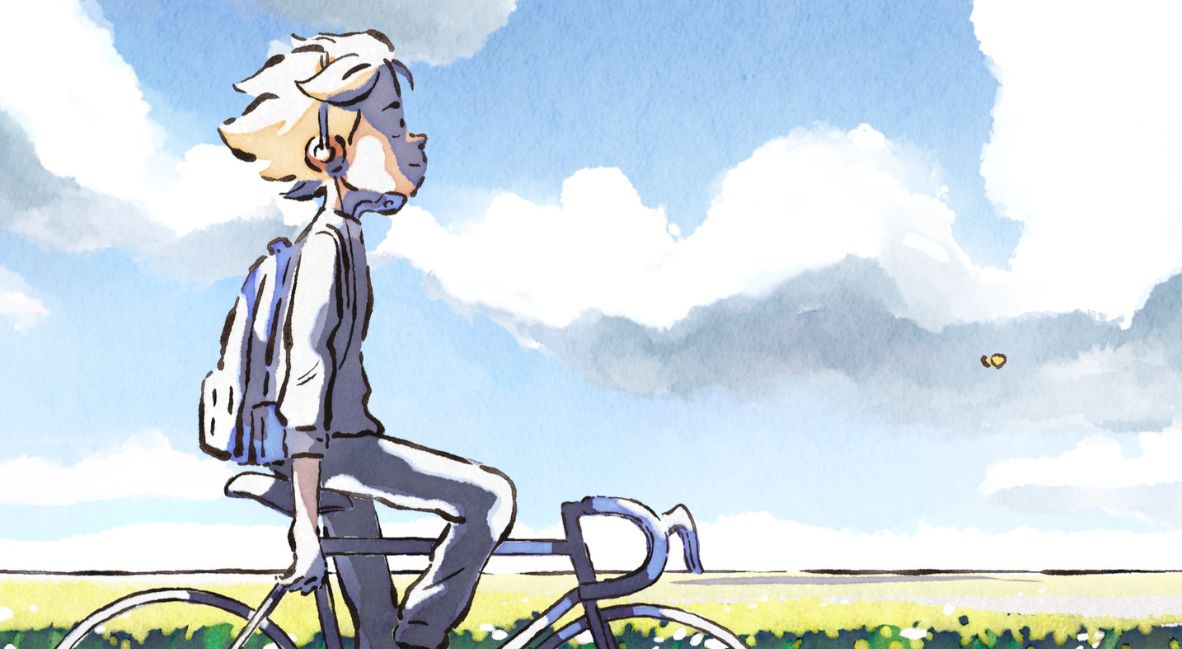
The watercolor effect brings the lush landscapes of the world to vivid life.
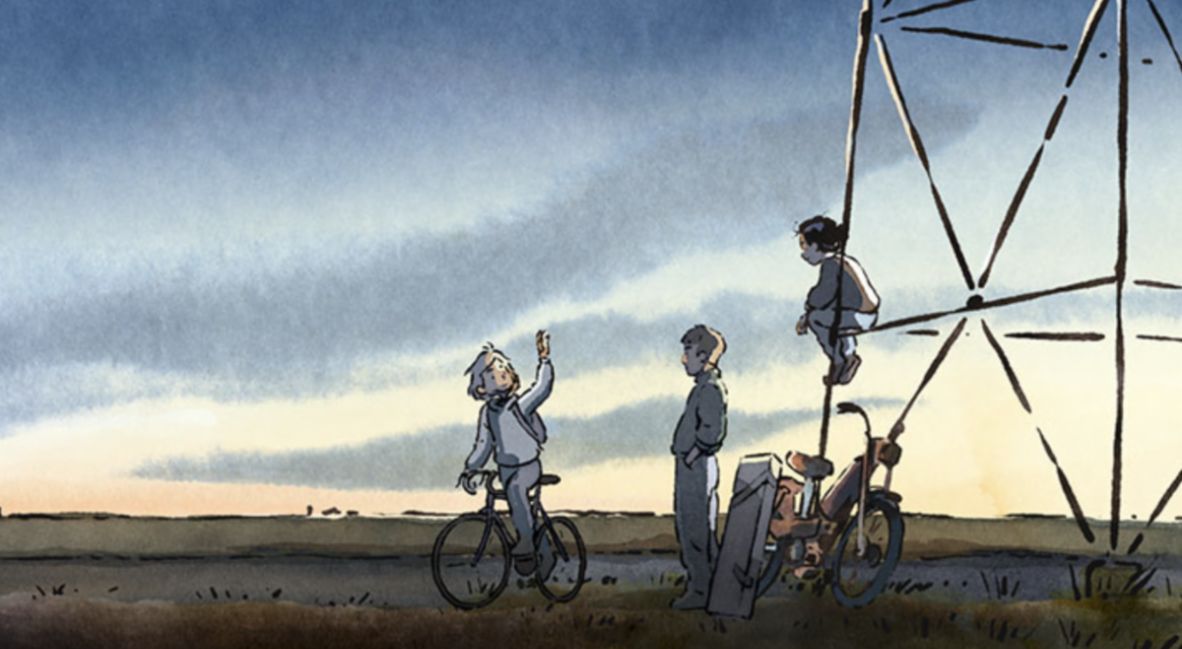
Iron Boy uses a mix of styles, but the watercolor effect is by far the most effective. It offers the film a picturesque timelessness. The rural landscapes give way to lush, autumnal shades and deep, evocative color stories that depict this tranquil setting, punctuated by bursts of color and whirlwind movement during Christophe’s imaginative takeovers. It does all of this without softening the edges of the Beauce setting with its flat planes where each major landmark can be seen from the next.
That naturalism gives the film texture. The watercolor effect merely highlights the organic beauty of the location. There’s no over-beautifying the spaces or the settings, and the family home is believable, worn and torn. But the animation and art style itself imbues the film with a greater sense of grandeur, a hint of magic.
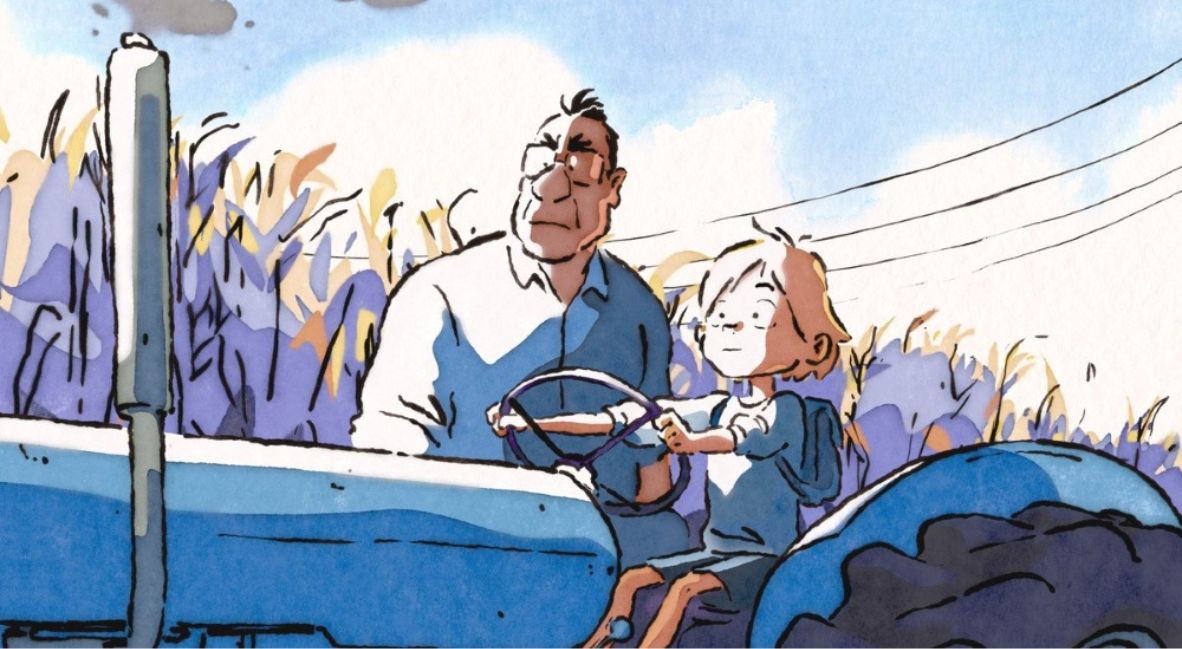
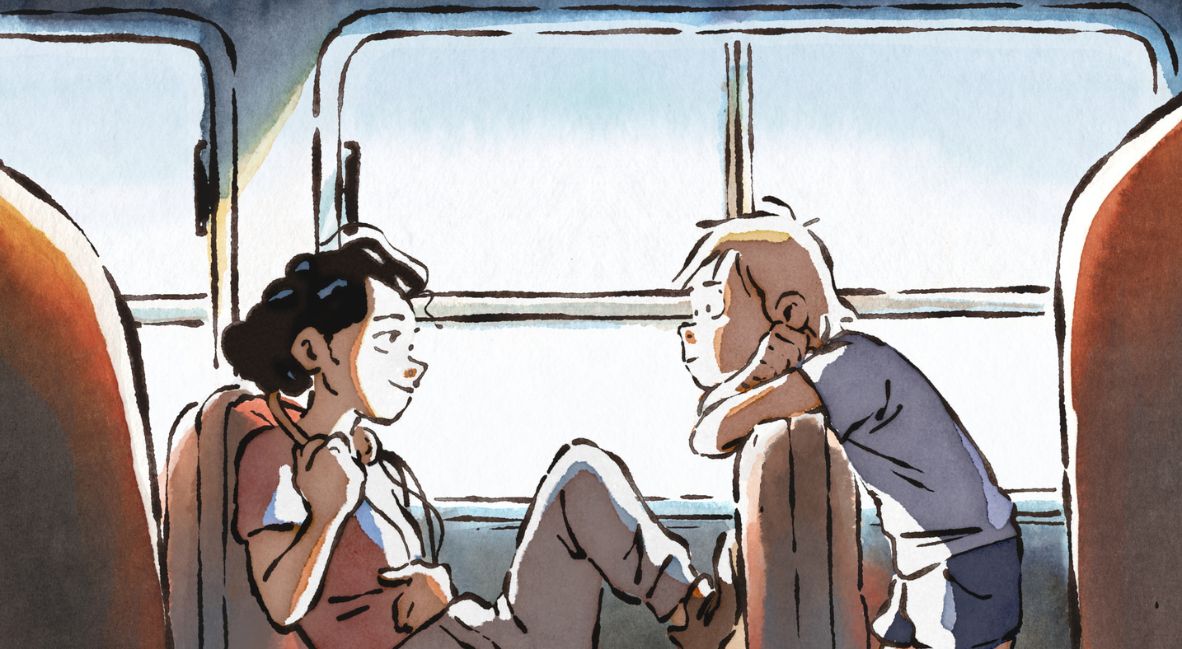
It’s brought to life with even more striking effect due to the use of the Chinese ink brush, which contains the colors of the world and maintains a sense of cohesion and movement even as the sprawling backdrops overwhelm the frames. Everything from how Clara slumps dramatically into a bus seat to the smoke of a tractor, to Christophe’s windswept hair as he flies down a path on his bike, lost in his music, to when he takes off in one of his daydreams is fluid yet structured.
By showing the world through the eyes of Christophe, Iron Boy flourishes with childlike wonder.
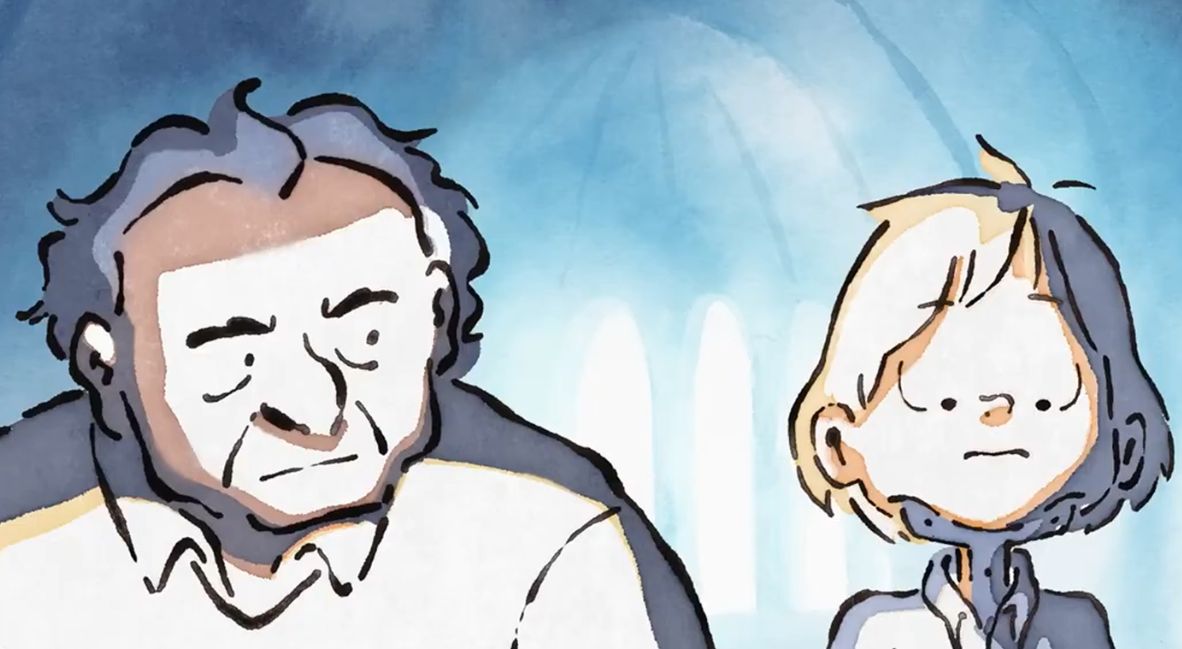
By using traditional methods, the film finds a delicacy that works in tandem with the thoughtful approach to the storytelling. The artistry allows us to see the world through the eyes of a child who both succumbs to the limitations of a small hometown while also being able to see the endless possibilities and sense of adventure.
Everything is big and mighty in the eyes of someone still so fresh to the world. Capturing that innermost delight and annoyance in the visuals is what makes them soar with the same infectious conviction as Christophe.
Iron Boy (Le Corset), with its vast, open skies, vibrant highlights, and playful, gangly character physicality, is a visual treat. Heartfelt and sweet, with a story at the center that speaks to the pivotal need to communicate, even when the going gets tough, the film delights in its ability to catch viewers off guard. It isn’t so much about rewriting the coming-of-age narrative as adding a new, impossible-to-ignore flavor. The effect is remarkable, making Louis Clichy a filmmaker to watch.
Iron Boy played as part of the 2026 Toronto International Film Festival.
Iron Boy (2026)
-
Rating - 9/109/10
TL;DR
Iron Boy (Le Corset), with its vast, open skies, vibrant highlights, and playful, gangly character physicality, is a visual treat. Heartfelt and sweet, with a story at the center that speaks to the pivotal need to communicate, even when the going gets tough, the film delights in its ability to catch viewers off guard.