

Andrew Scott is a generational talent and has been for some time now—a chameleon when it comes to how much space he occupies in any given role in any given scene. In Elsinore (2026), from director Simon Stone, he delivers a mighty, powerful performance that puts us through the emotional wringer. It’s so good that it’s easy to momentarily overlook some glaring issues, especially if you’re prone to tears. However, Elsinore isn’t a great movie, despite the great performance leading it. The film prompts an age-old quest (at least for this critic): is it good, or did it simply make me cry?
And, to that point, how much does this matter? If a film makes you feel something, isn’t that enough? To some, sure. But the problem with a film like Elsinore is that you can see the people in the back pulling the strings—the feet beneath the curtain.
It’s less that the story organically earns or elicits our emotional reaction and more that it plays into storylines that are hard not to feel something for. It’s hard not to feel something when watching a man give everything he’s got, through literal blood, sweat, and tears, to put on the final performance of his lifetime in an effort to cement his legacy and live on past his disease.
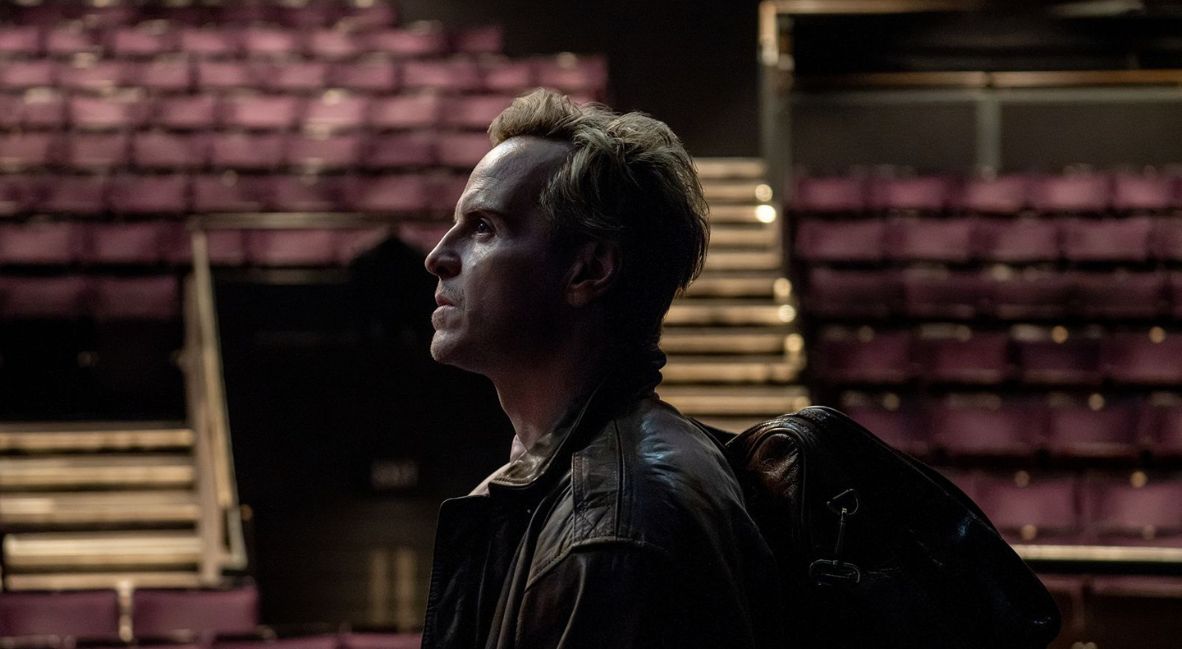
Andrew Scott plays actor Ian Charleson in Elsinore.
Set in 1989, Elsinore, in one of its few comedic beats, opens up as a young Daniel Day-Lewis promptly exits the stage at the National Theater during a live performance of Hamlet where he plays the titular prince. Meanwhile, across town, Chariots of Fire actor Ian Charleson is in a tireless chase to live up to the notoriety of his breakout picture, dissatisfied with movie-making life and the endless hours spent on set.
In his personal life, he’s checking for signs that would indicate his AIDS diagnosis has progressed. And, when that sobering moment arrives, it comes with an offer: to take over the role of Hamlet in Richard Eyre’s (Johnny Flynn) production. While his pioneering doctor, Margaret Johnson (Olivia Colman) is reticent over the notion that he pursue this goal, he’s steadfast. He doesn’t want sheer quantity to do what normal people do. He doesn’t just want to be able to get a coffee or go to the library. His life is about quality, and that means celebrating life and reckoning with his mortality in a play that wrestles with death.
What follows is a film that is trying to do too much and, as a result, struggles to linger on the moments that matter. Edited into an onslaught of montages, Elsinore acts as a highlight reel of the last months of this man’s life, rather than trying to hone in on the specificities of what drives him to the decision to lay his body on the line for the sake of his art.
It is all too much and not enough.
There’s simply too much going on and not enough time or investment to flesh it all out. There are his friends, led by Billie Piper’s Patsy Pollock, who stick with him to nurse him in his final days. There are his relationships with ex-lover Georgie (Luke Thompson) and bitter director Derek Jarman (David Dawson), who cast him in his first film role, who are also showing signs of their AIDS diagnosis progressing. And then, on top of that, his time spent in clinics and at the hospital, where he meets another, once acting hopeful, 21-year-old Nicholas (Joe Locke) and, of course, his rehearsals and eventual performances of Hamlet.
It’s a lot. And it shines a light on the greatest issue that plagues your modern biopic. The desire to show as much as you can about the life in question and the want to tell a story that feels fresh and new. Elsinore clearly wants to avoid other biopic trappings. Still, all the splicing together, the aggressive editing and incoherent jumps in time, and the forced decision to have moments in the play reflect the goings-on in Ian’s life make it both an exercise in excess and an example of how too much really can diminish the substance of the picture.
Elsinore should’ve just taken place in the rehearsals. The rehearsals plus the start of a show, maybe. Ian Charleson’s life comes across as both extraordinary and down to earth, but Scott comes alive when he’s in the middle of workshopping the performance and Ian’s relationship with the text. Given how many performances Scott has done in the theatrical rendering of Hamlet, it’s not surprising how naturally suited he is for the work.
Andrew Scott delivers a powerful, physical performance in Elsinore despite a split script and far too many montages.
Because of that, we want to see more of it. There’s this subtle gesture Scott does, as Ian, in the midst of one of the many rehearsal montages that does more in its silence than the film’s verbose script. While talking about those he’s lost and staring at the prop skull, he, in a fit of palpable despair, covers the eye sockets, unable to connect with the gaze of those he’s outlived. It’s such an unexpected beat, so soulfully tender and aching with the what-ifs of life that it leaves you breathless.
Unfortunately, the rest of the film lacks this, not so much subtly, but in the ease of performance. Andrew Scott is such a formidable force of nature, his attuned physicality showing the signs of Ian’s continued weathered appearance, the effort of performing taking a clear toll on his body. Elsinore as a whole is overbearing and overwrought as it tries (sometimes successfully)to squeeze the tears out of us. It’s not enough to make this a great film. A great showcase, sure. But the film, as a whole, needed to pick a focus and stick with it.
Elsinore played as part of the 2026 Toronto International Film Festival.
Elsinore
-
Rating - 6/106/10
TL;DR
Andrew Scott is such a formidable force of nature, his attuned physicality helping show the signs of Ian’s continued weathered appearance, the effort it takes to perform taking a clear toll on his body. Elsinore as a whole is overbearing and overwrought as it tries (sometimes successfully)to squeeze the tears out of us.