


In 2013’s The Hunger Games: Catching Fire, Haymitch (Woody Harrelson), a previous Hunger Games victor, ominously states that “Nobody ever wins the Games,” as victors remain subjected to emotional and sometimes physical torture by the vicious Capitol long after they win. Maybe no one wins the Hunger Games, but the fans win with The Hunger Games: Sunrise on the Reaping, a prequel that rewards and indulges them in turn.
It’s no spoiler that Haymitch wins his own Hunger Games, twenty-four years before the events of the original film, competing on behalf of the impoverished District 12. But the wisecracking, alcoholic Haymitch of the original series starts out as a scrappy, goodhearted teenager (Joseph Zada) whose two goals on his birthday are to not get chosen for the 50th Hunger Games and to spend the day with his girlfriend, Lenore Dove (Whitney Peak).
“May the odds be ever in your favor” is an adage oft-repeated in Hunger Games lore, and with the 50th Hunger Games being a Quarter Quell, meaning it comes with an extra-vicious twist, four unlucky children will be selected per district, instead of the usual two.
The Hunger Games: Sunrise on the Reaping spotlights Haymitch as we’ve never seen him before.

Haymitch isn’t initially chosen to compete, but is thrown into the mix after a scuffle with Capitol law enforcement necessitates a replacement for a male tribute. Haymitch’s fellow District 12 teammates are Louella (Molly McCann), a young friend who is Haymitch’s kid sister in all but name; Wyatt (Ben Wang), whose family is disliked in District 12 for taking bets on who will win the Games, and Maysilee (Mckenna Grace), a girl as notorious for her love of jewelry as for her sharp tongue.
The rules of The Hunger Games: Sunrise on the Reaping are not new to longtime Hunger Games fans, given that the rules stay the same, from the fight to the death to the puppet-like mandatory participation in the Capitol’s propaganda machine. The ability to distort the truth for public palatability is on full display, as up-and-coming producer Plutarch (Jesse Plemons) hacks away at any footage that makes the Capitol look distasteful. It’s a consistent, chilling through-line about the nature of control; Plutarch even encourages a tribute’s family to recreate the moment their child is chosen in order to get a more dramatic reaction on camera.
The Capitol itself is extraordinarily constructed, reminiscent of versions we’ve seen before but possessing its own visual flair, envisioning a retrofuturistic world where 1970s aesthetics have made a comeback after an apocalyptic war. Uli Hanisch‘s production design and Bina Daigeler‘s costumes reimagine a familiar world while distinguishing it from the ones we’ve seen fifty years before (in The Hunger Games: The Ballad of Songbirds and Snakes) and two dozen years later in the original series.
The Capitol’s exuberance is perfectly encapsulated by on-point styling and committed performances.
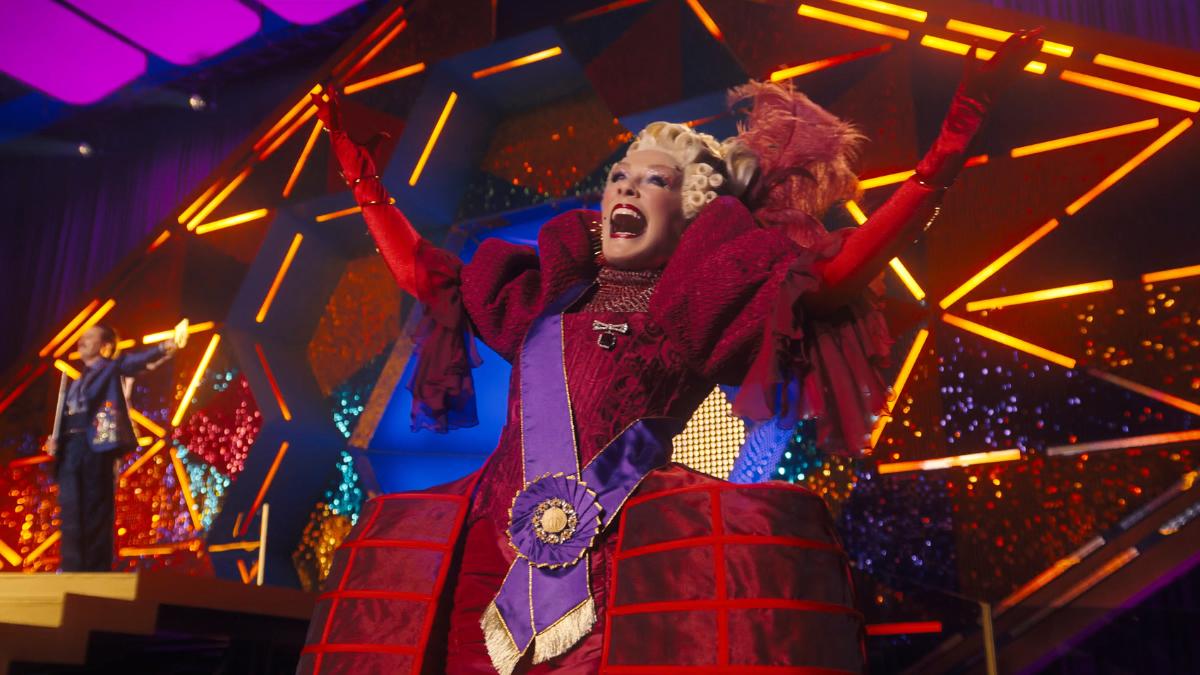
The makeup is garish in step with the Capitol’s outlandish styles; Glenn Close‘s face is stretched and contorted in ways that render her fantastically unrecognizable. Close is one of a number of notable actors in smaller but nonetheless memorable parts. She’s Drusilla, a callously cackling Capitol representative in charge of the District 12 tributes.
She’s a new character to the series, but Dylan Jury and Debra Zane‘s cast of younger versions of fan favorites is expertly assembled. In addition to Plemons (playing a younger version of Philip Seymour Hoffman‘s Plutarch), Kelvin Harrison, Jr. and Elle Fanning closely match their counterparts, bringing to life Jeffrey Wright‘s technological whiz Beetee and Elizabeth Banks‘ upbeat stylist Effie, respectively.
It’s a pleasure to see these characters again, and fans will appreciate references to their histories that expand the original franchise lore. (Lili Taylor‘s Mags is said to have been a victor from the year after The Hunger Games: The Ballad of Songbirds and Snakes, for one.) But the extensive lineup of fan favorites comes at the expense of getting to know the tributes of the 50th Hunger Games.
Ralph Fiennes doesn’t quite match Donald Sutherland’s career-making turn but still nails Snow’s tyranny.

With double the number of competitors, one would expect higher stakes, but The Hunger Games: Sunrise on the Reaping doesn’t bother to familiarize itself much with them beyond one-note depictions, ranging from “brutish” to “precocious.” The deaths of most tributes are kept offscreen, and those onscreen are sanitized or even wholly changed from their gruesome deaths in Suzanne Collins’ novel. That’s by design to maintain a PG-13 rating, but it detracts from the devastation these Hunger Games are meant to have.
When The Hunger Games: Sunrise on the Reaping does dive deeper into character exploration, it succeeds. Zada is a worthy successor (or in this case, predecessor) to Haymitch’s signature drawl, evolving from an innocent boy to the brash, broken Haymitch we know he becomes in adulthood.
Though Ralph Fiennes‘ President Snow doesn’t capture the same uncanniness of his older counterpart (Donald Sutherland), the bone-chilling tyranny is ever-present. President Snow singles Haymitch out as a rebellious problem early on, threatening to destroy Haymitch’s family if he steps out of line, and Zada’s performance is laced with Haymitch’s constant anxiety over the fear of fallout from his actions.
It’s tricky to build suspense when the outcome is known, but The Hunger Games: Sunrise on the Reaping does its best.

There’s little that’s surprising in The Hunger Games: Sunrise on the Reaping, only because five other films have already chronicled the Hunger Games and their established rules. It’s hard to create genuine suspense about a world in which the fate of its protagonist, and much of the supporting cast, is known (that Haymitch is known to survive these Games should tell you what happens to everyone else).
But director Francis Lawrence keenly understands this world, having directed four other installments, keeping a genuine pulse on the fear and emotion at the heart of this beloved series. Should the sun rise on another Hunger Games film, the fans will surely eat it up.
The Hunger Games: Sunrise on the Reaping is now playing in theaters.