


I will probably never look at cracked concrete the same way again after watching John Wilson’s The History of Concrete. On the surface, it’s a documentary about exactly what its title implies: the history of concrete. But very quickly, the viewer will realize the documentary has almost nothing to do with history and everything to do with the moment we live in now, and the future we are crumbling quickly towards.
Following the end of his work on several seasons of television, Wilson finds himself unsure how to move forward as a filmmaker. The documentary is shot entirely from his point of view, using either b-roll, casual interviews, or the occasional Zoom screen. He begins by explaining that going from a fully funded project with a crew by his side to no funding and virtually no crew has been hard on him creatively and mentally, and the subject of concrete was almost an accident.
The History of Concrete shouldn’t work as a film, but it absolutely thrives.
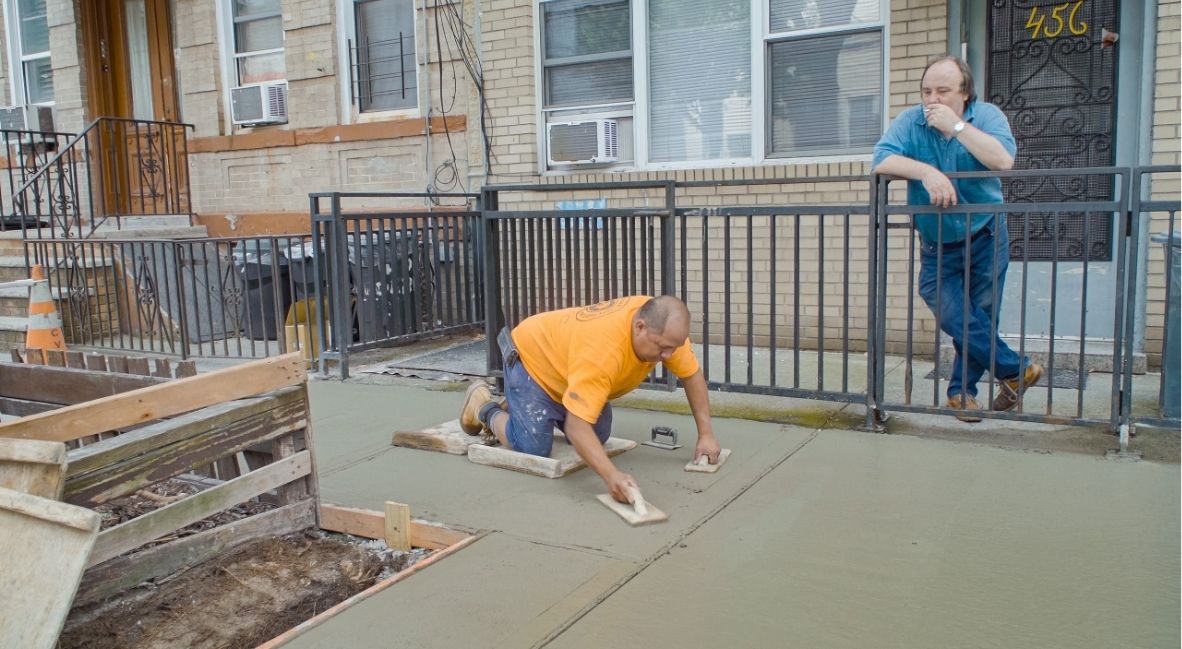
The rest of the film plays much the same way: like an accident. Every twist, turn, and tangent The History of Concrete walks down feels like Wilson simply stumbled upon it. In large part, because he does. It’s this stumbling that makes the documentary so captivating from the start. You have no idea what run-in he’ll have at a terrible house show in NYC that will lead to a liquor run, that will result in an intimate friendship, the death of a judge, and the relationship between DMX and concrete that makes this rambling documentary so human.
There’s no reason anyone should hear “The History of Concrete” and expect a documentary as moving as this is. And yet, it’s John Wilson’s human interest—his constant follow-up with subjects as soon as something about them piques his interest—that propels the heart of the movie. Yes, it’s about a quest to understand why the entire world is made out of concrete and why that concrete is falling down all around us. But it’s more so a quest to understand why he’s making this film at all.
The History of Concrete manages to be about virtually every modern plague, and yet it thoroughly entertains, too.

The documentary’s comedic pace isn’t lost, either. Wilson’s almost monotonous narration is met with knowing pauses, perfectly timed cuts, and visual irony that always carries an air of the unexpected. Sometimes, it feels like a miracle that he happened to capture exactly the right thing at the right moment. At other times, it feels like the documentary’s entire script was written just to use a joke based on one random image he captured.
Regardless of the technique used to develop the film, the experience always feels perfectly settled between authentic and contrived. Like you know the world he’s built is a little unnatural, like the concrete it rapsodises, but also completely natural, the way the concrete has so become in our world.
At times, the narration sounds too off-kilter, as if it’s imitating the AI voiceovers it’s making fun of. And yet, the natural way that Wilson stumbles over certain line readings feels like the kind of human mistakes that AI could never replace.
The History of Concrete lets curiosity guide an idea and lets the idea tell its own story.

That The History of Concrete manages to touch on virtually every facet of our modern misery under late-stage capitalism while remaining thoroughly entertaining and entirely human is spectacular. It’s not always clear why a certain person or the path they take John Wilson down was put in the film, but by the time things circle back to concrete, it doesn’t matter how stuffy the metaphor was.
The interaction didn’t need a deeper purpose or a direct relationship to concrete to be valuable. Those relationships and those pieces of human interest are more soulful than any piece of concrete the movie depicts, and frankly, have more soul than most of the interactions any of us have with strangers on a daily basis.
That’s the real point of the movie. That while the world crumbles and devolves around us, the only balm is in communities we build around us. Not the mortar and steel that shelter us—although it’s not clear what we’re supposed to do about replacing the clearly flawed and harmful substance at the movie’s core. But the human beings all around us that the slabs of concrete and all the toxicities they represent try to prevent us from connecting with. The History of Concrete is an excellent example of letting curiosity guide an idea and letting the idea tell its own story.
The History of Concrete is in theaters September 18, 2026.
The History of Concrete
-
Rating - 8/108/10
TL;DR
The History of Concrete is an excellent example of letting curiosity guide an idea and letting the idea tell its own story.