

A lot can happen in nine years. For international auteur Andrey Zvyagintsev, it was a near-decade of close calls, during which he survived hospitalization amid the global COVID-19 pandemic and fled into exile from his native Russia amid its still-ongoing invasion of Ukraine. With Minotaur (2026), his latest Cannes sensation, Zvyagintsev reworks Claude Chabrol’s La Femme infidèle into both a cold, calculating matrimonial thriller and a staunch anti-war indictment of Putin’s regime—and, despite having all the right pieces, it rarely succeeds at being either.
Since the release of his last film, 2017’s Loveless, the world and its social order have increasingly teetered toward unsalvageable inequality and the imminent rise of fascism, awaiting the return of Zvyagintsev’s latest, uncompromising critique of modern Russia and its fragile, war-mongering national ethos.
While admirable in its allegorical commentary and robust, layered imagery, Zvyagintsev’s thriller is, ironically, not thrilling enough to engross us in its overly familiar crime plotting. Neither for long stretches does it possess the nuanced bite necessary to be politically scathing or incendiary. The result is a film that is both too subtle and too overt in its thematic ambitions and narrative machinations, rarely striking the balance necessary to make its familiar infidelity-murder plot snap, spark, and crackle.
Minotaur is an experience that, while deeply prescient and artful in its construction, often tells you what to feel without giving you the emotional depth or foundation to truly feel it. The hallmark of a film that labors to evoke the best elements of genre cinema while remaining beholden to the worst constraints of arthouse pretension.
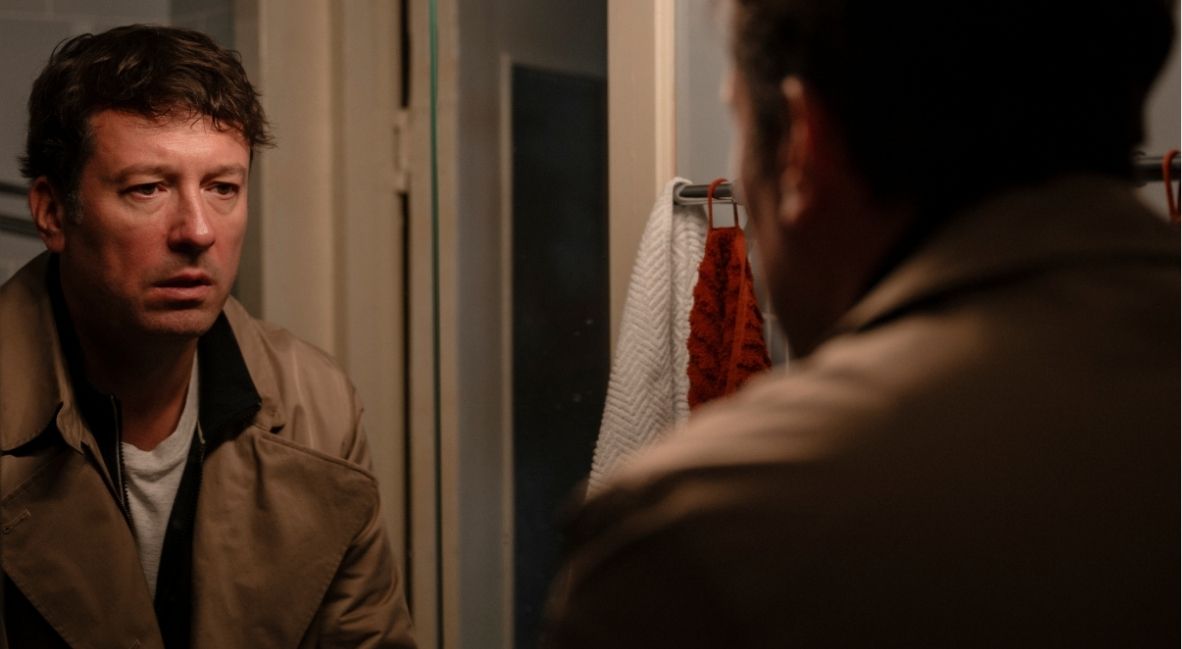
Dmitriy Mazurov stars as Gleb, the successful CEO of the biggest company in a small Russian town, who seems to have it all: a picture-perfect nuclear family—including his beautiful wife, Galina (Iris Lebedeva)—and a dacha that is as picturesque as it is inviting. Yet, when the Russian invasion of Ukraine begins, Gleb finds his company the main target of draft quotas, with city officials eyeing key employees as front-line fodder.
As desperate workers flee the country to avoid conscription, Gleb devises an inventive but deeply disturbing workaround to secure the 14 conscripts demanded of his company. The act echoes the sacrificial victims offered to the titular beast by King Minos.
Meanwhile, at his luxurious home, Gleb’s relationship with Galina is dispassionate and shallow, with the two barely looking at or touching each other as Galina turns her gaze toward another lover. Upon realizing what is happening right under his nose, Gleb takes matters into his own hands once again, albeit with a much more intimate, personal, and bloody touch—one that will prove far more difficult to cover up.
Minotaur’s performances and filmmaking are lived-in, but the story leaves too much to be desired.
As Russia’s invasion looms over every frame, Zvyagintsev and cinematographer Mikhail Krichman immerse us in a film defined by its cold, calculated, and meticulous sense of observation. Armed with a grand, layered depth of field, a series of stunning wides and fluid oners seamlessly acquaint us with Gleb and his family’s dynamics, insecurities, and secrets—tapping into a prevailing bourgeois apathy that serves as a key cog in Putin’s meat-grinding war machine.
It’s a thematic effect that reaches its visual zenith in a deft tracking shot that circles a table of Gleb’s unsuspecting, doomed war tributes who, in one fell swoop, offload the burden and cost of this conflict from the smug, winning, and dining ruling class.
But as the film’s crime-of-passion side-plot becomes the main focus, its slow-burn plotting and gorgeous framing manifest as a sideshow that attempts to mask the film’s blunter, heavy-handed commentary. While Minotaur draws a clear, pointed comparison between one measly, get-your-hands-dirty murder and thousands of invisible, state-sanctioned deaths, Zvyagintsev mires the film in a series of “do-you-see” moments and sequences. For all its restraint, Minotaur goes from being too subtle to incredibly obvious. It’s overly reliant on its setting, context, and obvious commentary to deepen its paint-by-numbers murder plot.
Once audiences understand what it’s getting at, which is bound to be early, Minotaur has few cards to play, besides abstruse imagery and prolonged bouts of pretentious stillness. It feigns over-extended contemplation in a desperate bid to get its two competing plotlines to gel and inform one another.
Minotaur has lived-in, passionate performances from Mazurov and Lebedeva, who extract as much emotion and pathos as they can from a well-worn narrative and thin thematic scaffolding. But the movie conjures the feeling of looking at a grand, politically charged painting, intricate and full of ambitious ideas, but with little emotional power or pathos. It seems the nine years between films have afforded Zvyagintsev ample time to grapple with what to say, but not enough space to ponder how to say it.
Minotaur screened as part of the 2026 Edition of the Toronto International Film Festival. It releases November 20th, 2026.
Minotaur
-
Rating - 6/106/10
TL;DR
Minotaur conjures the feeling of looking at a grand, politically charged painting, intricate and full of ambitious ideas, but with little emotional power or pathos.