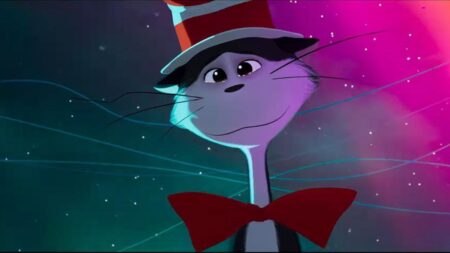


You’ll be hard-pressed to find anything that looks or feels like Ryuya Suzuki’s debut feature film, Jinsei. Hand-drawn, written, directed, edited, and scored by Suzuki, it is, if nothing else, a sheer display of ingenuity, innovation, and talent, and an urgent reminder of the tenacity of human-made work. Each frame, each still, each cut between scenes, has evidence of painstaking time and effort behind it. Blending the off-kilter whimsy of Wes Anderson with imagery that evokes Ryusuke Hamaguchi’s Drive My Car, and thematic undercurrents that run the gamut from Bojack Horseman to Stanley Kubrick, Jinsei isn’t just impressive because of how it was made but in its final creation.
The film opens with a montage of a life, but it’s just the prologue to the protagonist’s. Rolling footage as if captured on a camcorder, the postage-stamp-sized frame rate condenses the story into something personal and melodic. The structure lulls us as we succumb to it through quick cuts that show how a couple meets, has a child, and then the father leaves, with a new man entering the fray. It’s he and the son who, one night, stand witness – idle and active – as the woman, our hero’s mother, is killed in an accident. She is the last person who calls our hero by his name, Jinsei.
The film, with its rigid lines and staccato rhythm, breaks the story into parts, all captioned by the different names our hero, voiced by ACE COOL, is called throughout his life. And what a life it is, spanning a century with our largely mute hero as he chases a dream of idolatry and superstardom through training to become a J-pop idol, succumbs to impulsive violence, and is ostracized from society before becoming a beacon of its hope. As the aspect ratio changes for each segment, so too does his journey, marked by decisive moments in a life overwrought by acting as mere spectator to itself.
Ryuya Suzuki’s efforts are immeasurable in their sheer ambition.

Jinsei weaves throughout the decades from boyhood to final days, traversing with unexpected lovers, weirder friends, robots and warfare, aliens, and the end(s) of the world. He is forgotten and he is a God, the Grim Reaper, and humanity’s example. He lived while others died, and succeeded where others failed. His life, through these peculiar, jauntily miserable snapshots, is a cacophony of personal mini-deaths in an impossibly long existence.
Suzuki’s efforts here, worked on over the course of 18 months, are immeasurable. For comparison, look no further than Gints Zilbalodis, whose first animated feature, Away, was similarly directed with a sense of self-possession as the animator, director, writer, and composer.
His major breakout following? The Oscar-winning Flow. To think that Suzuki, like Zilbalodis, is capable of so much through his own singular touch and curiosity is a breathtaking realization for fans of a medium that is so often overlooked or underappreciated outside its existing fans. To think, someone could create all of this and still have the capacity and potential to do more.
Because, for as wonderful and odd as Jinsei is, it still falters due to an unruly script that is trying to say everything Suzuki has ever held contempt for in a span of 90 minutes. There’s unquelled rage that simmers throughout the film, bursting, like its character, in bouts of bloodshed or crass cruelty.
Jinsei has a lot to say and, for the most part, makes its many points.

But it’s in the writing, too, depicted in the callous artifice of the idol machine and in the way the wealthy in the upper echelons of society will always prioritize their own safety and easy comforts in the face of global destruction. These themes work, but by the admittedly jaw-dropping crescendoing, kaleidoscope finale, there’s no denying that Suzuki’s want for it all came at the cost of some narrative bloat.
That said, Jinsei is extraordinary despite it. Because, for all the big ideas, the simplistic, blocky nature of the animation helps keep the story anchored despite its very real efforts to lift off beyond the stratosphere. The jarring humor serves to keep the momentum going rather than making a joke of the story itself.
Because even as the world grows increasingly tumultuous, Suzuki’s pliable score matches each hysterical or subdued note, there’s this unexpectedly lovely note that links it all together, even in his most anarchic, nihilistic beats, where humanity, from that moment on, seems like a lost cause.
The film beckons in a staggering new talent while ruminating on the complexities of life.

And that’s chance. It was pure chance that our heroes’ mother picked up his father in her taxi. Chance that he’d meet Kin (Taketo Tanaka), become friends despite a contentious beginning, and join forces in their emotional tethers to become idols together. It’s a chance that he and his step-father were in the car, rather than the store, when the truck mowed it down, and a chance still that said step-father would be spared from moral self-immolation by an earthquake, letting him reunite with his son.
Chance leads our hero throughout the decades to impossible, stinking lows and euphoric highs of a chosen family. Chance is what builds the snapshots that adorn his room, linking him to his father, a former idol who is the crux of how he views his existence.
Therein lies Suzuki’s brilliance. Because that’s life, right? That’s “Jinsei” (which, translated, means a human’s life or one’s lifetime.) Messy and complicated and ugly, but all linked by the beauty of chance. Ryuya Suzuki’s production amounts to something spectacular and shocking in its universality. Structured with an immediate distinctiveness that makes it more an echo of other works than a direct inspiration, Jinsei is a commendable feat of artistry that, hopefully, paves the way for a genuinely exciting talent.
Jinsei is out now in limited theaters.
Structured with an immediate distinctiveness that makes it more an echo of other works than a direct inspiration, Jinsei is a commendable feat of artistry that, hopefully, paves the way for a genuinely exciting talent.