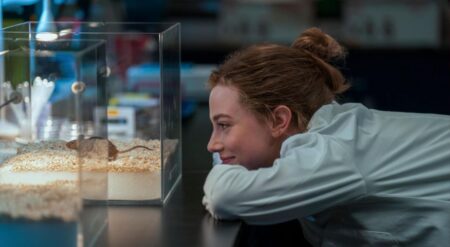


A carcinogen, a tumor, a particularly nasty toothache – a repugnant ailment in pop-star form. Mother Mary, directed by David Lowery, doesn’t mince words in Sam Anselm’s (Michaela Coel) descriptions of her former best friend, muse, and something more, in her monologued introduction to Mother Mary (Anne Hathaway). Whatever terms they ended on were rotten, soured further by time and careers built separately. Overcast in gray skies and rolling thunder, as Sam tears through fabrics while Mother Mary makes her harbinger-of-doom entrance, the film lays it on thick. This isn’t a reconciliation, but a reckoning.
Or, at least, that’s what the tone might suggest. But the most compelling aspect of the film is how much it omits while still guiding us with a heavy hand—a gripped shoulder rather than a gentle nudge. Mother Mary wants to be evocative – it wants us to feel something – and in many ways succumbs to a vibes-only, style-over-substance approach. And its greatest triumph (for the right viewer) is that it’s easy to let the film wash over us for what it is rather than pick it apart for what it isn’t.
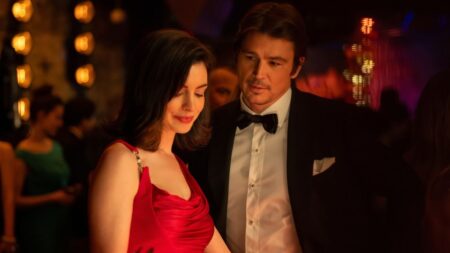
Because Mother Mary, for all of its gorgeous visuals and Coel and Hathaway’s dazzling, acidic chemistry, is very light on story. Mother Mary is an iconic pop star, drawing on the vestiges of Madonna and Lady Gaga with theatrics and devout fan following. She’s hit a rough spot, however, on the eve of her comeback performance, dissatisfied with her costumes and the dresses she’s been given. She needs a change, but we don’t realize how deep that desire goes until she reunites with her former costume designer, Sam.
Mother Mary luxuriates in an atmosphere-driven character piece.
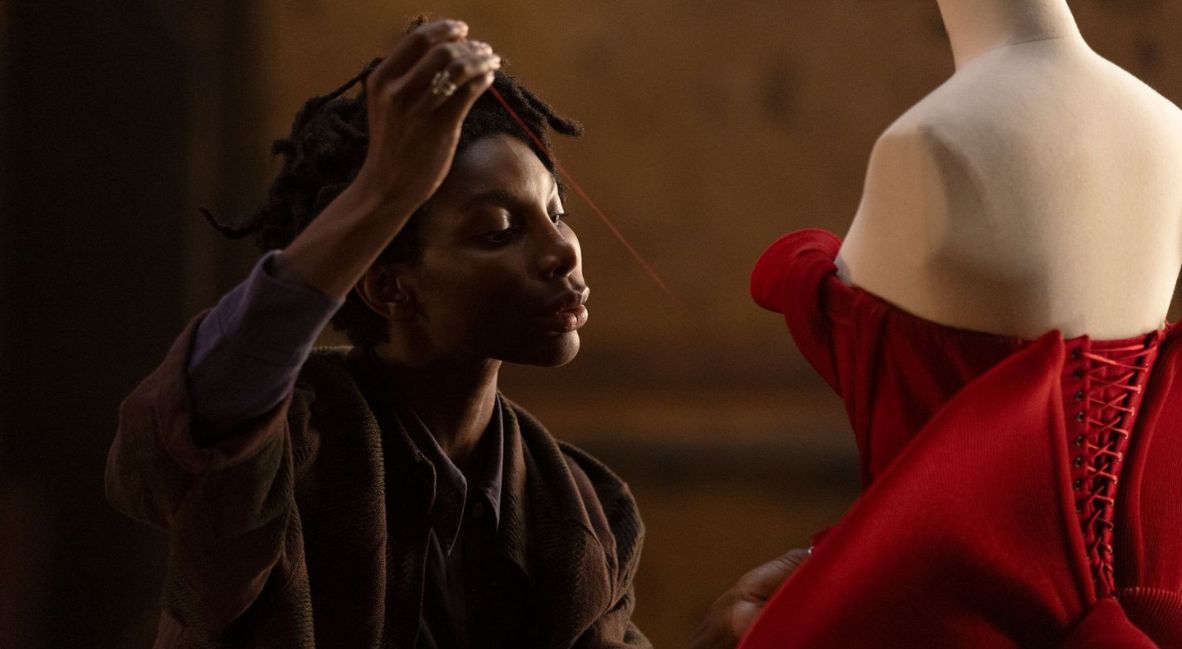
Sam clearly harbors ill will towards the singer. She’ll dress her, but at first it seems like a power play. For dominance. To reclaim something that was lost when Mother Mary, however unwittingly, drove her away from their combined efforts. Because while the singer sees herself as once a singular project, Sam always dressed her based on their combined personalities and histories.
From here, as the two sequester themselves in Sam’s lavish English countryside home, they must process their fallout, their careers, and what it means to have an inexplicable connection. And it’s that latter point that drives the momentum of Lowery’s film, which is so clearly enamored with the unexplained ways in which we’re tethered to others. Both the physical and the spiritual, the latter of which becomes more pertinent the longer the film continues.
To dress Mother Mary, Sam wants to intimately know her. Sam wants to know the woman she’s become in her absence, beyond the media coverage and viral clips. But she doesn’t want to hear her music, having refused to listen to a single one of her songs since they parted. She also needs to know how she plans to dance in whatever garment she makes, teeing up one of the more effective sequences of the film while also shepherding in the otherworldly specters that haunt the characters and the narrative.
Anne Hathaway shines in a role tailor-made for her competing strengths.
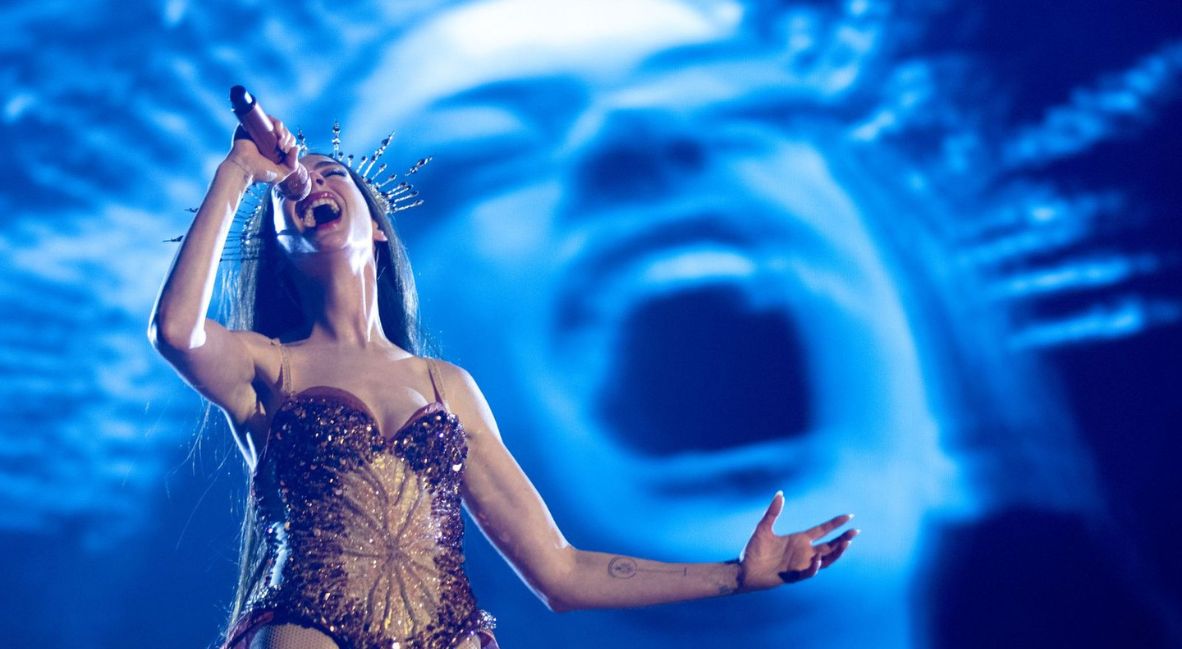
Hathaway has always been something of an enigmatic performer, straddling the line between theater-kid sincerity and tender, bruised depths. More than any of her projects to date, Mother Mary blends these two sensibilities, culminating in a raw, steel-nerved performance, her voice warbling and shaky despite the fixed, straight back and physicality.
And yeah, it lets her dance and sing, a reminder that she is one of our few, genuine triple threats. The scene where she performs the dance to her lead single is reminiscent of 2025’s brilliant The Testament of Ann Lee, with its bruising choreography, the slap of bare feet against wooden panels, and the thumps of fists against thighs. Sinewy and exhaustive, she dances like a possession, and she dances like it’s a punishment. It moves from graceful to animalistic in a blink of an eye, and we, like Sam, watch in awe and slight horror as she contorts herself.
It’s the first sign that Mother Mary, despite arriving as a blank slate for Sam to dress, is not all she appears to be. And it’s that hint of more, the suggestion of ghostly apparitions that overwhelm the rest of the story, that makes Mother Mary so difficult to quantify. Because the story is loosely plotted, it is not so much interested in a structured narrative as in the emotional give-and-take between two women seeking some form of power and connection, and finding it in their shared ghosts.
What we endure for the sake of art and what we love.
Despite the esoteric natures and the feel-first, think-later approach, there are some moments of Lowery’s script that are too quick to spell things out to us. Moments such as the crown Mother Mary wears during her performance, leaving her head bleeding, plus the Joan of Arc plating on one of her costumes and the bleeding chest piece that adorns it, are clear: “heavy is the head that wears the crown.” There’s no subtlety here. It’s somewhat surprising given Lowery’s work in the spectacular The Green Knight, which also drew on folklore and legends for the sake of crafting a reflective character study.
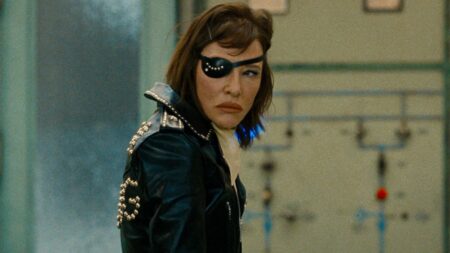
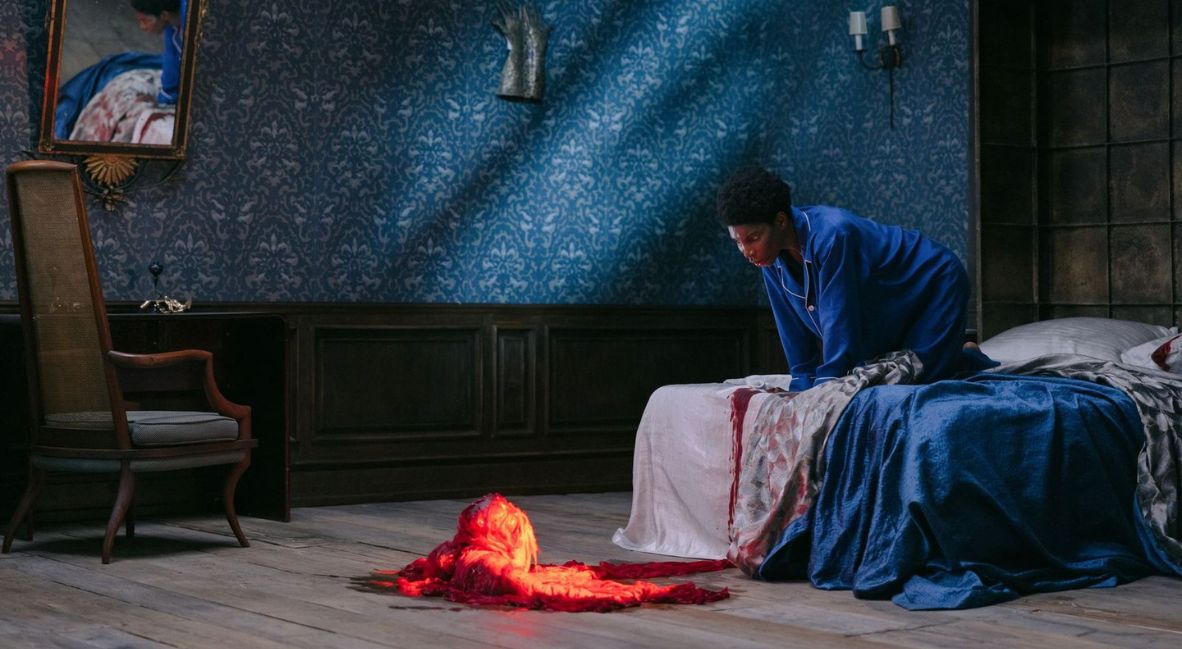
And yet so much of it still works because it nails the emotional pull, even as the film inches towards an increasingly psychological horror story. There are some genuine thrills, albeit more atmospheric than jarring. FKA Twigs makes a brief but memorable appearance, helping manifest the spirits they’re dealing with. There’s even the thematic pull of how the red spirit appears and what it takes from Sam and Mother Mary, suggesting greater thematic weight, as Sam bleeds for her interaction while Mother Mary holds it hostage between her ribs.
All of which builds to the idea of what we bear, what we break, and what we endure for the sake of our art. Mother Mary isn’t a subtle film, but it’s effective. Coel’s performative indifference matches Hathaway’s overt vulnerability, her acerbic delivery that leads into genuine shock or discovery, a fantastic reminder of her strength as a performer. And her and Hathaway’s chemistry threatens to combust, suggesting that if they were to move too close to each other’s orbit, they might catch fire.
Michaela Coel and Anne Hathaway brew scathing chemistry.
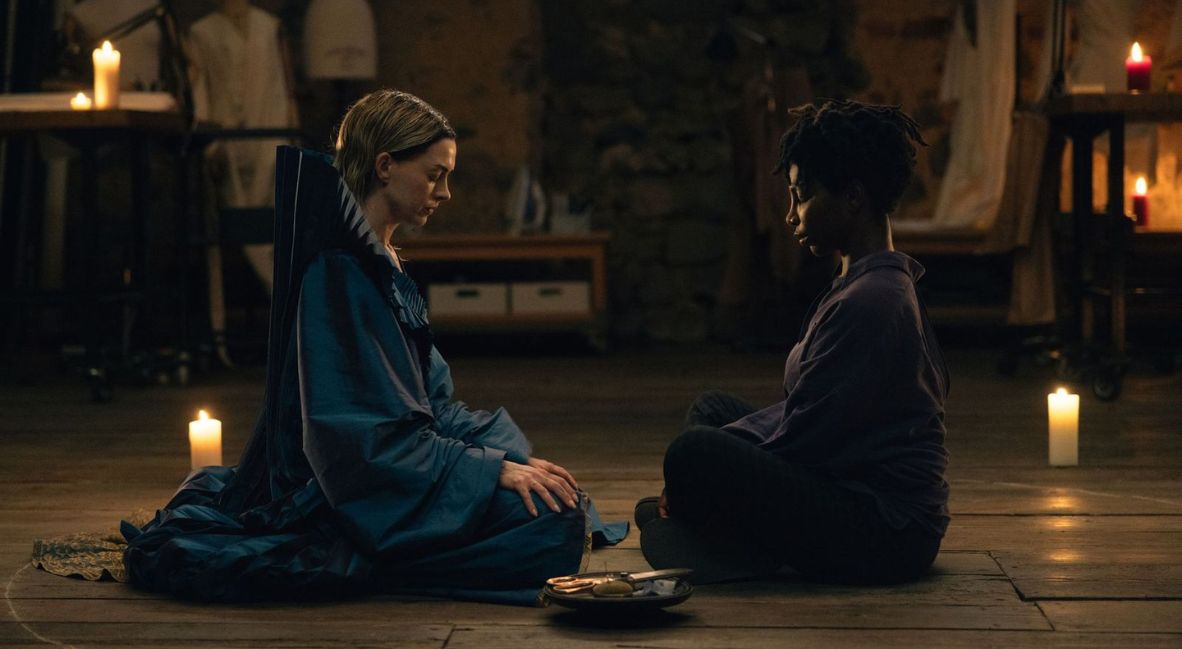
Mother Mary is also visually stunning. From the lavish costuming by Bina Daigeler (beautiful gowns!), to the haunting cinematography by Andrew Droz and Palermo Rina Yang, and the mixed aesthetics of Daniel Hart’s compositions and the influence of Charli XCX for the original songs, it’s a sensory feast. Each frame is laden with detail and beauty, culminating in a movie that works because of all the elements, not so much in how they’re strung together. But the effect is undeniable.
It’s one of those films that you’ll either love or hate. There’s a distinctive, divisive quality that speaks to Lowery’s own affinity for rule-breaking oddities that speaks to a very specific type of filmgoer. It isn’t without fault. But the flaws somehow enrich the tapestry of the story, because the stitching and intent are so evident, packaged with curiosity and a desire for original storytelling, that it’s hard to discourage it, even harder to dislike it.
David Lowery has always had an interest in ghost stories and the invisible string that pushes us through the fabric of life and beyond. Mother Mary might not be his best film, but it perfectly aligns itself with the stories he seeks to tell, a reminder that he’s a critical cinematic voice. Mother Mary flies in the face of convention for a story about the self-destruction of art, the inexplicable bonds we form in the hardest moments of our lives, and the proof of love manifesting in the ghosts we share.
Mother Mary is out now in theaters.
Mother Mary
-
Rating - 8/108/10
TL;DR
Mother Mary flies in the face of convention for a story about the self-destruction of art, the inexplicable bonds we form in the hardest moments of our lives, and the proof of love manifesting in the ghosts we share.