


It feels almost crude to describe a historical action film as “refreshing,” but when your film is about a conflict that hasn’t been seen on the big screen before, it stands out as a genuinely new type of historical action drama. Paul Greengrass’ ruthless but hopeful new film The Uprising brings a keen sense of modern relatability to its 14th-century setting. Among an ensemble led by Andrew Garfield, Jamie Bell co-stars as John Ball, a priest in radical pursuit of social equality amid oppressive royal reign.
“I knew nothing about this about this until I read the script,” Bell confessed, having been unfamiliar with the Revolt despite being English himself. In the film’s press conference, writer/director Paul Greengrass described The Uprising as tapping into “the unfairness of the world” and the rage it inspires in people who have had their money, livelihoods, and hope stolen from leaders who refuse to help them.
Jamie Bell’s John Ball is a priest unlike any clergyman you’ve seen before.

Highlighting a conflict last seen onscreen in a 1969 BBC special, The Uprising chronicles the origins of the 1381 English Peasants’ Revolt. With Richard II, then a boy king, on England’s throne, the royal council sought to increase their own wealth and protect their interests while systematically raising taxes on the long-suffering working class, still reeling from the aftermath of the Black Plague several decades earlier.
In The Uprising, the rebellion is incited by Andrew Garfield’s Ploughman, a fictitious everyman whose mission for justice is intrinsically tied to his grief after losing his family to the plague. But along the way, Ploughman meets real figures from the Revolt, including Bell’s John Ball, a priest unlike any clergyman you’re used to seeing onscreen.
Greengrass first began developing The Uprising in the early days of the COVID-19 pandemic, finding it interesting that the English Peasants’ Revolt began as a response to the economic suffering suffocating those already grieving after the Black Plague. That keen attention to history, and its relatability to modern struggles, is what made Greengrass’ sensibilities, and signature tone of gritty realism, the perfect person to bring this era of history to life.

As a self-described “big fan” of Greengrass’s prior films, Bell was keen to sign on to The Uprising. Though Greengrass’ work typically skews towards 20th- and 21st-century conflicts, Bell found that the English Peasants’ Revolt was right in “[Greengrass’] wheelhouse.” He thought the Revolt spoke to prior themes in Greengrass’s work, seeing The Uprising as “a struggle for control against oppressive systems, the chaos of that and how you make decisions in that chaos, and what’s the next right thing to do.”
As with the Revolt, Bell hadn’t been familiar with John Ball, whose methodology for enacting change and relentlessness make him different from other depictions of clergymen in film. (Stephen Dillane’s own Archbishop of Canterbury in The Uprising is a member of the king’s self-interested council, by contrast.) Ball is shamelessly violent in his quest for justice and equity for the working class.
Ploughman first encounters Ball during one of Ball’s addresses to the masses, which made him one of the key figures of the Revolt. Ball’s egalitarian ideals and skillful preaching made him exceedingly popular among the rebels, while detractors also labeled him a heretic.
John Ball is “a lover of his fellow man” in The Uprising.
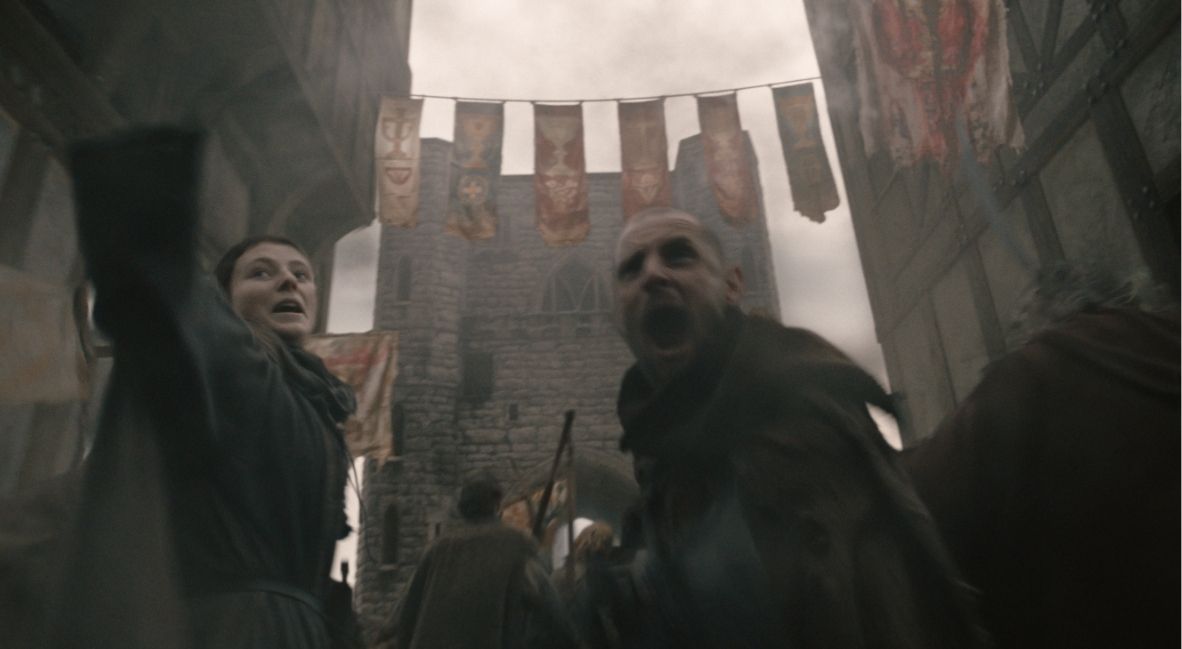
In researching Ball’s involvement in the rebellion, Bell found him “self-possessed” and “radical,” and even dangerous. Though Ball is a supporting player in Ploughman’s story, researching Ball’s history and reputation built a firm foundation for crafting Bell’s performance. Bell learned that the priest had “been in prison multiple times, excommunicated, labeled a heretic,” making him a clergyman audiences won’t soon forget.
Though Ball is, both in The Uprising and in historical record, remembered for his intensity, Bell described him as “a lover of his fellow man” and “to some degree, a good guy.” Ball’s relentless quest for social equality reminded Bell of other, more contemporary stories of ordinary people pushing back against inequality. He saw parallels between The Uprising and his own upbringing in County Durham, England, in the years following the 1984-1985 miners’ strike.
Bell noted that the strike was chronicled in his first film, 2000’s Billy Elliot, and felt that The Uprising had similar themes of ordinary people taking action against systems that refuse to make room for their own rights or needs. “The whole kind of idea of standing up, I try to personalize as much as possible,” Bell said, describing it as “really, really fun to do.”
Jamie Bell says hope is the only way to unite as a community.
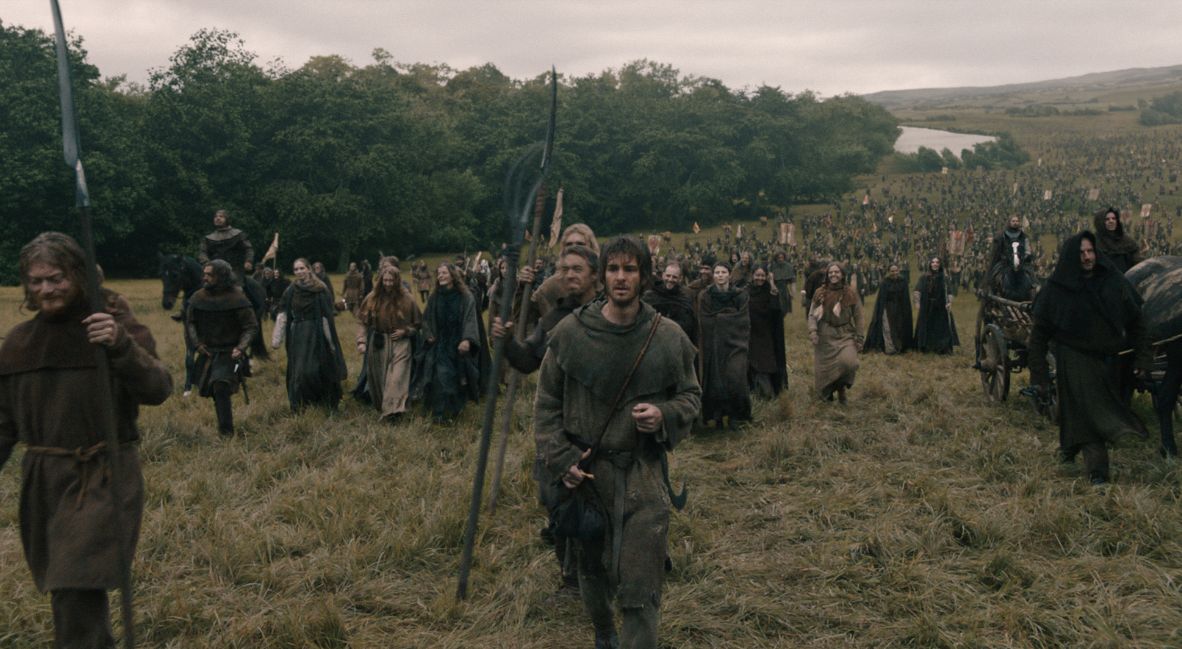
The titular event in The Uprising begins with Ploughman engaging in a violent conflict against the king’s tax collector, successfully driving them from his impoverished town. Word of his actions spreads quickly across England. “It’s almost unheard of to rally ten thousand people and multiple counties to kind of adhere to your message and stand behind you and march upon England,” Bell marveled. When assessing how quickly word spread of the rebellion in the 14th century, compared to the instantaneous spread of social movements online today, Bell called it “an unbelievable feat of ingenuity.”
Though The Uprising is unflinchingly brutal, even gruesome at times, the rage at the center of Ploughman, Ball, and other figures in the film is rooted in a radical hopefulness. That optimism, however motivated by grief and anger, is palpable across The Uprising, as Ploughman, Ball, and their fellow rebels march toward London in hope of appealing to their young, easily swayed king.
That kind of relentlessness can only truly be rooted in an unwavering sense of hope, and it comes through the film as a light in an otherwise grim era. When asked about what brings him hope in fraught times, Bell found inspiration in “unity, community, coming together. That’s kind of the only way. And it is the only way.”
The Uprising is now playing in theaters everywhere.