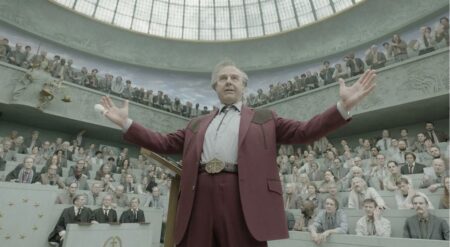


Per Aspera Ad Astra (Xing He Ru Meng), the sci-fi action comedy from director Yan Han, is a delightfully absurd look at humanity’s growing dependence on technology. From the first scene all the way until the ending credits, Per Aspera Ad Astra uses larger-than-life visuals, abstract concepts, and masterful cinematography to add to the growing list of recent films like Toy Story 5, The Devil Wears Prada 2, and Good Luck, Have Fun, Don’t Die to tackle how the world around us is changing because of technology.
The clever construction of Per Aspera Ad Astra begins with the title itself. In the original Mandarin, the title is Xing He Ru Meng, which roughly translates to “the galaxy is like a dream.” The title for Western audiences, Per Aspera Ad Astra, is Latin and translates to “through hardships to the stars.” The premise is that in the not-too-distant future, space exploration has exploded, and long-range ships are being sent out to colonize distant worlds.
Scientists have figured out how to stop the aging process during hibernation, but the bigger problem now is that long-term hibernation causes neuron degeneration until a company called Sweet Dreams comes up with an expensive dream world simulator called LM Systems. By selecting the dream you want, you go into hibernation and enter whatever dream world you’ve selected, and it keeps your neurons engaged despite the forced hibernation.
Despite its exposition dumps, Per Aspera Ad Astra achieves its mission.

Both titles are surprisingly accurate for the themes explored in the film. In its original Mandarin, Xing He Ru Meng is a bit more on the nose, as the ship, which is called The Meng, is literally translated as The Dream. For a movie all about traveling through the stars using dreams to protect the passengers’ health, a title like Xing He Ru Meng ends up clobbering the audience on the head with how direct it is.
The title, Per Aspera Ad Astra, on the other hand, has an aspirational or heroic quality to it. The two main characters are a canyon apart from each other on those ideas. Xu Tianbiao (Dylan Wang) works for Sweet Dreams and is aboard the ship as the LM Administrator. He appears not to take his job too seriously and routinely disrespects other people in positions of authority and even argues with the ship’s AI interface, regularly calling it a “moron.”
During a routine check that requires Tianbiao to be awake, LM Systems on board begin to malfunction, and in order to wake the ship’s captain, Li Simeng (Victoria Song), he is forced to violate privacy laws and enter Simeng’s dream to retrieve her. Simeng sits on the other side of that canyon, a consummate professional who demands to be called “captain” instead of “lady.”
Dylan Wang and Victoria Song give commendable performances.

While Per Aspera Ad Astra suffers from some very clunky exposition dumps, especially at the beginning, overall, it achieves exactly what it sets out to do. Despite the trailer ending with the phrase “0 Preaching, 0 Melodrama, 0 Worry,” there is plenty of all three to go around. The stakes are high, the melodrama is even higher, and there is a real message waiting to be uncovered at the end of the movie.
The characters learn and grow, and by the end of the film, they’re more than just random heroes traveling the heavens despite hardship. They’re people the audience can care about. They leave an indelible mark on the viewer that can’t be overstated. In that way, the title Per Aspera Ad Astra may start out as an ironic joke aimed at itself, but by the end, the film truly earns its title.
Dylan Wang and Victoria Song are incredibly skilled at bringing Tianbiao and Simeng to life, but the real acting genius belongs to Per Aspera Ad Astra’s villain, Ge Yang (Duo Wang). Duo Wang is required to give a more versatile performance than any of his co-stars, sometimes playing it straight, being soft-spoken and respectful to authority. He’s clean-shaven, wearing his uniform, and seems not to cause anyone any problems.
Duo Wang steals the show in Per Aspera Ad Astra as the villainous Ge Yang.
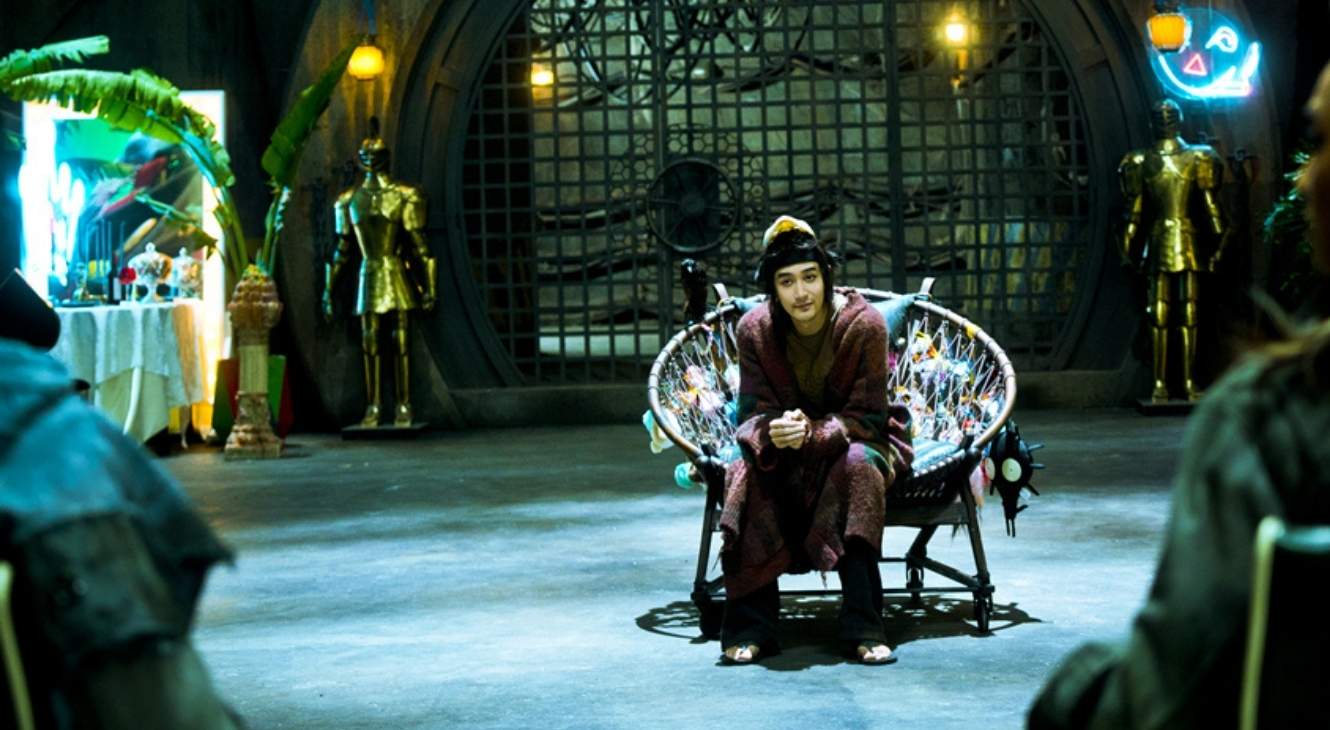
When it becomes clear that it’s all an act, Duo Wang transitions with no hesitation into playing a deranged lunatic. He starts off looking like a cartoon villain that over-explains his master plan, but by the end of Per Aspera Ad Astra, Duo Wang stands fully decked out as a clown, clearly riffing on Heath Ledger’s Joker. While no one can actually hold a candle to Ledger in a clown suit, Duo Wang certainly knows how to play unhinged very well. Still, Ge Yang isn’t just crazy. He’s also wildly intelligent and extremely clever. Duo Wang delivers a performance of a lifetime, showing every facet of Ge Yang’s character without forcing audiences to infer it.
Every time the protagonists interact with LM Systems, it starts with a calm, soothing voice saying, “Wonderlands and galaxies at your will. Welcome to LM Systems.” It’s exactly what you’d expect out of a futuristic wellness/tech company. It comes off to the characters and, by proxy, the audience as reassuring. By the end of Per Aspera Ad Astra, it starts to feel very different. It’s always associated with something very chaotic, just on the other side. It comes off as a very intentional direction to make LM Systems feel unsafe to the audience. It’s not unlike how HAL 9000’s calm voice becomes unsettling in 2001: A Space Odyssey.
The cinematography is absolutely bananas in the best possible way, despite a less-than-memorable score to transport audiences through the chaos. With nods to popular action movies as dream worlds crumble, Per Aspera Ad Astra peppers in obvious references to Inception, Everything Everywhere All At Once, The Matrix, and more.
Even with its homages to various films, Per Aspera Ad Astra crafts its own identity.

The film doesn’t appear to take itself too seriously until the very end, when the somewhat predictable ending confirms what’s really going on the whole time. With visual effects that would make for a great IMAX experience, humor that keeps the laughs coming, and characters that eventually get a huge emotional payoff, Per Aspera Ad Astra takes the audience on an insane journey that ends with an end-credit scene to let audiences know that this story is far from over.
Per Aspera Ad Astra uses satire and self-deprecating humor to mask its true identity as a futuristic tale with a real message about the way that we interact with the technology around us, designed to make our lives better. Even the use of pop-culture references and high-intensity wackiness ultimately serves the narrative’s indictment of society. Still, as a whole, Per Aspera Ad Astra finds that the human spirit is incomparable, and even the underachievers can find their way to the stars.
Per Aspera Ad Astra is streaming now, exclusively on Netflix.
Per Aspera Ad Astra
-
Rating - 8/108/10
TL;DR
Per Aspera Ad Astra uses satire and self-deprecating humor to mask its true identity as a futuristic tale with a real message about the way that we interact with the technology around us, designed to make our lives better.