

Fallout 76 is in Season 25, and the developers are putting a focus on bringing the map to life. The “Gone Fission” update in Season 21 started bringing more depth to the Appalachian wasteland by letting players “fish anywhere you can swim.” With Season 24, “Backwoods,” public events added even more life to Appalachia, and now, Season 25’s “Infestations” is pushing players into other areas of the map, and bringing it to life.
During Summer Game Fest in Los Angeles, we spoke with Creative Director Jon Rush and Production Director Bill LaCoste about the recently launched “Infestations” and even learned a little bit more about the pets coming to help you as you explore Appalachia.
“It’s been a learning experience.” Jon Rush said, looking back on Fallout 76’s tenure. “It’s been a fun learning experience. This is the first multiplayer Fallout game, and kind of a first of its kind for Bethesda, so it’s been a time where we’ve gotten to become much more familiar with our wonderful community and offer them a unique playscape where they can play together in Fallout 76. It’s been great, and we continue to learn and continue to grow from them and with them.”
Bill LaCoste added, “It’s been an amazing run and journey with our players, because we are locked in with the community, in terms of being actual players of the game, we play our own stuff all the time. We have 1000-plus hours of ourselves playing in a live product, [which means] we’re invested in the characters we build, and we have multiple characters and multiple styles. Whenever players talk about something, we usually know where that pain point is.”
Infestations are all about community and building a richer map.

And that community drive is what keeps it all going and helps the developers push to expand exploration in the game, and it’s not always with massive updates. “In a way, our fishing update was a big inspiration for ‘Infestation.’ We have our updates that are like big content updates, like a map expansion… but we also have those kinds of updates that sort of cast a blanket of more interactivity over the existing playscape. Fishing in a big way did just that, right?”
Adding, “And what that does to me as a player is [that it] refreshes the whole map for me, I get to explore the whole map again and see what kinds of stuff I can pull out of the water, right? So it adds that layer of enrichment to an existing playscape, which is what Infestations do, too. In a lot of ways, it’s fishing, but without water, and with fish that bite you back.”
Ultimately, it all comes back to encouraging players to engage more with Appalachia. “It could be a place you’ve never been to. It could be a place you haven’t been to in a long time, but the point is, it gets people moving around our map, and the more people move around our map, the more they’re having fun,” LaCoste said.
Investment in Appalchia also makes sense from a player perspetive as Jon Rush exaplined, “A lesson that we’ve taken over the years is that by watching players, seeing how they play, seeing how they respond to different types of updates, our players genuinely love to play and stay on the Appalachian map, because it’s a space they can influence, it’s a space that changes in unpredictable ways, it’s a place they can create new stories with their friends.”
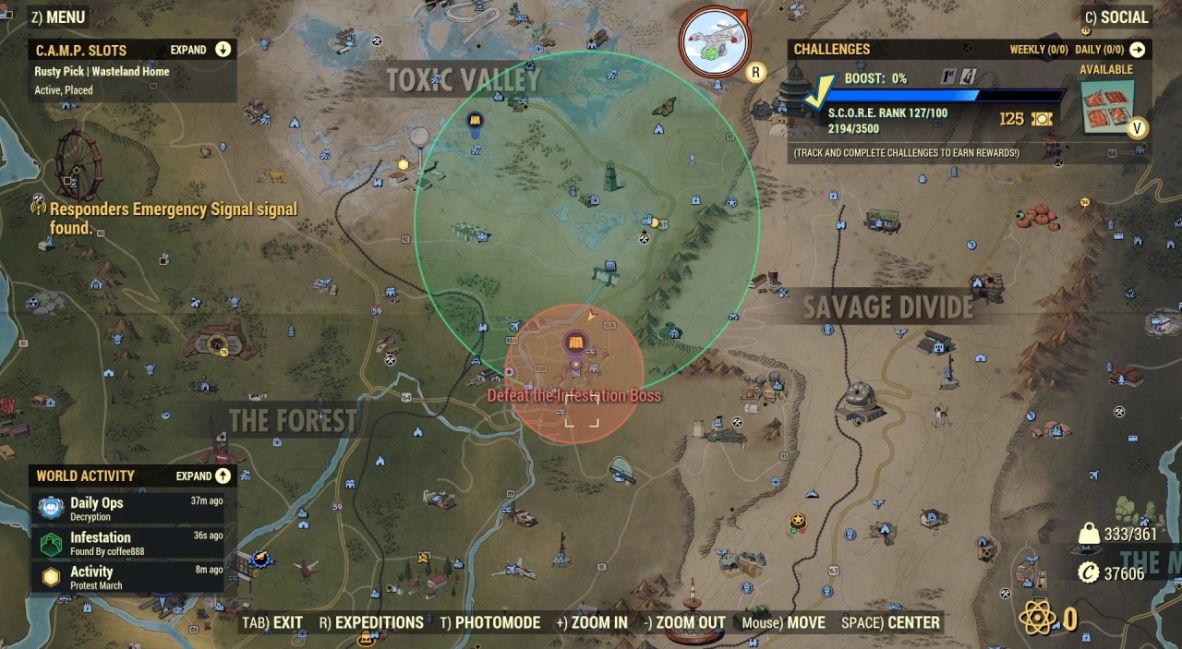
One of the most important elements of Infestations is that the events can’t be easily traveled between using quick fast-travel points. Making sure that players are encouraged to explore the map and return to locations they haven’t been to in a long time, as well as places they’ve never traveled to. But in order to keep the game stable, how the team implemented Infestations was key.
Rush explained their process, “One of the challenges was not to mess with people’s games, so infestations only occur in areas that already have no build zone, so lots of lots of points of interest that players can not build, so those will not conflict with players’ camps. Another concern was not to add to our server count of high-level AI. If we exceed our server’s capability of processing too much high-level AI, we start seeing things falling out of the sky and just dying, which causes instability. So, we didn’t want to do either.”
“And so, the way infestations work is it happens in places where players already can’t build, it happens in places that already have spawns for creatures, and what happens when an infestation occurs is those spawns get overwritten by whatever faction infestation is there one to one, so there’s no degradation to server performance,” he continued.
Building up Infestations also involved looking to Fallout’s iconic factions, too. Rush continued to dive into Season 25. “Fallout has such unique factions on its own, and Fallout 76 also on its own has unique factions that it’s introduced to the world,” he said. “We’d also like to find ways down the road to further play up factions, you know? We’ve got First Responders, Blue Ridge Caravan Company, Free State’s Raiders, and Settlers.”
Looking to the future, Rush asked, “How can we make those decisions more meaningful down the road?” And then answered himself, “So, leaning into that with the more nefarious citizens of Appalachia seemed like a great first step to feel out how we would want that presented to players down the road. Plus, it’s more fun.”
Infestations, fishing, it’s all about building investment into Appalachia.

In most MMORPGs, spawns like those we see in Infestations rely on players interacting with them by systematically finding them and grinding them out. In games like Final Fantasy XIV, Hunt Trains and Fate Farming take this place. Find the spawn point, go to the closest fast travel, rinse and repeat. But for Fallout 76, that wasn’t what the developers wanted for the new Season 25 elements, and in reacting to fast travelers, they’re also building for what’s next.
Jon Rush “The initial vision for Infestations was that an infestation can happen somewhere on the map and [players] need to go find it, and so, it wasn’t marked in any way. What we found [in the public test server (PTS)] was that the players just kind of turned the game into a fast travel game. It was fast travel, fast travel, fast travel, fast travel. We don’t want people to play like that, and [players] don’t want to play like that.”
“So our next big implementation on the PTS was to have a large circle, even bigger than a nuke zone, that says ‘There’s an infestation.’ When you’re somewhere, you now go find and explore, so that worked out a lot better for players,” he said. “And so, where we go from there now is finding ways to slow that experience down and possibly direct them towards the source of the Infestation in a way that doesn’t feel very heavy-handed.”

While Public Events, which were introduced in the Backwoods Update, are open areas, Infestations aren’t always. With the diversity of the Infestations, we asked Jon Rush and Bill LaCoste what their favorite Infestations are.
LaCoste answered first, “Infestations offer a little bit more of a strategic element to each of these locations, in a way. One of my favorites is in White Spring Golf Club, and the boss loves to hang out down below in the bottom of the clubhouse at the end of the hall, and sometimes it can be a Mole Miner with four ot five other minions, all with rocket launchers.”
Adding, “So if you try to come down, all of a sudden five rockets hit somebody on the on the stairs and they die, they tumble down to the bottom, or if it’s a robot, it’s got lasers going down the hallway and knocking people out… it allows for just different strategies and different like engagements, and also different experiences too, and instead of just being all in the open air.”
Rush responded next, “I think one of my favorite spaces for these is probably House of A Wired Path, because it’s wide open and you get a lot of minions for whoever the boss is spawning, and there’s really nowhere to go. I think one of the funniest stories that I saw was when we were flight testing at the Top of the World. There’s this boss, and a Mole Miner boss decided to go inside the bus, so people would have to come in on the back and just sit back. It took us forever to get in there and find the ticket. It was great.”
The interesting element that Rush continued to expand on was that Infestations occur where spawns already happen, and this also allows players to see really interesting and surprising interactions. Adding ot the explanation of the Top of the World Infestation, he was describing, “What happened on the Top of the World one time was two Infestations formed an overlapping one. Then a Scorchbeast decided to fly over. You get these layers of interactivity that you can only get on the Appalachian map.”
Fallout 76 is embracing everything unique to its franchise.

To close out our interview, Jon Rush and Bill LaCoste wanted to add one more thing that the Fallout 76 team had been teasing: the evolution of pets. The C.A.M.P pets have long been a point of contention in Fallout 76. They functionally do nothing but sit at C.A.M.P as decorations. But with a franchise whose most lovable character has also found a life in Prime Video’s live-action series, Dogmeat, it is vital to explore the Wasteland; just looking at your pets hasn’t been enough.
“Oh, there’s one more big thing coming to PTS really soon, and coming out later this year!” Rush said, excitedly, before we concluded the interview. “Between you and me, picture a wasteland where your camp pet becomes your campaign and follows you around Appalachia, adventures with you, gives you companionship, quests with you, and fights for you. You can tell it to sit, to speak, to come to guard and to kill, and you can level up your pet, and there are pet perks, and that’s dogs, cats, rad hogs, and deathclaws. That sounds exciting, right?”
And it is. Pets have long been requested by the Fallout 76 community, and, as with all the other things we’ve discussed, it’s clear that the team behind Fallout 76 is listening to the community, learning with it, and pushing players towards a richer, more alive Appalachian Wasteland.