

This interview contains spoilers for Supermassive Games’ Directive 8020 and has been edited for length. To listen to the full interview, hit play on the audio player below.
Supermassive Games’ Directive 8020 took me by surprise. With a cast anchored by the incomparable Lashana Lynch, the game embraced space horror, wearing its inspirations on its sleeves and telling one of my favorite sci-fi stories in recent memory. While it’s a great time to love space with Ryan Gosling’s Project Hail Mary, Housemarque’s Saros, and Don’t Nod’s Aphelion, Directive 8020 establishes itself as a part of space horror’s long legacy and differentiates itself from the crowd of releases we’ve seen in 2026.
The game sets itself apart through a concerted exploration of space horror tropes and characters that beg you to learn more about them, even if they die in Episode 1. And much of that comes from Supermassive Games’ dedication to the horror genre and a deep understanding of the space-horror subgenre.
We sat down with Directive 8020’s Creative Director, Will Doyle, to discuss the game’s inspirations, Supermassive Games’ approach to storytelling in the Dark Pictures Anthology series, and how their latest title shifted their narrative formula. If you’re unfamiliar with the title, the game is part of the studio’s Dark Pictures Anthology, which began with 2015’s Until Dawn. With a cinematic approach to storytelling, the series’ choice-driven environment, featuring branching narrative beats, shapes the core of Directive 8020’s gameplay.
Supermassive Games isn’t afraid of shouting out its inspirations, and Directive 8020 follows suit.
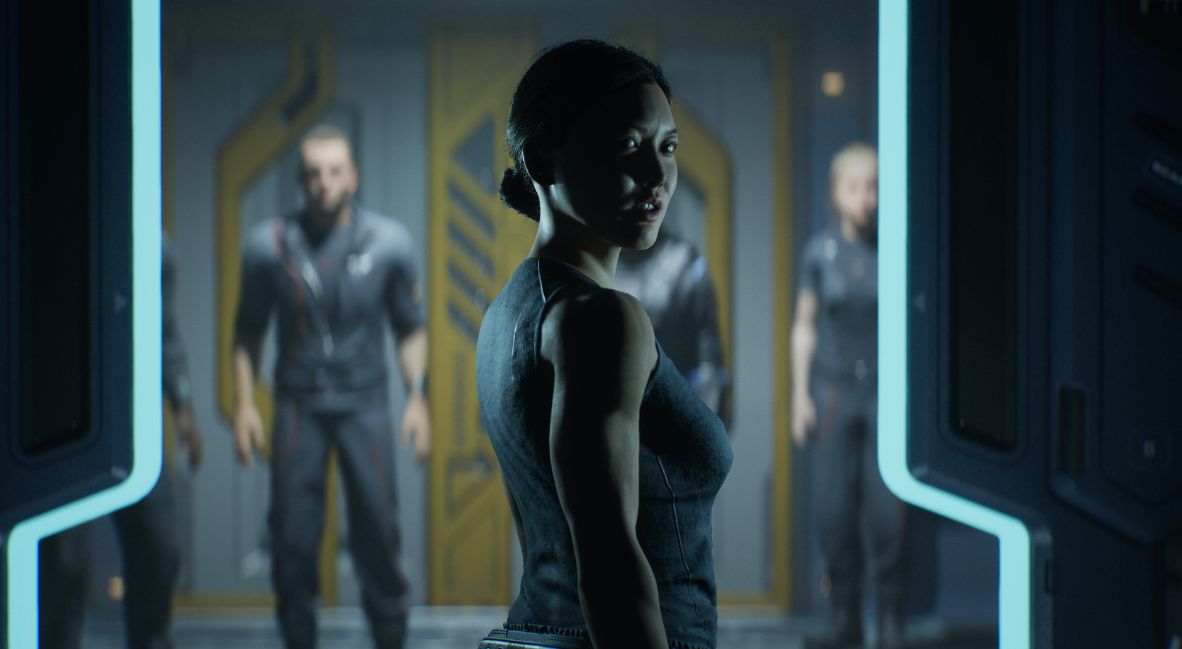
Directive 8020 gives space horror fans the first real taste of the genre since Dead Space’s homage to Event Horizon. The game wields space horror to great effect, letting the story and characters carry it.
As skilled genre storytellers, the studio has honed in on how the strengths of horror speak to audiences’ fears. While space horror can often explore the banality of space travel with corporate overlords (think Alien) or a life-saving mission (think Sunshine), bridging the two is where Directive 8020 succeeds. And that choice to lean into both elements.
In Directive 8020, you play as the crew of the Cassiopeia, a ship on the way to Tau Ceti F, in order to find humanity’s home. In the process, the ship is struck by something, breaching the hull and turning the mission into a test of survival as the alien threat both tries to kill the crew and take their faces too. Only this isn’t a mission funded by global cooperation without strings attached; it’s one run by Corinth, a corporation that has appeared in the Dark Pictures universe before and does its best to rival the Weyland-Yutani Corporation.
“Our games are based around choices, and so we always look at stakes,” Doyle said, discussing the game’s approach to the genre. “Everything has to come back to, ‘Why am I making this decision?’ and ‘If I make this decision, what will I lose?’ For Director 8020, we wanted to create huge stakes by saying that the fate of humanity is at stake. We wanted this desperate mission, where the earth is dying, and humanity is looking to the stars, trying to find a home for themselves in space. It was inspired a little bit by the movie Sunshine, where the sun was going to go out, and we’ve got to restart it.”
But in looking at the life-saving stakes, Will Doyle and his team looked to hone in on the personal as well. “We wanted to tell a story [all about] humanity, so we had a very multinational cast. Once we set that all up, we then thought, well, what is one of the really big themes of sci-fi? All sci-fi is, to some degree, extrapolation, but the corporate angle is very classic. It’s an angle that’s right at the heart of [the Alien franchise].”
Corinth emerges as the ship’s biggest horror the longer you play.

And Doyle is correct. As much as science fiction tells us about ourselves through a lone man playing god, aliens taking over Earth, or time traveling, it also confronts capitalism head-on. Sci-fi corporations that wonder and awe at the universe and commodify it, own it, and strip it bare. With the CEO of Corinth aboard the ship, Directive 8020 tackles that directly.
“Corinth is, in our game world, a company that goes back decades. We had this idea to create this billionaire, Williams, and ask ‘What if he’s on the ship?’ It was elevating and extrapolating on some of the concerns we have now in the present day, of huge, powerful corporations, and what do they have really in mind for us all?” he continued.
But Corinth, in Directive 8020, isn’t a faceless entity on the ship; it has Williams. However, based on how you play the game, Williams’ personality also shines through, with elements of admiration for his hero Commander Stafford. Allowing the game to humanize every piece of the narrative, even when they’re the mouthpiece for a corporation pulling the strings.
What’s exciting about the latest Dark Pictures title is that Supermassive Games wears its inspiration on its sleeve. The overlap with titles like Sunshine, Alien, and The Thing makes it immediately recognizable to large audiences, treading familiar ground with its own approach and execution. But for space horror fans really into the genre, there are other bits of inspiration beyond just the iconic films and franchises we know. To see those influences, players can look at hypersleep and, well, the alien creatures that are terrorizing you.
“There’s a relatively lesser-known film called Pandorum, quite a bit of the story is kind of inspired by some of that. [Pandorum is] about a bunch of people waking up after a long hypersleep, and it’s got this idea of hypersleep sickness [that becomes] a sort of madness that goes into people,” Doyle explained.
From Sunshine to Pandorum and At the Mountains of Madness, Directive 8020 stands on a solid genre foundation.

And while The Thing is the immediate creature and property that players think of when they look at the monsters, there is something more cosmic at play. Something more…Lovecraftian. As Doyle explained, the other inspirations that the Supermassive Games team turned to, H.P. Lovecraft, of course, got a nod.
“Other inspirations come from the writings of H.P. Lovecraft, specifically the story At The Mountains of Madness. [That story] has this idea of this alien species that was used by another alien species as a tool; they were created as this kind of worker race. That ties in quite a lot to our creature. The actual design of the creature itself was really, really interesting, which is inspired by The Thing, but also by H.P. Lovecraft’s story, and then of course we kind of gave it our own twist as well.”
It’s that personal twist that helps Directive 8020 carve out its own place in both space horror storytelling and in space horror games as a genre. Still, the game’s success has also led the team at Supermassive to learn more about their audience. During our conversation, we asked the Creative Director what he learned through the game’s production.
For Doyle, the lesson was more about a feeling than for him as a developer. For him, the journey working on Directive 8020 taught him about fear. “We spend a lot of time talking about fear in our games, and what it is that is going to scare people. A lot of our games start off on a very high level, [looking at fears]… People don’t like gore, they don’t like being chased by monsters, and all these kinds of surface-level things.”
Continuing, “Directive 8020, particularly, I think, established a different sort of fear. I’ve always had a fear of space. And you know, I’m quite safe, I’m not going to go up there. I kind of hate the idea of the danger that [being in space] puts you in. But this game, as we developed it, there are a whole load of different, slightly more subtle fears that we got into. With the twist in this story, there’s a really interesting thing here about exploitation from the corporate angle. That I thought was very, very relevant, and I guess what that’s told me is our stories always work well when they go deeper.”
A Dark Pictures Anthology game needs to go deeper than the surface, and the corporation Corinth helps do that.
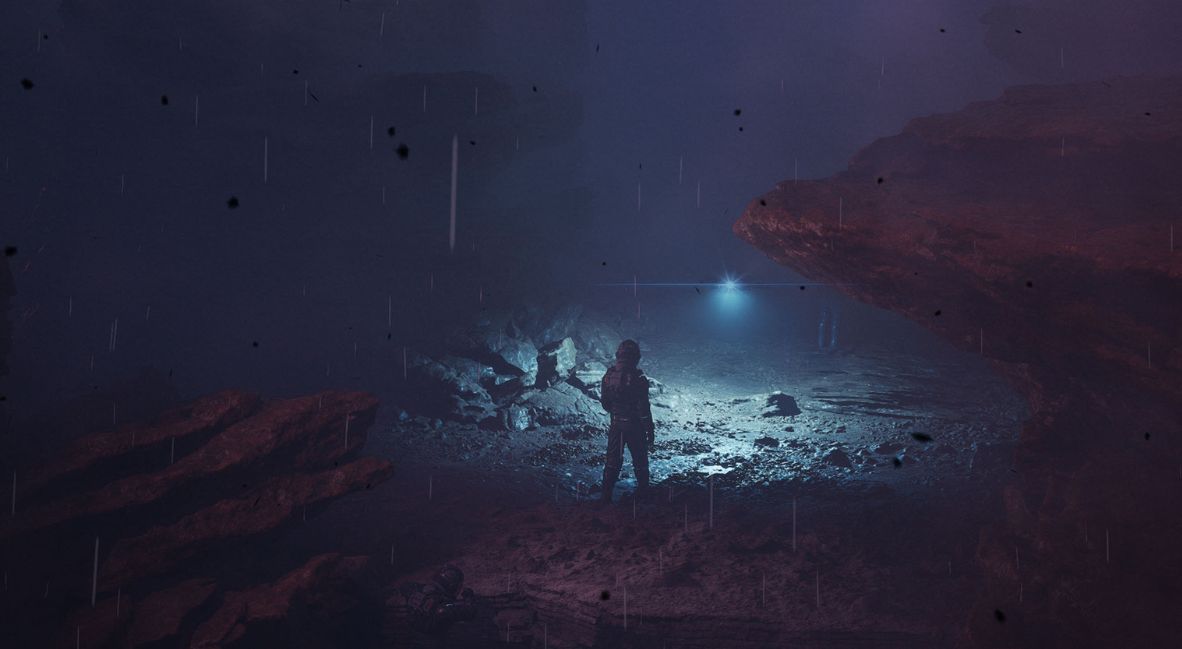
“We always aspire to go, ‘Okay, we’re going to try and tell a story on multiple levels,’ but Directive 8020 really has resonated with a whole load of people for a whole variety of different reasons. I think that has definitely taught me something,” he said, before we ended our conversation.
And Doyle is right. As a game, Directive 8020 has a space horror laurel to rest on: isolation. You can’t run away in space. You don’t know what is around you, or even if there is anything else there. Life is different. The cosmos is wondrous, but space is terrifying. You can die to an alien, be shot into a rocket, or even attempt hyperspace. That is what makes the setting so fruitful for horror.
Still, by homing in on corporations, Directive 8020 picks up the sci-fi horror baton and highlights that sometimes our enduring our worst fears isn’t accidental. Sometimes, a corporation has put us there as a part of their plan, and more often than not, they’ve already factored our death into their math. It’s a salient point that rings true: even in a game where you control every choice, there is still someone at the top.
With their latest addition to their choice-driven anthology, Supermassive Games was shooting to make people scared on multiple levels. And in the process, found the power of corporations to make billionaires one of the scariest horrors on the ship.
Directive 8020 is available now on PC, Xbox Series X|S, and PlayStation 5.