


In the 1960s, a Japanese women’s volleyball team composed of factory workers swept through the sport. Their name was Nichibo Kaizuka, but they were called “Oriental Witches” by the European media after an impressive undefeated streak of 24 games that was later on extended to 258, which included victories at the World Championships and the Olympic games. They conquered volleyball, helped a country during a recovery period, and inspired numerous manga and anime series, including the hugely popular Attack No. 1 by Chikako Urano. Julien Faraut’s new documentary The Witches of the Orient (original name Les Sorcières de l’Orient) tells their story with love, creativity, and some of the best use of anime you will ever see.
Your affinity, or lack of, toward volleyball, or any other sport, is unimportant. Julien Faraut will draw you to this film through sheer originality, a fascinating outlook on a specific period of Japanese history, and a universal story of seemingly ordinary people achieving extraordinary feats.
To bring to life their story, Faraut assembled several surviving team members to learn about their experience. Some we see gathered around a dining table; others we follow through their coaching and workout routines. They all share their recollections about the training, the pressure of being on the team, their relationship to the press, and their elegant, handsome, and sometimes ruthless coach Hirofumi Daimatsu, who was famous for surviving months in the Burmese jungle during World War II.
These interviews are accompanied by tremendous graphics and vibrant archival footage of the fiery training techniques of the team and later on of their key games against the fearsome USSR. But the key ingredient of The Witches of the Orient is the implementation of said footage.
Faraut and editor Andreï Bogdanov don’t just show the volleyball games and training sessions. They organically combine them with scenes of the Attack No.1 anime, reactions of the crowd, a dynamic sound design, optical elements, and a terrific score by Jason Lytle and French musician K-Raw, whose techno and CAPCOM-esque vibes create a unique sense of awe and drama. The experimental touch is exquisite and elevates this documentary far beyond any sports-related story. The editing is fast-paced and engaging, just like a volleyball championship match. This is truly masterful work.
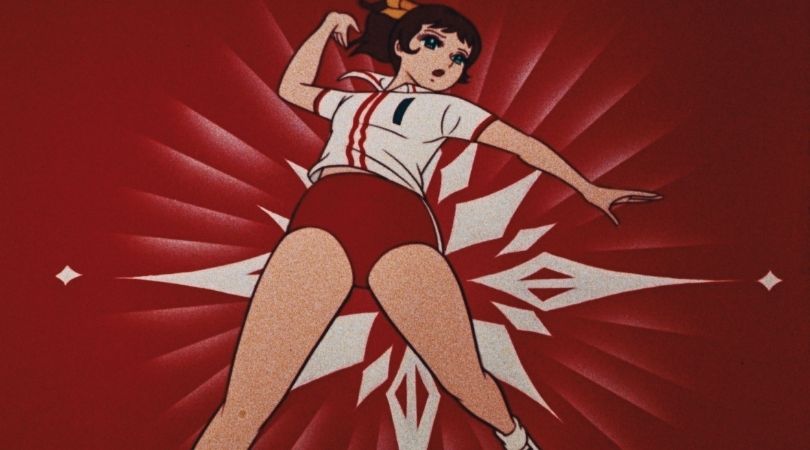
And then, Faraut goes one step further. When talking about the relentless training regime of the Witches, we are treated to a mind-blowing montage of a brutal drill session in which coach Daimatsu is relentlessly spiking the ball toward the players, over and over again. “Machine Gun” by Portishead is perfectly used as the orchestra to this anxiety combo that also incorporates anime to great effect. Sometimes, the industry disregards documentary editing and sound design as a minor form of art. The Witches of the Orient shows how wrong all of them are.
But the film isn’t just being flashy for the sake of it. This moment of brilliance is a representation of the Western media’s obsession in portraying Nichibo Kaizuka’s training regime as “frightening” and “abusive.” Through insightful testimonies of the players themselves, we can learn about it from a different perspective. The training was based on respect, trust, and teamwork. They got used to forcing their bodies to their limit, and together, they would come up with solutions to protect themselves from physical extenuation. Also, most girls didn’t have a father or even parents, and they saw in coach Daimatsu a father figure whom they could rely on. The West media tried to portray it all sensationally but never tried to actually understand it. Thanks to Faraut, you can forge your own opinions about Daimatsu’s methods.
Like any good sports story, Faraut keeps the underdog spirit alive throughout. We are reminded about the humble beginnings of a factory team and, despite their dominance, there’s tension in the game montages, as well as an exploration of the pressure the players had, both as a team and individually, on their shoulders. Everything culminates in the 1964 Olympic Games in Tokyo, which represented an opportunity to show Japan’s recovery to the world several years after the devastating ending of World War II. The stakes were high for these volleyball players. Once again, this is represented in the documentary through smart editing of devastation and actual footage of the Olympic games.
The Witches of the Orient is one of 2021’s best films. By giving historical and social context to a relatable sports story, Faraut created a victorious hit that serves as a tribute to a team with borderline magical athletic skills and their legacy on art, society, and pop culture.
The Witches of the Orient opens July 9 at Film Forum in NYC. You can check its theatrical and virtual run on KimStim’s webpage.
The Witches of the Orient
-
Rating - 9/109/10
TL;DR
The Witches of the Orient is one of 2021’s best films. By giving historical and social context to a relatable sports story, Faraut created a victorious hit that serves as a tribute to a team with borderline magical athletic skills and their legacy on art, society, and pop culture.