


Football, for all its ills, is best when it grounds us in community and friendship and serves as a vehicle to connect with the world around us. But the sport’s violence feels like it runs counter to that. That is, until you realize the violence on the field and the brutality of war are two very different things. No matter how much a coach says his players are warriors, The Mosquito Bowl drills into the reality of violence and the joy of football.
Directed by Peter Berg and written by Berg and Mark L. Smith, the Netflix Original film is a biographical drama about a group of former college football players turned Marines in WWII. Based on Buzz Bissinger’s book The Mosquito Bowl: A Game of Life and Death in World War II, the film is set in the Pacific theater and becomes a larger story of growing up and manhood that confronts the horrors of war as they are.
While the film does lean into some moments of traditional American jingoism around the Second World War, the larger story we see displayed through the young men is how much violence shatters life, and how sport can still be the common language to get you through it all.
Netflix’s The Mosquito Bowl uses football as a common language to process the trauma of war.
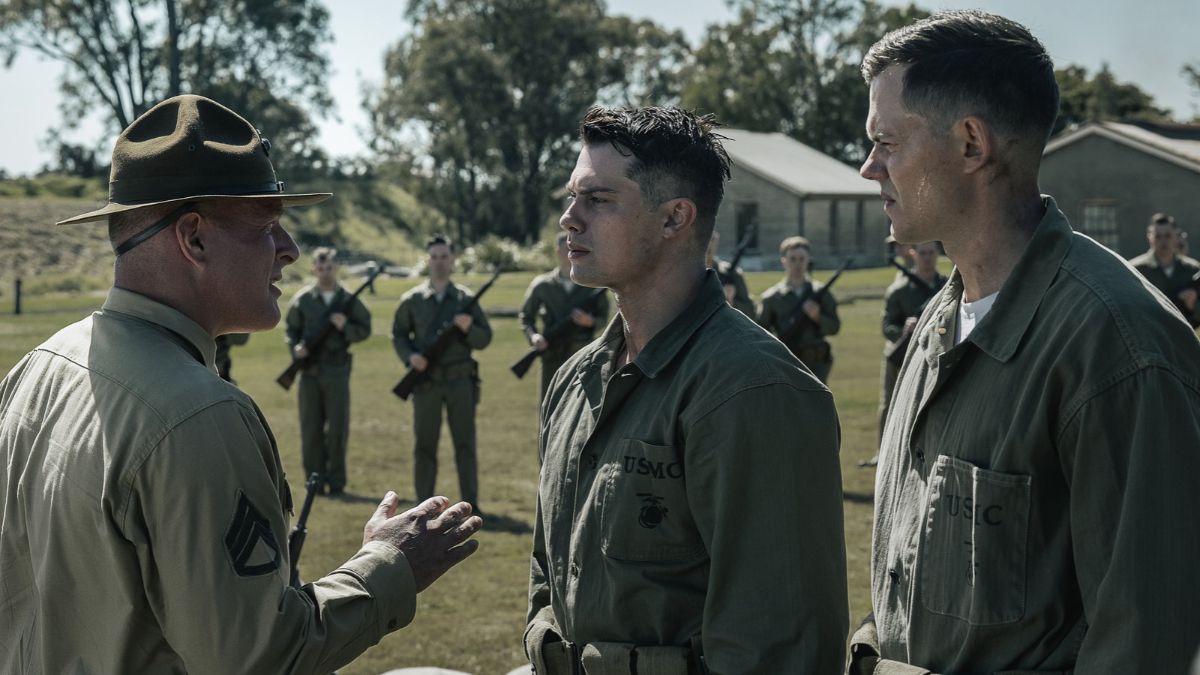
In The Mosquito Bowl, Nicholas Galitzine, Bill Skarsgård, Ray Nicholson, and Tom Francis star as four of America’s top college football players who set aside their promising athletic careers to enlist in the Marines and join World War II after the attack on Pearl Harbor.
The film follows John McLaughry (Nicholas Galitzine), Bob Bauman (Bill Skarsgård), Tony Butkovich (Ray Nicholson), and Dave Schreiner (Tom Francis) from the field to basic training, then into the Pacific theater’s most brutal battles, all leading up to the invasion of Okinawa. Named after the football game played before the invasion, the film tracks how each man changes during deployment and, more importantly, the bonds that keep them together. Each of the four main actors’ performances offers a raw look at the toll of war through two shared experiences: football and war.
Berg’s past directorial experience on Friday Night Lights shows through. Football was never just football to the director, and in The Mosquito Bowl, war is not just war. The running theme throughout the film is that the horrors of war far outweigh any violence in a college football game, and then one of the characters brings football into it. While this may sound like a bad mismatch of tone, it isn’t.
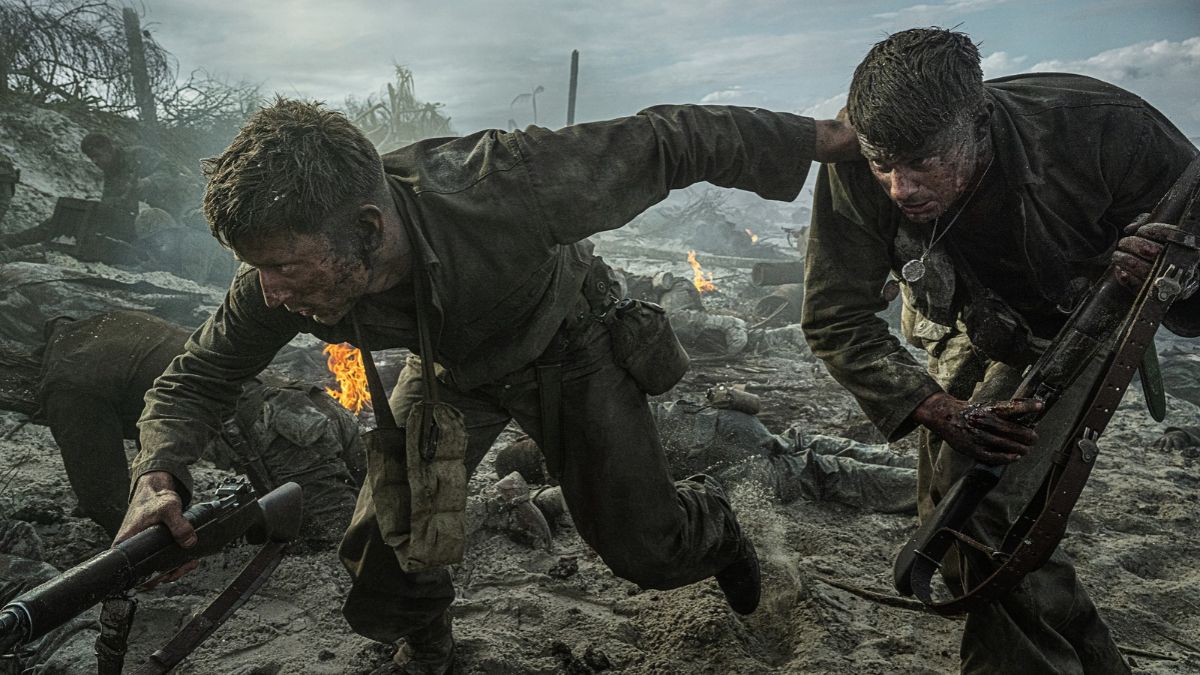
American football at both the collegiate and professional level has been an apparatus of the American military-industrial complex. They start games with flyovers, hold games dedicated to patriotism, and you’d be lying if you didn’t see at least one military recruitment ad every other commercial break during any given game. But despite the dedication to militarism on the field, it is not, and will never be, the devastation and brutality of serving.
“Stay awake. Stay violent,” is a line we hear right before graphic depictions of the Pacific theater’s violence. We know what it means in this context. The men are holding a line through the night, taking turns standing watch. But the line also makes sense in football chatter and motivation on the field. Small elements of the sports language in the film build a fully realized understanding of the importance it holds for all of them.
The film consistently draws parallels between the opening sequence of Purdue against Wisconsin and the feats of strength on the field with the war itself. Whether it’s describing the Marine Corps as the best offensive line in football history or showing the glimmer of joy football brings, tainted by a truly heinous act. This sticks out most sharply when a Marine asks for Tony Butkovich to sign his rifle, right before committing a war crime by killing a crying Japanese prisoner of war.
The Mosquito Bowl knows the relationship between the sport and the military now, and uses that to drive its narrative.
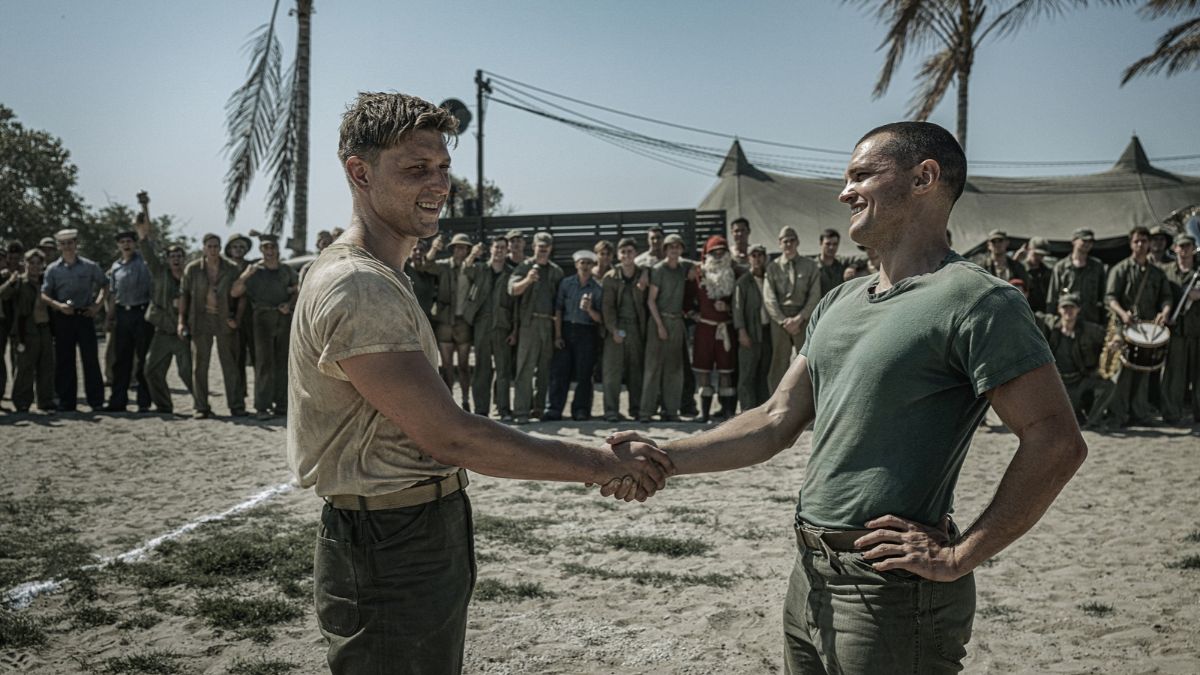
The Mosquito Bowl’s writing understands how football fans view the sport in relation to the military and how the game itself breeds a mentality of aggression and dominance. But when the film finally gets to the titular football game held right before the siege of Okinawa, we see football distilled into a children’s game that brings hope and brotherhood.
It’s two-touch, no-tackle football, played to keep the Marines happy and take advantage of the number of former football players who had enlisted. This is the film’s joy. It’s the last moment of respite and care before the film’s climactic ending battle, where the majority of the men we have followed die. In its simplest form, football is shown as a guiding force for hope. It’s the power of sport on display, even as the audience understands this moment is the last for many.
Leading up to the Mosquito Bowl, we see the characters experience the Bob Hope visit differently, but all understand that the wounds they carry may not be physical yet; they are still there. The shell-shocked perspective is depicted as Billie Holiday’s “I’ll Be Seeing You” plays in the background, sung to inspire hope for return and the love the soldiers have back home.
Instead, we see a PTSD episode that captures fear and guilt as we see dead soldiers from both American and Japanese sides on the screen. In a moment meant to boost morale, the men don’t feel it. Instead, the Bob Hope troupe feels like an almost ghastly presence in Guadalcanal.
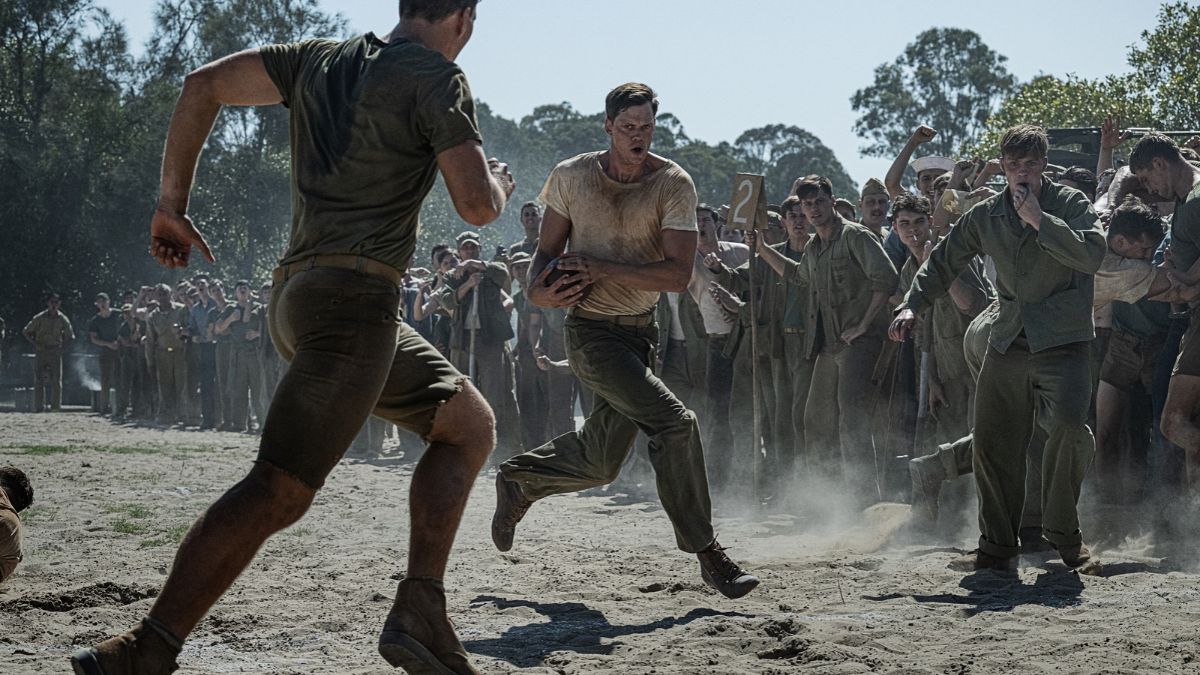
They’re supposed to distract the soldiers from the fear rising ahead of the storming of Okinawa, which the audience knows is the deadliest battle the US has faced. But there is no respite, only a memory of a time that the soldiers can’t return to and a panic as their time in the Pacific starts to crash in on them.
This is what gives the film’s titular moment so much weight. Playing football in its most childlike form calms the men’s minds and lets them disappear into their teams and the sport.
The Mosquito Bowl, even with some traditional American war-drama stumbles (particularly in how it depicts Japanese soldiers), is worth watching for fans of these kinds of stories. The film isn’t about anything much larger than the impact of sports and the idea that the sport and the military go hand in hand. But its execution is where it finds success.
Still, even with its obvious motives, the film becomes a visceral experience that rivals some of the best war-drama action sequences. And through its performances, The Mosquito Bowl taps into grief, trauma, and the way war rips everyone into thin shreds of their pre-war selves. The somber ending is one of remembrance, and one that aims to bring soul and heart to football.
The Mosquito Bowl is streaming now, exclusively on Netflix.
Rating
The film isn't about anything much larger than the impact of sports and the idea that the sport and the military go hand in hand. But its execution is where it finds success.