

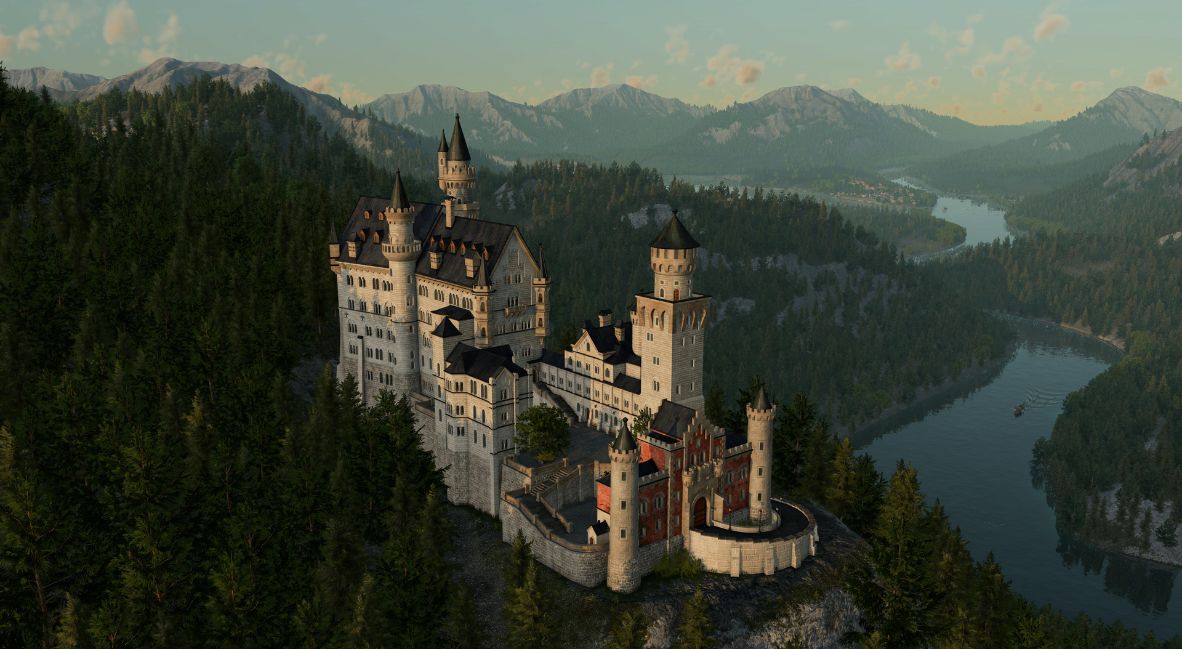
Urban Games and the Transport Fever series are set to return in September 2026. In the upcoming latest installment of the series, Transport Fever 3, players will get a chance to build and develop their company across the 20th century and beyond. Transport Fever 3 will be the newest release since Transport Fever 2, which was released in 2019. Transport Fever 3 was still developed by Urban Games; however they will be published by Paradox Interactive this time around.
Transport Fever 2 was by far the most successful game in the series; while it did not receive true downloadable content (DLC), it did receive plenty of post-launch content and support via major updates and community-driven additions. The game also had a console port that launched in 2023. We spoke with the Urban Games team earlier this year about Transport Fever 3 and how one of their main goals for this next installment was not to reinvent the wheel, but to expand on Transport Fever 2.
Transport Fever 3 has two main game modes: campaign mode and free game mode, aka sandbox mode. Campaign mode consists of eight increasingly difficult levels that involve a variety of challenges for players to take on. Free Game mode allows players to set up their own map using their own settings and build their company however they choose.
Urban Games’ Transport Fever 3 is a glow-up from the sequel.
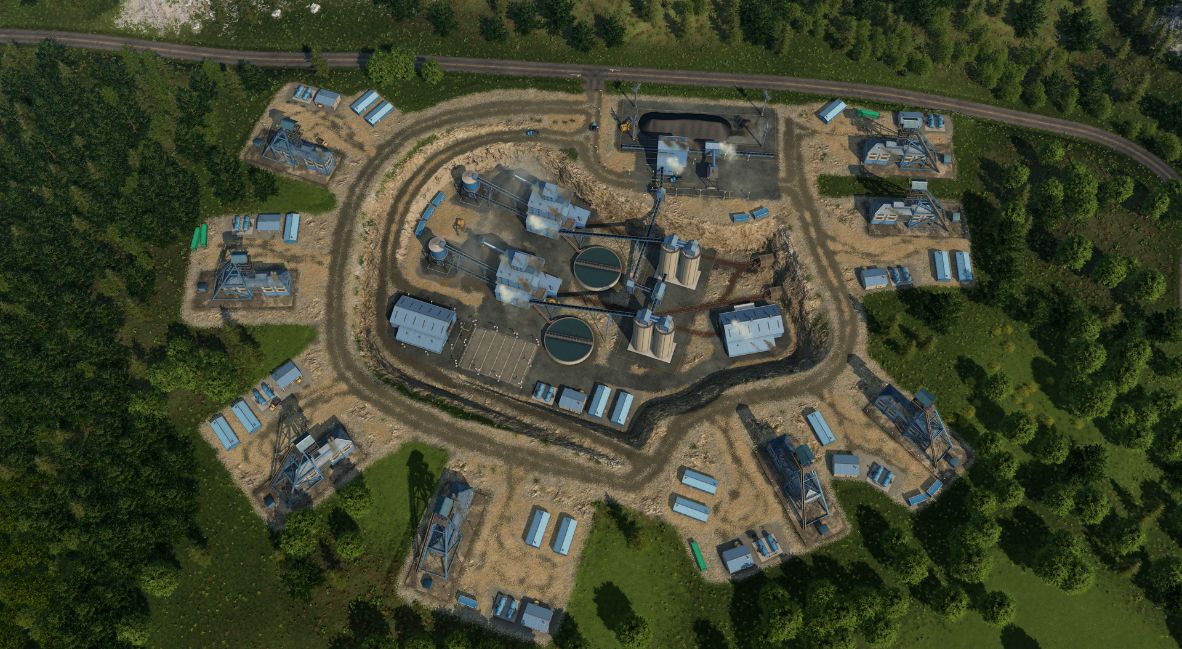
The Campaign has been vastly overhauled compared to Transport Fever 2. There are eight campaign missions that increase in difficulty. The first mission is a complete tutorial that helps players learn the fundamentals and basic mechanics of Transport Fever 3, unlike the later missions that increase in challenge.
These missions draw on historical events to give players a story to follow as they complete scenario-based challenges. Some of these scenario-based missions include Mardi Gras, Woodstock, and even Wadi Rum, Jordan, the location of Lawrence of Arabia.
The campaign missions have players achieve between one and three stars depending on how above and beyond they go at achieving their goals. I did run into a few issues, such as because campaign missions can be very linear in what you are doing; if you make a mistake, it can ruin the entire mission.
I had to modify a train in one of them, and I misclicked on the desired modification, which normally wouldn’t be a huge ordeal, except I was locked into the goal of needing to modify this train, and I wasn’t allowed another attempt to modify the train; thus, I had to reload an entire save, as I just wasn’t able to do anything, as everything was locked.
The campaign isn’t anything super spectacular, but they do have some interesting moments and can really help players learn and try new things. Obviously, the main game mode that the majority of players will spend their time in, and where I spent a good bit of my time in Transport Fever 3, will be Free Game mode.
Free Game allows players to build and manage their own transport networks based on their own personal settings, including actual Sandbox mode, which has unlimited resources and unrestricted building. Players can start by “designing” their map, which includes choosing one of the four climate zones, map size, how many industries or cities, and much more. Players can even select their starting decade between 1900 and 2030.
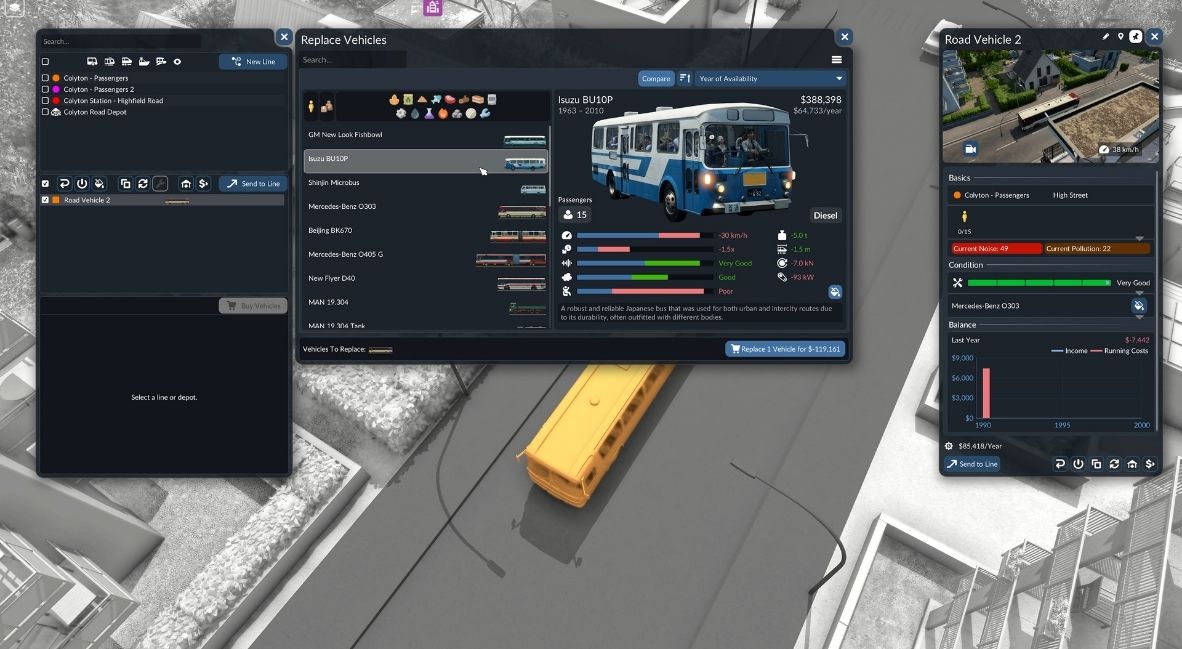
Once you set your preferences, it’s time to start moving that cargo. Those familiar with Transport Fever 2 will recognize all the bells and whistles and basic mechanics for Transport Fever 3. That doesn’t mean there haven’t been any improvements, as there certainly have. I mentioned this in my final preview, but the UI and the general way you do things like “creating a line” have been vastly improved. Managing your vehicles is also quite streamlined and much more intuitive.
Creating a line and assigning vehicles can be as simple as clicking a few locations. There is no longer a need to go through multiple menus to assign vehicles; this can all be done while creating or editing a transport line, or even when purchasing a vehicle.
One of the biggest upgrades is that players no longer need to make a cargo station at every single location. Players can now just have their vehicles assigned to the industries themselves, and they will be able to drop off and pick up cargo. Players will still need cargo stations at train stations, harbors, and similar locations, but not having to build so many is a relief.
Transport Fever 3’s quality of life improvements are just as noteworthy as its completely new additions.
Transport Fever 3 added more industries and cargo for players to play with compared to Transport Fever 2. It now has 35+ industries and over 40 cargo types, including specific cargo for the new Arctic climate zone.
Cargo itself has been expanded in multiple ways; cargo time matters, as items will deteriorate over time and even spoil. Passengers will become unhappy if their travel time is taking too long. This also matters for making money, since the more unhappy or damaged an item is, the less money you will receive upon delivery.
To help with all of these new requirements for cargo and passengers, stations and warehouses can be specialized for specific goods. These specializations help with loading speed as well as preservation of cargo. The drawbacks, of course, are that the non-specific items take a much longer time to be loaded and unloaded at these specialized warehouses and/or cargo stations. Vehicles can also have their own cargo specializations that do the same as the stations: improve loading speed and preserve items.

Each industry can now be boosted via workers or sometimes another different resource. This adds new layers to transport, as players will need to set up lines for both passengers and cargo for each industry. These worker or tool boosts increase production of the resources and help expand industries faster.
These boosts, of course, are optional, and you can just run everything regularly without any of these, but as your cities expand and require more items, they do become helpful, and it does give your population a more realistic feeling of, “Hey, they have to go to work just like me.”
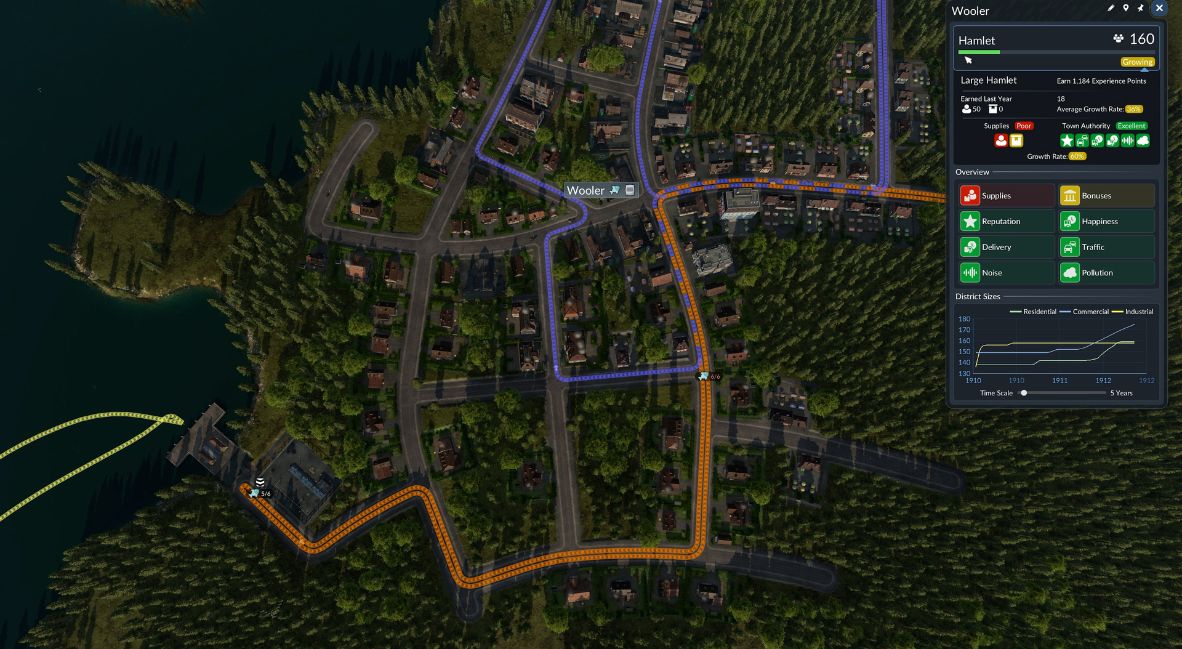
Urban Games really wanted to expand on city development and what matters for each city. Players will not be building every building as usual, but they will now have more factors they need to look at to maintain and manage their cities. Delivering cargo is vital as expected, but now cities have more depth than just how well you are delivering cargo. Some of these items include Pollution, Noise Pollution, Reputation, Happiness, and Bonuses.
Transport Fever 3 has a lot of systems to manage, which also makes it easy to lose hours.
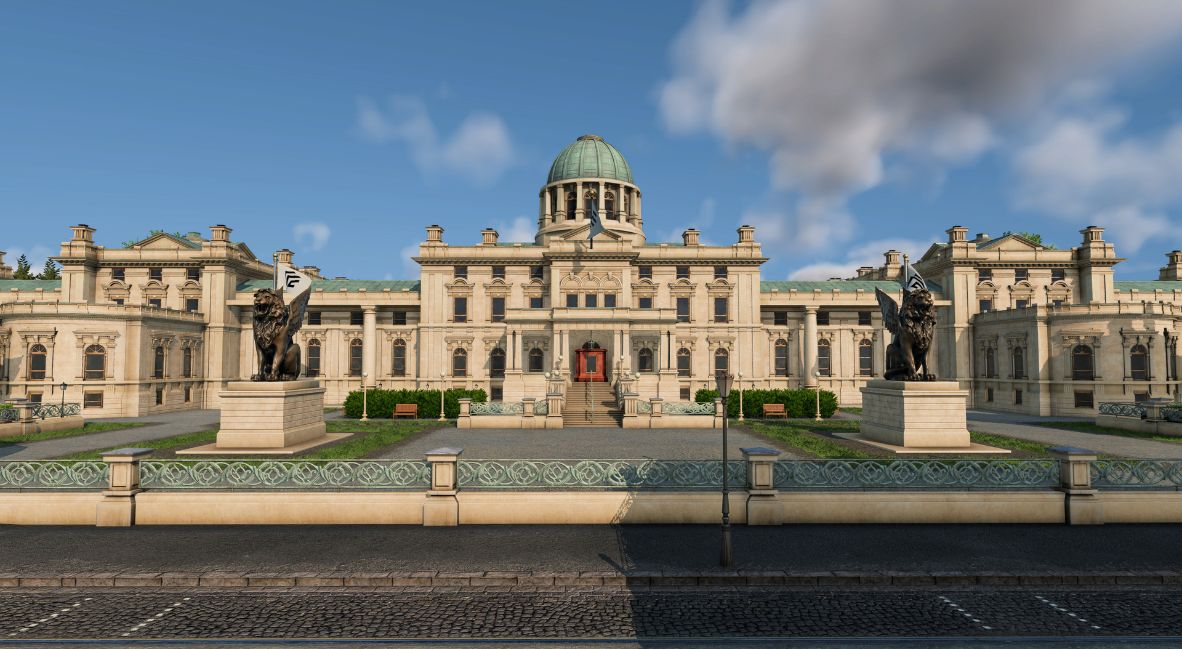
Another part of this city development is the headquarters, as this has been overhauled and landmarks have been added. Headquarters in Transport Fever 2 was just for aesthetics and didn’t really do anything at all. Well, that is totally different in Transport Fever 3, as leveling up your company allows you to expand your headquarters as well as unlock bonuses and landmarks.
Some of these bonuses include town growth, helping with reputation, whether by gaining or loss prevention, pollution, or happiness. These bonuses can be applied either by expanding your headquarters or players are given items that they can use on other industries or cities. An example of this is that players can earn items that will reduce the pollution of an industry.
Prospecting new industries is something else that has been added, where players can try to find specific industries within their city boundaries. So if you have an area that could really use some grain nearby, you can use these single-use items, and a grain industry has a chance of spawning within that city boundary. This is really useful, as anyone who has played Transport Fever before knows the struggle of when your industry is all the way across the map and the challenges that come with that.
Transport Fever 3 also adds two new features: landmarks and subsidies. Landmarks are historical buildings or recognizable locations that players can build that give massive bonuses. These landmarks do require quite a bit of resources to be able to build, such as the first one players unlock, which is the coliseum, which requires 400 stone to be delivered for this to be built.
These landmarks are single-use only, so players will need to think before just placing a landmark. While these are designed to give players bonuses, they also add challenges and a sense of enrichment and beauty. Transport Fever 3 really isn’t a typical city builder, so cities can sometimes use some flair, and these landmarks can do that.
Subsidies are another feature, and these are basically in-game quests for players to do for money and temporary boosts. After a while, they can get a little repetitive, and some of them are really easy to complete, such as delivering workers to an industry.
They do give quite a bit of money, especially if you can complete them, so they are worth doing; however, failing does come at a cost, and it can be quite costly. I was fined for failing one of these 6.6 million dollars, which, depending on where you are within your game, can be meaningless or really hurt.
Transport Fever 3 isn’t your typical city-builder, and that’s what makes it fun.

Urban Games set out to expand on Transport Fever 2, and they really did with Transport Fever 3, as I feel like there is still so much more that could go into whether it’s all the new vehicles such as helicopters, industries including offshore industries, or even just how beautiful the game looks. There are vast improvements, new features, and mechanics to go with more depth in building up your tycoon company.
There are still some pathing and building issues, like it took so long to figure out how to build dual railroad tracks over water. Cargo Stations, for some reason, when snapping, get built too close to roads that you can’t seem to add new entrances to, or you must build further away from the road due to collision issues. However, these little hiccups weren’t enough to take away from all the major improvements.
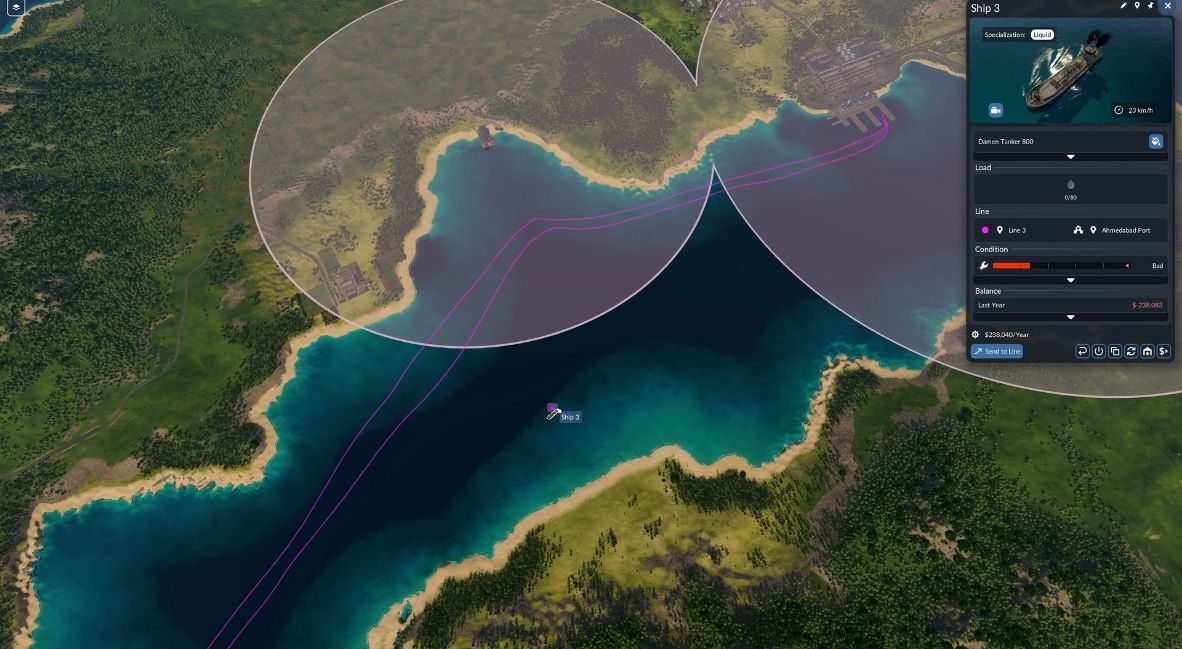
Overall, Transport Fever 3 is a massive game with plenty to offer and tons of fun, especially for genre fans. With a significantly improved UI and streamlined systems, new players can enter the franchise and veterans can focus on more important things than sifting through menus to assign a truck to a new fish cargo line. The simplicity of color coding and the use of radius circles really highlight these UI upgrades. And with so many industries and so much cargo to dive into, there is so much to do that it’s easy to lose track of time, which is exactly what a game like this should be.
Transport Fever 3 releases on PC, Xbox Series X/S, and PlayStation 5 on September 29, 2026.
Transport Fever 3
-
Rating - 8.5/108.5/10
TL;DR
Transport Fever 3 is a massive game with plenty to offer and tons of fun, especially for genre fans. With a significantly improved UI and streamlined systems, new players can enter the franchise and veterans can focus on more important things than sifting through menus…