

Mortal Kombat II (2026) is a film that knows exactly what it is. The film is far closer to its fighting game origins than its predecessor, resulting in a silly, violent, and profoundly stupid follow-up. However, Mortal Kombat II does not purport to be anything more than that. Similarly, it doesn’t ever show much in the way of shame of being a video game adaptation, but revels in it, even when it really shouldn’t.
Director Simon McQuoid is banking on viewers having seen the first film. Aside from a fight scene to establish the new character, Kitana (Adeline Rudolph), there’s no room for setup. Immediately, the titular fighting tournament is in full gear, and within the first 20 minutes or so, the first round is wrapping up. Mortal Kombat II isn’t interested in much beyond the fights themselves. This is most evident in how the film introduces the franchise’s third-most recognizable character, Johnny Cage (Karl Urban).
Urban’s Cage is a curious interpretation. In the classic games, Johnny Cage is an extremely stereotypical Hollywood celebrity jerk: attractive, self-centered, cocky. That personality radiates from all of his animations in the game, which is part of what’s made him so iconic for the franchise.
Mortal Kombat II struggles to define Johnny Cage.
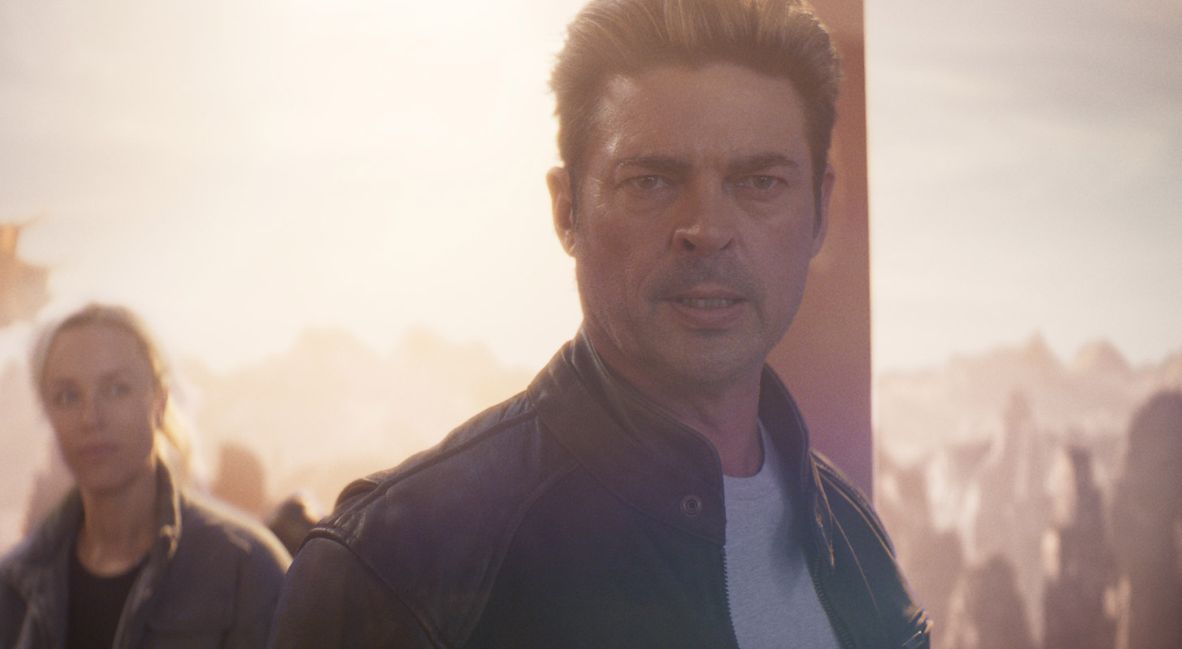
Mortal Kombat II tries to leverage this as well, but finds itself stuck up against the reality of Karl Urban’s most iconic roles, particularly The Boys. As a result, in some moments, he’s a jaded former star who doesn’t believe in his ability, in others, he’s full of himself. At no point does the film commit to threading a needle for this, because it’s simply not interested in telling a story.
The execution isn’t too surprising. Staying completely on brand has been successful for other Hollywood video game adaptations; one need only look back at The Super Mario Galaxy Movie for an example. Mortal Kombat II goes even further than that, however. None of the first film’s writers return for this sequel. Instead, screenwriter Jeremy Slater (Godzilla X Kong: The New Empire, Moon Knight) takes the reins. Slater’s experience working primarily on IP adaptations positions him as an expert at matching the right tone for a project.
This explains why Mortal Kombat II plays out its non-combat scenes primarily as transition pieces. No one’s coming to this film expecting a deep character piece. Slater knows full well that as long as there’s enough consistency to sell the tournament’s concept, the audience will buy it as justification for blood sport. Cage doesn’t need a character arc beyond some pontification from thunder god Raiden (Tadanobu Asano), because what matters more is Shao Khan (Martyn Ford) yelling the iconic “Finish Him!”
The film prioritizes spectacle over substance.

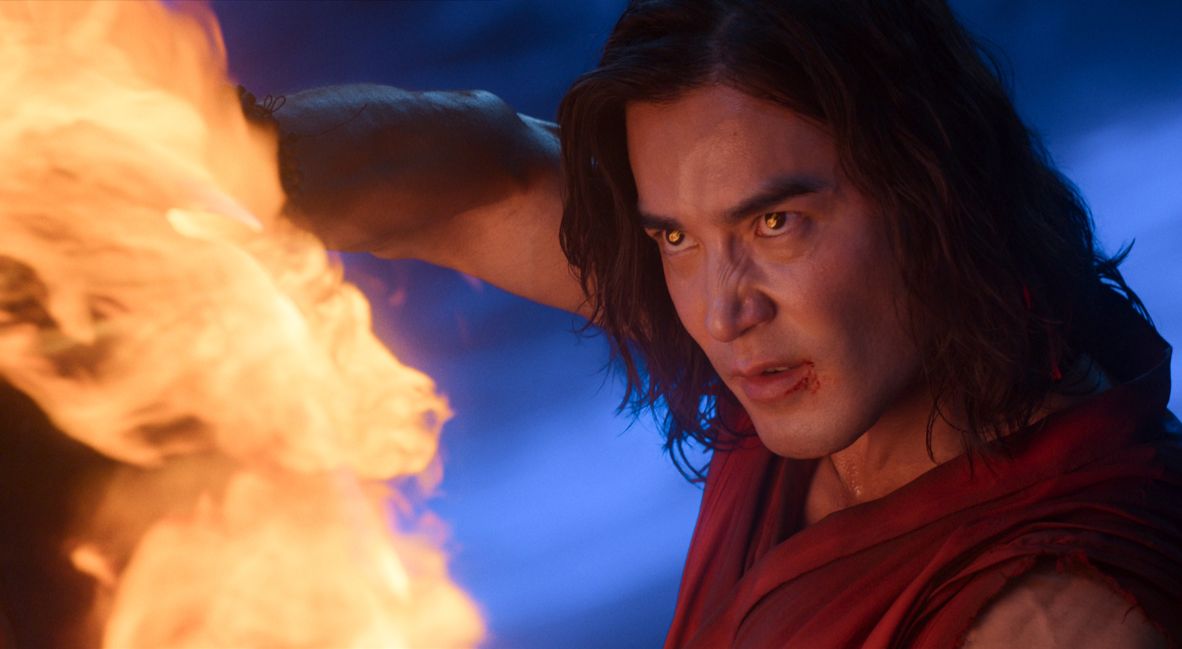
To the film’s credit, it’s not entirely wrong about the spectacle of the fights. The brutal and bloody fantasy violence that is the franchise’s trademark is here and in full force. Little time passes before the next spout of gushing blood or deadly wound over the course of the film. There is a certain uncanniness to this violence, often pushing it into the absurd rather than the grotesque.
These moments showcase the film’s best staging, with strong choreography and set design. Quality stunt work is demonstrated throughout, fights are engaging, and some are strong enough that clips of them will certainly do well on YouTube.
But strong fight scenes do not help the rest of the film’s poorly executed connective tissue. Things often just happen to get characters from A to B, despite each round of Kombat teleporting its fighters to the arena. Character relationships become throwaway one-liners, even those that featured in the first film, like special forces agents Jax (Mehcad Brooks) and Sonia (Jessica McNamee). There’s no sense of time or space, to the point where a section of the film completely forgets where any of the cast are and hustles them to where the fighting is, with no explanation.
Mortal Kombat II lacks any thoughtfulness despite the legacy of the game it is adapting.
The legacy of Mortal Kombat in the annals of video game history is undeniable. Its tone, while practically juvenile today, makes it one of the boundary-testing games of the ’90s that were necessary to evolve the medium. But even after decades of entries, the franchise has never reached a place where it has all of the components to translate to a medium like film.
This is a trap that studios will almost certainly keep falling into: video games are a highly interactive medium. There’s a certain amount of self-insert that a player brings into the experience; inputting the Fatality commands, mastering a specific character’s moves, banging one’s head to the music while digging out more quarters. Mortal Kombat II cannot replicate this in any meaningful way. It also knows that, so it doesn’t try.
In essence, Mortal Kombat II is a movie that wants its audience to care about all the death and violence on display without motive or control. There’s no expectation of deepening its characters or even presenting a truly accurate version of them. The film surrenders any attempt at coherence to its own critics. Only the cameo of game creator Ed Boon seems to have any thoughtfulness put into it. The result is a truly absurd, empty adaptation that fails to believe fans of the franchise could want more
Mortal Kombat II is in theaters now.
Mortal Kombat II
-
Rating - 3/103/10
TL;DR
In essence, Mortal Kombat II is a movie that wants its audience to care about all the death and violence on display without motive or control.