

Developed and published by Ubisoft Mainz, the Anno franchise has a long history of drawing on history to inspire its games. Known for bridging humor and history, the developers tapped into something even larger with their latest title, Anno 117: Pax Romana. You can see inspiration from a number of satirical stories about the Roman Empire and its history of conquest, leading, of course, to its war with the Gaels.
With Albion’s core mechanic in Anno 117 focused around assimilation and cultural preservation, its Gaelic inspiration, and the province’s Pirate Queen being named Voada (the first published name of the Celtic warrior Boudica), there is no shortage of historical references. But to make this time in history funny, one need not look any further than the long-running French comic and eventual franchise, Asterix and Obelix.
If you’re unfamiliar, Asterix (with later works named Asterix and Obelix) is a popular French comic book series created by writer René Goscinny and artist Albert Uderzo, following the adventures of a village of indomitable Gauls resisting Roman occupation in 50 BC. Just 60 years before the Pax Romana, the tone still fits the declaration the Emperor gives you as a player to colonize Albion.
Anno 117 is inspired by history, but its humor also draws on Asterix and Obelix.
It was finding this series, driven to search for Roman series and movies because of playing Anno 117, that made me reach out to Ubisoft Mainz and ask the simple question: Did you use Asterix and Obelix for inspiration? The answer is yes, and even more. We spoke with Senior Writer Matt Cook and Creative Director Manual “Manu” Rhenier about Anno 117’s inspirations, humor, and how storytelling even includes product descriptions.
Matt Cook answered, first explaining that the studio never wanted to take a historical angle without humor, because there are other games for that. “Our team is very interested in history. And of course, it’s not always visible to all players because we don’t want to take a very serious tone in the game. Anno historically, and as a series, has always had a sort of tongue-in-cheek feel to it, with history transposed into the game. We have a duty to keep that going, and to do that in a way that honors the series.”
“One of the things that we do there is, of course, sprinkle in some humor to a certain degree. We pick and choose the things that make sense to include, and maybe pass some topics that we think don’t suit the tone of the game,” Cook said.
That signature humor is what made me add every Asterix and Obelix film I could find, Horrible Histories, and Plebs to my Prime Video queue. Sharing that with the developers to highlight the conversation also opened the door to discuss the balance between gritty historical accuracy and a humorous look at history.
Read our launch interview with Manu Rheiner here.
Cook continued to explain why Ubisoft Mainz focused on humor first in their games, stating, “We want lots of different people to play [Anno], of all ages. History is a horrible thing, hence the name Horrible Histories,” he said, referencing my watchlist. “That’s why there are ways of treating those topics in a lighter way. But we have to be a bit selective about that part.”
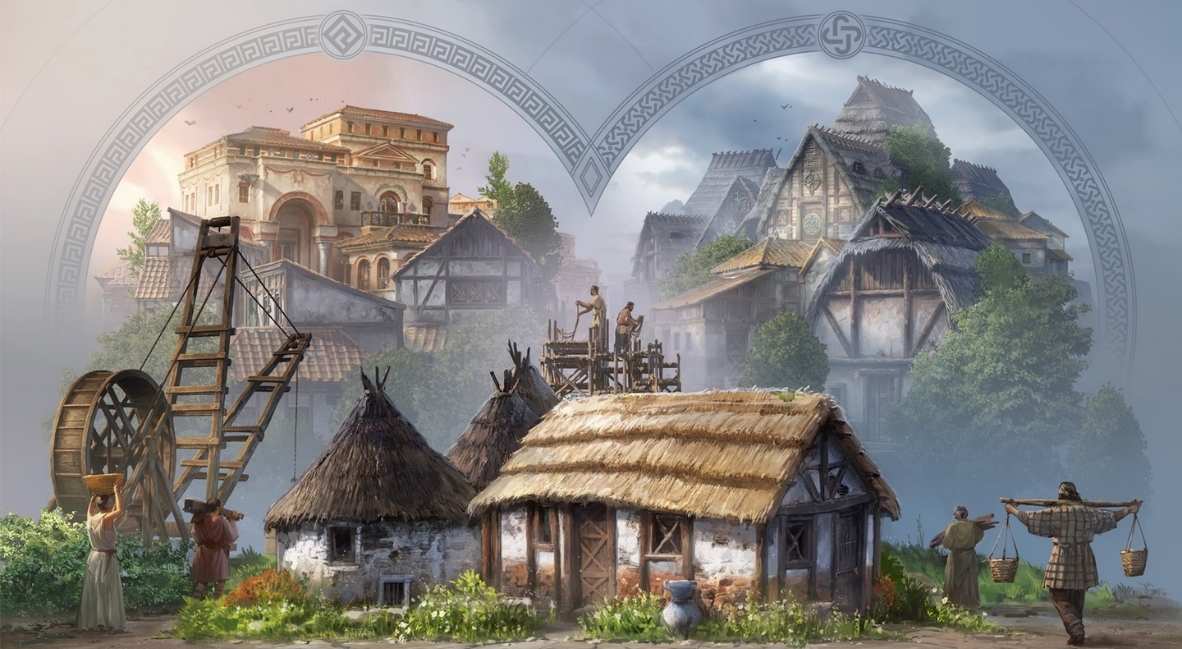
And what better way to meet audiences than to seek some inspiration from a duo that has been around since the 1970s? Cook continued, “Tonally, humor-wise, I think Asterix and Obelix is pretty good parallel [to Anno 117]. Obviously, as a kid, many other team members and I were also big fans [of them]. I think we used an image in one of the early presentations because, funnily enough, there was one Asterix comic that showed a village in Lutetia, so Paris, split in half. You see these two sides, with two different cultures, effectively living as an ensemble—living together.”
“And that image was quite a striking one, because we also thought ahead about how our big topic in [Anno 117], multiculturalism, would appear in the end. It allowed us to dream a bit more about how our game could really change and show that,” Cook said.
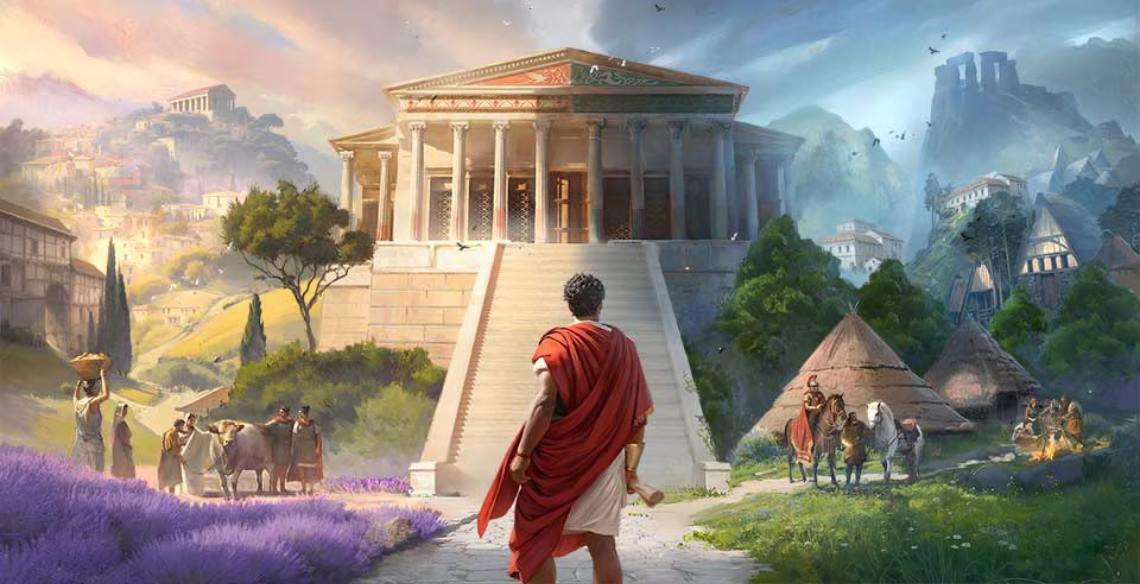
But of course, it’s not just a comic that inspired how the team at Ubisoft Mainz tackled Rome. Manu Rheiner added, “I think another big reference was also the archetype of having the Roman Empire, the south of the Empire, and combining it with Albion, the Celtic world. Because this has such a strong contrast, and there’s so much room for stories, for tensions, and for humor, just by featuring these very different cultures interacting under this one umbrella.”
History, in Anno 117, is about looking under a sugar-coated hood to see the world as it was.
Continuing, “Another thing I want to add is that, and this is not only true for writing, but also for the visuals or the music, Anno should feel warm and welcoming. We want to invite the players in, but when you look a little under the hood, you see there is also drama and conflict. We don’t shy away, but on the first [look], it’s a bit sugar-coated, and that’s what our fans also really like.”
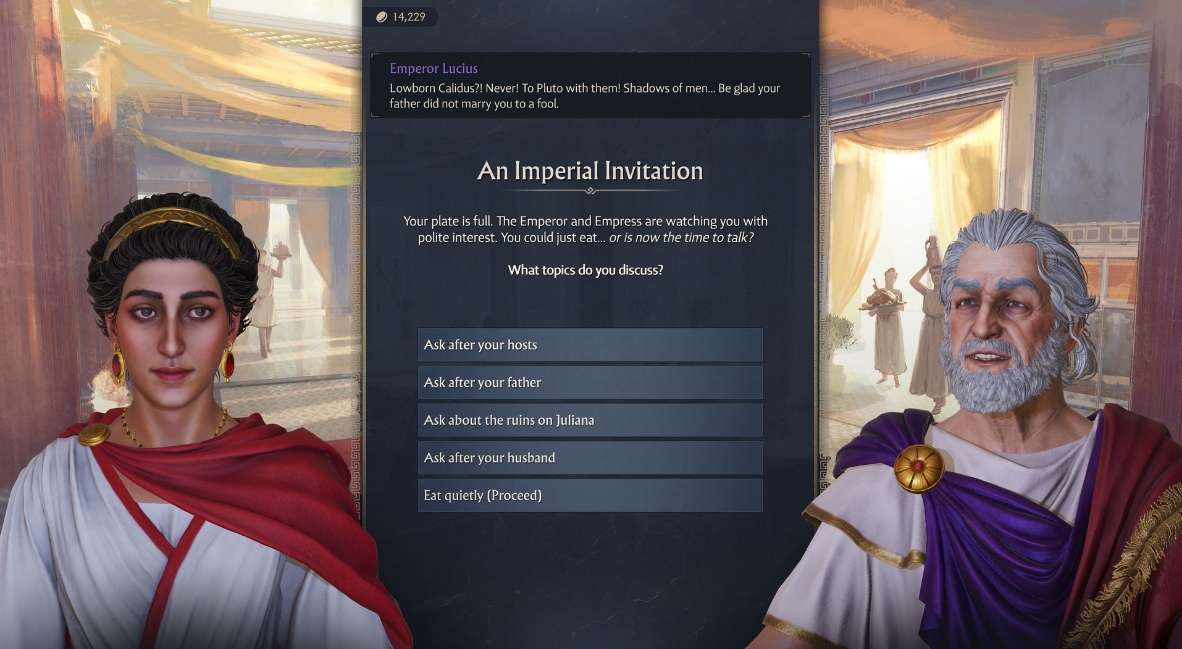
That sugar-coated approach to history is evident in Anno 117’s campaign, which features a playable female character who becomes governor. But, it is 117 BC, and that only happens after the husband she has never met before dies, and she takes his place without telling the Emperor. This is just one way that the writing team on Anno 117 leaned into history, but also balanced it against the tone that the franchise is known for.
Matt Cook explained, “Marcia’s story is an example of how one of the things we wanted to do was to create a playable character who also brings something [different] to you, who you can imagine who you are fully. I think it was a good thing to try, and I think that with Marcia, that story, especially with the context of the time period, created this feeling that not everything is going to go your way. And creating a little bit of friction, I think, is something that players secretly love. So this is something we’re quite proud of.”
Finding bits of history has helped create Anno’s unique voice and player experience. Ultimately, though, Manu Rheiner added that it’s a springboard for players to research more about the world, how it looked, and what happened.
Read Manu Rheiner’s interview about Anno 117’s Albion’s creation and focus.
“We really hope that we inspire a lot of people to look beyond the game and get excited about a certain time period in history or a certain location or reference that we have in the game,” Rheiner said. “When you look closely, we try to sprinkle this in everywhere in the game, be it in small texts that you find in Goods or just the Goods [themselves]. For example, bird tongues in aspic is a very weird Good that we brought to [Anno 117]. And one of the reasons was to surprise people, to let them think about how [people in the past] really ate that. And think about how foods traveled through the Empire.”
Storytelling is more than just dialogue choices and playable characters; it’s everywhere. And for Anno 117, the trading routes are another key historical element. Rheiner continued, “[Historically], food was much more than just something to feed people—it was also a sign of luxury or prestige. You find it everywhere, including larger locations. We want to encourage people to think about Pompeii and other major events through the content we provide in our game.”
This latter part talks specifically about Anno 117’s first DLC, which releases to kick off Season One of the game’s post-launch support. Titled Prophecies of Ash, the DLC, the expansion introduces a new deity, a new resource (obsidian), a new trader named Ceacilia, and Cinis–the largest island ever in the Anno series and home to a volcano that threatens to erupt at any moment.
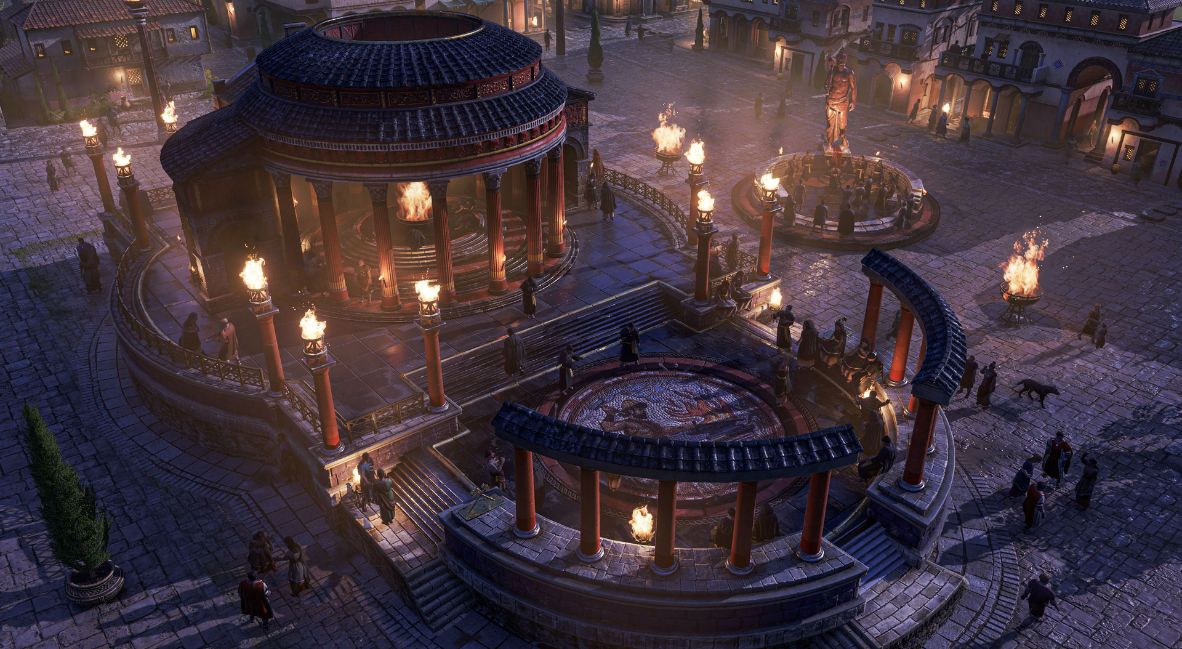
As our conversation continued, Rheiner turned the conversation to Cook, who had a lot to say about Goods and their impact in representing the world as it was, even if not every player knows the meanings. Where Rheiner used bird tongues in aspic as his example, Cook turned to garum.
“Goods are a good example of how you can see [history] quite straightforwardly. For example, garum was something that, even within the team, some people thought [whether or not we] should include something like that in the game, since some of us didn’t know what it was. It [also] demonstrates a very slight movement in the series towards something a little bit more authentic. I think in the past there have been Goods that weren’t to my personal taste, also because I didn’t feel they really reflected the places they originated from well,” Cook explained.
Adding, “I also wanted the narrative team to support the project by doing a little bit more scrupulous research and make sure that we included really important things to Romans. Garum is definitely one of those essential condiments. If you’re Southeast Asian, it’s still an essential condiment, since it is fish sauce.”
“Every single part of the game, we think about whether we should include the historical equivalent of the thing, and sometimes the decision is not to. Some of the settlements we have, or we thought about, like the villa in Latium, for example, are documented all up and down the coast of West Italy. Some of the visuals really match what those historical examples would have been,” Cook said.
Anno 117 may not lead with its inspirations, but that doesn’t mean they aren’t there.
But it’s not just the Goods that needed to be researched; everything else did too. The process of weighing the authentic representation of history against a humorous approach clearly comes into play at every stage of development. It was clear in our conversation that the team’s discussion of history was constantly moving among the different elements of Anno 117.
Continuing with more examples, Cook said, “It’s not like we broadcast all the players that this is the case. We just hope that somebody notices this, maybe somebody who is closer to history than others. And [history is] not in your face all the time, but it is definitely always there. Some of the characters, like Emperor Lucius, for example, were comprised of different real-life people. There’s an emperor who famously fiddled with the books of Rome in his own study. He basically ran the whole of the empire from his own office. And that’s where we reference that in the story, and maybe people don’t necessarily [connect] the dots, but it’s all to weave in authenticity.”
Ultimately, though, Anno 117 is about Romanization, and there is no questioning that. Whether you choose to drain the wetlands of Albion and make Romano-Celtic residents or preserve the Celtic culture, it’s up to you. But the developers want you to be thinking about it.
While an Asterix comic may have sparked some of the cultural discussions in Anno 117, the property also serves as a good mirror of the game. This is not just because they share a historical topic, but also because, like Asterix and Obelix, Anno 117: Pax Romana is encouraging people to learn more about history.
Rheiener explained, “I think what in particular around the launch, I was super happy to see [the topic of Romanization] spreading beyond our players, because the game’s big topic is about Romanization and different cultures. When we talked about the theme, podcasts and streams picked up on that, and the [creators] took it further. This idea of providing a new angle on this well-established setting for a broader audience is really fun.”
With Anno 117’s first post-launch season in full swing and the promise to take players to Egypt’s delta later in 2026, the series continues to expand its world, and hopefully, the history it puts in players’ hands.