

David Cronenberg‘s Videodrome was the first film I watched behind my parent’s back, knowing full well I was too young to be watching it. Squirming in my seat and not entirely sure of what I was watching but horrified by it, all the same, it started my admiration of body horror, and Cronenberg became a film language I loved to explore. In his latest film, Crimes of the Future, we see him turn horrific and traumatic into something sensual and starving.
Set in a dystopic environment, the human species has begun to adapt to a synthetic environment, undergoing new transformations and mutations—an evolution that removed the human understanding of pain. With his partner Caprice (Léa Seydoux), Saul Tenser (Viggo Mortensen)—a celebrity performance artist—publicly showcases the metamorphosis of his organs in avant-garde performances, undergoing intimate surgeries to remove the evolutionary moments from his body. But Saul’s notoriety and the grotesque platform become the ripe setting to shed light on the next phase of human evolution. All the while, obsessive fans and investigators get involved.
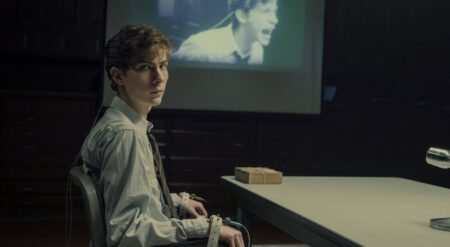
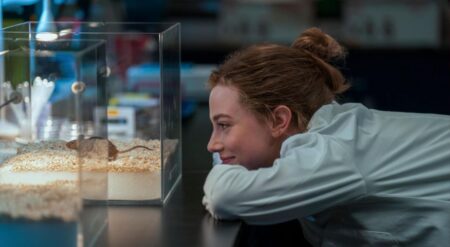
The blending of eroticism and sensuality with body horror makes Crimes of the Future visually stunning, stripping the trauma and shock from injury and presenting it as a sensual work of art. While those who aren’t good at sitting through surgical or internal imagery will have a hard time, Cronenberg is actually fairly restrained in his presentation of body trauma. In fact, trauma isn’t even the right word because, in the end, Cronenberg uses the characters—who are witnessing bodies being cut open and faces being mutilated—to assert this as an experience to look on in awe and not terror. There aren’t copious amounts of blood, nor is there fear in the characters and how they relate to their bodies being cut open. Instead, everyone is serene or gobsmacked, and that sets the tone for the viewer. This isn’t Videodrome; it’s the Louvre.
But this restrained hand means that much of what Cronenberg puts forward is more of a slow-evolving emotion rather than a visceral, unsettling experience. He builds layer on layer as the story unravels until the end.
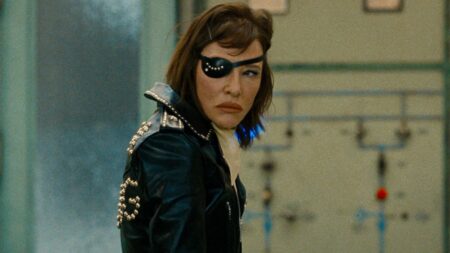
The cast of Crimes of the Future excels in subtlety. Their mannerisms, word choice, eye movement, and every bit of each performance are somehow methodical and emotional in one go. The best example of this is Kristen Stewart as Timlin, the obsessive registrar of the National Organ Registry. While she has sparse scenes in the film, her words catch in her throat each time she appears, holding something back and grasping onto an ideal in every interaction with our lead, Saul. Her eyes well with emotion, and she continually moves forward just to move backward, with her character’s place in the larger scheme revealing why each choice was made in every conversation.
The care in each performance is the silent strength of Crimes of the Future. While I heard some people walked out of the film at its Cannes showing, the score, atmosphere, and performances are as calming as they are thrilling. Cronenberg approaches his dystopia with a tender care that makes every scene an intimate moment, even when a spectacle. The deaths are intimate. The mutilation is voyeuristic. And all of it hums with a calmness I didn’t expect from Cronenberg.
This tame and intimate approach to cutting bodies open is starkly different from some of Cronenberg’s other works. That said, its only fault is its runtime. At just over an hour and 40 minutes, the film feels slightly incomplete, open-ended, and lacking. It’s sensually thrilling and beautiful, but it leaves a hole in you, waiting to be resolved, making me question the film’s narrative.
That said, the craving for more and searching for satisfaction, even if incomplete, pushes the work that Cronenberg showcases in Crimes of the Future. While I expected to be squirming in my seat, I found myself enamored and transfixed, much like the characters on screen, making this David Cronenberg film one to watch.
Crimes of the Future is playing in theaters nationwide now.
Crimes of the Future
-
Rating - 8.5/108.5/10
TL:DR
The craving for more and searching for satisfaction, even if incomplete, pushes the work that Cronenbergshowcases in Crimes of the Future. While I expected to be squirming in my seat, I found myself enamored and transfixed, much like the characters on screen, making this David Cronenberg film one to watch.