


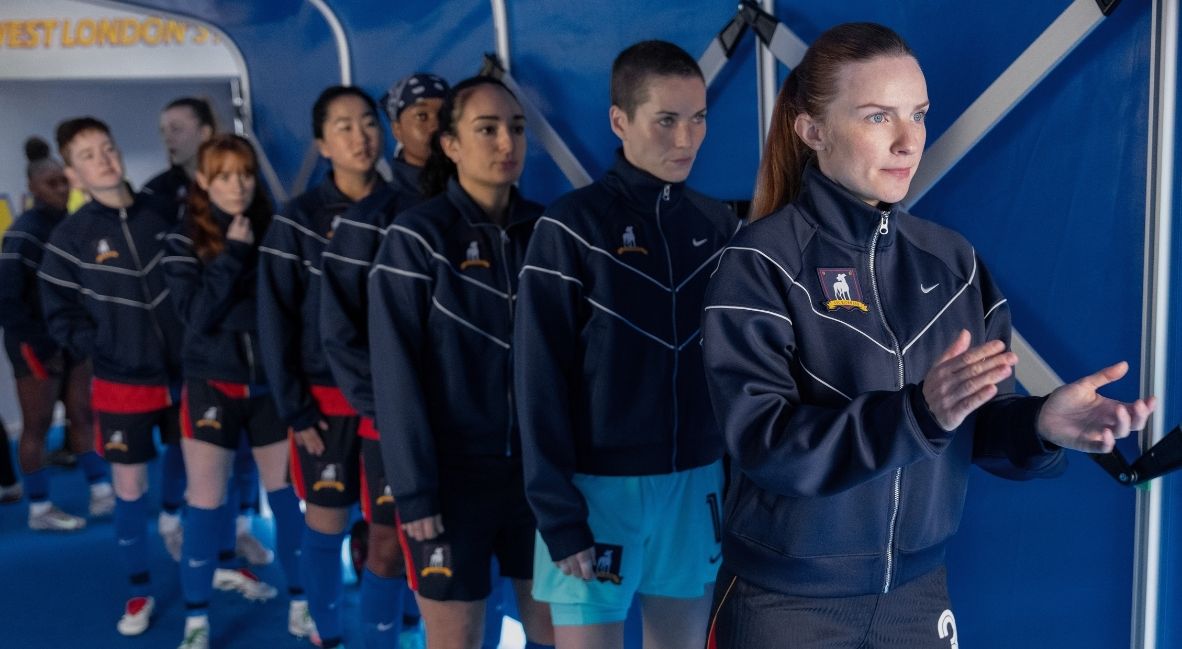
Ted Lasso Season 4 returns to Richmond through a team still fighting for the right to exist. The Lady Greyhounds give the series a new dressing room, a different set of pressures, and an opportunity to examine what the Richmond Way offers players who cannot leave the rest of their lives outside the stadium.
Building a second-division women’s team allows Ted Lasso to move forward without repeating what the men already accomplished. These players face financial instability, limited support, childcare problems, second jobs, rising rent, and the expectation that every mistake could become evidence that their team was a bad investment. Belief can bring them together, but it cannot make those pressures disappear.
The season works best when it allows the Lady Greyhounds to define what Richmond’s philosophy means for them. Ted (Jason Sudeikis) brings the same curiosity and optimism that transformed the men’s team, but he cannot enter this dressing room with the same authority or understanding. He has to listen, adjust, and accept that supporting the women sometimes means stepping back.
The Richmond Way might not be enough to overcome the pressures of the women’s game.

That change keeps Ted from repeating his original arc. He remains a central figure without becoming the answer to every problem. His greatest contribution is creating enough room for other people to lead, particularly Alice Chilton (Tanya Reynolds).
Alice enters Richmond with an understanding of women’s football that Ted and Rebecca Welton (Hannah Waddingham) do not have. Her reserved personality and demanding coaching style make her easy to read as cold, especially beside someone as emotionally expressive as Ted. Ted Lasso Season 4 gradually reveals how deeply she cares about the team, even when that care comes out as anger, pressure, or an inability to explain what football means to her.
Alice still has to recognize when her approach is hurting the players she wants to prepare. Her growth comes from learning that being demanding does not require shutting everyone out or treating vulnerability as weakness. She begins trusting Ted, listening more closely to the team, giving Shannon (Shannon Hayes) a real opportunity, and confronting how much losing football shaped the person she became.
For some players, football just isn’t enough to make a living.

Tanya Reynolds steals the season. Alice can break down over Gemma’s injury, admit the loneliness of losing football, imitate a cat in front of the Diamond Dogs, and deliver the finale’s most emotionally honest line without any part of the character feeling inconsistent. Reynolds connects Alice’s strange comedic rhythm to the walls she has built around herself. Her range gives the Lady Greyhounds a coach who can carry whatever comes next.
The players surrounding her receive enough personality to make the team feel distinct from Richmond’s men. Lizzie (Faye Marsay)’s responsibilities as a mother shape what she can give to football. Gemma (Abbie Hern) has the financial security and professional opportunities to imagine a life outside the game. Shannon spends much of the season waiting for the coaches to recognize what Ted saw during the open tryouts. Coupled with other interpersonal relationships, the team has a unique dynamic that is worth watching blossom throughout Ted Lasso Season 4.
Their differences prevent the women from immediately becoming another happy Richmond family. Attackers, midfielders, and defenders divide into cliques. Old resentments surface. Some players can afford to treat football as one opportunity among many, while others need it to become something more. Their unity develops through fights, pub quizzes, losses, injuries, and the slow realization that they are carrying many of the same pressures.
The Lady Greyhounds get to inherit Richmond on their own terms in Ted Lasso Season 4.
The “Believe” sign becomes the clearest example of the show allowing the Lady Greyhounds to inherit Richmond without treating them as replacements for the men. Lizzie’s son initially reads the sign as “some pig,” connecting it to “Charlotte’s Web” without knowing any of the history surrounding Ted’s message. The women also have no reason to immediately understand why a handwritten word should mean so much.
Alice eventually adds “And Win.” The addition does not reject what Ted built. It makes the idea useful to players who cannot afford to believe without demanding a result. Childcare will still fall through. Rent will still increase. Jobs and relationships will continue competing with training. The women acknowledge every obstacle and expect themselves to win anyway.
That perspective gives the football matches real emotional weight whenever Ted Lasso Season 4 remembers to show them. Richmond’s early undefeated record hides problems forming inside the dressing room. The Chelsea match shows how players can reclaim a game even when the score tells everyone else they failed. Gemma’s injury then forces the team to prove it has become more than one gifted player.
The season could have used more of that football.

The final promotion push pays off months of quieter development. Alice must lead without waiting for Gemma to rescue the team, Shannon receives the opportunity she earned, and the community surrounding Richmond travels with them. Mae (Annette Badland) riding the bus with the players captures how fully the Lady Greyhounds have become part of the club.
The season could have used more of that football. Several episodes allow romantic subplots and misunderstandings to consume time that could have developed the promotion race, individual players, or Keeley Jones’ (Juno Temple) work around the team. When the matches return, the season’s larger purpose snaps back into focus.
Keeley begins Ted Lasso Season 4 determined to build support for women doing exceptional things. She understands how the Lady Greyhounds can connect with Richmond’s community and keeps pushing when shareholders, attendance figures, and financial reports give people reasons to dismiss them. Her work helps create the sold-out stadium the women eventually experience.

The season gradually removes Keely from the professional story she helped launch. Zelda Southport (Tracey Ullman) moves closer to Rebecca and Leslie Higgins (Jeremy Swift), while Keeley becomes increasingly occupied with Roy Kent (Brett Goldstein). By the time Richmond faces its largest ownership crisis, Keeley is barely involved in the conversations determining the team’s future.
Her pregnancy makes that sidelining more noticeable. Keeley can be happy about becoming a mother and still deserve a professional arc. She can love Roy, mentor women, work beside Rebecca, and help shape Richmond’s future. Ted Lasso Season 4 repeatedly chooses one part of her life at the expense of the others.
That choice feels especially disappointing because Keeley and Rebecca’s relationship initially gives the season one of its strongest foundations. Rebecca is trying to support Alice, mentor Keeley, protect the club, and maintain a life beyond Richmond. Keeley reaches a point where she can challenge Rebecca’s assumptions instead of only looking to her for guidance. Their relationship should place them together at the center of the fight for the Lady Greyhounds.
In the back half of the season, Keeley’s initial efforts to build support for the Lady Greyhounds almost disappear from the story. She contributes a viral promotional video and finally gets to experience the sold-out stadium she helped create, but she is largely absent from the decisions determining the team’s future. The professional ambition driving her through the opening episodes gradually gives way to another season of waiting for Roy.
Zelda provides an effective threat because she recognizes the anger driving Rebecca and knows how to use it. Her belief in women supporting women ultimately means supporting herself, regardless of what happens to everyone around her. Rebecca survives because her version of solidarity includes people willing to stand beside one another when doing so becomes expensive.
The women who refuse to sell their shares, Mae’s continued influence, returning sponsors, and Leslie’s loyalty demonstrate what Rebecca has built. Zelda views power as something one woman takes. Rebecca learns to see it in the community ready to protect what they created together. That resolution would have carried even more weight with Keeley in the room.
With Roy and Keeley, it’s never will-they-won’t-they; it’s just ‘when?’

Roy and Keeley often feel like a separate romantic comedy grafted onto the ensemble. Roy spends the season speedrunning dates, using another woman to prove he is ready for Keeley, refusing to fix his knee, and waiting for the perfect moment to explain feelings the audience understood long ago. His injured knee becomes a plot device capable of ending dates, starting relationships, delaying travel, and forcing intimacy whenever the story needs him to remain stuck.
The will-they-or-won’t-they question is never convincing because the answer is always “when.” Their chemistry remains intact, and Goldstein and Temple can make even the weakest material charming. Chemistry cannot replace the substantial conversations their reunion needs.
Roy eventually says he had to realize he was worthy of Keeley. Ted Lasso Season 4 rarely shows how he reached that realization beyond other women explaining his heart to him. His doctor ends their relationship after recognizing that she became part of his attempt to prove something to Keeley, then still reassures him that he deserves love. Chelsea honors him despite his refusal to attend the ceremony and later offers him its head coaching position.
Strong relationships in Ted Lasso Season 4 help outweigh the weaker ones.

Roy keeps receiving rewards while the women around him carry the consequences of his emotional avoidance. The finale improves him by returning him to the Diamond Dogs and allowing him to seek advice from people beyond Keeley. That is the Roy story the season needed much earlier.
Keeley receives far less room to decide what she wants. She helps Ted create a dating profile, arranges Roy’s Chelsea recognition, supports Rebecca, builds attention for the Lady Greyhounds, and waits for Roy to become ready. Her pregnancy then gives their relationship a future before the series gives her an arc that belongs entirely to her.
The frustration does not erase the season’s many successful relationships. Coach Beard and Jane continue proving that nobody outside a partnership can fully explain what holds two people together. Ted and Michelle find a healthier understanding without treating remarriage as the only sign of healing. Alice’s girlfriend pushes her toward growth while accepting the person hidden underneath her defenses.
Ted Lasso Season 4 remains remarkable at using cultural references to make a great metaphor.

Ted’s relationship with Henry also gives the season a meaningful direction beyond football. Moving his son to London does not automatically make Ted a present father. Henry’s questions about his grandfather force Ted to recognize that protection through silence can create another kind of distance. Telling the truth becomes part of staying.
Ted Lasso remains remarkable at using history, poems, songs, films, and books as invitations. The season starts with Leslie learning about the Negro Leagues, establishing its larger interest in people and stories pushed outside the version of sports history most of us were taught.
From there, it moves through Susan Boyle singing “I Dreamed a Dream” and Anaïs Nin’s words about the pain of remaining closed inside a bud. Even a quick conversation can jump between Harry Potter, Percy Jackson, and Ferris Bueller’s Day Off to show how different generations recognize the same kinds of people through different stories.
Ted Lasso Season 4 rarely pauses to explain why each reference belongs. It trusts viewers to become curious, look up what they do not recognize, and find meaning that continues beyond the episode. Ending the season with Mary Oliver’s “When Death Comes” turns that curiosity into one of the show’s final acts of connection.
In Ted Lasso Season 4, the Lady Greyhounds make Richmond their own.

That curiosity helps Ted Lasso Season 4 survive its uneven writing. The Lady Greyhounds give Richmond a future worth exploring, Alice completes the season’s strongest arc, and Ted learns how to support change without needing to control it. Keeley deserved the same room to grow, while Roy’s romantic detour repeatedly pulls the season away from its more compelling team.
In the end, Ted Lasso Season 4 loses its way whenever Roy and Keeley’s romantic comedy takes over, but the season’s biggest moments are powerful enough to overcome it. The Lady Greyhounds make Richmond their own, Alice becomes the leader they need, and Mae’s final words bring the entire community together through grief and change. When the season remembers whose story it is telling, Ted Lasso remains as moving as ever.
Ted Lasso Season 4 is streaming now on Apple TV.
Previous Season
Ted Lasso Season 4
-
Rating - 8.5/108.5/10
TL;DR
When the season remembers whose story it is telling, Ted Lasso Season 4 remains as moving as ever.