


I cried when the Forever Ago trailer was released. Published by Annapurna Interactive and Third Shift, the narrative-driven game follows a man named Alfred, Alfie for short, as he travels the open road. But this isn’t a game about a road trip so much as a journey through grief.
Alfie has lost his spark in the wake of his wife’s death. He’s angry and isolated, lost to grief. When he finds a journal with a message from his wife, Audie, he attempts to honor her one last time. Following the directions that she left in the journal, Alfie tries to continue their adventure, returning to places in their life that meant a lot to them. With prompts decorated with Audie’s art, and equipped with a camera to take pictures to add to the journal, Alfie begrudgingly decides to continue life after this insurmountable loss.
Following the path laid out by the love of his life, Alfie’s emotions paint every single chapter in the game. Forever Ago never tries to isolate grief as simply being sad. Instead, Alfie’s dialogue brings you through a wealth of emotion as he processes his wife’s death. He feels sadness, yes. But he also feels anger and a crushing loneliness that grows as he realizes that the world has changed to the point of making Audie’s journal requests almost impossible.
Forever Ago doesn’t shy away from darkness even as Alfie makes new connections.

But Alfie also feels love. In every location, players must find mariposa lily petals on the ground. Bright and red, the flower was Audie’s favorite. In the game, they signify a memory for the player. This allows you to see the past and experience the love and joy that Alfie once felt. The sweet moments we see of Audie and Alfie’s love story make the return to the present increasingly lonely. But it also shows players the deep excitement that Alfie is capable of.
What starts as a journey alone eventually becomes a story of new relationships. But to do that, Alfie first has to decide there can be an after to his life. This journey through grief and into acceptance isn’t guaranteed. Alfie has to decide that there is a life after Audie, but the choice isn’t simple.
While Forever Ago never overtly calls out the darkness that Alfie is feeling, it does a good job of showing the player just how much guilt has built up in his grief. We see that Alfie no longer drinks, though we don’t know why. We learn that Alfie pushed his wife to exhaust all treatments, was broken by trying to solve her illness, and missed moments with her. We know that they fought. And we know that Alfie’s need for structure often brushed against Audie’s need for adventure.
Forever Ago is melancholic and beautiful in one moment and joyful in another.

Forever Ago’s narrative structure reveals layers of Alfie and Audie’s relationship and later marriage in small pieces. The game leaves their arguments and Alfie’s inability to accept a life without his wife to be revealed over time, and it defines the end of the game. And because it waits to broach that tension, each emotional response carries immense weight. But through it all, you can see Alfie’s love in each choice that he makes.
Throughout the game, Alfie experiences moments where the grief consumes him. It isn’t simply about living through the happier memories. In these moments, you learn more about Audie’s death and how Alfie handled it. You learn about his responses to her illness and his mistakes. You swim through Alfie’s regret as much as his love, and in doing so, you start to understand the complexity of grief itself.
When Alfie begrudgingly welcomes a dog on his trip and begins to open up to strangers he meets along the way, Forever Ago opens up brilliantly. As a character, Alfie is never one-note. He grows with each page he fills out in the journal. Every line of dialogue, every environment choice, all of it feels handcrafted to pull the player through emotion in every bit. There is nothing superfluous in Forever Ago, and in that, it finds its strength.
Third Shift’s approach to dialogue and experience makes Forever Ago shine.

I’ve been with my husband for 12 years. I’ve grown with him, and I’ve learned. The woman I am now is better because of it. When you love someone, their presence in your life feels like breathing. Natural and necessary. Capturing the weight of an empty seat next to you, an unanswered question, or the quiet that would have been filled with laughter isn’t easy. But Forever Ago understands the interconnectedness of who we become when we’re in love. When we spend half of our life or more with a person who loves us.
More importantly, the reward in Forever Ago is seeing how much Audie’s love still touches Alfie even now that she’s gone. She plots a course grounded in memory, but in doing so, she’s asking him to make new ones. She’s asking her husband to look backward and to realize that it’s okay to look forward. It works.
In the later parts of Forever Ago, your dog becomes central to how Alfie begins to experience life. After being talked into keeping her, you’re given the choice to name the dog. You can choose from a few names, but to be honest, I saw Hope and didn’t read the others. It just felt right.
Forever Ago is something anyone with love in their life will identify with.

Alfie deciding to live his life isn’t done in one act, but many. When Alfie decides to give the former trash dog a name, he’s deciding to give her a life, to make her a part of his. What starts as frustration with a dog who just won’t leave your side turns into friendship and a choice to open your heart again, even though you know your dog’s life is also fleeting.
Still, it’s the part of the story that is left unsaid in Forever Ago that makes the companionship with Hope so striking. Without making grand exposition dumps or blatantly saying that Alfie has thought about ending his life, Forever Ago shows you in little acts. Small comments, small outbursts, and then Alfie realizes that Hope has saved him by giving him someone who needs him, by giving him a friend. But he still has to choose not only to care for Hope, but to love her.
But perhaps, the subtlety of Forever Ago’s message is what makes it resonate emotionally. We don’t see it in big words: “it gets better.” Instead, we very much know that life will never be the same now that Audie is gone. What matters is that it will keep going, and the choice to keep going is central here. Alfie has to choose to be alive again; he has to choose to see beauty in the world again. With each new person he meets along the way, he learns a little more about how to do that.
Forever Ago walks the player through the complexities of grief and how hard it is to keep going.

Forever Ago is a moving character study of grief and learning to feel again. It’s about the journey to making new memories without the love of your life, when you thought that they would always be by your side. That said, with the limited interaction with the game itself, with many sections just moving the left stick forward, you have to wonder why this medium of a video game was chosen.
The limited interactivity is also betrayed by the game’s length. While fellow Annapurna Interactive video game Mixtape excelled with limited player interaction, much of that success came from the title’s length (at about three hours). At around double the length, Forever Ago starts to suffer from its pacing.
The story itself is deeply moving, with an eloquent script that scratches at melancholy. That said, it doesn’t distract from how the length can grow tedious. Progression through any given scene is locked, meaning players cannot skip or fast-forward through scenes with dialogue.
Pacing and technical issues start to mar the experience, but Forever Ago’s story is too good not to recommend.

While this was a tad frustrating on its own, it is often used to highlight the anxiety or stress that Alfie, our protagonist, is under. However, due to some of the game’s technical issues, the moments when I had to restart the game, depending on where the save was, became a frustrating task just to get back to where I was.
With small details in the game’s mechanics having issues, the game’s cracks are there. Some issues I encountered were that certain interaction prompts didn’t pop up unless you were at a very specific angle (or sometimes not at all, which required a restart). This primarily happened in the latter parts of the game.
Forever Ago is generally open about how you complete some tasks, letting you hear Alfie’s perspective on certain elements and creating a more immersive world. However, if some elements are completed out of order, it impedes some of the dialogue progression, or you wind up accidentally progressing forward when all you wanted to do was take a picture of a statue, which happened to me in one of the game’s very last sections.
Third Shift uses gameplay features to stoke emotion from frustration to sadness, and a lot inbetween.
These small technical issues begin to mar the experience. With so little gameplay, much of your time with Forever Ago isn’t very tactile. But ultimately, its story shines so blindingly bright that it’s hard to knock it. Additionally, the game’s mechanics bolster its emotional atmosphere, and most of them work perfectly.
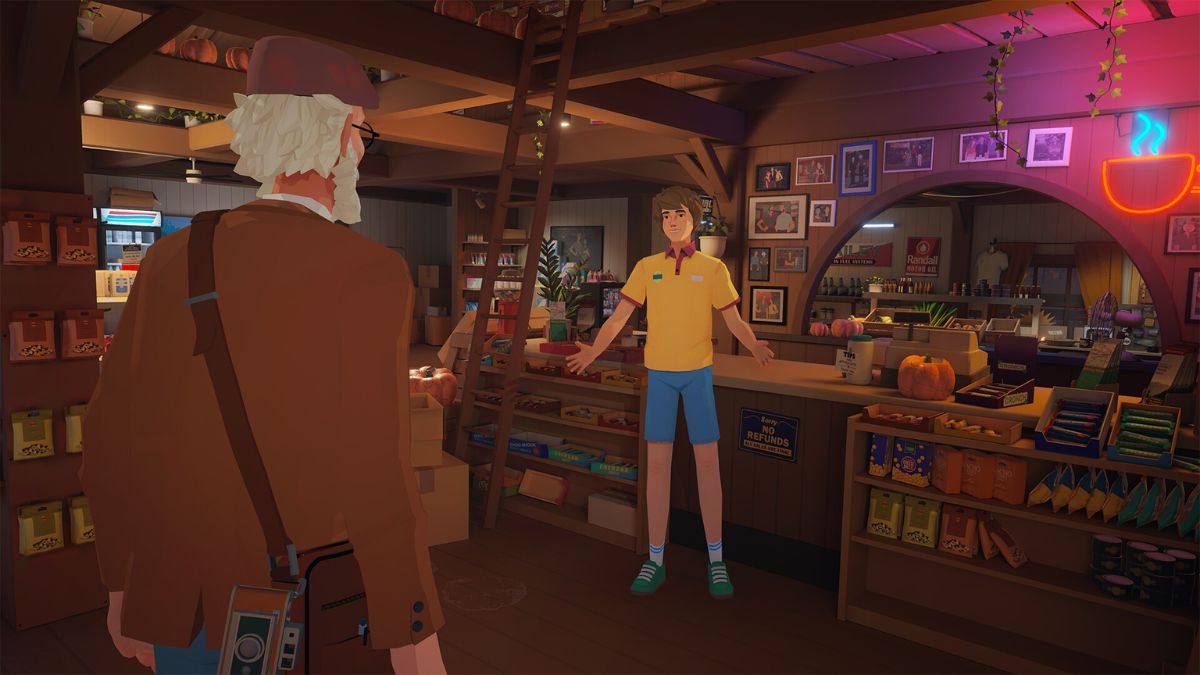
In fact, the developers are experts at engineering frustration. Early in the game, you enter a convenience store. You’ll pick up food and other odds and ends for the trip that your wife wanted you to take. Filled with grief, most of the dialogue at this point in the game is about Alfie looking backward, and this gas station is the first sign that nothing is the same as it was in your youth.
As you move through the gas station, the new attendant, Milton, constantly interrupts you. He’s young, excited about sales, and just won’t leave you alone. The frustration comes from browsing the shelves, being in the middle of looking at an item, and Milton interjecting. The emotional intensity you feel with Milton is matched by Alfie yelling at him. It’s a sequence in the game that lets you browse the store but also traps you in a confined space, creating friction.

The game design here is superb. And for the rest of the game after this section, the limited moments of interaction are built to bring Alfie’s feelings to life. We feel his worry, his grief, and by the end, his peace. But because gameplay asks you to engage in Alfie’s life and feel how he feels, these constructed moments of frustration work well to accent the story’s peaks.
That said, using game mechanics to push frustration on a player is a gamble, and there’s one portion of the game where this choice backfires. Toward the end of Forever Ago, players are asked to row a boat. In the bottom right of the screen, you see the button that you have to press to move the oars. But unlike other actions in the game, you can’t just hold the button down, and the limited UI doesn’t make that too easy to understand.
As I tried to move the boat toward my destination, I wound up turning it completely and moving in the wrong direction. My annoyance rose, but given where the story was, it was clear this was intentional. But then it kept going. The story then jumps to 1996: you’re in the boat with Audie, and you’re arguing.
Forever Ago feels more like a movie than a game most of the time.

Narratively, this is the first real time we see Alfie’s stubbornness and just how different the two are. This moment rounds out their love story, showing the player that love is forged by the choices we make to stay with the people we love even in the hard times, not just when we’re happy.
To show how out of sync they are, the game moves you from controlling both oars of the boat to holding only one. As you argue with Audie, the boat becomes even harder to control. It sent me in circles; it moved too far one way, and no matter how much I tried to match Audie, I just couldn’t. At first, this works excellently. I knew exactly what was happening, but I didn’t know how to fix it.
As I explain this mechanic, it’s clear how poetic the gameplay in Forever Ago is. However, the situation kept going, and I stopped playing for a couple of hours. It was frustrating, and much of that came from not being able to execute what I knew I needed to do. While this all matches the scene’s emotion, the frustration I felt undercut the scene’s eventual loving outcome.
Alfie’s ending isn’t a storybook, but it is a continuing adventure.

Forever Ago stands out for its approach to game design and the developers’ ability to evoke emotion through action. However, that ambitious task can backfire when the emotion outlasts the intended story beat. Still, Forever Ago’s journey through grief and the complex emotions buried in those moments is unparalleled. And despite some technical difficulties, there is too much heart, love, and life in Forever Ago to let this title slip away.
The world is as dark as it ever has been, and in that darkness, we often need reasons to keep going. We need a push to keep moving forward. But we also have to choose it. As a story about love, life, and making the choice to keep adventuring after grief, Forever Ago is one of my favorite stories of the year in any medium.
Even if the gameplay doesn’t always match the strength of the narrative, it’s hard not to see a piece of your life in Forever Ago. It may not be an experience you’ve gone through yet, but playing the game as someone with a spouse who has made them a better person, it’s hard not to see yourself in Alfie. But more importantly, it’s hard not to see yourself in the future. Sometimes the best way to honor those you love is to keep going, and Forever Ago understands that. With every new memory that Alfie makes, his love story charges ahead.
Forever Ago is available on PC, Nintendo Switch 2, PlayStation 5, and Xbox Series X|S.
Forever Ago
-
Rating - 8.5/108.5/10
TL;DR
Forever Ago’s journey through grief and the complex emotions buried in those moments is unparalleled. And despite some technical difficulties, there is too much heart, love, and life in Forever Ago to let this title slip away.