

Ubisoft Mainz’s city builder Anno 117 is nearing its first anniversary. Following in Anno 1800‘s footsteps, Year One has brought new additions to the game from “Prophecies of Ash” to “The Hippodrome,” but as the year gets ready to conclude, it’s the “Dawn of the Delta” that is on players’ minds. As the most significant update since launch, Dawn of the Delta brings Anno 117 Year One to a close by adding new challenges and dependencies and embracing Egyptian history.
During Gamescom 2026 in Cologne, Germany, we spoke with Anno 117: PAX Romana‘s Creative Director, Manuel “Manu” Rheiner, about Dawn of the Delta and what players can expect. As expected, the new Anno 117 DLC brings with it more than just something to build or a challenge to race against. Dawn of the Delta will bring new resident and workforce types, exciting new historically inspired challenges, and most importantly, new supply chains that will be used across regions to fulfill needs,
From changes to irrigation, including the introduction of a water wheel that attaches to aqueducts, new reed ships that maneuver more easily in the Nile, where Roman galleys struggle, and the challenge of managing three different environments (one of which includes flooding), to the fact that the Nile brings both life and disease, big things are coming. Not to mention, players will finally get the dependent, needs-based production chains they’ve been looking forward to as Egyptus enters the game as a new region with the DLC.
In our conversation with Manu Rheiner, we discussed what players can expect. But since the DLC is still in active development, the nitty-gritty elements like caps on aquaduct spaces, increases in disease, and how the game will interact with mountain slots in a region known for being, well, flat, are all things we don’t get the answer for here. But all in good time.
This Anno 117: Dawn of the Delta DLC interview has been edited for length and clarity and was conducted with the help of Kate Sánchez.
BUT WHY THO: From a historical perspective, was [the Anno 117 team] looking towards the Ptolemaic influences in terms of Egypt’s architectural development that we see happening once the Romans reach Egypt, or did you all focus more on pre-Roman aesthetics to build the base of Egyptus, before the player chooses to romanize or stick to traditional Egyptian ways?
MANU RHEINER: It was, for us, I would say a mix [of the two]. Of course we did the research, but also, this whole province or the culture in this province has been there for 2000 years since the Romans arrived. So, we’re trying to find our spin on that that can be somehow iconic. Well, at least we think it’s iconic, and it works [for the game].
Everyone understands what we have [in Egyptus], and then we pick and choose different elements that we solve for in our research to shape our vision [and our] version of this empire [in Anno 117].
BUT WHY THO: As you all are designing Egyptus and variants for buildings in the region, what was the process of finding balance in using the buildings that we have in Latium but also keeping it consistent and fitting the Egyptian-inspired culture that [Dawn of the Delta is ] representing?
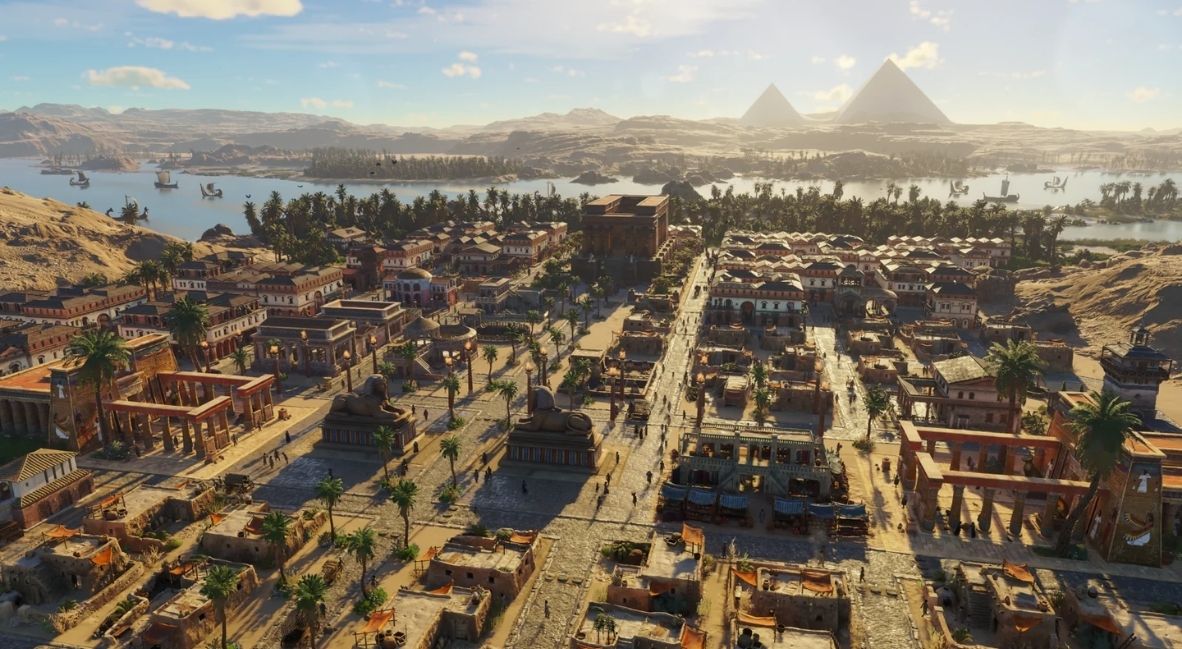
MANU RHEINER: I mean, wherever the Romans went, they somehow exported their building style, and this was helpful also for us. We really wanted to support the idea that you Romanize [new provinces], that [Egyptus] is now Rome, and not just that you are playing as an Egyptian. This is something we wanted to do, but we needed to make adjustments. Some of the [architecture] adjustments are dictated by the gameplay because they need to be readable. They need to be able to separate those buildings, so we needed a lot of color and material adjustments.
Also, when you look closely at the details that we have in our buildings [in “Dawn of the Delta”], we also wanted to customize them so that they fit [Egyptus] better, with different plants and different decorations to make it really fit the region, but still they should clearly be Roman structures. There is a lot of research, and we do a lot of testing and prototyping to then finally end up with something like you see here in the screenshot [of “Dawn of the Delta”].
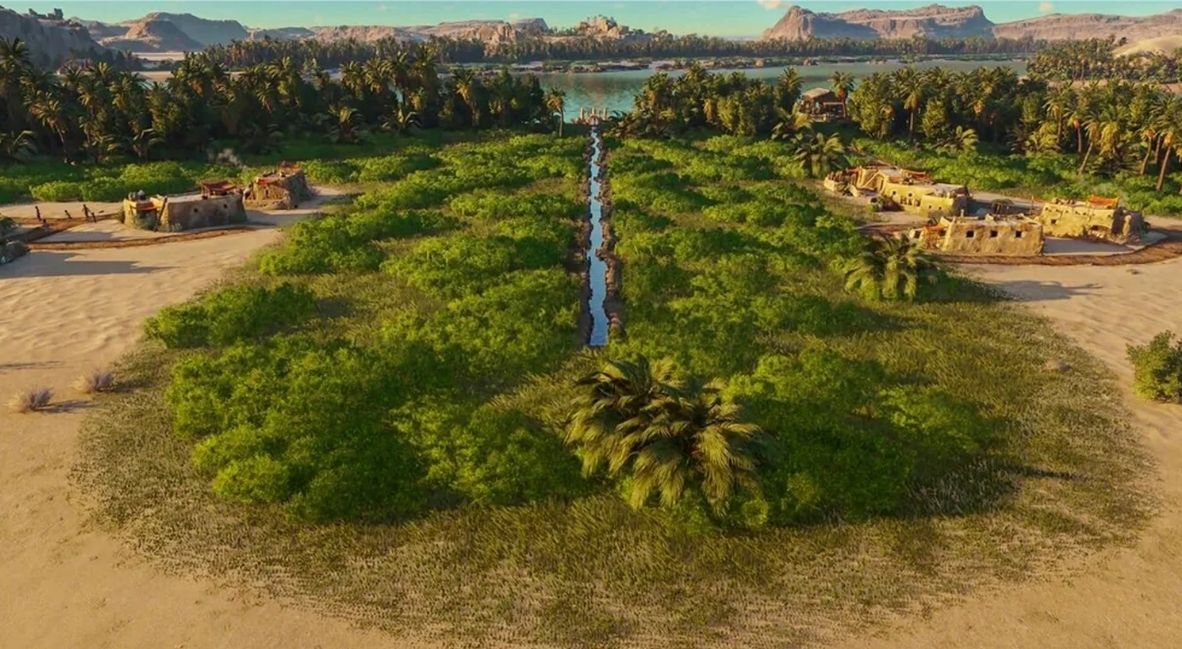
BUT WHY THO: Did you all kind of redo the way that the team designs regions? Because it looks like there are more channels, landmasses, and water compared to some of the other regions we’ve seen [in Anno 117].
MANU RHEINER: It’s a good question because we really want to catch up the delta feeling. There are a lot of river arms and so on that have a huge influence on the available construction space, so there are still construction space limitations. But the whole feeling is very different [than Latium and Albion]. Also, because of the river and the gameplay we have, ships behave differently on it. This also allows a nice gameplay challenge.
For example, it would be clever for you if you want to have a trade connection with other provinces that you place some settlements really close to the coastline where you have access to the open sea, because then you can use all your fleets. But on the other hand, if you want to optimize trade networks on the river, it would be nice, or it would be good and clever if you use dedicated ships for this because then you would have both improvements or the best possible work together.
BUT WHY THO: So in Anno 1800, players saw “Land of Lions,” making this the second time that Anno is coming to the African continent. What did [Ubisoft Mainz] learn from developing “Land of Lions” that you all were able to bring into developing the Delta?
MANU RHEINER: One of the things that we showed today was the whole topic of irrigation, which works to some extent similarly, like in “Land of Lions” and in Enbesa. So that’s something. We could draw on all of our knowledge for what we could include in [Egyptus] that we [included in Enbesa].
For example, what does a good UI look like? How do we communicate about certain things? These are things we could take into account [from “Land of Lions”]. But we also had to do a lot of things completely from scratch because we also showed the flooding mechanic [in Egyptus]. [Flooding is] something we’ve never done. How can we raise and lower the water level? This was quite a challenge that we had.
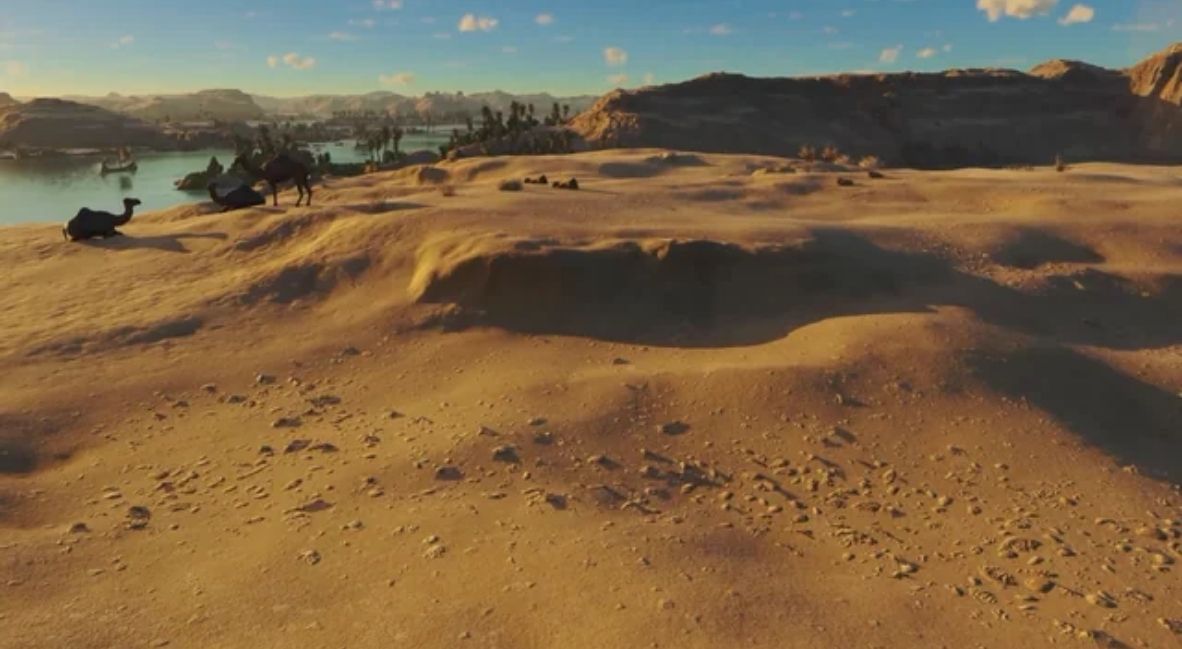
And also, when you look closely, all the materials, the whole terrain, everything looks different. Yes, it’s sand, so the color tone might be the same, but the rest is really unique. As you really look closer, you will see heat haze; you will see some atmospheric effects like sandstorms. All of this is there, so there are a lot of new things we haven’t done before.
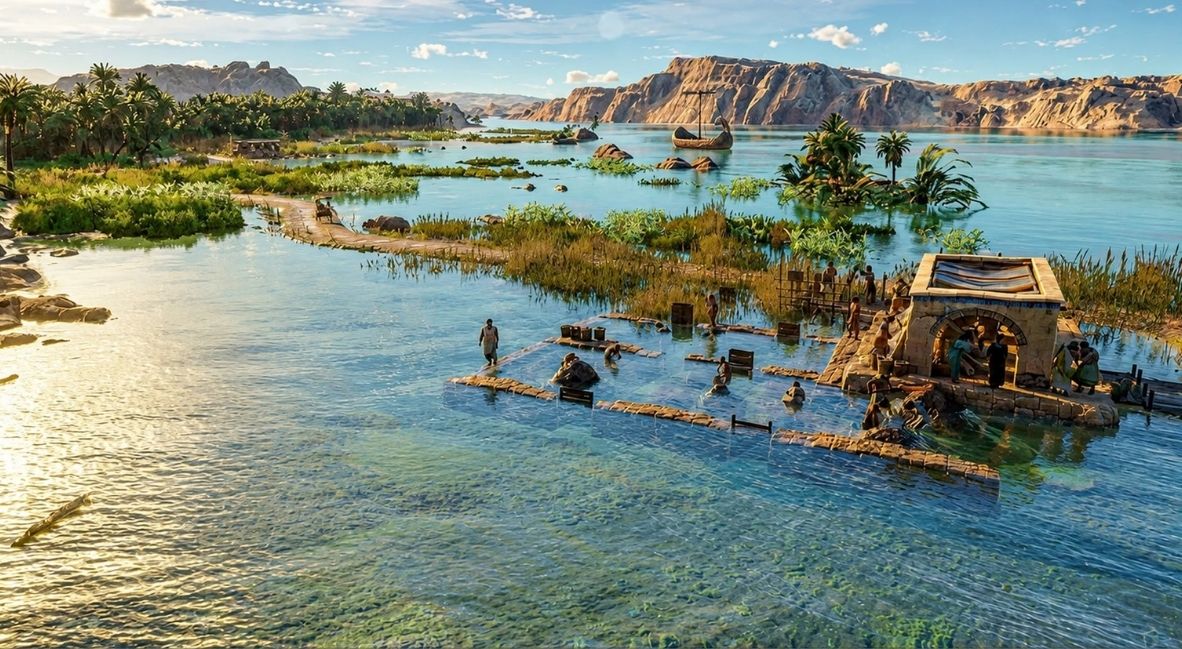
BUT WHY THO: So was flooding added to compensate for the fact that there aren’t too many mountains that you can get minerals from naturally within that region of the world, or are we still going to see a mix of some sort of rocky structures to still do that type of mining that is kind of core to a lot of the island building that we’ve seen up till now?
MANU RHEINER: We don’t want to go into the details now, but yes, there will be a lot of options available, so we don’t remove [mountain slots]. The [reason] we did the flooding is that, usually, when we develop games, we try to deliver a full fantasy, and for us, the River Nile and the seasonal flooding are a big part of that fantasy.
That’s why it was quite clear that if we go there, we want to have it in the game, and we want to find full mechanics that are also based on real life that we could weave in, and so that’s why we have chosen this.
BUT WHY THO: Obviously, we’ve seen a lot of irrigation, and kind of like a big component of this. Is there any benefit to not trying to irrigate all of your area?
MANU RHEINER: It’s a good question. I will not answer it because it goes into the details. But a good question.
BUT WHY THO: So what is really kind of striking to me is in Albion, and especially as we got deeper into our playthroughs when we were playing, there was almost like the need for Romanization because the islands are much smaller, and the marshland constricts you so much.
If you wanted to grow, you had to Romanize, and you had to really take away the water. You had to take away the marshland, and here it seems to really be stressing the life that water brings. And so it’s not about taking it away, but giving it back.
How did you all, when just kind of thinking about developing it, how do you balance those two against each other in terms of making sure they’re different gameplay, but also kind of intuitive for the player to kind of come to.
MANU RHEINER: It was a good question, of course. I mean, we developed Albion before Egyptus, so we knew: “Okay, this is what we did there.” So when you do a new province, you try to find something else that feels different, that plays differently. And as you rightfully described, here it’s more about bringing life to the desert.
This is a topic or theme we want to carry through [“Dawn of the Delta”]. So, for us, almost the river is more like a character. You know? It’s like a living character in [Anno 117]. It’s breathing. Yeah? It’s the flooding, and there is the dry season, and it also spends life in the dry land. So this is the overarching theme that we wanted to fully embrace here.
BUT WHY THO: Now, in Anno 117, with “Dawn of the Delta,” we can make it now where we have three regions, but players really don’t have to go to all the regions if they don’t like to. How did you all decide to give the player choice of, “Hey, you can either stay in one region, you can go to two, or if you want to go to three,” versus forcing everybody to be in all three of them?
MANU RHEINER: That’s exactly like that. So let’s say, I mean, we know that our hardcore fans want to have everything in one empire, which is also something we want to celebrate and allow [in Anno 117]. But we also know that for a lot of players, even reaching the endgame or building tier four is something very, very hard for them. We have a lot of people who don’t reach this point and the option now is that [they] can start in all the provinces which really also gives them the chance to explore the new content, the new province directly.
So that was one of the main reasons why we decided to push in this direction, and we also tried to make sure that all the provinces feel somewhat different. I would still advise everyone to start the game in Latium if you’re a newcomer because it’s a bit simpler. [Latium] doesn’t have complex marshes to deal with, or you don’t need to deal with the river [in Egyptus], which is something that makes it special. In general, every province should feel different. And it was important for us to make them available right from the start. If you want to check it out, without the endgame.
BUT WHY THO: I think one of the things that was also really exciting was that it seems now that there’s more complexity with the different tiers. You showed more investment in the needs flowing throughout the region if you are using all three. How was it developing the goods that you showed us so far and making sure that they work with each other?
MANU RHEINER: We try to identify goods that make sense somehow. For example, the need for red wine, a lot of people will understand. And then, of course, we look at the needs and their stats to find also good combinations that allow gameplay [in Egyptus].
We always had this idea in mind, even when we started developing the base game: at some point, when we add a new province, we really want to make it feel connected, and it should benefit the player if you have trade connections. The other aspect is also that this [connection] was the case in reality, and that’s something we wanted to mimic in the game.
BUT WHY THO: This may be too detailed of a question, and I you may just say no, but there is something really interesting to me about looking at how everything’s developed because when you’re in Latium, fire is a real hazard, even if you’re not playing on on Volcanic Island, and in and in Albion, it’s space that is your real challenge.
You noted very briefly about the disease that comes from the Nile as well. So, are we going to have to put more focus on health facilities that we may or may not have invested a lot of time in?
MANU RHEINER: I will answer this question at a later point, as we’re gonna reveal more in the next weeks and months.
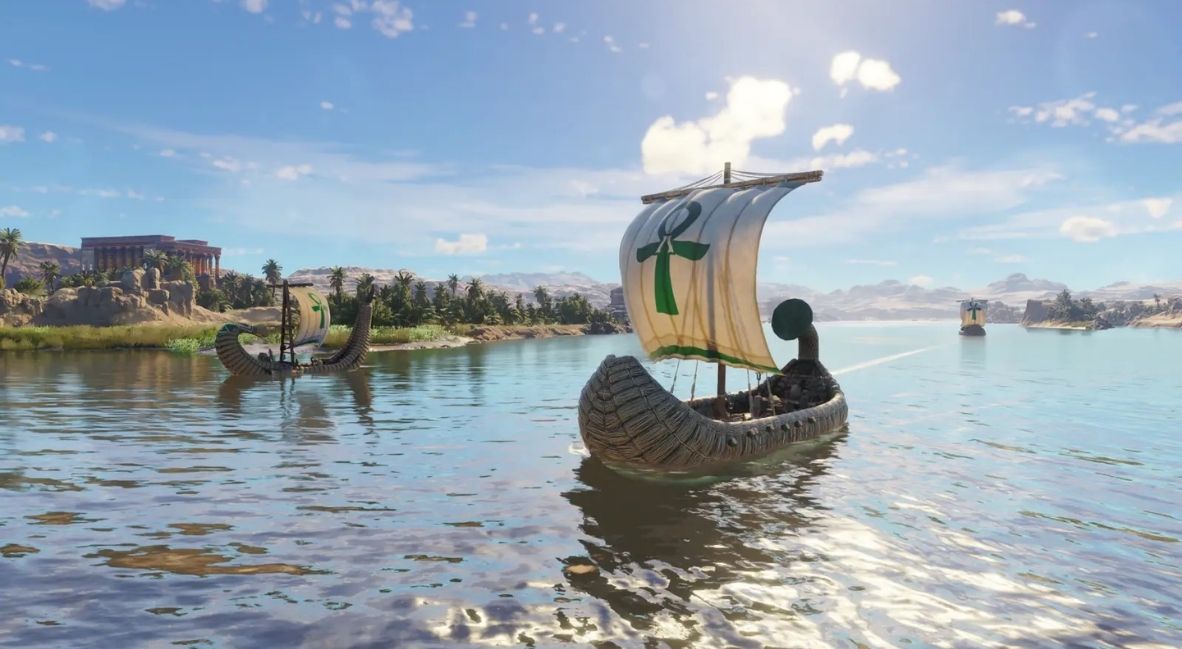
BUT WHY THO: You talked about different types of ships. Can you kind of go into a little bit more detail about what we’re gonna be able to see from these different reed ships that we won’t be seeing in some of the other regions?
MANU RHEINER: So what I can tell you now is that we have two types of reed ships, and that you can use them also on the sea. They operate better on the river, and it’s the same for the Roman galleys or the Roman ships. You can also see in the [keyart] that there are some Roman ships also in the background, so you can also use them here. But they are not as efficient as the others. We’ll go into more detail on the rest later.