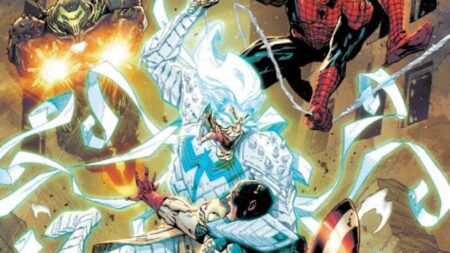

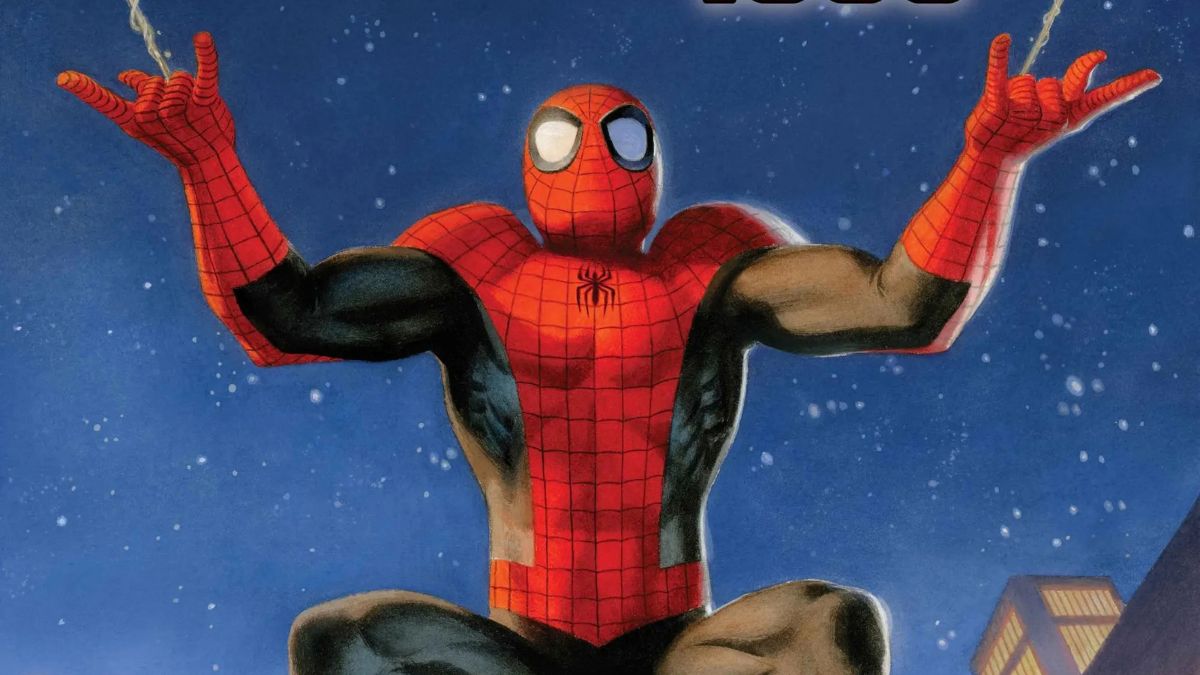
Amazing Spider-Man Issue 1000 is published by Marvel Comics. It’s an anthology issue that features multiple stories by several creators.
The main story in Amazing Spider-Man Issue 1000 is written by Joe Kelly, art by Pepe Larraz, colors by Federico Blee, and letters by Joe Caramagna. “Still Standing” is written by Noah Hawley, with art by Patrick Gleason and colors by Marcio Menyz. “Requiem for a Goblin” is written by J.M. DeMatteis, pencils by Humberto Ramos, inks by Victor Olazaba, and colors by Edgar Delgado.
“Tears of the Spider-Queen” is written by Frank Miller with art by Peach Momoko. “The Big Night” is written by Triple H, with pencils by Ed McGuinness, inks by Mark Farmer and colors by Matthew Wilson. “The Gesture” is written by Brian Michael Bendis, art by Stuart Immonen and colors by Marte Gracia.
“Of Webs and Six Guns” is written by Larry Lieber, pencils by Giuseppe Camuncoli, inks by Klaus Jansson and colors by Rachelle Rosenberg. “I Can Never Rest” is written by Dan Slott, with art by Marcos Martin and colors by Muntsa Vicente.
The main story is directly tied into the current story that Kelly and Larraz are telling. Peter has found out he has a cousin, May and Ben’s son, and Aunt May has suffered a severe stroke. That means Amazing Spider-Man Issue 1000 starts on a fragile, fraught note. It’s devastating, especially when May is completely confused about who Peter is.
And from there, a vicious and emotionally devastating fight breaks out that is intensely emotionally charged and personal. And as the frantic pace erupts in Amazing Spider-Man Issue 1000, there are these cutaways that detail the hardships both Peter and May have been through together. From childhood to adulthood, she has practically been Peter’s mother.
The concept itself requires a lot of suspension of disbelief, but everything within Amazing Spider-Man Issue 1000 is about emotional connection, and this first chapter is exactly that. Larraz delivers a phenomenally physical fight, and the colors are absolutely staggering when Spider-Man breaches the hospital and enters the city. But the opening focuses on Peter Parker, and Larraz perfectly conveys how broken Peter is and what May’s love means to him.
“Still Standing” is a very unique Spider-Man story, because it takes place at the very end of Peter Parker’s life. Peter is in a nursing home, now very old. And though he is long retired and ailing, he is starting to see things that may be connected to one of his classic villains.
Like the previous chapter of Amazing Spider-Man Issue 1000, it’s beautifully written as Hawley creates decades’ worth of stories, establishes a family for Peter, and more. Peter has never been a character associated with old age, also looking younger and boyish, so Gleason crafts something surprising. It’s a story that understands aging and respects it too.
The dialogue is exquisite as a new resident and a very old flame of Peter’s moves in next door. Amazing Spider-Man Issue 1000 sows seeds of doubt about his sanity and senility, and can be upsetting at times. The imagery is glorious, with a golden hue used at times to paint people in the best life. And whilst “Still Standing” is set in the future, it is memories that provide the most importance within the story.
“Requiem of a Goblin” taps into one of Peter’s most complicated friendships. It’s Harry Osborn’s funeral, and Peter wrestles with whether his friendship with Harry was ever real. It’s a wonderful example of how sad Peter Parker’s story can be, and the pain he feels whenever he loses someone close to him. He’s a man who carries his grief and guilt with him wherever he swings to. There are so many conversations in this part of the issue about what’s real and what’s not, and just how doomed Harry was after being cursed with such a twisted family history.
DeMatteis is a legendary writer for Spider-Man, and his emotional eloquence is extremely profound. Ramos, also legendary in his own right, does a terrific job with Olazaba, transitioning from normality and sadness to comic-book costumes. The story jumps from Spider-Man and Green Goblin to Peter Parker and Mary Jane and then back again, because they are so intrinsically linked.
That’s the beauty of the Spider-Man story: so many of his closest villains are either related to him or related to someone he went to school with. Delgado’s colors are also fantastic in the final part of the story, because the slow fading of shades highlights that things aren’t quite real.
“Tears of the Spider-Queen” is a strange, horror-adjacent story in Amazing Spider-Man Issue 1000 that takes Spider-Man from the tops of skyscrapers to the sewers below. Miller is an icon of the industry, telling some of the most important comics ever told. And Momoko is quickly becoming one, too, with a truly unique art style that brings manga to comics and an auteur approach that Miller himself would be proud of. It’s a refreshing refrain in Amazing Spider-Man Issue 1000, something of a palate cleanser amid the heavy emotional toll of the first three stories.
It’s still a scary, sinister story with a startlingly disturbing design. Something rare in Spider-Man is that the narration isn’t in the first person. Instead, it uses a poetic, omniscient style. When Spider-Man’s own narration begins, it is reactive and repulsed. What this story does highlight is just how varied a Spider-Man tale can be, and how much horror has played a role in Spidey comics.
“The Big Night” brings a celebrity guest writer in the form of legendary wrestler and executive Triple H (Paul Levesque), and it actually answers a question that has stood firm since the very first issue of Amazing Spider-Man. Why wrestling? When the radioactive spider first bit Peter, his first thought was to become a professional wrestler. This story reveals his reasoning, and it has a lot to do with Uncle Ben. And once again, the tone within this comic becomes one of love, kindness, and remembrance.
It’s happy and sentimental, and it also serves as an example of the good that wrestling can bring. The art is phenomenal because it begins with a very geeky young Peter in a very expressive couple of pages. His glasses are huge, and it’s heartwarming to see him and Ben so happy. But then there is a brief page in which the spectacle of wrestling unfolds.
“The Gesture” is the one tale within Amazing Spider-Man Issue 1000 that connects Spidey with other members of the superhero community. It features a standard but exhausting fight for Spider-Man, which is the one moment in this massive anthology when his humor really stands out. He bounces between his foes, firing quip after quip. It’s amazing to see Immonen’s art return, even if it’s fleeting.
The energy within the fight is gorgeous. And then Spider-Man has a conversation with Captain America, and Bendis shines. As a writer, Bendis has a very specific, conversational tone that makes this setting work.
“Of Webs and Six Guns” in Amazing Spider-Man Issue 1000 has a classic feel and a familial one, too. Lieber is Stan Lee’s younger brother, and the fact that he is writing this story at the young age of 94 is incredible in itself. Spider-Man gets drawn into a Wild West adventure with the Rawhide Kid.
Lieber uses a dialogue style that was so prevalent and recognizable within the 60s, when he was first created. It’s a style that works better when written by people who naturally understood it, not modern writers trying to replicate it. It’s nice to step out of the seriousness again with something silly and fun, and Lieber scripting it is special.
The final story of Amazing Spider-Man Issue 1000, “I Can Never Rest,” is another one that ventures to the very beginning. It features an old police captain and his quest to bring in a dangerous thief and burglar, long before that burglar even started killing Ben. It’s a sad story because of what it sparked, but there’s also a passing of burdens.
Spider-Man often looks like he carries the weight of the world on his shoulders. And this man, someone haggard and haunted by what he went through, is an example of what chasing monsters can do. It explores so much around those very formative moments, and what they did to create Spider-Man.
It should also be noted that Caramagna does an exceptional job lettering every page of Amazing Spider-Man Issue 1000, as he has for hundreds of Spider-Man comics.
Amazing Spider-Man Issue 1000 is a terrific outpouring of history, emotion, and gratitude. There is so much recognition of just how incredible the web-slinger is as a character, and the contributions of countless creators. Many of those make appearances within this book, almost all of them still alive.
The endings of several stories in Amazing Spider-Man Issue 1000 include notes of thanks from the writers to Stan Lee and Steve Ditko, Spider-Man’s creators. There are portraits of them, crafted by Phil Noto. There are interviews with multiple creators, too, and Tom Holland and Destin Daniel Cretton appear on the letter pages. It’s a really heartfelt celebration of what Spider-Man has been put through and done and what he represents in comics and fiction. And he’ll be that for another 1000 comics to come.
Amazing Spider-Man Issue 1000 is available now wherever comics are sold.
Amazing Spider-Man Issue 1000
TL;DR
Amazing Spider-Man Issue 1000 is a terrific outpouring of history, emotion, and gratitude. There is so much recognition of just how incredible the web-slinger is as a character, as well as of the contributions of countless creators.