
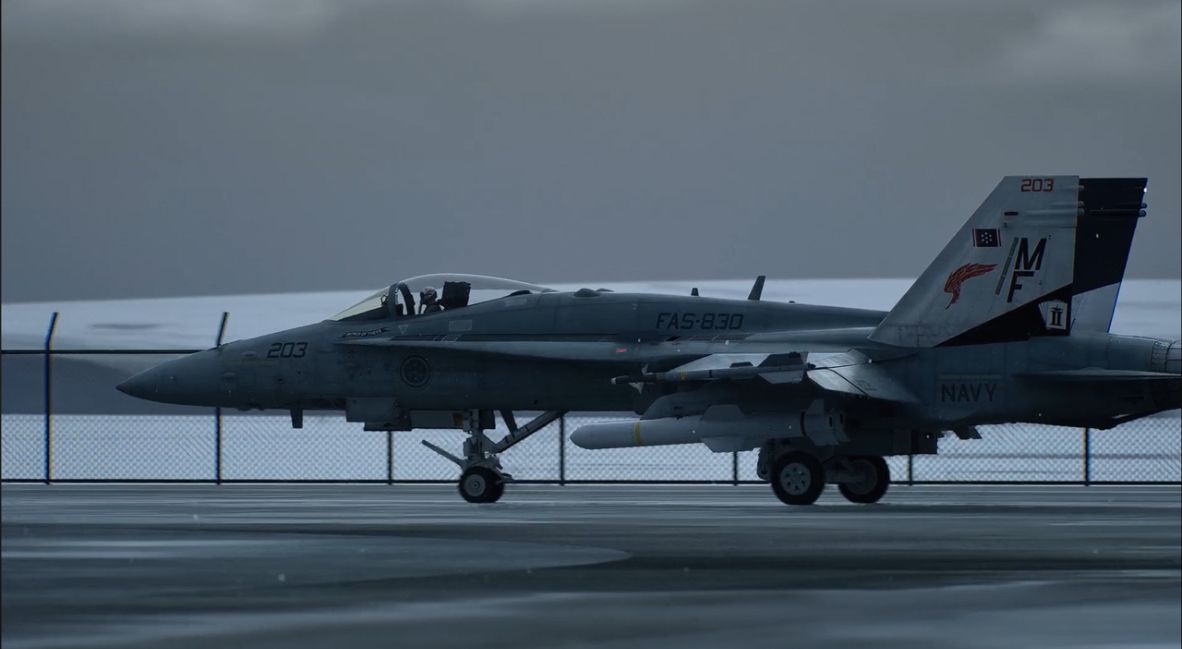
The last Ace Combat game I obsessed over was Ace Combat 04: Shattered Skies on the PlayStation 2 back in the early 2000s. I’ve dabbled over the years, but nothing has pulled me in quite like Shattered Skies did. A quarter-century later, the franchise marks its 30th anniversary with its first mainline release since Ace Combat 7: Skies Unknown. Ace Combat 8: Wings of Theve still trips over itself whenever it pulls you out of the jet, but once you’re back in the air, dogfighting has never felt better.
Developed by Bandai Namco Aces Inc. and published by Bandai Namco Entertainment, Ace Combat 8: Wings of Theve is a combat flight simulation game set in Strangereal, the series’ fictional take on our world, during the summer of 2029. The Republic of Sotoa has steamrolled the Federation of Central Usea (FCU), and the aging aircraft carrier Endurance, its decks crowded with refugees and what’s left of the navy, is one of the few FCU forces still fighting back.
You start the campaign as the weapon systems officer riding behind Jan “Rex” Cope, the FCU’s most famous ace and the man the public knows as the Wings of Theve. When Cope doesn’t make it back from an early sortie, his callsign falls to you, and so does the uncomfortable truth that the legend attached to it was built to keep morale afloat. From there, you lead Joker Flight off the Endurance’s deck with Ellington “Professor” Baxter, William “Noise” Coster, and former acrobatic pilot Tasha Severskaya.
Ace Combat 8: Wings of Theve celebrates its legacy.

The campaign in Ace Combat 8: Wings of Theve is hefty, and a ranking system that grades each mission on things like your score and how quickly you clear it gives you plenty of reason to go back and chase a better result once the story wraps up. It’s also nice shifting between setups, making each experience different.
The Standard control scheme handles turning with the left stick alone, so newcomers can focus on lining up their shots while they learn the ropes. Series veterans can switch to Expert, which separates roll and pitch into something closer to how a real jet handles and opens up sharper maneuvers for anyone willing to put in the practice.
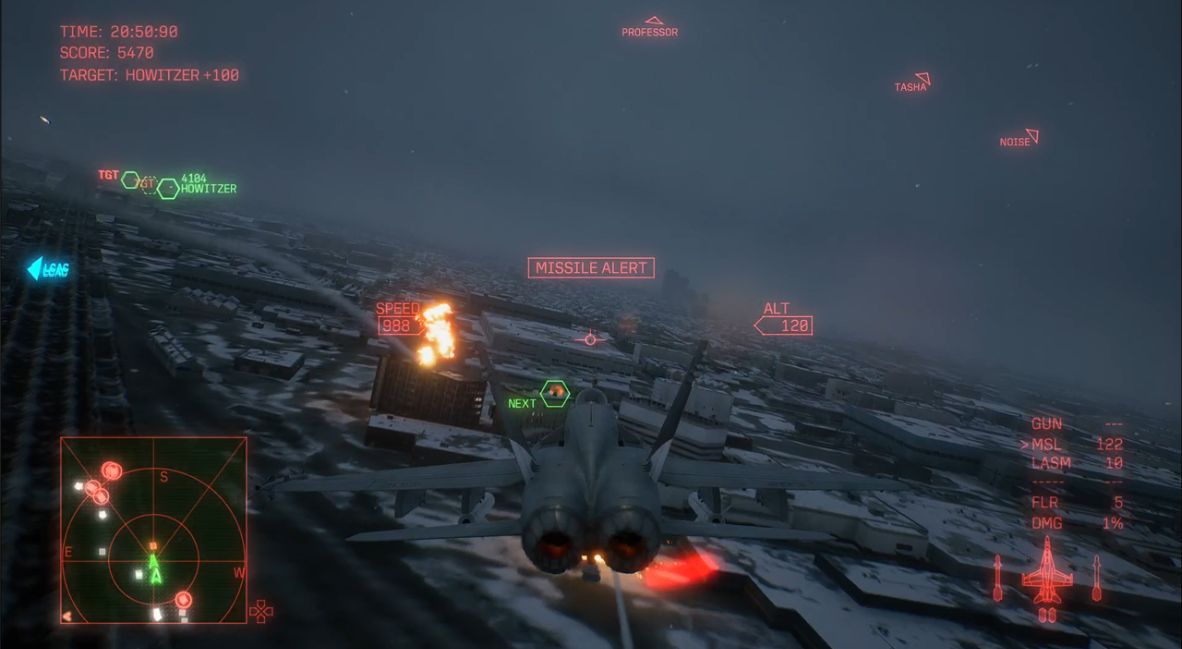
Once the controls click, the dogfighting takes over. Missiles tend to miss when you fire them head-on, so nearly every engagement turns into a scramble to get behind your target, and the HUD flashes a SHOOT cue when your heading lines up closely enough with the enemy’s to make the shot count. Chasing that prompt through a tight turn while watching your airspeed and praying you don’t stall before it pops up is where Ace Combat 8: Wings of Theve shines.
Yes, the clouds are a standout. And yes, they will effect how you play.
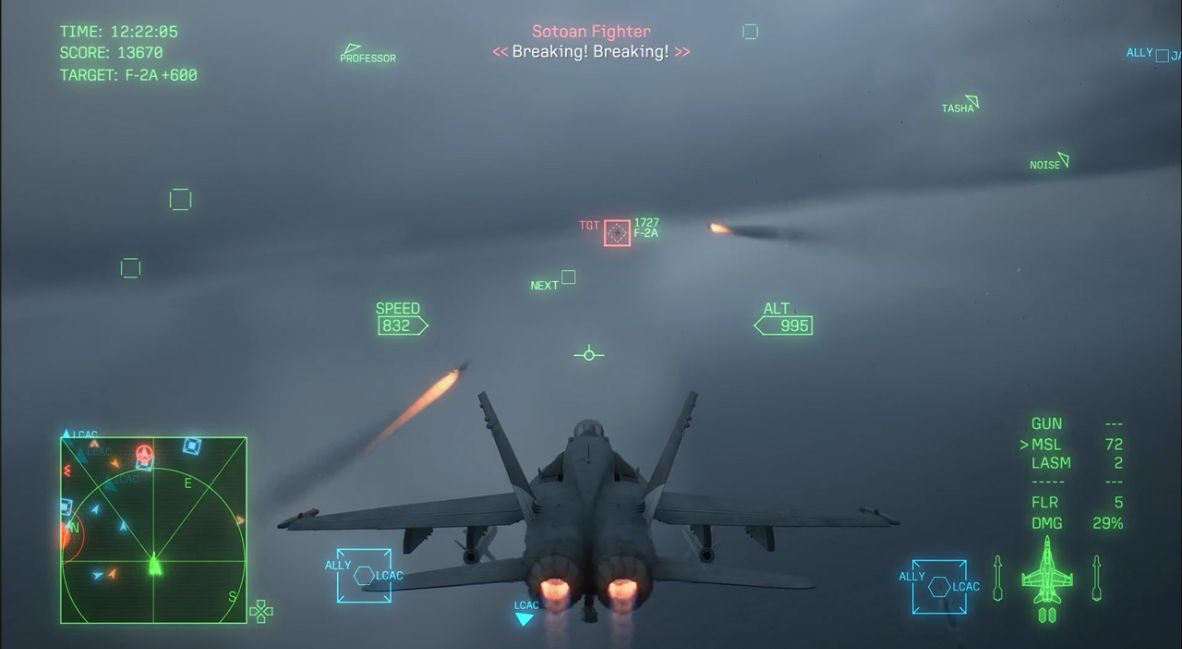
In an unexpected turn, the clouds are the best thing about Ace Combat 8: Wings of Theve. Bandai Namco Aces built its own cloud engine, called Cloudly, to replace the third-party tool behind Ace Combat 7‘s skies, and it stacks the sky in layers that look and behave differently depending on how high you’re flying.
They’re gorgeous to look at, but the bigger surprise is how much they change the course of a fight. Dive into a cloud bank with a missile on your tail, and there’s a good chance you’ll shake it, while an enemy hiding inside one shrinks your lock-on range and can break your lock entirely, which turns firing blind into a quick way to waste a missile.
Linger too long, though, and the clouds start working against you. Ice builds up on your plane until it handles like it’s full of sand, and a lightning strike can knock out your radar. Every dive into cover becomes a gamble between escaping the missile behind you and flying half-blind a few seconds later. Cloudly changed how I flew more than any other system in the game, and all of it ran smoothly on my PS5 Pro, with no performance hiccups during my time with the campaign.
The themes are effective but don’t carry necessary weight.
The wingman commands felt like a gimmick at first. Four orders sit on the D-pad, covering forward attack, dispersed attack, support, and special weapons clearance, and in the opening missions it’s easy to forget they’re there. As the campaign ramps up, that option disappears. I lost count of how many times I called for support to get someone off my tail, or sent Joker Flight after a bomber while I scrambled to bring it down before it reached the target I was supposed to be defending. By the end, reaching for the D-pad felt as automatic as reaching for the throttle.
Carrier landings are a different story. The first one shows up early, and lining up the approach on a moving deck takes more attempts than I’d like to admit before it finally clicked. The game lets you skip them and give up a small score bonus, and it’s easy to assume most casual players will take that deal every time.
Our hands-on preview zeroed in on the story’s identity angle back in June, and the full campaign builds its themes of propaganda and nationalism around it. Carrying a dead man’s callsign, along with a legend that was never real to begin with, gives every sortie stakes beyond the dogfight in front of you and makes each mission feel like part of a larger war. Those themes never hit quite as hard as they could, though, and the handful of story choices scattered through the campaign don’t necessarily carry the weight the game wants them to.
The game stumbles in the sound mixing and when the story pulls you out of the jet.
Some of that feels like it is by design. The flying feels so good that it’s easy to tune out whoever’s talking on the radio and go looking for the next kill. The campaign seems to want thoughtful players to notice that pull and think about how easily people get swept up in a war and the myths that keep it going. It’s a smart idea, even if it hits harder as something to chew on after a mission than as something felt in the middle of one.
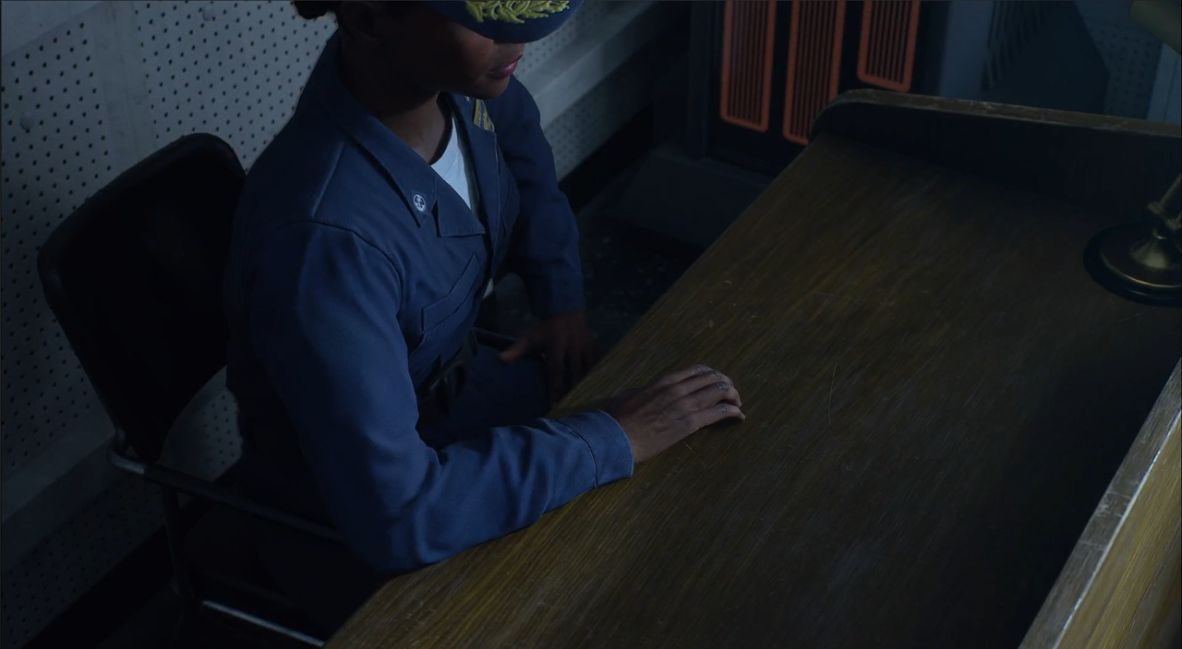
The first-person scenes aboard the Endurance are the series’ newest storytelling experiment, and they don’t work. The goal of putting you inside the ship and letting you look around while your squadmates talk is understandable, but those scenes pull you out of the jet for long stretches, and the momentum from the previous mission tends to drain away before the next briefing starts. I would have traded a lot of that time for more world- and character-building in the cockpit, where the radio chatter has always done this series’ heaviest lifting.
That radio chatter has some competition, though. The soundtrack is good, but the mix pushes it loud enough to bury dialogue in the middle of a fight, and there were stretches where following the music and my wingmen at the same time was difficult. Yes, I’m aware of how old that makes me sound.
Ace Combat 8: Wings of Theve is at its best while airborne.
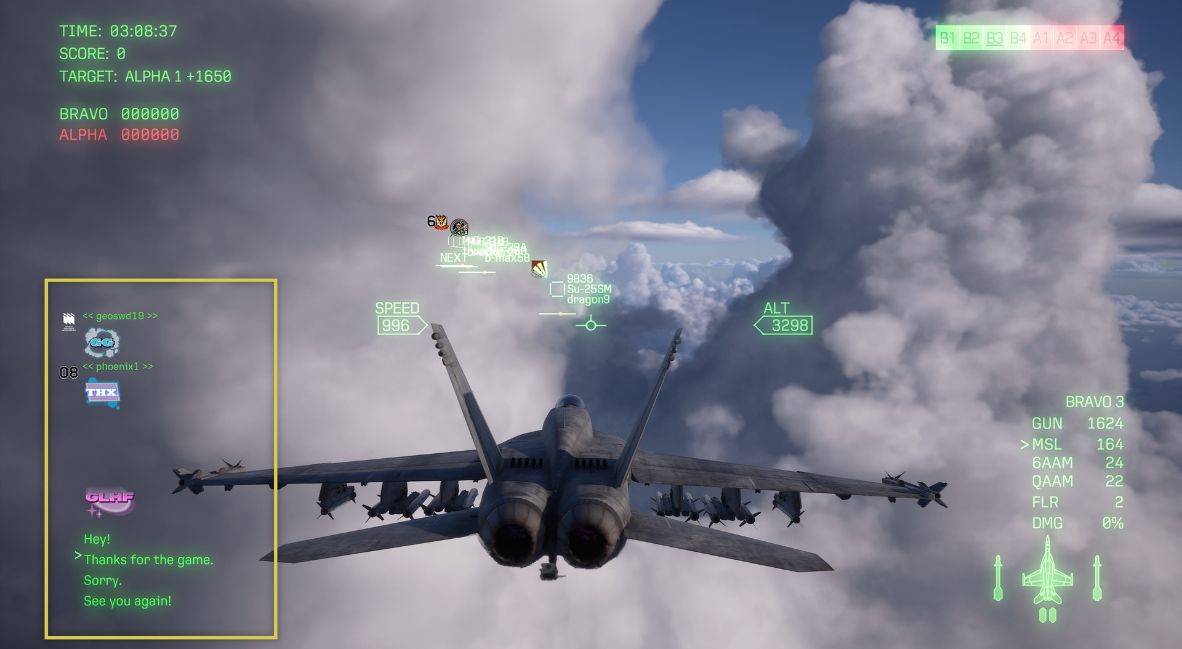
Outside the campaign, Ace Combat Online runs as its own mode with separate progression and an Air Base lobby that holds up to 100 players. The two core co-op modes each put two teams of four in the sky. Co-Op Assault has both squads racing for the higher score against AI enemies, while Co-Op Warfare throws the teams at each other with NPC units filling out the battlefield.
The menus are a mess, and it takes a while to figure out where anything lives. Once the match gets going, though, both modes are a lot of fun, especially with a lobby full of reviewers all playing the objectives. How long that lasts depends on the community. Team scoring works when everyone flies for the squad, and it could get messier once public lobbies fill up with pilots who only care about their own numbers.
Ace Combat 8: Wings of Theve still has some growing to do on the ground, with a story that never quite lands its biggest ideas and first-person scenes that keep you out of the cockpit longer than they should. Once you’re in the air, though, it’s the best Ace Combat has ever felt.
Ace Combat 8: Wings of Theve is available Oct. 2, 2026, on PlayStation 5, Xbox Series X|S and PC.
Ace Combat 8: Wings of Theve
-
Rating - 8/108/10
TL;DR
Ace Combat 8: Wings of Theve still has some growing to do on the ground, with a story that never quite lands its biggest ideas and first-person scenes that keep you out of the cockpit longer than they should. Once you’re in the air, though, it’s the best Ace Combat has ever felt.