

Of all the visual novels out there, few have lived up to the standard set by the original STEINS;GATE in 2009. The series has evolved since then, selling millions of copies across multiple game entries and even spawning an Anime adaptation. STEINS;GATE RE:BOOT, developed by MAGES. and published by Spike Chunsoft, takes an already excellent foundation and gives it a modern facelift.
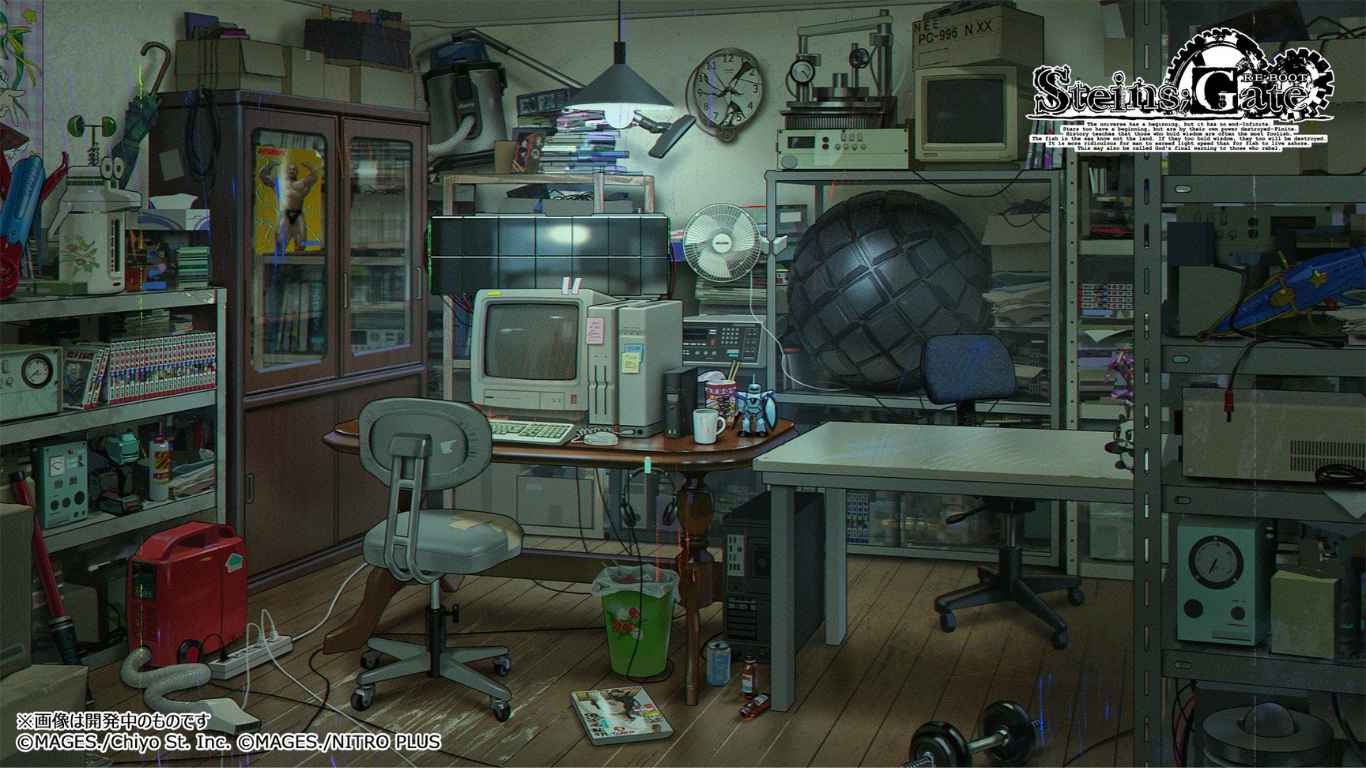
STEINS;GATE RE:BOOT follows the story of Rintaro Okabe, a self-proclaimed “mad scientist” who also runs his own lab. Well, sort of. The Future Gadget Laboratory is run out of a cramped Akihabara apartment that lives on top of an old CRT TV store. It’s not necessarily the most prestigious lab, but it does the job for Okabe and his invention club.
He is surrounded by a team of other young geniuses. Mayuri Shiina is his childhood friend; Itaru “Daru” Hashida is an accomplished hacker; but the real standout is the prodigy Kurisu Makise. Makise becomes almost a second protagonist alongside Okabe. An experiment gone wrong accidentally sends a text back in time, unleashing a dangerous chain of events that quickly spirals out of control.
STEINS;GATE RE:BOOT builds on an already excellent foundation.

The entire premise, set in 2010, serves as a fascinating period piece, but the story takes a little bit to get going. MAGES. has streamlined the story a bit, but as a newcomer to the series, it did still take some time to get used to the pace. Slow doesn’t mean boring, though. The slowed-down pace allows STEINS;GATE RE:BOOT to explore its characters and the setting in a way that makes later story beats really hit home.
STEINS;GATE RE:BOOT takes its time allowing you to feel like you understand the characters so that the shift in tone and stakes later on can have a larger impact. Okabe is the best example of this. At the start, he is playing up an obnoxious mad scientist persona.
He takes fake phone calls with imaginary co-conspirators and is downright absurd. I was not looking forward to more of that version of the character, but there is so much beneath the surface that unveils itself as the story progresses.
By taking the time to build him up, it also allows players to experience how the other characters react to him. The friction between him and the rest of the cast is natural and human, and the relationships shift in real time. Okabe is a top-tier protagonist because STEINS;GATE RE:BOOT allows him to shift from absurd comedy to genuine emotional weight.
Newcomers to STEINS;GATE may need time to get used to the pacing, but it’s rewarding at the end.

It helps that the voice cast, who re-recorded their lines for this release, all understood the assignment. Mamoru Miyano is a prolific voice actor who was already well-established in 2009, but 17 years is a long time for someone to further develop their craft.
He brings a gravitas to Okabe that takes the character to a whole new level. He isn’t alone either; Asami Imai’s delivery as Makise is what makes her such an impactful character as well.
STEINS;GATE RE:BOOT didn’t stop at just re-recording the voice lines. Every illustration and animation was redone from the ground up by the illustrator huke. The 2009 artwork was great, but STEINS;GATE RE:BOOT takes it to an entirely new level. There is a distinct charm to the backdrops that makes it feel like you are genuinely experiencing Akihabara as it was in 2010. That really matters in a visual novel, and huke nailed it here.
Composer Takeshi Abo rebuilt the soundtrack as well, and it pays off. Some of the most powerful scenes in STEINS;GATE RE:BOOT would have been hollow without Abo’s incredibly thoughtful and emotional score backing them up. Updating soundtracks can be divisive for long-time fans, but this one is a certified banger.
Being a visual novel, the focus is on the story more than actual gameplay. There is one major gameplay mechanic, though. The Phone Trigger system is a souped-up way to disguise dialogue choices as a more involved action.
That said, it is not incredibly in-depth, but it does not need to be. I appreciated feeling like a character taking action instead of just selecting a dialogue option. It fits the story of STEINS;GATE RE:BOOT perfectly, but just don’t go in expecting any overly involved mechanics.
STEINS;GATE RE:BOOT’s new story content offers a payoff for franchise veterans.

STEINS;GATE RE:BOOT also features an entirely new story route, the Gamma Worldline route. I don’t want to get anywhere close to spoiler territory, but I was blown away getting to experience it on a second playthrough. Is the additional story route worth a full price tag for series veterans? Probably not. But it is a perfect addition for newcomers wanting to spend more time in this world.
Finding the different paths is not too complicated (although getting the true ending might require a guide if you’re new to visual novels), but all of the side routes are at least worth taking a look at. The save system allows you to save at branch points. You can also skip through dialogue if you end up having to start from scratch. My recommendation is to go in blind and follow where the story takes you. Trust me, it’s worth it.
STEINS;GATE RE:BOOT is a game that rewards your patience with some incredible storytelling. The character work is top-notch, and the updated visuals, streamlined story beats, and excellent performances make this easy to recommend to anyone looking for a new story to dive into.
STEINS;GATE RE:BOOT is available August 20 on PC, with the PS5, Xbox Series X|S, Nintendo Switch 2, and Nintendo Switch versions releasing on October 29. 2026.
STEINS;GATE RE:BOOT
-
Rating - 9/109/10
TL;DR
STEINS;GATE RE:BOOT is a game that rewards your patience with some incredible storytelling. The character work is top-notch, and the updated visuals, streamlined story beats, and excellent performances make this easy to recommend to anyone looking for a new story to dive into.