

Riftbound Vendetta, the fourth set for the League of Legends TCG, is the first maturity point for the game. Over the previous three sets, Riot Games has been laying a foundation of design to some success and some friction. With Vendetta, Riot really does seem to have their sea legs on the ocean of card game design and that’s fulfilling some of the promise its premise offers.
As one would expect, Vendetta brings in brand new mechanics to open up new play styles. While other Riftbound mechanics aren’t bad at all (I’m glad to see XP Yi succeed personally), Vendetta‘s mechanics have a particular elegance about them. All three of them share a common thesis: simplicity. That might seem reductive, but that simplicity makes everything Vendetta brings to the game easy to pick up while being open enough for future iterations.
In fact, the Empower keyword could be called a streamlining of the XP mechanic from Unleashed. Similar to XP, Empower grants extra abilities to Legends, Units, and Gear when they become Empowered.
The difference is that instead of having a separate tracker for the status of the player’s XP, Empowered is a status the cards themselves have. That means that a card is either Empowered or it is not, something much easier to designate on the table.
Because XP is a value that has to be accrued, there’s a bit of buy in that a player has to make when constructing their deck. Without enough ways to net XP, cards that need a certain amount may end up having no impact. On the contrary, Empowered affords much more flexibility. The keyword pairs well with other gameplay strategies, such as with Vendetta‘s Legend for Kennen.
Heart of the Tempest
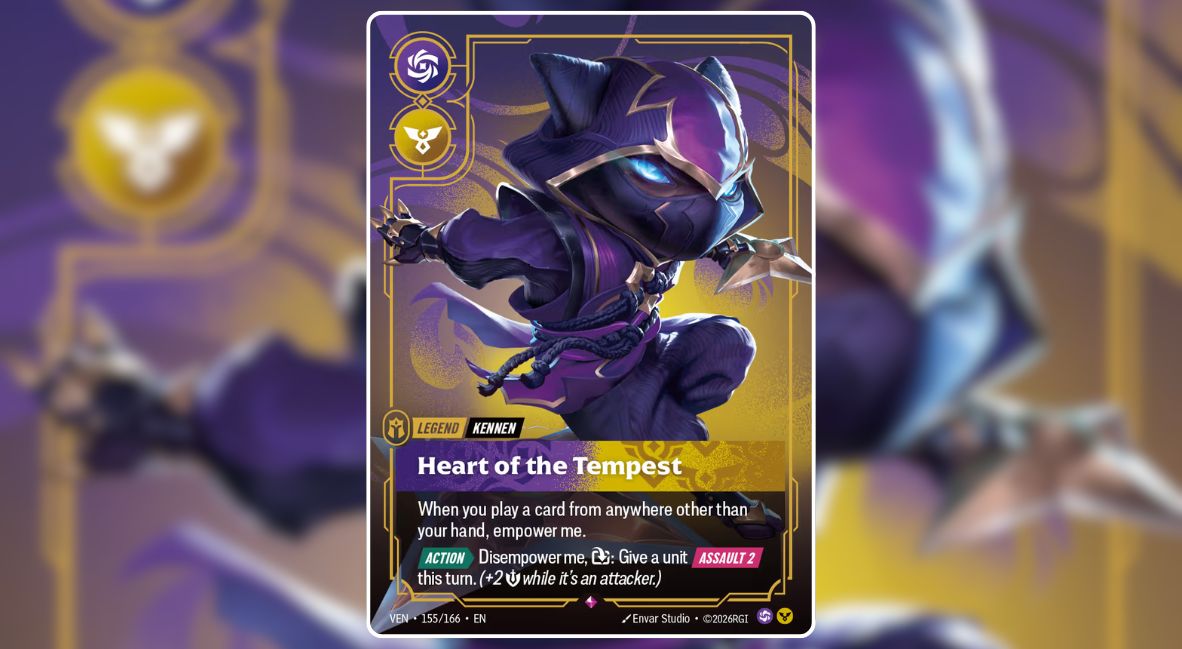
Chaos, Order | Legend | Kennen
When you play a card from anywhere other than your hand, empower me.
Action: Disempower me, Exhaust: Give a unit Assault 2 this turn. (+2 Might while it’s an attacker)
While this Legend does not explicitly say it, Heart of the Tempest wants to be played with the Hidden keyword, playing well with the established actions of hiding facedown cards and then playing them as reactions. Then, on its turn, Heart of the Tempest can make going on the offense easier. That’s the elegance of the design on display – a simple flow that a player can pick up and experiment with.
Heart of the Tempest doesn’t only play well with Hidden, but with Riftbound Vendetta‘s other keywords. Burn and Flow are two separate keywords, but go hand in hand.
Burn directs players to put the indicated number of cards from the top of the main deck and put them in the trash. Then, Flow is an alternative cost that a player can pay to play that card from the trash later, with the card being banished from the game to prevent repeated play.
Riftbound Vendetta uses “Burn” to great effect.
To seasoned TCG players, these likely sound very familiar. Burn is Riftbound‘s take on what the community colloquially calls “mill,” taken from the classic Magic: The Gathering cards that first explored that design and became a keyword in that game.
Many TCGs leverage milling to open up the win condition of removing all of an opponent’s options before they can draw them. And many of them later discover the extra layer: the exciting risk and reward of putting the right cards in the right spot for explosive results.
Flow is that layer in action. Cards with Flow aren’t lost resources; they become extra options. In the right kind of deck build, the player can practically have two hands, to say nothing of being able to double-dip on effects. Yeah, this is Magic’s Flashback in a League hat, but respect to Riftbound for just going straight for quality discard pile gameplay solutions instead of stumbling into them. The way these two keywords play together well, and again, it’s something simple to pick up while having wide applications.
Death Mark | 2 Rune Cost, Recycle Fury or Chaos Rune

Fury, Chaos | Signature Spell | Zed
Burn 3 (Put the top 3 cards of your Main Deck into your trash.)
Play a 0 Might Shadow Clone unit token. (It has “When I attack, you may banish a unit from your trash. If you do give me Assault 4 this turn.”)
Flow 1 Rune Cost, Recycle Any 2 Runes (You may play this from your trash for its Flow cost. Then banish it.)
Zed’s Signature Spell in Riftbound Vendetta showcases the clean lines connecting Burn and Flow. Playing Death Mark will put 3 more cards in the trash, any of which could be another copy of Death Mark.
Plus, if the Death Mark being played came from hand, it will also go to the trash. Depending on resources, a player could immediately follow up with another Death Mark. Before long, Battlefields will be swarming with clones that can use all the remaining Units from the trash to become stronger.
New mechanics aren’t the only strength of Riftbound Vendetta, though. This sets seeds more and more recurring keywords, pairing them up with the new mechanics in interesting ways.
Not every Zed unit has Burn on it, but one may also make a similar Shadow Clone token to pay off playing cards with Burn. Empower’s clean simplicity lets it pair up well with other mechanics to create other interesting lines of play.
Steel Paws | 1 Rune Cost
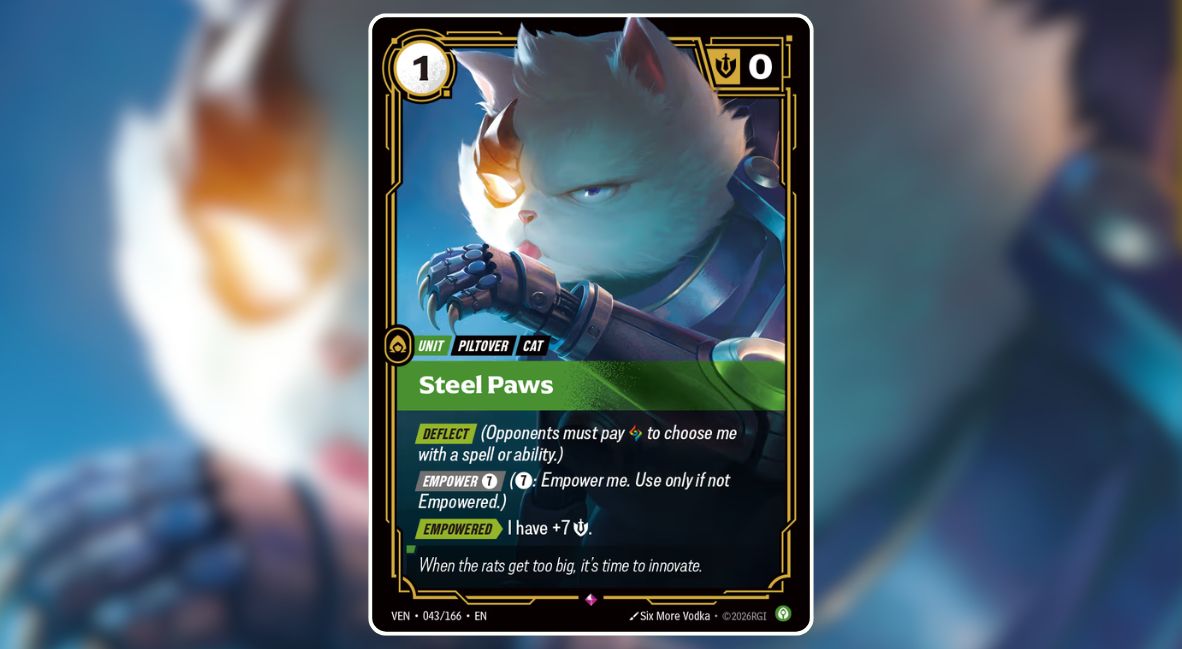
Calm | Unit | Piltover | Cat
Deflect (Opponents must pay 1 recycled rune of any domain to choose me with a spell or ability)
Empower 7 Rune Cost (7 Rune Cost: Empower me. Use only if not Empowered.)
Empowered I have +7 Might.
0 Might
Steel Paws doesn’t look like much at first, and without Deflect there’d not be much to protect it. But having some built-in protection gives the opportunity to build up enough runes to Empower it, which at least has to be some level of threat in a casual game.
No, a card like this won’t break the metagame, but it shows that the team at Riot are not just looking to have each new mechanic they design exist only in their own decks, hand-delivered every set. For those who love brewing decks, these are exciting signals to see.
That said, Riftbound is still trying to figure some things out. Riftbound has been criticized for having a lot of errata and adjustments, including some pretty basic mistakes. One such adjustment is to the sideboard rules.
With Vendetta, the number of sideboard cards players are allowed to have for swapping between games has been increased from 8 to 10. This is a change to be celebrated; it gives competitive players a bit more wiggle room for counterplay as the game’s meta continues to evolve and grow.
The change comes at the perfect time too, because Riftbound Vendetta introduces some honest-to-goodness hosers. Vendetta contains a full cycle of “Decrees,” spells that target an enemy domain type. These give sideboards some staple reactions to meta shifts, which is nice by itself. However, the Decrees also have some elegant design, because the way each one plays is very in character with its own domain.
Decree of Strength | 1 Rune Cost
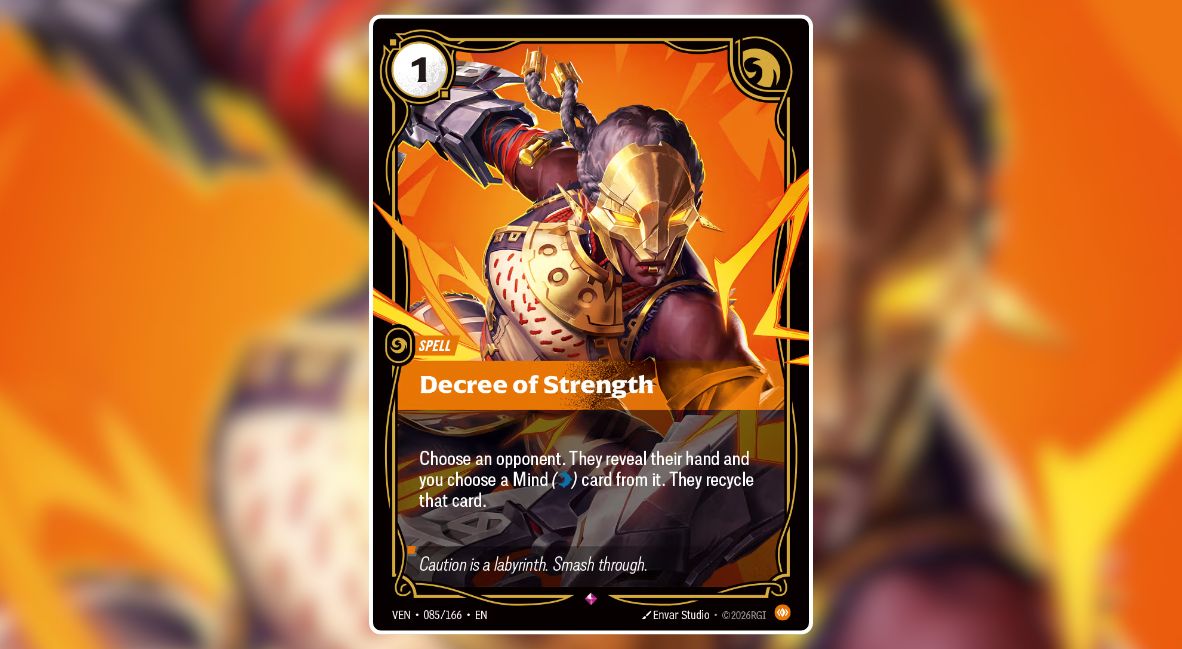
Body | Spell
Choose an opponent. They reveal their hand and you choose a Mind card from it. They recycle that card.
Without spelling it out, Decree of Strength highlights the thematic rivalry between the Body and Mind domains. This Decree targets the hand rather than something in play, because Mind domain cards tend to play reactively.
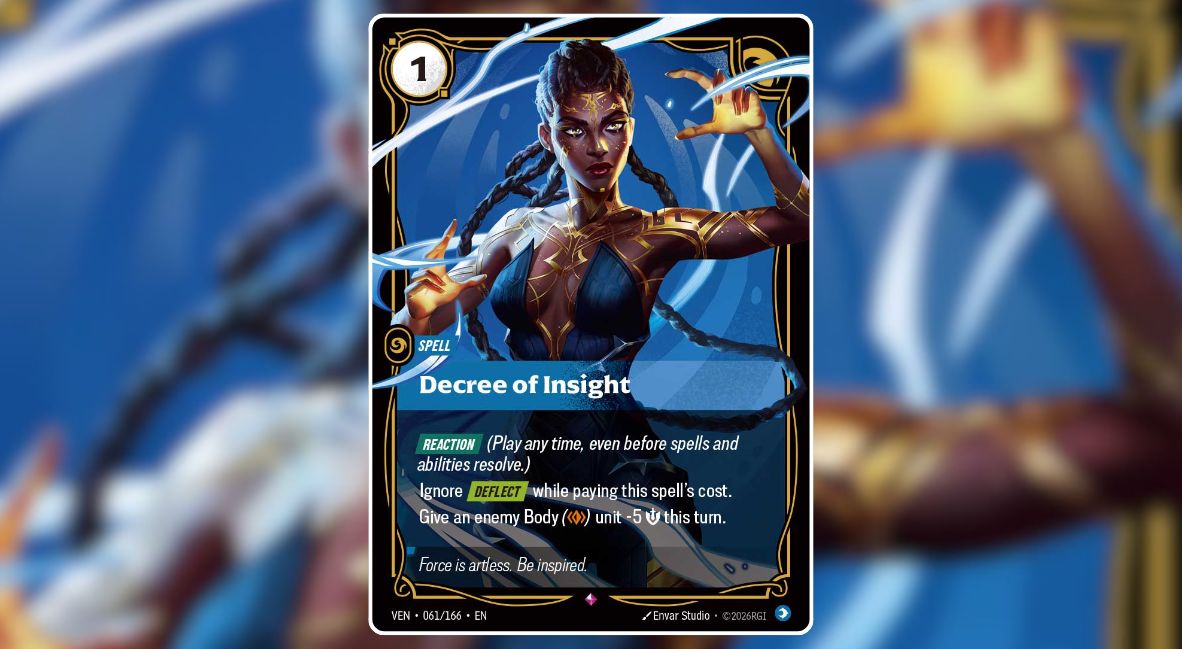
To that end: the Mind Decree, Decree of Insight, is a Reaction, meaning it can be played during an opponent’s turn. It seems kind of obvious when written like this, but this kind of design helps evoke the world of League of Legends without requiring familiarity with the original game. That’s very valuable for long-term success.
With Vendetta, Riftbound is stepping up its design game, and it’s definitely got the juice. These inviting and engaging design choices make the best sales pitch the game has had yet. While there’s definitely some aping of other games happening on Riot’s part, it’s in the form of leveraging best practices to improve and deepen their own ideas. Four sets in, and Riftbound is absolutely hitting a high stride.
Riftbound Vendetta is available now in game stores and via Riot Games.