

Riftbound’s Set Design Lead, Jon Moormann, is confident that Vendetta will shake things up in big ways.
He also offered insight into how his team is helping mitigate card erratas moving forward.
Riftbound, Riot Games’ League of Legends trading card game (TCG), first launched in October of last year with the aptly titled set, Origins. Since then, we’ve seen the release of two more expansions in Spiritforged and Unleashed, plenty of erratas, over a dozen Regional Championship tournaments across the world, and even a few much-needed bans. The next set, titled Vendetta, is the game’s next expansion and, from what we’ve seen, will shake up the game in massive ways.
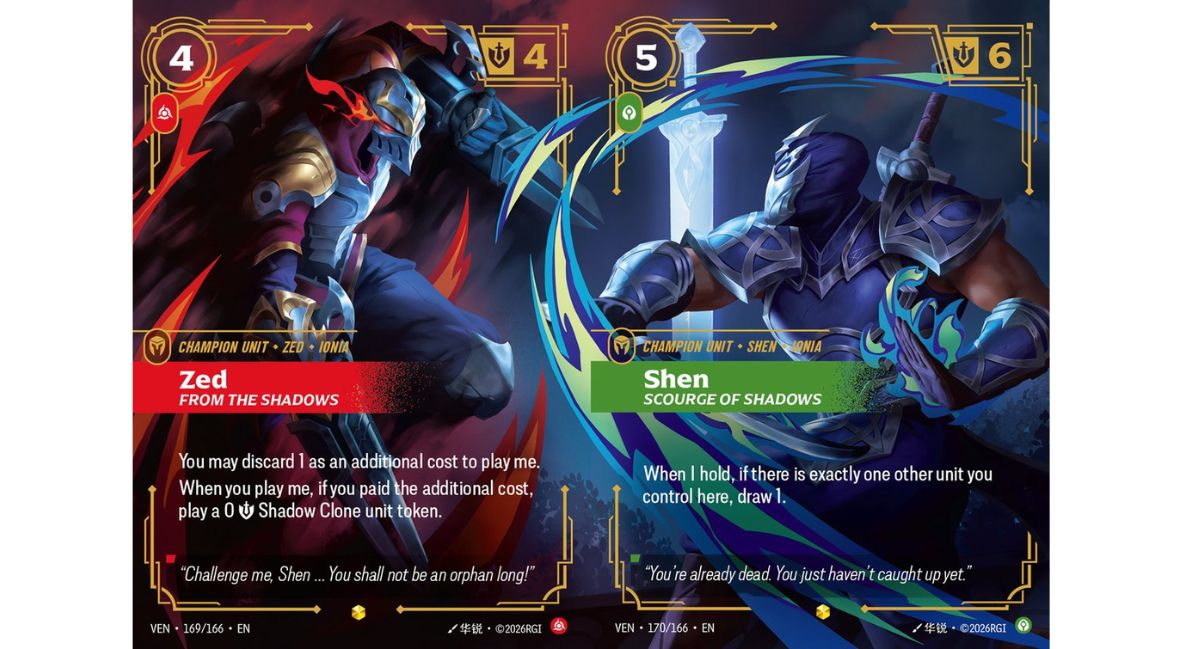
I was recently invited to Riot Games HQ in Los Angeles to get a preview of the new cards from Vendetta, playing a game of Riftbound with Set Design Lead Jon Moorman using the new Showdown Decks featuring classic League Champions Zed and Shen. Since Vendetta is all about iconic rivalries from throughout League of Legends’ long history, it was only fitting that the inaugural Showdown Deck, Riftbound’s version of dual starter decks, showcased one of the game’s longest grudges.
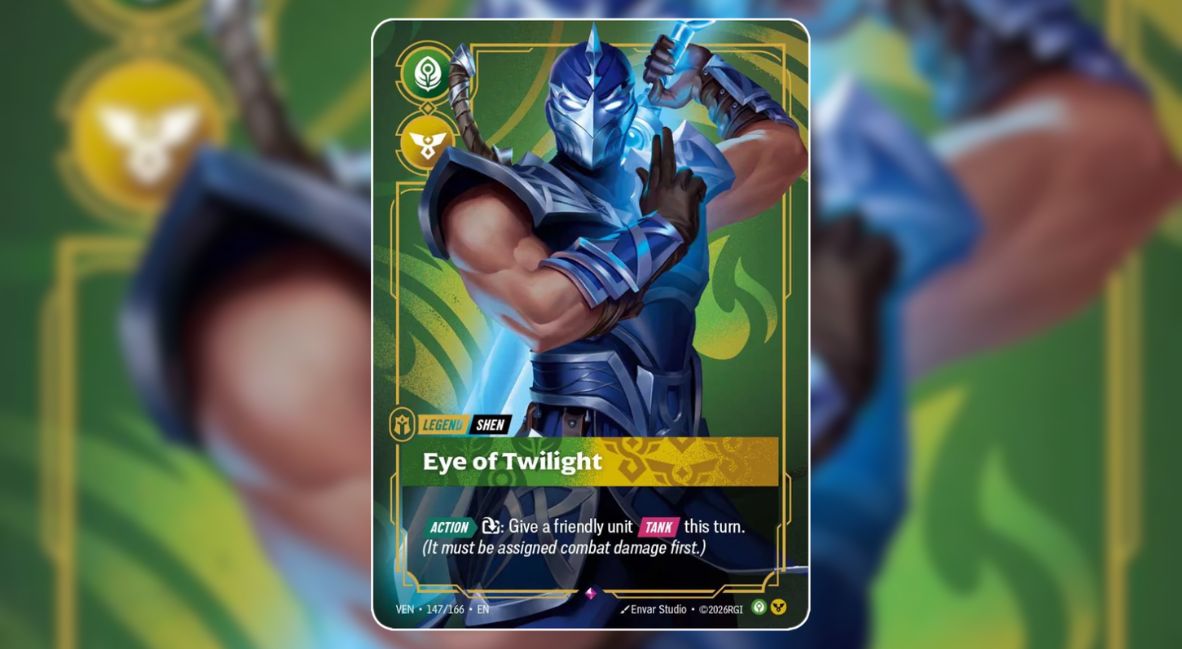
This is even more evident in each deck’s design; Zed is a hyper-aggressive deck that aims to swarm the board, making Shadow Clones and synergizing strongly with the trash pile. Shen prefers to win by offering up strong defenses, holding for points, and giving his units the powerful Tank and Shield abilities to withstand attacks.
But after playing a round, I also was able to steal even more of Jon’s time. We sat down to chat about Riftbound’s fourth expansion, where I was curious about the lessons the design team has learned following three successful set launches and community-supported bans.
This Riftbound Vendetta interview has been edited for clarity and length.
BUT WHY THO: After the third expansion Unleashed and the bans, the competitive metagame feels like the healthiest it’s ever been. Are you hoping Vendetta keeps that trend going or are you concerned about power level at all?
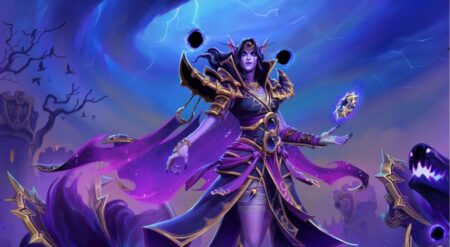
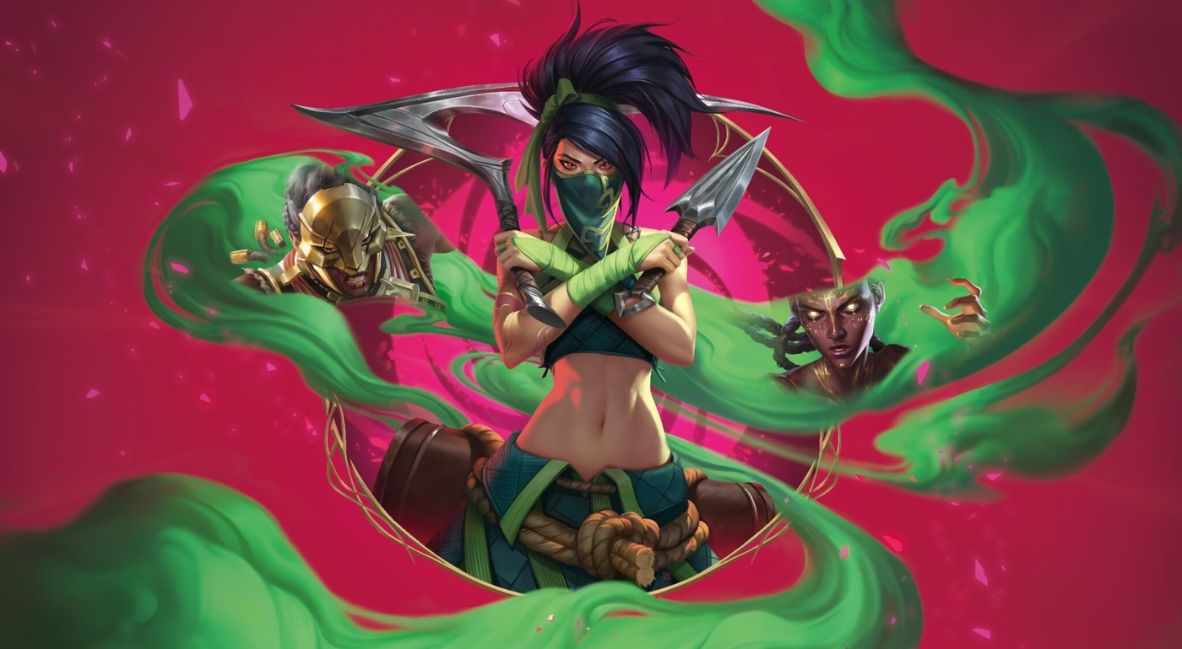
JON MOORMANN, Set Design Lead: I’m definitely hoping Vendetta keeps that trend going. I speak for the whole design team when I say we’re excited to see new Legends showing up pretty consistently, so seeing things like LeBlanc making really strong showings at competitive events is very exciting for us. [Vendetta also] opens up doors to brand decks in a way that’s pretty exciting with Kennan, Akali, and Jayce [using] these opposing Domain decks that we haven’t really been able to build before. I’m excited to see what kind of hay they can make because that’s a combination of cards we haven’t used before.
BUT WHY THO: That leads perfectly into my next question. We haven’t seen the opposing Domain pairings yet, Calm/ Fury, Chaos/ Order, and Mind/ Body. For me as a player, Chaos/ Order feels very strong. Were there any design or balance challenges design for these new archetypes?
JON MOORMANN: The biggest one I can think of is [Jayce, Man of Progress from Spiritforged]. We knew we were going to make Jayce [Mind/ Body] at some point, and so were like “we can NOT let this put [Dazzling Aurora] into play”. So we intentionally changed the design of that original card so that the maximum size of the Gear that you can put into play is not the same as Dazzling Aurora. And obviously [Chaos/ Order] will have its own [card combinations], and honestly all of the color combinations have some stuff that works together better than you’d expect and opens up some new doors you wouldn’t necessarily see otherwise.
BUT WHY THO: You mentioned changing a card mid-design process. Since Origins, every Riftbound set has seen numerous erratas post-launch. With Vendetta or future sets that you’re currently working on, are there plans in place to mitigate that and have cards ready to go at launch?
JON MOORMANN: Oh, yes. We’ve already started the process of mitigating it. It’s an unfortunate thing with tabletop games; it’s a very large boat, and it’s hard to turn it. So in some ways, we’ve brought people onto the team that are specialized in editing and specialized in rules in a way that we didn’t have when the team was smaller.
We’ve basically been able to grow our capabilities to make sure we’re doing less and less errata. I like to think that’s true even with Vendetta, but it’s especially true [for future sets]. Origins is kind of a special case where we didn’t 100% know all the rules of the game at that point, we’re still kind of figuring out what the game does. I think we’ve gotten better at writing cards since, speaking as one of the people who was not as good at writing cards at the time [laughs].
BUT WHY THO: Vendetta is your smallest set to date, with 133 new cards including 9 Legends, whereas the other sets would have 12+ Legends. Were there any challenges designing a smaller set in terms of balance or for Draft?
JON MOORMANN: It’s an interesting thing; we knew that we wanted to open up with larger sets. We needed to kind of get a bunch of cards into the Riftbound pool to make it feel like it’s an interesting competitive environment. If we continued at 12 Legends per set, I think we’d get to a point where Standard (currently the only constructed format) becomes overwhelming, and you can’t actually know everything you might go up against. It would just be over-taxing to the player.
There’s a good value, we think, [where] we want to have enough Legends to where it’s exciting, and you don’t feel like you’re playing against the same [deck] every round, but not so many Legends that you literally can’t know what the cards do. So I think small sets and moving towards this shape helps us even that out and introduce new strategies.
In terms of balance for draft, 9 Legends is a bit easier than 12. We managed to line up our colors still, so that colors have various things, and we’re really working on developing our methodologies for limited formats. I think as the sets move along, they get better and better. There are definitely some crimes committed in Origins I wish I could take back with some uncommons (laughs).
BUT WHY THO: Something that kind of plagues older TCGs is power creep. With Riftbound currently, I don’t think it’s become an issue quite yet, but is this something you’re keeping an eye on long term?
JON MOORMANN: Absolutely. Power creep is something that we kind of always have to be aware of, because we have to walk this balance between: I’m going to get you to play the new cards, because that’s when the game is fun and exciting, but at the same time I don’t want to make it feel like the cards you already own are not valuable.
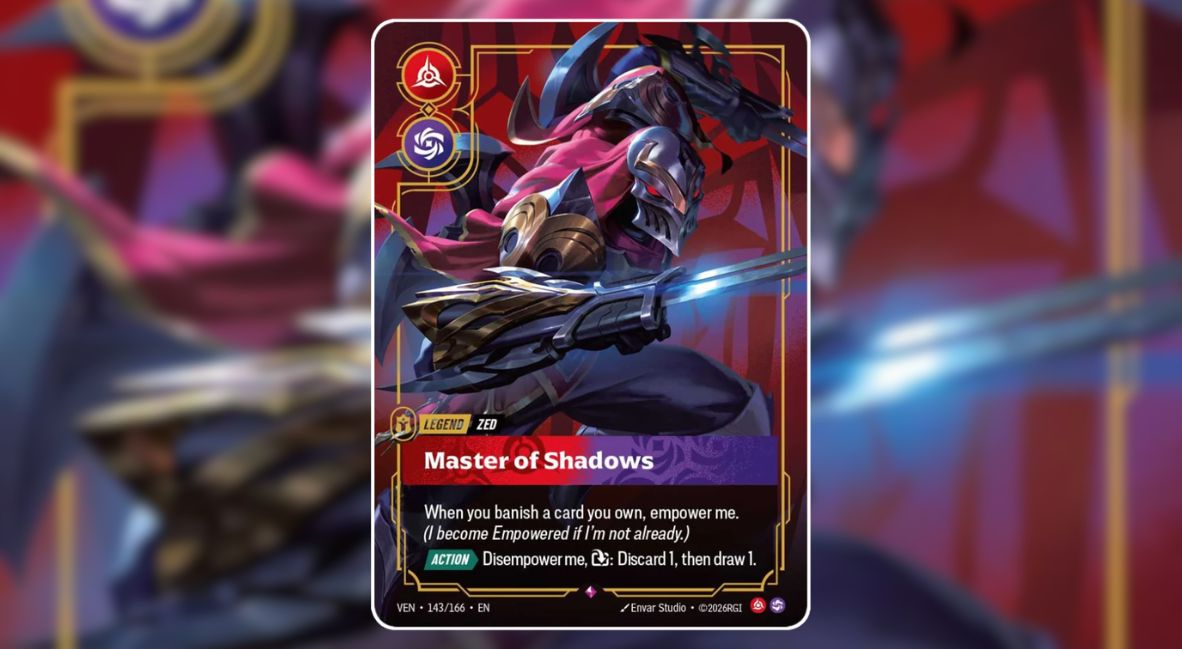
That’s why I think doing things like going enemy Domain pairs is really strong for this . . . But Zed, for example, [synergizes with Flame Chompers]. He gives you a discard outlet, and he really pays you off for getting things out of your trash that’s just banishing in general, that works well with [Vi, Destructive].
Being able to do these elliptical patterns where we look back at previous sets and say, “how can we make Zed with the context of the cards that exist before?” lets us reawaken these existing cards that may not be as strong. And similarly, Zed’s going to introduce a lot of stuff that’s really good for [Jinx, Loose Cannon], Punching Poro is the best 2-drop Jinx is going to find.
BUT WHY THO: This is another issue I don’t quite think is necessary yet, but a lot of the community has called for banning Dazzling Aurora. What are your or the team’s thoughts on this?
JON MOORMANN: Dazzling Aurora is a really interesting one. We can ban cards for a lot of reasons. Sometimes it’s for direct power level, or very specific interactions. Sometimes it’s for play pattern issues. We are aware of the fact that Dazzling Aurora, while not dominating the meta from a win percentage [perspective], we don’t love the idea that the best way to get a [Best-of Legend card] for any [Body] champ is to just run the same Dazzling Aurora shell back to back. [So we’re keeping an eye on it always].
BUT WHY THO: In that same vein, how has the Called Shot/ “Miracle” package affected your design philosophies moving forward? Are you on the lookout for infinite or near-infinite combos?
JON MOORMANN: We’re definitely keeping an eye out for infinite combos. We love seeing the crazy stuff people come up with, and we don’t think every combo is inherently unhealthy. Miracle was sort of a special case because it was fairly competitive and also took a long time to execute, which made it a problem in tournaments. But yes, definitely something we are watching, and we’ll pursue action when necessary
BUT WHY THO: Are there plans to support more multiplayer formats going forward outside of just Regional Qualifier side events? Maybe on the LGS-level?
JON MOORMANN: Long term, we want Riftbound to be enjoyed in multiplayer; we designed it to allow for that, but we want to make sure the current competitive scene is stable and expand as there’s demand for it.
BUT WHY THO: Riftbound is no stranger to cards getting the alternate collectible variants on cards, and Vendetta has 50 of them with various Overnumbered versions. How do you decide which cards get this treatment?
JON MOORMANN: Vendetta is a set all about rivalries in League lore, so we wanted our Showcase cards to represent that with the diptych series. So we wanted to feature some of the rivalries within the set, as well as famous rivalries from champions already in Riftbound.
BUT WHY THO: With how many different rivalries there are in Riftbound, how did you arrive on Shen and Zed being the mascots for the Showcase Decks?
JON MOORMANN: Showdown decks are meant to be played against each other, so to fit Vendetta’s theme we knew we needed to pick some classic enemies from the set. From there, we also wanted to choose two decks that played well into each other, showcasing different speeds and philosophies on the game. Zed’s aggression against Shen’s defensive hold gameplan just made sense. Also, who doesn’t like ninjas.
This last question was answered by Design Director Nik Davidson over email, and was requested by my local Riftbound community in Los Angeles.
BUT WHY THO: How do you decide what Skirmish promos will be available? Are there plans to offer any with alternate art in the future or offer more meta-viable cards compared to what we’ve had so far?
NIK DAVIDSON: Not much we can say on this one yet. We’ve received a lot of feedback on the Summoner’s Skirmish program. We’re actively evaluating ways to improve local play for players, including it. We’re not quite ready to share details, but we can say that this program is one that we are particularly interested in improving. More info will be available in weeks, not months.