

In the first few episodes of Go For It Nakamura!, you kind of think you’ve got the show’s tone and rhythm figured out. And, certainly, the series doesn’t stray too far away from that immediate charm that is equal parts coming-of-age awkwardness and gag humor. But the further it progresses, most notably at a midway point and the final two episodes of the season, the more this silly, joke-heavy series finds itself poking at a tender, sweet heart.
The silliness is inherent – crucial, even. And the adaptation has no interest in straying from that fact. But by bringing to life the gentle sense of infatuation and heartache, the series from Studio Drive accentuates the story’s generous charms.
Over the course of thirteen episodes (here’s hoping for a Season 2), we watch as Okuto Nakamura (Chiaki Kobayashi, tremendous) clumsily deals with, processes, and strengthens his crush on classmate Aiki Hirose (Yuki Sakakihara). At first, this merely amounts to a sequence of cringe-inducing results. From uncomfortable efforts to impress Hirose to letting another classmate draw art of the two of them as his favorite BL manga protagonists and his constant overreactions to any slight, friendly affection from Hirose, it’s astonishing how often you’ll want to close your eyes.
Being a teenager is, objectively, awful. Being a teenager with an unrequited crush? Even worse. And for a while, it’s hard to watch Nakamura as he keeps stumbling or sticking his foot in his mouth. However, as Go For It Nakamura progresses, the more enjoyable his journey becomes because it’s less about him giving fruitless chase over a boy who can’t return his affection and more about the ecosystem of the school, growing pains, and what it means to grow up as a queer kid in a space where heteronormative lifestyles surround him.
The anime adaptation builds on the highs of Syundei’s manga.
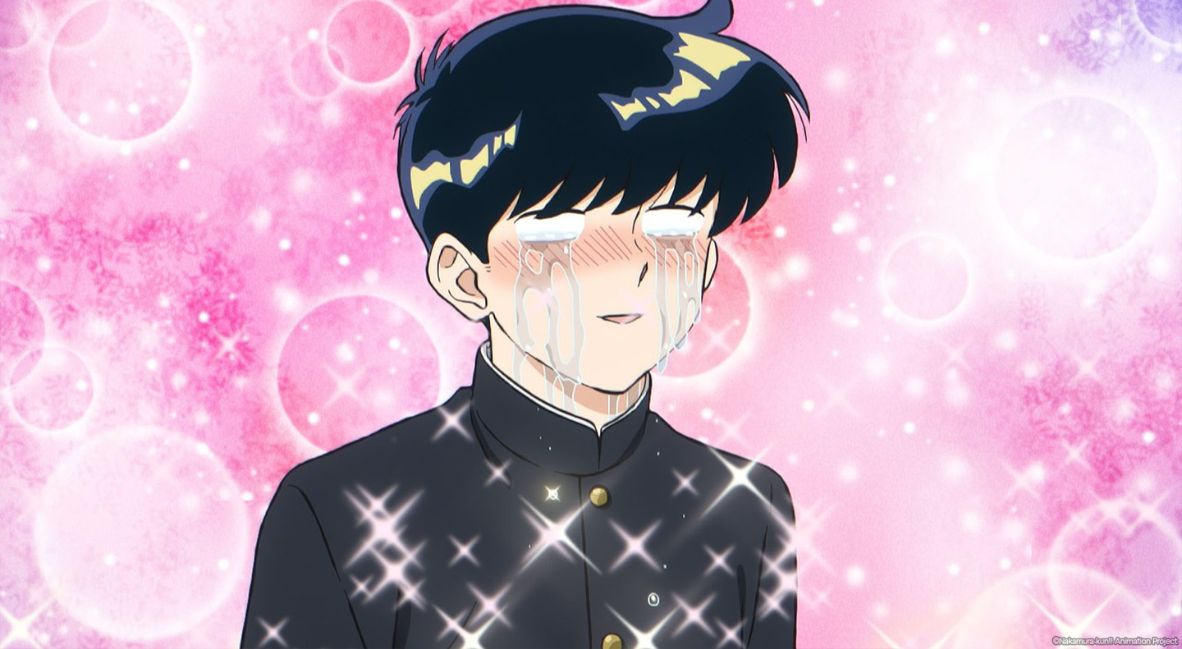
That it captures all of this while maintaining the abundance of humor and physical comedy is a testament to the series’s ability to find the innate humor of being a teenager and the pain of it. It is, without question, a formative period in our lives. It helps when a wider cast is introduced.
The ensemble might not be as pivotal a focus as other coming-of-age, slice-of-life anime, but it allows Nakamura to breathe a little. Because, again, he’s introverted and shy but not incapable. It’s only Hirose who leaves him tripping over his words. Meanwhile, he has to face down an unlikely antagonist (a boy from another school similarly obsessed with Hirose), the leader of an occult club, a student filmmaker, and maybe even a ghost.
Based on the manga by Syundei, the anime helps expand on the ideas with original stories and sequences that build on the established world. It’s a smart adaptation, written by Aoi Umeki and Yasuko Aoki, that shines a light on the story’s strengths while tamping down on some of the more uncomfortable elements of the source material.
While the ensemble is fun, we care about Hirose and Nakamura.

But the real strength lies in the burgeoning relationship between Nakamura and Hirose. They are, without question, the heart of the series, with Nakamura in particular being the key driving force. It would be easy to be frustrated with the series playing up the ‘boys love’ labeling with how much it, in the end, focuses on the friendship between the two. Some very likely people tuned in for the whole idea that a gay couple would be the winning romance. But there’s something so profoundly touching about their dynamic – platonic or otherwise – that it’s hard to be mad at it.
If anything, it feels more realistic. And that might be the issue, the idea that the story with the queer protagonist isn’t offered the same sense of fantasy and happy ending that a straight couple in a shojo would inevitably get. And it’s certainly frustrating that so few actual BL anime adaptations achieve the same level of animation as Go For It Nakamura (even the best adaptations suffer from slide-show-style effects to save budget). But the overall effect is so goddamn charming and well-earned.
Because Hirose, from the start, is receptive to Nakamura as a friend. It’s why Episode 6 is such a stunner. When Nakamura, summoning all his courage, asks Hirose to be friends, Hirose responds that he thought they already were, and it’s clearly something Nakamura needed to hear.
Go For It, Nakamura prioritizes the friendship between the two leads.

From their Go For It, Nakamura continues to develop their friendship, even when Nakamura still harbors a crush. And it’s most threatened when Hirose, for what seems like a week, gets a girlfriend. The penultimate episode of the series bruises with the intensity of Nakamura’s hurt and confusion.
Hurt because his crush remains unrequited, and with visible proof that he was never (seemingly) an option in Hirose’s eyes. Confusion, because he’d thought he knew this was an inevitability. He thought he was in on his own fantasy, knowing that it couldn’t come true, but happy for Hirose as long as the latter was happy.
The direction in the episode is stunning, keeping an arm’s length between the framing and Nakamura’s pain. There’s greater emphasis put on his physicality – the hunched shoulders and clenched hands – zooming in on the tears as the wounds make themselves clear to him.
Add to that the deliberate point to depict him walking through a crowd of heteronormative pairings on dates or raising kids, and it offers a subtle but no less pointed insight into just how isolated he’s currently feeling. All of which is topped off by the end credits, which are absent of the usual city pop needle drop that becomes customary (and different each episode) throughout the course of the series.
Overrun with infectious writing and characters, Go For It Nakamura is a standout.

That clever direction isn’t specific to just Episode 12. Instead, it’s indicative of the overall quality of Go For It, Nakamura. Because the series is stunning. The tone mimics the character’s retro style for an overall aesthetic that appears timeless due to the heavy lines and grainier shading. It’s a lavish production, with colors that pop and linework that gives the world texture. All of it lends itself to the distinctive quality of the style, which blends classical models with a fresh, energized animation style.
From the way the characters move to the incessant physical comedy (Nakamura simply power-walking in an effort to find Hirose the perfect gift is hilarious) to the vibrant backdrops, there’s a clear artistic vision. Even those city pop numbers from ’80s and ’90s catalogues are handpicked to help stress Nakamura’s emotional state.
There’s room to believe by the finale that Hirose could, potentially, one day harbor feelings for Nakamura, alluded to through subtle blushes and gestures. But that is not the story for now. Instead, Go For It Nakamura embraces a retro style with palpable thrill, delivering a frequently hilarious, often heartwarming journey of one boy learning to deal with what it means to have a crush and all the exuberance and pitfalls that come with it.
The painful awkwardness gives way to genuine excitement whenever he earns a win, and the series clearly knows it has a winning foundation. What it builds from there only heightens the existing joy, sweetness, and hide-behind-your-hands level cringe of the source material.
Go For It Nakamura! is streaming now on Crunchyroll.
Go For It Nakamura
-
Rating - 8/108/10
TL;DR
Go For It Nakamura embraces a retro style with palpable thrill, delivering a frequently hilarious, often heartwarming journey of one boy learning to deal with what it means to have a crush and all the exuberance and pitfalls that come with it.