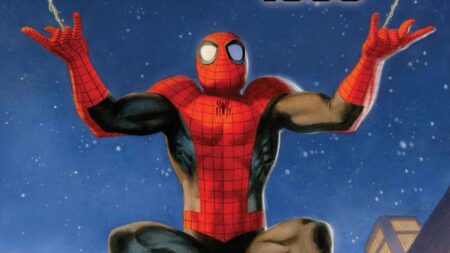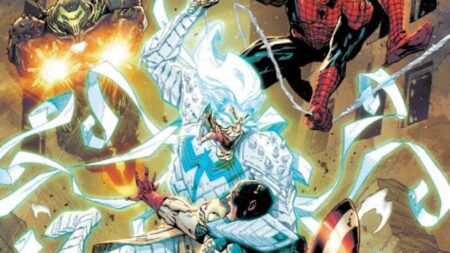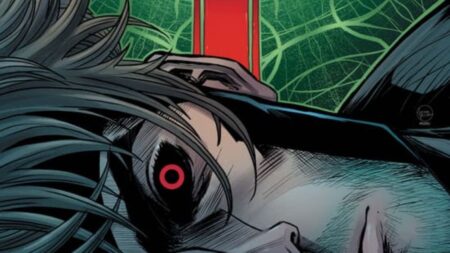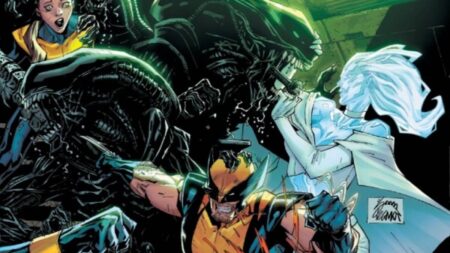


Queen in Black: Defenders of Black and White Issue 1 is published by Marvel Comics, written by Al Ewing and Tom Waltz, art by Zé Carlos, colors by Fer Sifuentes-Sujo, and letters by Joe Caramagna.
This is part of the Queen in Black crossover event. Two strike teams hit the two big enemies, Hela and Knull.
Arriving at the same time as the main Queen in Black book, it means that reading this tie-in in conjunction with the first issue of the event is essential. It takes place right after the final page of the opening chapter, with Cable and Iron Man creating two teams to tackle both major villains of the crossover at the same time. A team of Darkforce users, including Cloak and Darkstar, backed by Iron Man, Anti-Venom, and Cable, attacks Knull. And then a team of light-based heroes, notably Dagger and Photon, led by Beta Ray Bill, goes after the Symbiotes.
It’s a sprawling, chaotic opening issue that has come to be expected in this event. The book bounces between the two locations as the true power of their enemies is revealed. There are individual plot threads on both sides of space, stemming from both the Asgardian element and the war between light and dark. Queen in Black: Defenders of Black and White Issue 1 spends a long time setting up what each team is meant to do, but then the pacing becomes rapid and frantic. The danger is apparent from the start, with either battle having its own unique challenges. And from the ending, no one is safe from the immense power of the villains.
There is an enormous cast in Queen in Black: Defenders of Black and White Issue 1, making it hard to build each character’s personality, but Ewing and Waltz do try, largely by having two figures central to each battle. That falls to Cloak and Dagger, Earth’s own embodiment of dark and light. However, these two runaway teenagers are far out of their depth, and each hero reacts differently to being thrust into the action.
Cloak is desperate to fight and help, but is pushed back by Iron Man and Cable. To them, he is their egress and necessary to escape. Meanwhile, Dagger is daunted by her company and the enemy. It creates an uneasy tension across both sides of the story. With the ragtag nature of each team, there isn’t an immediate synergy within it. Iron Man is like an encouraging coach of a sports team, whilst Cable is a serious general forged in a future filled with pain.
Beta Ray Bill has become a serious weapon and figurehead within Queen in Black, with an otherwise absent presence of Asgardians. So when Tyr, the God of War, touches down, there’s a fascinating confrontation with delectable dialogue. It questions Beta Ray Bill’s connection to Asgard, the loss he feels alone, and what he would do to save it. Then there is Knull, who has an entirely new approach to life. Now, he is a master of light, and that gives him a fresh set of powers, which his enemies never accounted for. He and Hela are just various forms of evil on opposite sides of the light spectrum,
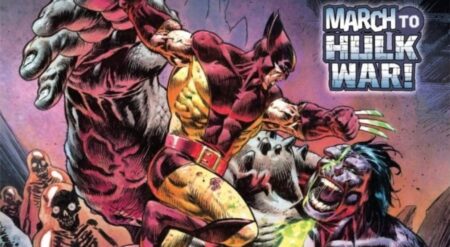
The art unleashes two battles simultaneously, with page after page of action. Both battlefields have their own enemies to fight. Knull’s minions are crystalline creatures, his seraphim. They are spiky beings backed by Knull’s favorite creatures: dragons. Meanwhile, Hela and Tyr have an army of symbiotic soldiers, with swirling masses of tendrils, vicious teeth, and extended tongues. Carlos brilliantly captures the variety of powers and fighting styles his heroes possess as well.
Iron Man switches from his normal armor to something bulkier and built specifically for the task at hand. And yet, despite the enormity of the situation, Carlos also spends time detailing just how bewildered Dagger is. There’s a significant power gap between her and the likes of Monica Rambeau and Sunfire. Not only that, but there’s a clash between the huge bodies of Beta Ray Bill and Tyr, which is something much more physical.
The colors create an ominous atmosphere throughout the comic. Knull may now be a champion of light, but there are corners of his new home that are dark. The intruders also bring the fire and vibrancy, which livens up the action even more. In Hela’s arena, the red and black are almost oppressive, threatening to suffocate those who enter. In this regard, it falls to Earth’s defenders to try and brighten up the place. The lettering is consistent with the main book, even when handled by a separate letterer.
Queen in Black: Defenders of Black and White Issue 1 continues the chaos from the start. As the event has unfolded, Queen in Black has barely provided time to hesitate or even breathe. In the same week, three parts of the same crossover release, and that’s a lot. That has positives and negatives, from the distance already traveled to the money needed to collect the comics. What’s also mind-blowing is that Carlos illustrated both books, which is an astounding level of work. The light-and-dark motif is now being reflected in the villains, along with an alarming collection of heroes and villains. The crossover is moving fast, and if you don’t hang on, it can throw you off.
Queen in Black: Defenders of Black and White Issue 1 is available now wherever comics are sold.
Queen in Black: Defenders of Black and White Issue 1
TL;DR
Queen in Black: Defenders of Black and White Issue 1 continues the chaos from the start. As the event has unfolded, Queen in Black has barely provided time to hesitate or even breathe. The crossover is moving fast, and if you don’t hang on, it can throw you off.