

Mongil Star Dive, a free-to-play action-adventure gatcha game developed by Netmarble Monster and published by Netmarble, invites players to go on an adventure with protagonists Cloud and Verna to save a colorful world from the return of an ancient evil. Along the way, they’ll make friends, overcome dangerous foes, and discover treasures. That is, if you can endure the game’s several egregious faults.
The game’s world is, at its heart, a bright, eye-catching place to tell a fun adventure story in. There is a Saturday morning cartoon vibe to much of the design. Bright colors and monsters that are often cuter than threatening roam the wild areas, promising a laid-back, enjoyable road ahead. And by road ahead, I mean it more literally than you might expect.
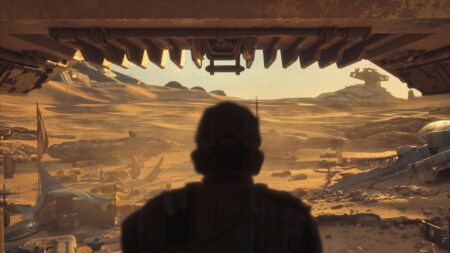
While Mongil Star Dive’s world is broken into zones, these spaces are mostly explored via linear paths that guide the player from point A to point B. There are frequent side paths that can be explored, typically leading to a small battle or a puzzle that will reward you with a chest. But this isn’t a big open world to run around and explore. This more linear pathing isn’t fundamentally bad, but it does lower the scope of the experience. Don’t expect to run around a world searching for chests and the like.
The cast of characters is one-note and obnoxious.
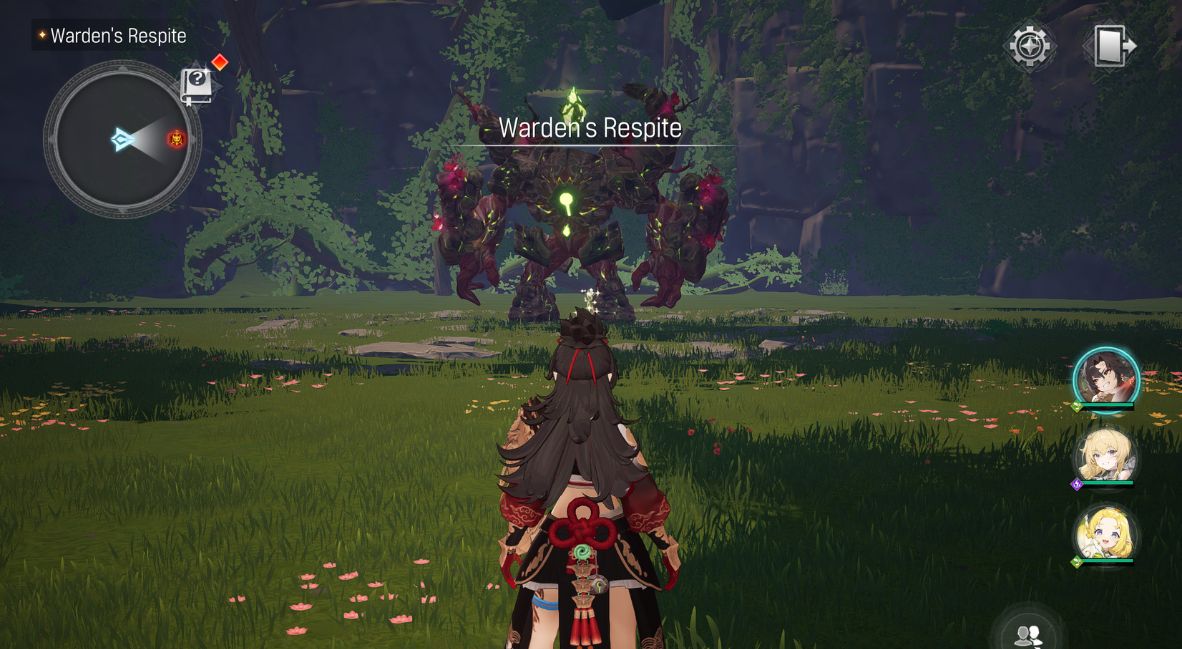
Making navigation even more straightforward is the inability to jump, climb, or perform any other traversal besides walk/run. There are contextual moments where the player is prompted to push a button and jump or swing across a chasm, but that’s it. This quickly makes map traveling unexciting, as you just run everywhere.
This is helped by generous fast travel points, so you won’t have to mindlessly run any more than necessary.
While the world itself has its charm, even if it is unexciting to navigate, the same cannot be said for the game’s cast. Every character is both one-note and obnoxious in their own special way. Cloud’s constant inane observations are rivaled in their unwelcomeness only by Verna’s constant derision of him. Their back-and-forth feels like it’s supposed to be humorous, but it never is.
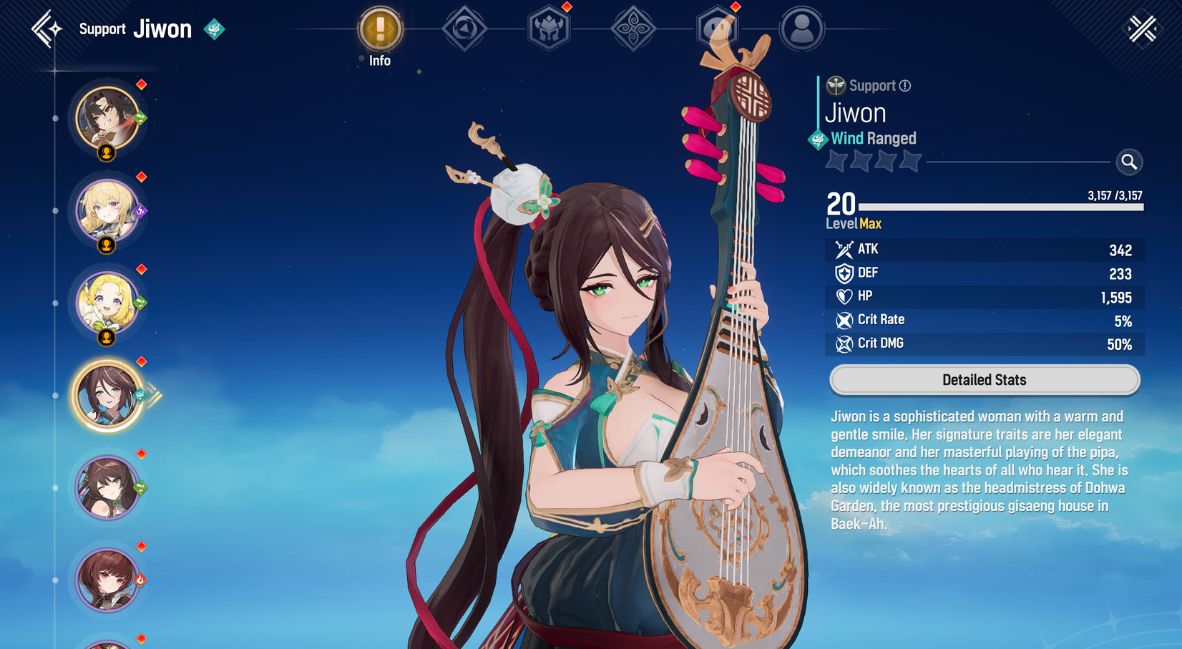
The struggling leading duo gets no help from its supporting cast. Each person has something they cannot help but talk about constantly. Whether it’s Flair’s desire to set anything she can on fire, or mage/nurse Francis’ need to interpret any social situation into an awkward expression of love, every character here overstays their welcome in minutes. If you are a cutscene skipper, you are in luck; you will miss no interesting characters here.
The plot of Mongil Star Dive is familiar but has its charms.
The general plot, by comparison, is better, but only because it doesn’t go out of its way to be bad. The “rush to stop the ancient evil” fantasy plot is as well-worn as they come, but there is a reason it sees so much use. If the cast were likable and compelling, the story would be serviceable as an excuse to tag along on the journey. However, it’s not nearly enough to provide a compelling reason to pursue the game.
So, if the narrative side struggles, does the gameplay pick up the ball? Sadly, it lands in the same spectrum as the rest of the game: serviceable at best, bad at worst. In the story, it is the grand that is fine, but the characters that struggle; this time, those roles are inverted. The moment-to-moment is fine, but the larger structure falls to pieces.
The combat in Mongil Star Dive sees players form groups of three heroes, each with an elemental affinity and class. The class breakdowns are somewhat unique. Rather than focusing on classic groupings, the game breaks into different territory: fighters are best against crowds, while destroyers are best against individual encounters.
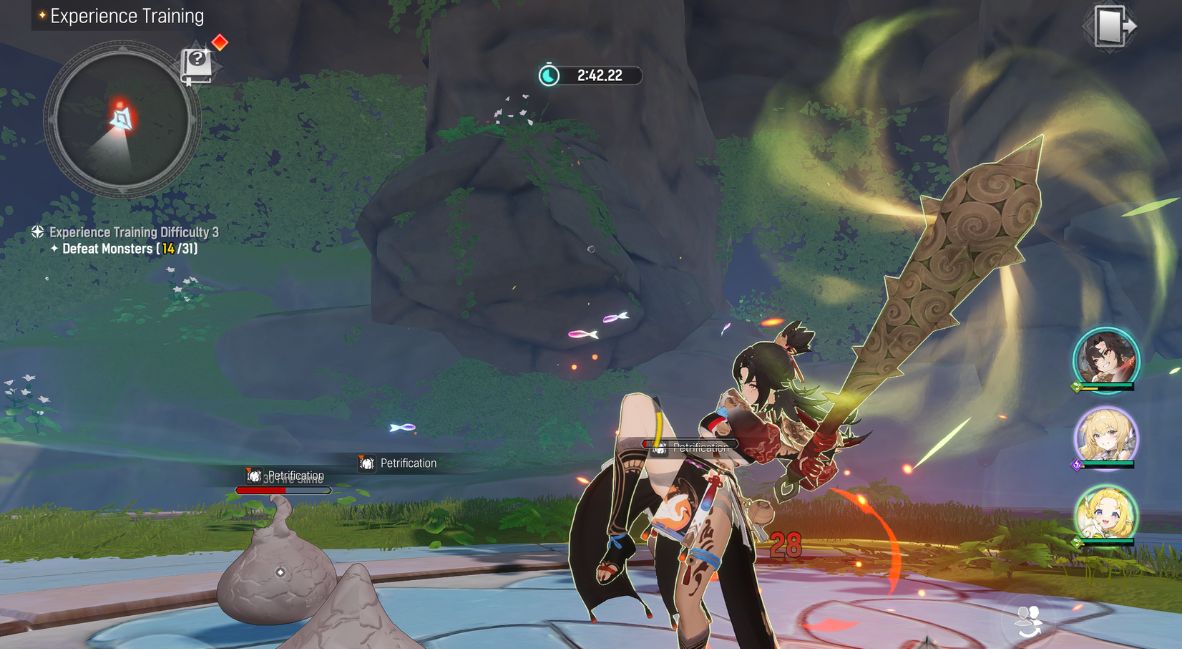
The visual element of the combat is one of the few bright spots of this gacha game.
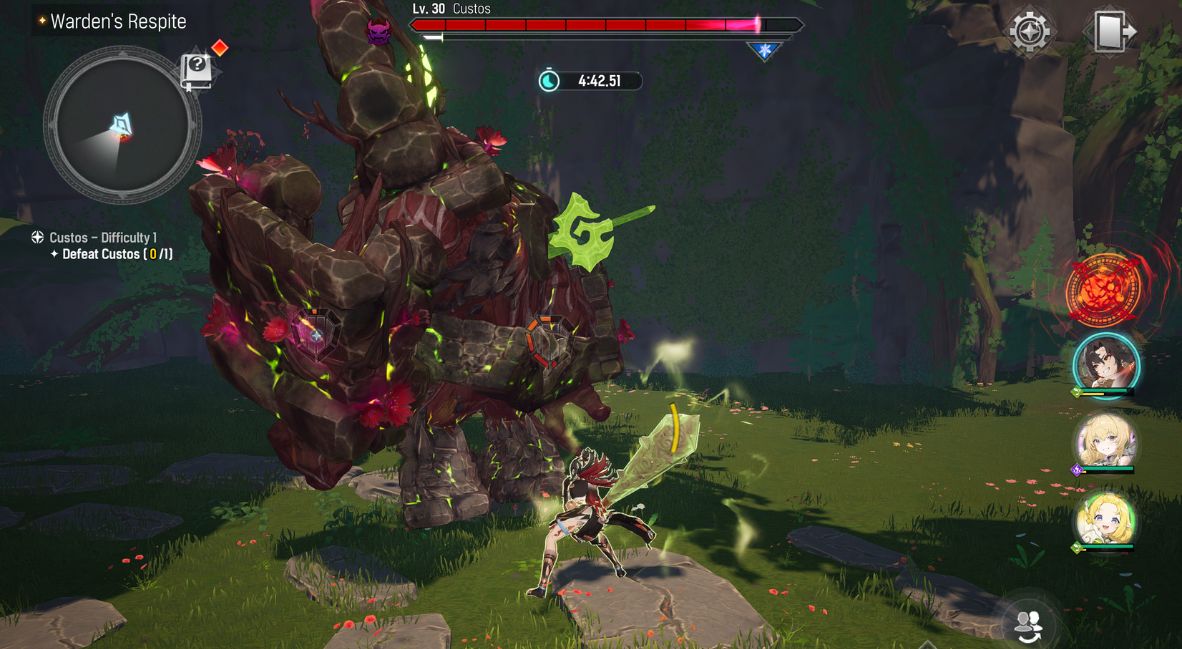
Players swap between their three characters during combat, using their skills, basic attacks, and ultimates to beat down foes. There are some status effects in play within the combat, as well as buffs and debuffs for damage types, but all around the combat is fairly simple. The dodge counter system is rewarding and fun, but most of the combat feels bland in execution. The one bright spot is the healers.
Several of the healing characters in Mongil Star Dive have a support ability that allows them to momentarily appear on the map and heal the active character when their health drops below a threshold. This heal wasn’t the best they had, but it worked as a way to give the player the ability to keep their damage dealers on the field, even if they aren’t nailing all their dodges.
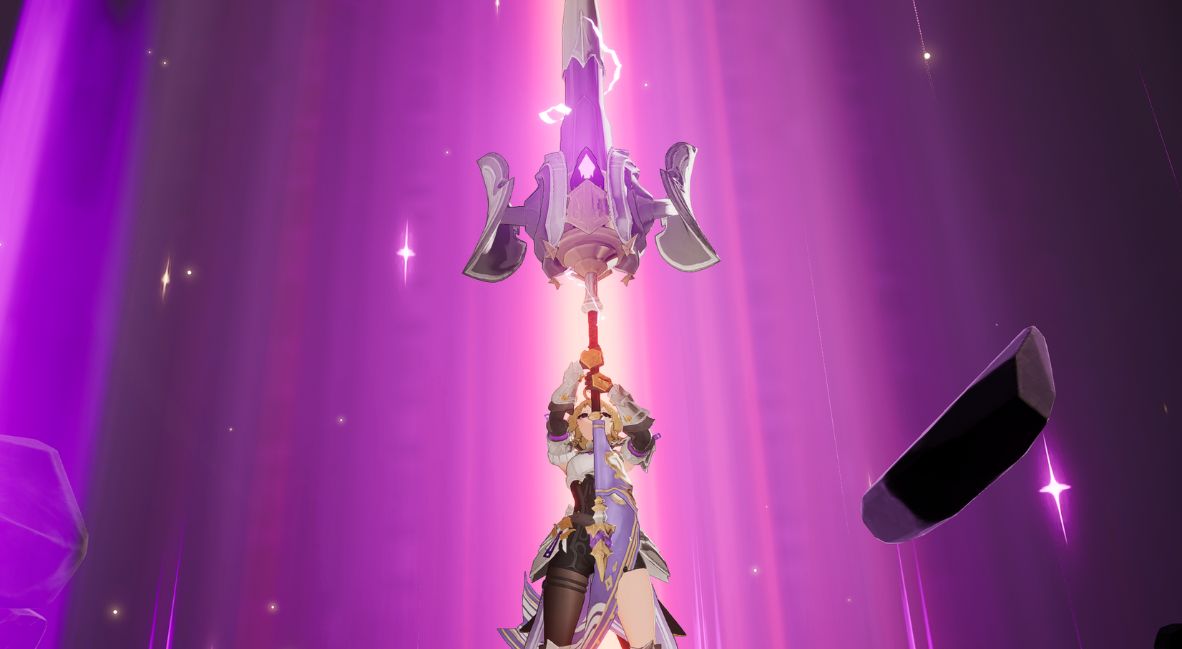
The visual side of the combat is wonderfully implemented. The skill animations, especially ultimates, fit the tone of the world, delivering colorful animations that exude fun and excitement, even if not as epic as other offerings would have such abilities be. What they lack at times in flair and scope, they make up for with charm.
The methods used to level up is a hindrance to Mongil Star Dive.
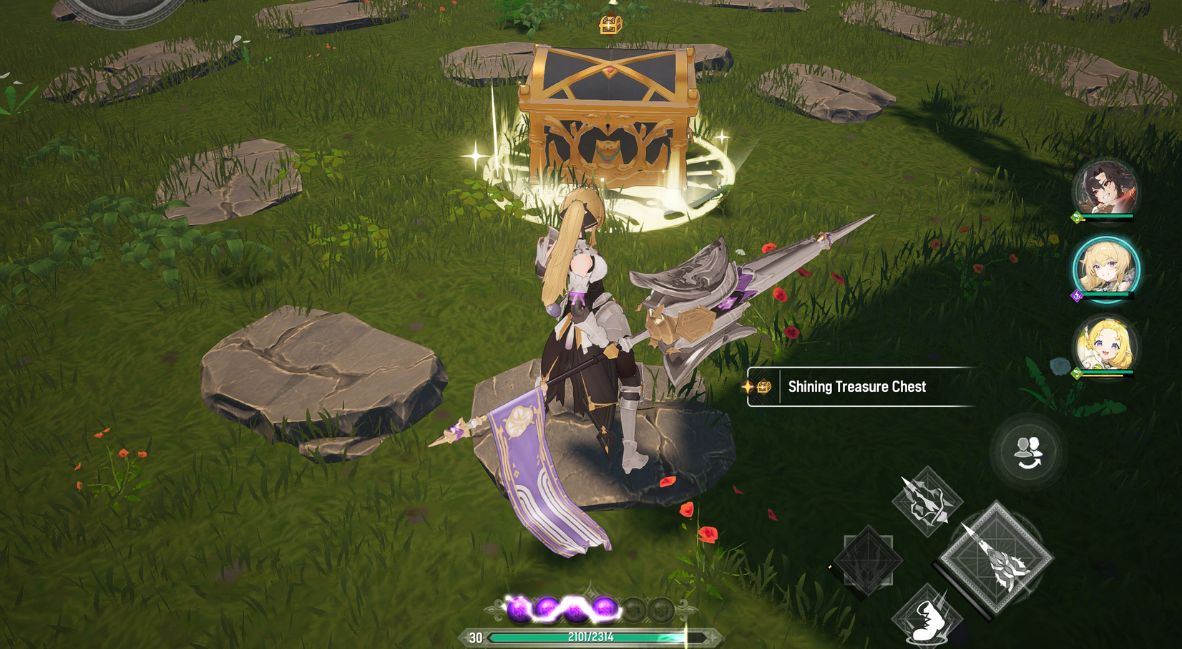
This easy-to-understand tag combat system would be enough if the surrounding framework were compelling. However, Mongil Star Dive leans into some less-than-ideal concepts in its leveling mechanics, which are sure to leave many players frustrated. These offenses all spring from boss battles.
This game’s boss battles are all timed, generally with a three-to-five-minute window to accomplish the fight. The game tells you what level it recommends you be at, as well as an elemental type that is favored for the encounter. Not having the elemental type in the party is a solid hindrance when confronting some of these battles. It can be overcome, but it will require players to fully utilize and upgrade their gear and abilities.
On the face of it, nudging players to improve their kits to overcome a challenge isn’t a bad thing. Many games encourage players to make full use of their options to secure victory. The problem is the method you use to obtain the necessary leveling materials.
The rate at which you earn anything but the lowest-level materials is painfully slow at first. While you can unlock harder fights to accelerate their acquisition, those opportunities are gated behind story progression. And you will need the materials before you get to that point in the story, at least, unless you have the right character.
The game exhausts players stamina and quick.

It doesn’t feel coincidental that the biggest roadblock comes in a boss fight that recommends air elemental characters. Which is what the initial premium pull character, Esther, is. How much of an advantage I would’ve had if I had her on my roster is impossible for me to say, as I failed to pull her, but the odds of that being a coincidence don’t feel great.
Even in the first few hours, Mongil Star Dive had already put me in the position of grinding for level-up materials or paying for the premium character. I had already exhausted my “stamina” points for material battles, and my damage output was still barely enough.
This frustrating situation is made worse by the inclusion of gear that provides random stat buffs. Rather than knowing what a given piece of gear will give you upon acquisition, you must level it up to learn, spending resources to do so. If a piece of gear is trash, you wasted most of those resources in the process. Gear can be used to level up other pieces of equipment, but it’s a diminishing return.
There’s little joy to be found even when triumphing in boss fights.
This gear system isn’t new. Wuthering Waves uses a similar setup with its Echo system. However, such stat buffs are only needed for post-game battles, allowing a player to approach gathering them and leveling them up at their leisure. No story progression is hindered if your echo set bombs.
Even when success is finally achieved in a boss fight, little joy is found. The frustration of coming as close as to a sliver of health, only for the timer to run out on you, suffocates any excitement the victory could’ve brought.
There is a story mode that lessens the difficulty, but not in a satisfying way. The game reduces the opponent’s damage and total hit points. This makes it so that a strong character with proper healing support needs to do little but mash the attack button and dodge the bigger attacks to succeed.
While having an easy mode for less experienced players is a nice option, many who have to opt into it will find it unsatisfying. If you were struggling with the fight because of the timer rather than because you were getting hit too much, having to neutralize the challenge altogether is likely to be frustrating.
Despite being sold as a key feature, there’s not much by way of monster taming.
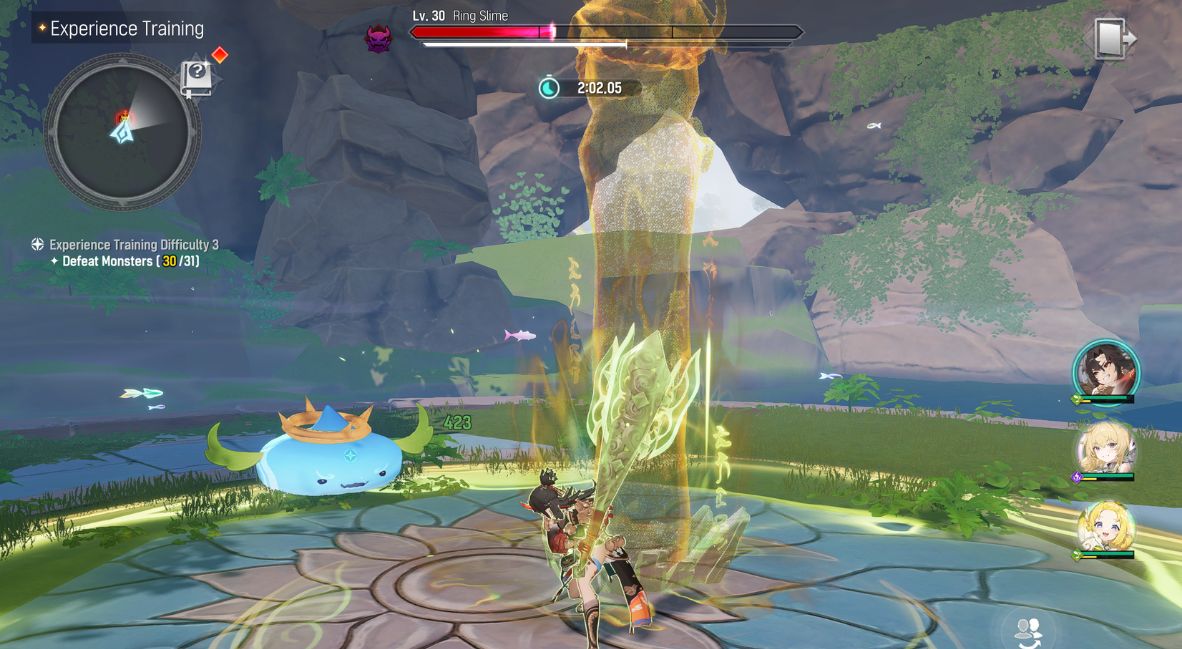
Another place where players may be disappointed in Mongil Star Dive’s gameplay is its “monster taming” elements. As a feature emphasized both in the early game and in the game’s advertising, this aspect isn’t really in the game much. Sometimes, when a monster is beaten, they leave a ghost image behind that can be collected and equipped for combat bonuses.
Some monsters can also appear during fights when particular circumstances are met. Early examples include when the attached character is hit or performs a skill. The monster appears, does a little attack, and then vanishes. Fun, but not what many may think of when they see “monster taming” as a selling point.
Finally, we can’t talk about a gacha game without going into the gacha of it all. With the combat layout so bent towards pushing players to spend on pulls at standard difficulty, the expectation may be that the gacha system would be brutally painful. Happily, that is not the case. Premium banners guarantee their highlighted character in 90 pulls, with no 50/50 chance of getting a standard character. Signature weapons are acquired in 80 pulls at most, without a 50/50 chance involved.
You can find plenty of better action-adventure games than this.
As for buying additional pulls, the exchange rate in the shop feels about standard for most games. Some one-time buys offer a better-than-normal return, while the rest of the offerings will be more expensive than many will want to approach, but that is normal for a gacha game. Daily log-in bonuses and other such offerings are also available to make gaining currency less painful, and at a kinder rate, as one would expect.
A final note about Mongil Star Dive is about where to play it. Having spent a fair amount of time with the game on both my high-end iPad Pro and my PC, I can say that either option works great. The touch interface on mobile devices is responsive and well-laid out. Obviously, if you have a nice gaming PC, that is ideal, but as long as you have a good mobile platform available, you’ll have no trouble there either.
Mongil Star Dive misses far more than it hits. Obnoxious characters weigh down a passable story, while decent gameplay is curtailed by an oppressive leveling system that feels too inhibitive to the experience. If the writing lands for you, this could deliver some enjoyment, but there are many better options in the action-adventure genre than this.
Mongil: Star Dive is available now on PC and Mobile devices.
Mongil Star Dive
-
Rating - 3/103/10
TL;DR
Mongil Star Dive misses far more than it hits. Obnoxious characters weigh down a passable story, while decent gameplay is curtailed by an oppressive leveling system that feels too inhibitive to the experience.