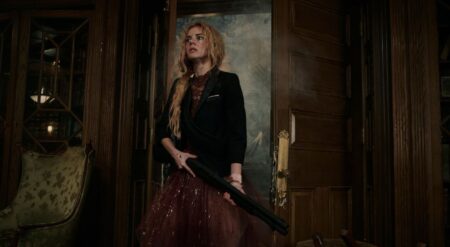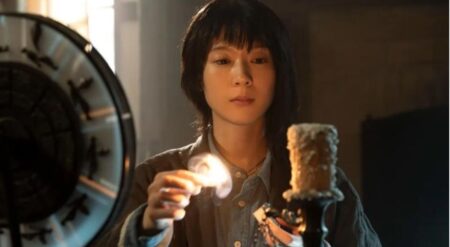

Every other day, it seems like there’s a new attempt to forge a horror icon. At first glance of the poster, Rod Blackhurst‘s Dolly looks to be cashing in on that phenomenon, with its Halloween Costume-ready antagonist front and center. That assumption would be wrong. Dolly, which premiered at the 2025 Fantastic Fest Film Festival, is a true return to the nasty shock of 1970s exploitation and hillbilly horror. Based on Blackhurst’s 2022 short Babygirl, the feature film adaptation is an aesthetically inspired, frequently uncomfortable journey into darkness that uses its influences to channel a resonant terror.
Chase (Seann William Scott) and Macy (Fabianne Therese) are on a trip into nature, where Chase intends to propose to her. Once Chase wanders off the beaten path, Macy is forced to contend with the horrors that lurk in the woods: a mysterious figure (Max the Impaler) dressed like a doll who wants to make Macy her child. As Macy tries to escape the clutches of this “Dolly”, she’s confronted by her warped psychology.
What immediately sticks out about Dolly is its pronounced aesthetic choices. In the tradition of the sort of scuzzy midnight movie that would play at “grindhouse” theaters in the 1970s, Rod Blackhurst is emulating. Dolly is shot on Super 16mm film by cinematographer Justin Derry.
Dolly immerses you with overwhelming, atmospheric dread.
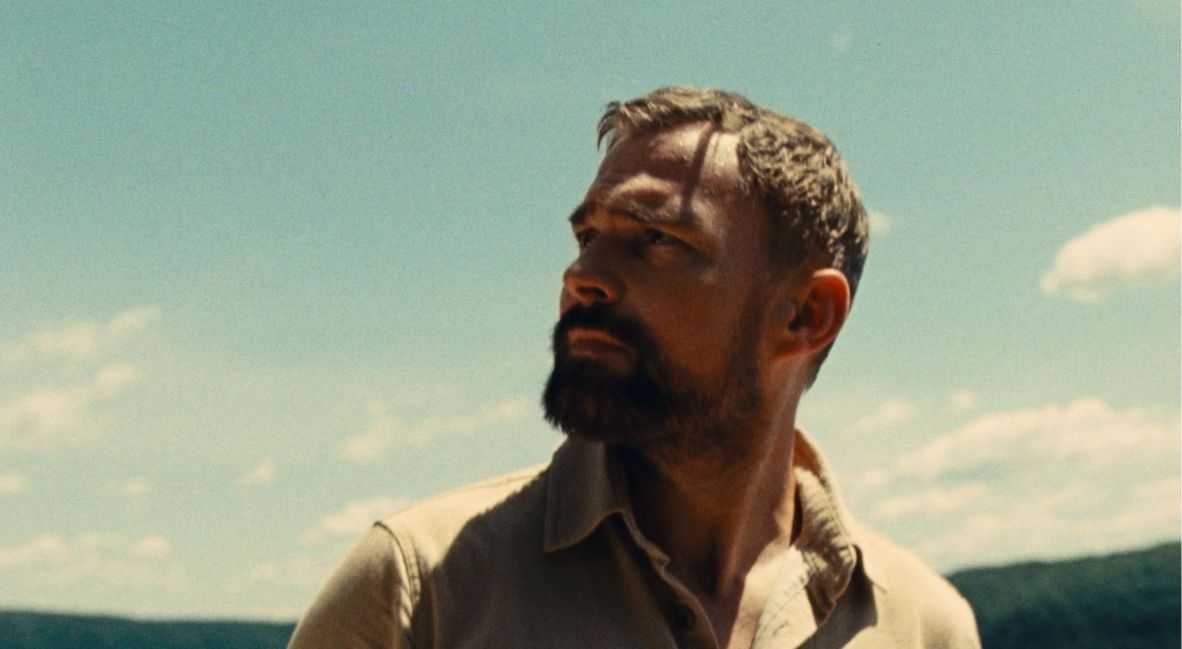
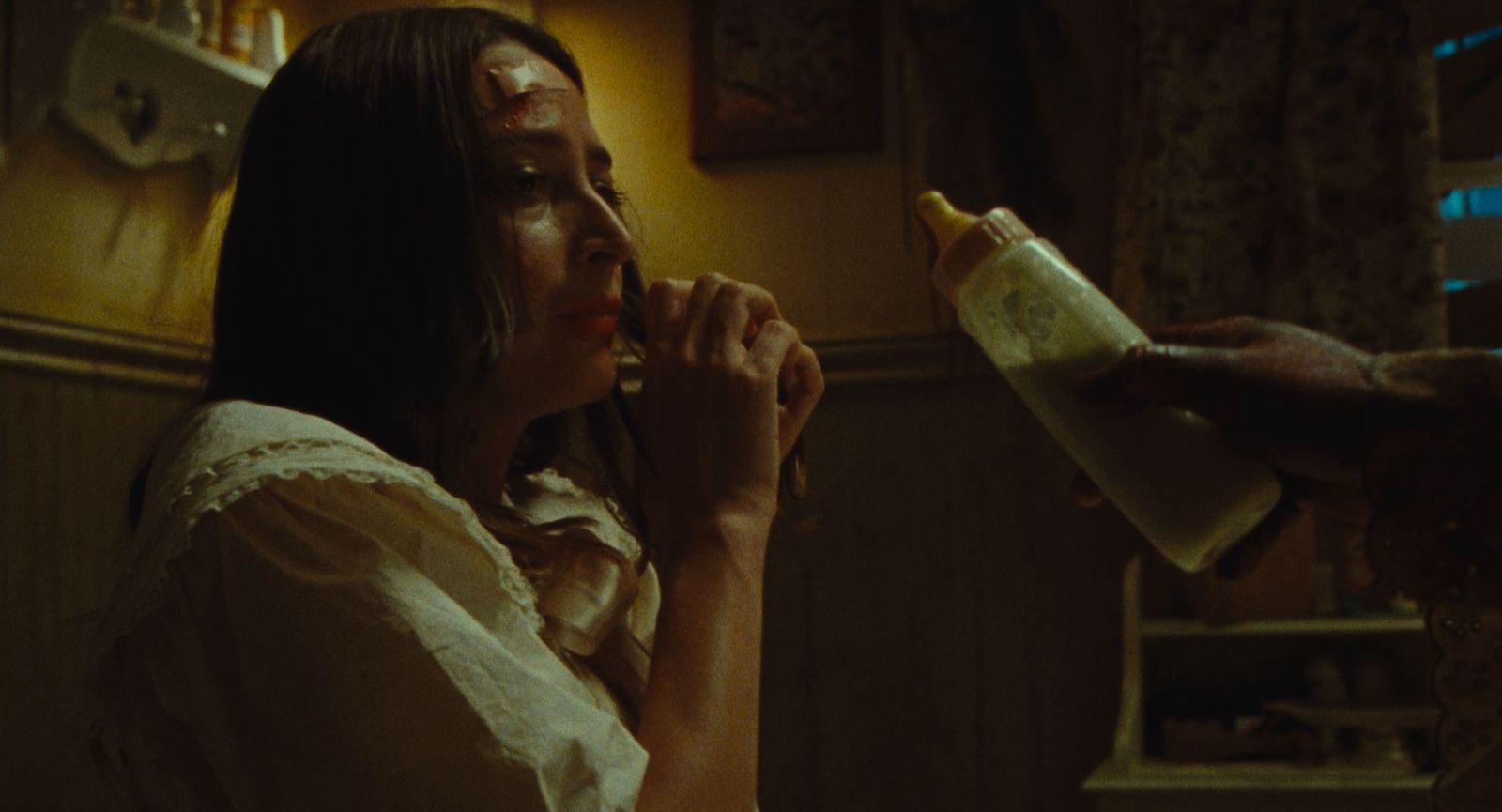
Outside of adding a pronounced retro character, the grainy, textured look of Dolly makes the film feel more immersive, almost like you’re stepping into a depraved fairytale. You can really feel the evil that the dim woods hold within them, enhancing the dread every time Dolly comes onscreen. This is what homage used properly to enhance a film looks like.
Dolly goes beyond visual homage to outright emulating exploitation horror. Sometimes this can be a boon, other times a misstep. On one hand, Dolly has an amoral, hyperviolent sensibility that rubs its audience’s nose in the dirt, making them witness some truly abhorrent situations and never allowing them to feel safe. Is this approach for everyone? No, but it’s essential for the kind of movie Dolly aspires to be. Where Dolly stumbles is when it mirrors the exposition of 1970s horror.
Early scenes of dialogue between Seann William Scott and Fabianne Therese are stilted, feeling more like information delivery than a conversation between two characters. They’re oddly stylized, with a clear intention. Regardless, there’s room to question why the most grating part of lower-budget, more extreme ’70s horror had to be included, as the rest of the film uses its pastiche as a storytelling tool rather than blanket tribute.
Pro-wrestler Max the Impaler makes for a formidable villain.
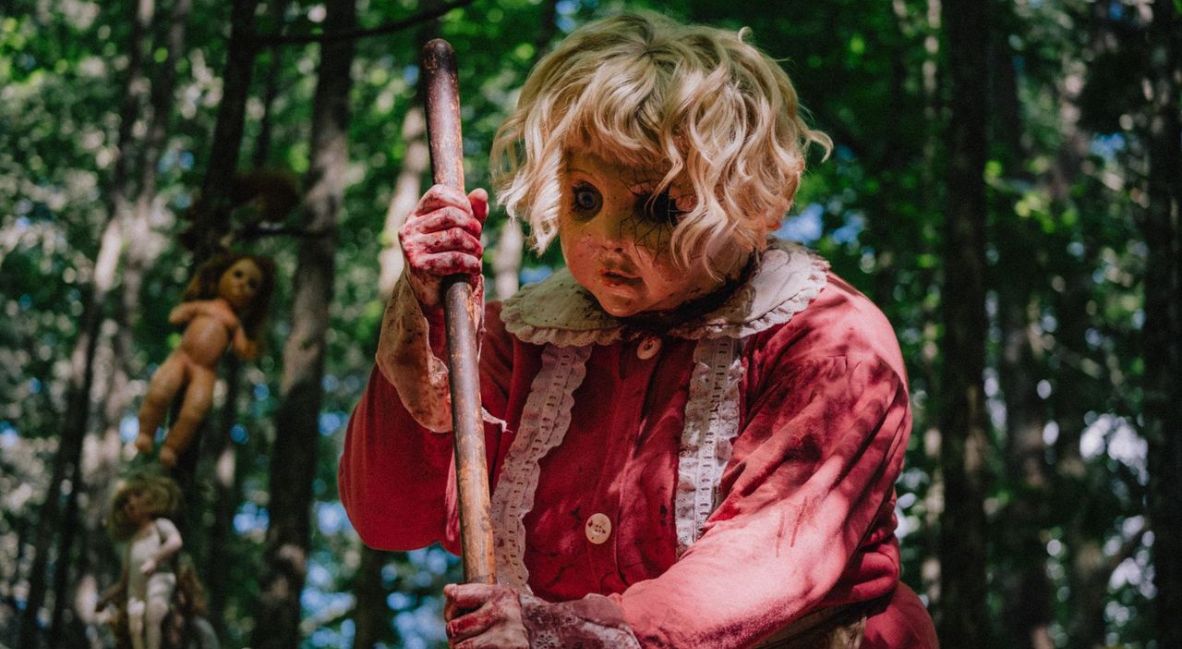
It’s easy to forgive an expositional misstep when the titular villain at the center of Dolly is wonderfully twisted. Donning a porcelain mask resembling a doll’s head and a striking red gown, a piece of her porcelain “eye” is missing, suggesting something lurking beneath. Is she a maladjusted human or something altogether more monstrous? We never know. Yet, thanks to the pronounced physicality brought to the role by professional wrestler Max the Impaler, we know she deeply desires to be a mother.
Dolly pointedly takes on that role when Macy arrives on the scene, treating her like her own little plaything. These scenes are incredibly disturbing, as Dolly prods the protesting, battered Macy to eat the slop she makes and behave in exactly the way she demands. Therese makes for a formidable scream queen, communicating the guttural terror of being in the grimy clutches of Dolly. Even amid that terror, Therese imbues Macy with notable resilience. When she doesn’t acquiesce to the fantasy, however, Dolly responds with violence.
I applaud the film for not holding back in its gore. One of the earliest shock moments in the film involves a man’s jaw being nearly severed, left to hang onto his face by mere strings of tissue. Instead of dying, the man tries to survive and take his revenge. Every time we see that man, that disgusting prosthetic hanging from him is visible. It isn’t treated as a gag, but something to be actively revolted by.
Experience pure horror cinema and all the scares and gore that come with it.
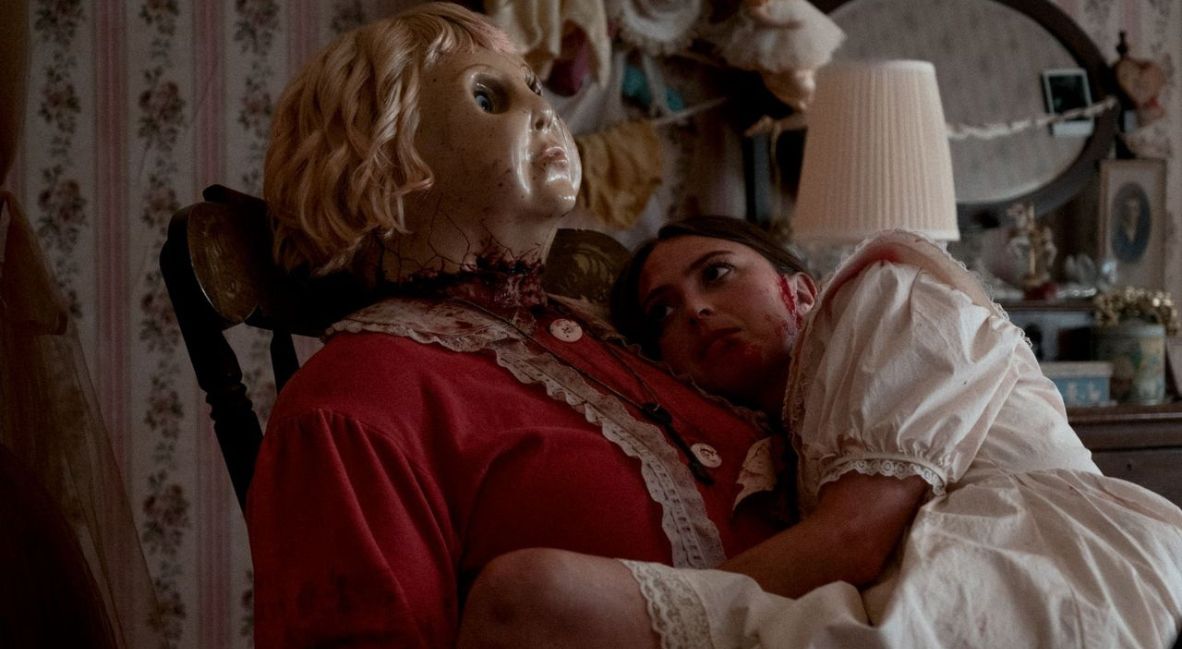
This visual feels like a statement on what director Blackhurst is trying to do with this film- forcing the audience to sit in a stunned shock for the duration of its 82-minute runtime. Scenes like Dolly beating someone’s head into mush with a shovel would be played as a darkly humorous set piece in something like the Terrifier franchise. Here, it’s something to be disgusted by, a notion that calls back to one of Blackhurst’s more modern inspirations, the New French Extremity.
Underneath her violence, there’s something deeply sad about Dolly. Her pained breathing echoes through the porcelain prison around her head. Like her predecessors, namely Leatherface of the Texas Chainsaw Massacre franchise and the Mother from Barbarian, it’s clear as day that Dolly is unwell and a victim despite her actions. A victim of whom we don’t entirely know, but Blackhurst and Brandon Weavil‘s script leaves a couple of tasty breadcrumbs, namely a subplot featuring Ethan Suplee (Babylon), that let the audience paint the picture themselves.
With its short runtime, Dolly could be seen as too slight. More critically, its extreme violence and pervasively putrid vibes will certainly put off the majority of audiences from even setting foot into Rod Blackhurst’s venture into darkness. What Dolly can’t be accused of being is inauthentic. Dolly is a no frills, pure horror cinema experience coming from a nastily inspired vision that uses its homage to one of the most visceral eras of horror to do the most important thing: scare its audience. The audience writ large will have the last laugh, but if you ask me, it absolutely succeeds.
Dolly is now playing in theaters.
Dolly (2026)
-
Rating - 8/108/10
TL;DR
Dolly is a no frills, pure horror cinema experience coming from a nastily inspired vision that uses its homage to one of the most visceral eras of horror to do the most important thing: scare its audience.