
Witch Hat Atelier, the fantasy manga written and illustrated by Kamome Shirahama, has, bar none, some of the most extensive, gorgeously rendered artwork of any current manga being released today. Her work is startling in both the lavish design of the world, which blends classical form with modernity, and the intricate detail of the character designs and expressions, often delivering more about the interiority of their emotional stasis than what’s verbally addressed. It is, in all accounts, a masterwork. So much so that any production team looking to take on the adaptation faced a formidable battle.
Enter Bug Films. Bug Films, which, quite famously, seemingly struck gold with their adaptation of Zom 100: Bucket List of the Dead, before production delays fumbled the final product. However, with Witch Hat Atelier, the studio (hopefully) seems to have learned its lesson, pushing back the release date to ensure enough time and attention were given to bringing this gorgeous world to life. Witch Hat Atelier Episodes 1-2 are, by and large, a major, chill-inducing success.
Witch Hat Atelier takes place in a world where magic exists but can only be conducted by witches. It’s a truth to life that our protagonist, Coco (Rena Motomura), has struggled to shake. From a young age, she’s been enamored with magic, having come across a witch who gifted her a wand and a book of spells. However, she’s never been able to create magic herself, believing again that only those born as magical users are capable of such a life.
Coco is quickly swept into the world of magic.
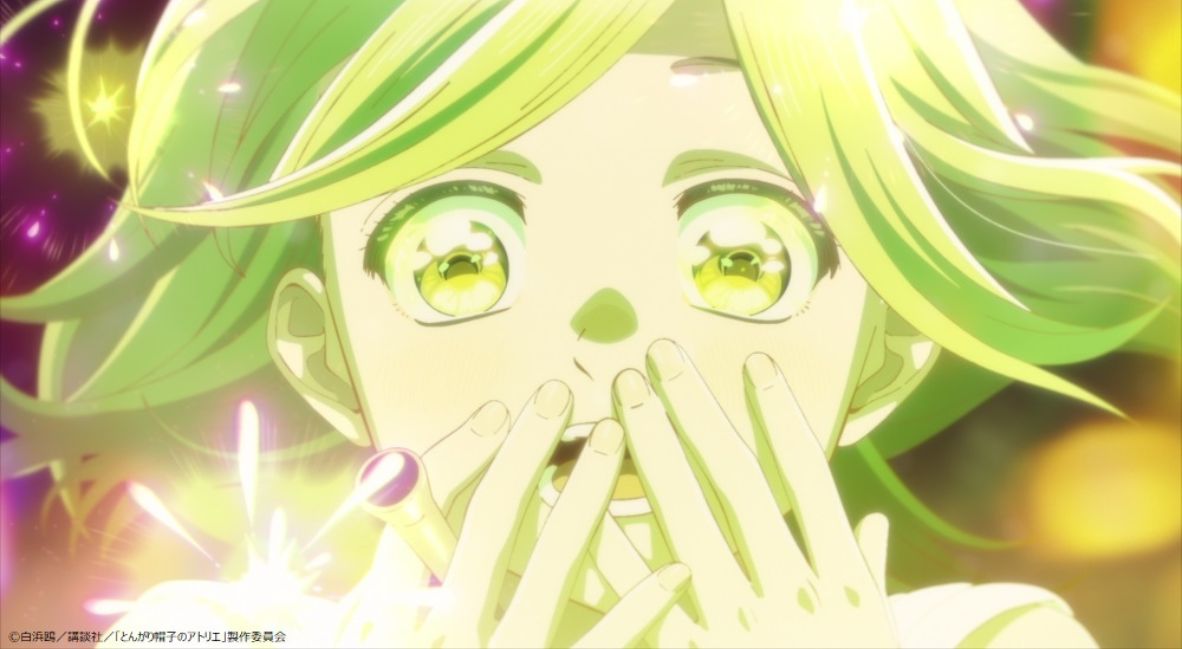
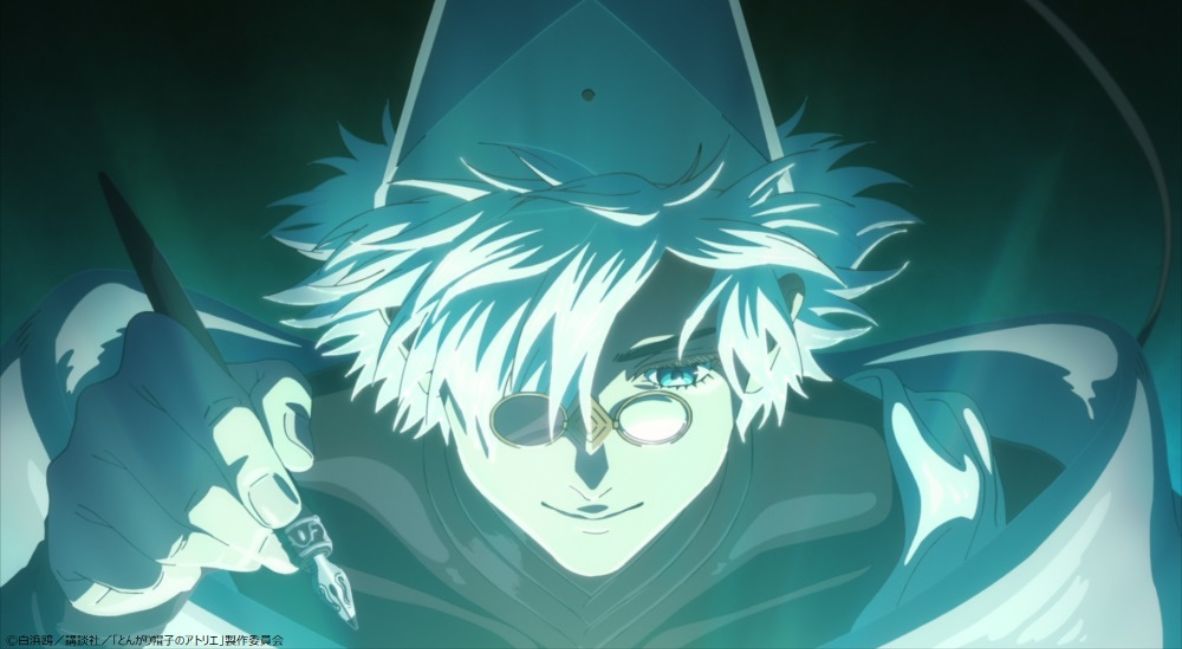
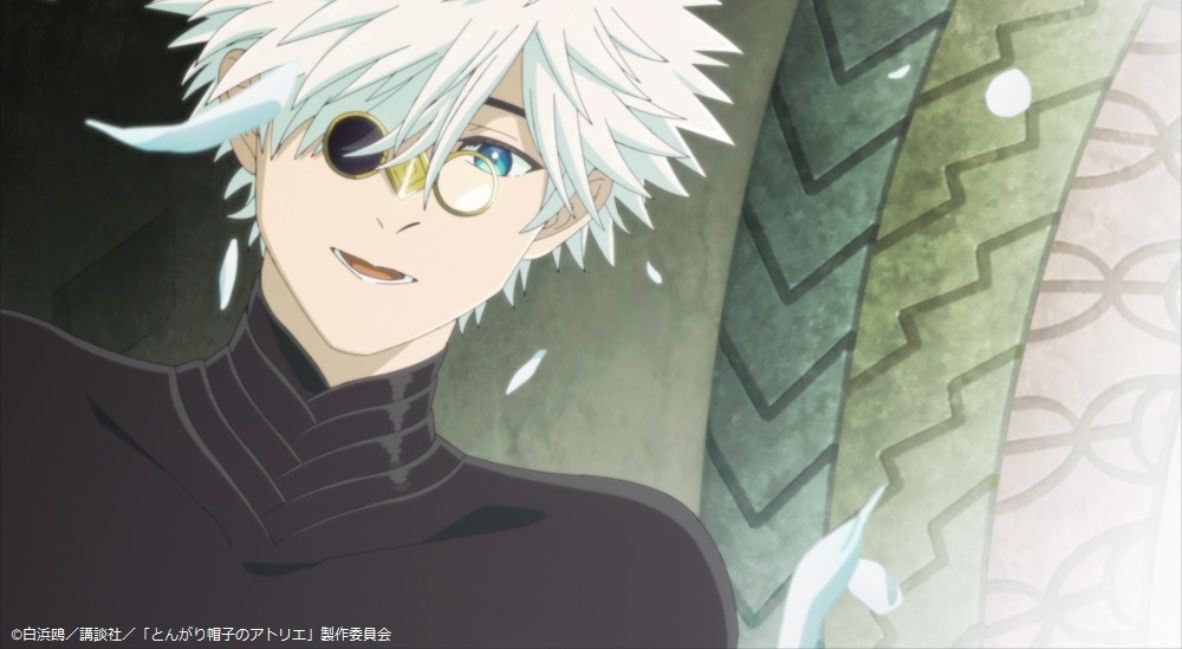
Things change when she meets Qifrey (Natsuki Hanae), a witch who stops by her and her mother’s home, where they work as dressmakers. Through watching him, she learns a well-kept secret: magic isn’t conjured through wands, but through drawing. And it’s because of this knowledge that she begins to practice casting her own spells, now that she knows that the wand she was gifted was, in fact, a pen and ink. Through her euphoric realization, she soon also faces a devastating consequence: magic is a tool that must be taught and supervised.
Witch Hat Atelier Episodes 1-2 is a powerful premiere that understands the weight of Coco’s despair as she learns the “absolute secret” of magic. Following the discovery, she becomes Qifrey’s apprentice in an effort to understand magic and all of the horrors it is capable of. Meanwhile, Qifrey, now the teacher of a grieving child, must try to demonstrate the gentle possibilities of magic, too.
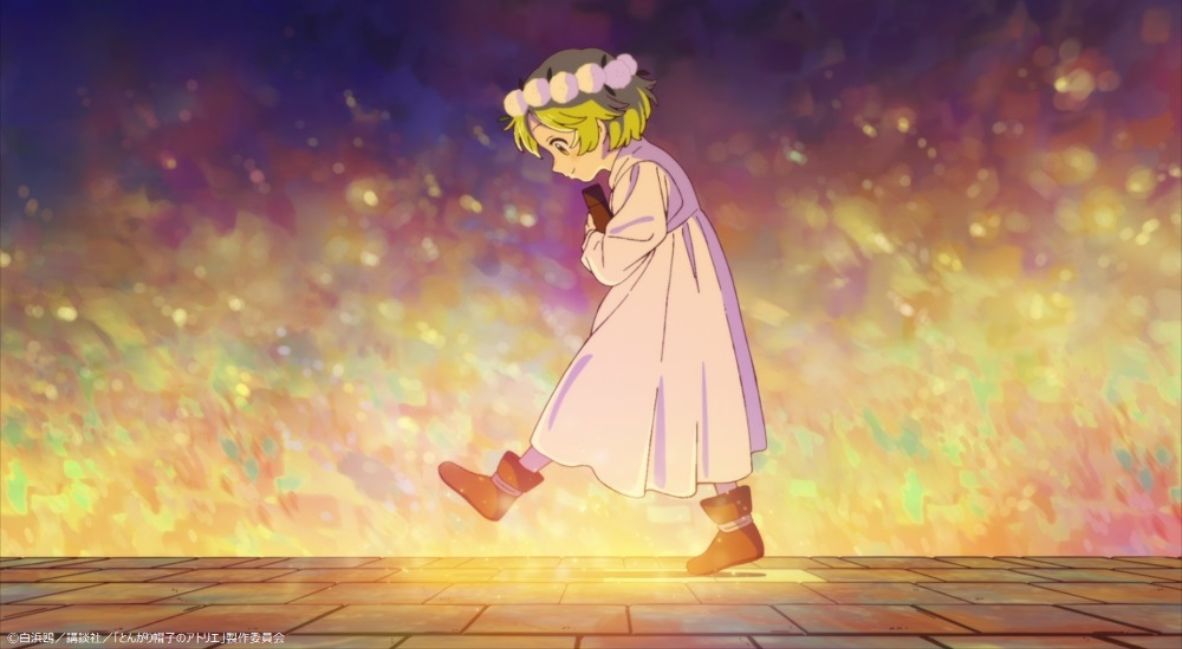
It’s fitting that Coco’s first interaction with magic as a young girl came through lights that lit up with each of her footsteps, before they ultimately extinguished on her long walk home. Because that is magic. That is life – the light balancing with the dark. As she journeys with Qifrey into her new life, she leaves emotional wreckage behind in search of new hope.
The world that Kamome Shirahama has created comes to vibrant life.
Directed by Ayumu Watanabe, the premiere explores the immense possibilities of this world and the grandeur that awaits Coco. This is visualized through the expansive horizons surrounding her and the skies populated with a smorgasbord of splotchy colors.
The world feels large because it’s seen through the eyes of a young girl who, at the start, had yet to leave her village. As she embarks on her adventure, the world ripens and blooms into something greater, both terrifying and beautiful.
There’s a tactile vibrancy to Witch Hat Atelier that’s summoned through strong character acting and enriched landscapes. The imagery positively stuns, capturing the intricate detail of Shirahama’s stylized artwork. Moments such as the haunting, dreamlike memory of Coco being gifted her wand are breathtaking for their fantastical touches and use of color. Similarly stunning is the deceptively simple, twisting direction as Coco walks down the stairs in her home. There’s confidence in ensuring each step is visible, capturing a character’s specific cadence and gait.
We see it again when she’s cutting cloth. It’s simple but effective in terms of tactile quality. We get so used to certain qualifiers when declaring what is and isn’t the best. And often it’s these small moments built around the specificities of movement that truly shine a light on actual excellence.
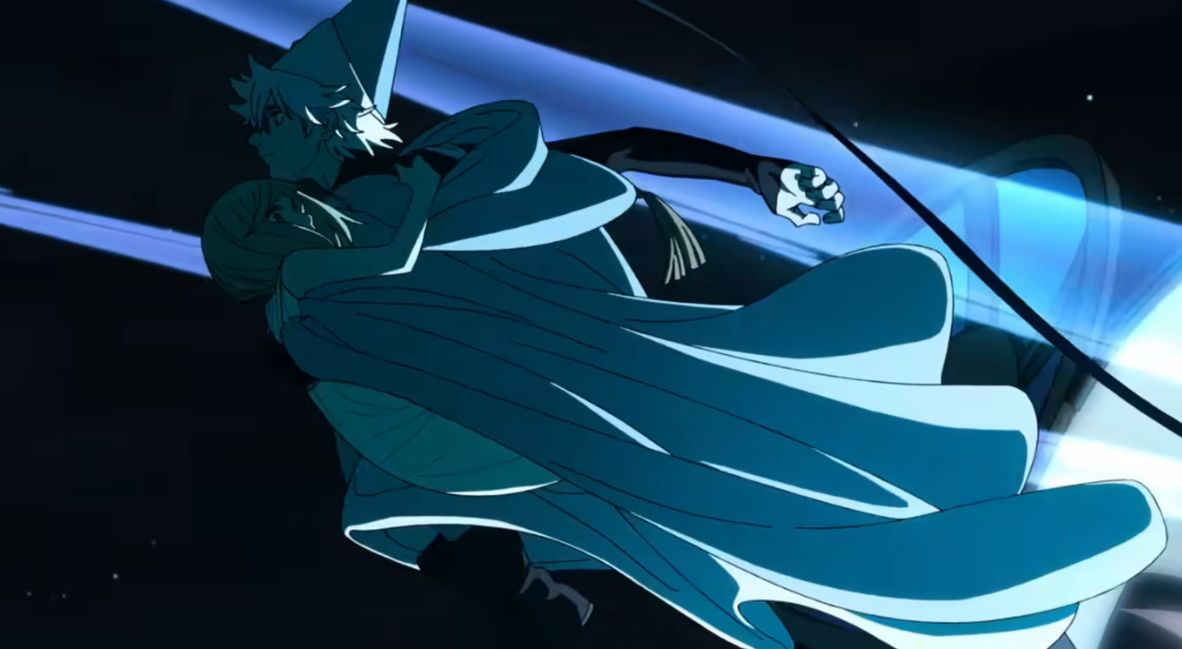
Qifrey rescuing Coco is the standout, spellbinding sequence.
But the highlight of the first two episodes is, without question, the scene of Qifrey rescuing Coco from the spell she mistakenly casts. There’s so much going on in the sequence, from Qifrey’s face expressing a rare, intimidating urgency, to Coco’s emotional distress, the light that bursts out from the window, and the way in which the drawings on his shoes launch them into the air. It bears playing the whole sequence back to catch the fine details otherwise missed, such as the crisp motion in which Qifrey races along the roof and settles them tumbling into the air.
This fluidity gives the sequence a sense of gravity, even more so when Coco tries to fight him in, and when Qifrey races to protect her with a tangible thump on the ground. The craft involved is satisfying because there’s clear artisan care to bring Shirahama’s work to life with the expressive beauty it deserves.
While Episode 2 relies a bit more on still images, it doesn’t veer into slideshow mode. Instead, it utilizes Shirahama’s own penchant for framing to depict the shifting elements of Coco’s life as she meets the other students at the Atelier. The strong introductory moments make her quiet, contemplative, and grief-ridden, settling all the more potent because it reminds us how much has happened to her in such a short period of time.
Rena Motomura and Natsuki Hanae are pitch-perfect as Coco and Qifrey.
Beyond the story (excellent) and the visuals (masterful), Witch Hat Atelier is further buoyed by two key components. The first is the pitch-perfect casting. Rena Motomura and Natsuki Hanae are excellent in these pivotal roles. This is only Motomura’s fourth role and grants Coco both playful curiosity and a soft melancholy as her world pivots. It makes for a strong contrast with Hanae.
Hanae, who, through his work as protagonists in Demon Slayer: Kimetsu no Yaiba and DanDaDan (as Tanjiro and Okarun, respectively), has often played younger, boisterous roles. As Qifrey, he retains a youthful spirit while leveling his performance to embody a necessary, enigmatic charm.
The two are such strong characters, with Coco already fleshed out while Qifrey remains slightly unknown. Yet there are telling moments of expressive personality even in otherwise subdued sequencing. The image of Coco and Qifrey in Episode 1, striking the same pose as they listen in on another conversation, is already a highlight.
Yuka Kitamura’s score gives Witch Hat Atelier a necessary, fantastical atmosphere.
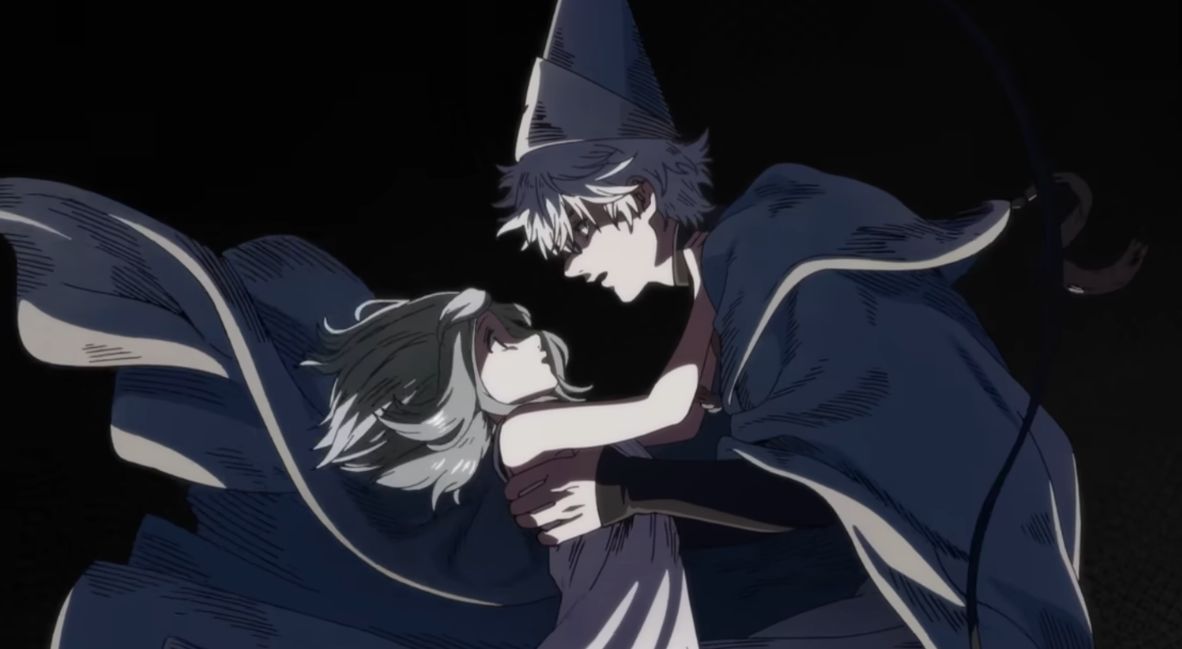
But the other major, crucial element in Witch Hat Atelier’s success is the music. Composer Yuka Kitamura, best known for her work on video games such as Elden Ring and the Dark Souls series, is absolutely critical in building the world’s scale. From the twinkling, whimsical notes that introduce the world, to the bombastic peaks reached when Qifrey saves Coco, there’s a vast and varied tone at her fingertips.
It’s what helps define the series’ energy and the atmospheric tone of otherworldly magic and innovation found through trial and error. This youthful way Coco engages with the world is heightened by a score that captures the world through cinematic, auditory cues.
Witch Hat Atelier Episodes 1-2 are gorgeous and, at times, pure excellence. There’s evident care that’s gone into bringing this world to life to a degree that’s divine when it hits its highest notes. Through vigorous animation, stunning landscapes, distinctive character acting, and an all-timer of a musical score, the series earns the greatest compliment: being a worthwhile adaptation of one of the best manga being written today.
Witch Hat Atelier premieres April 6 on Crunchyroll.
Witch Hat Atelier Episodes 1-2
-
Rating - 9.5/109.5/10
TL;DR
Witch Hat Atelier Episodes 1-2 are gorgeous and, at times, pure excellence. There’s evident care that’s gone into bringing this world to life to a degree that’s divine when it hits its highest notes.