
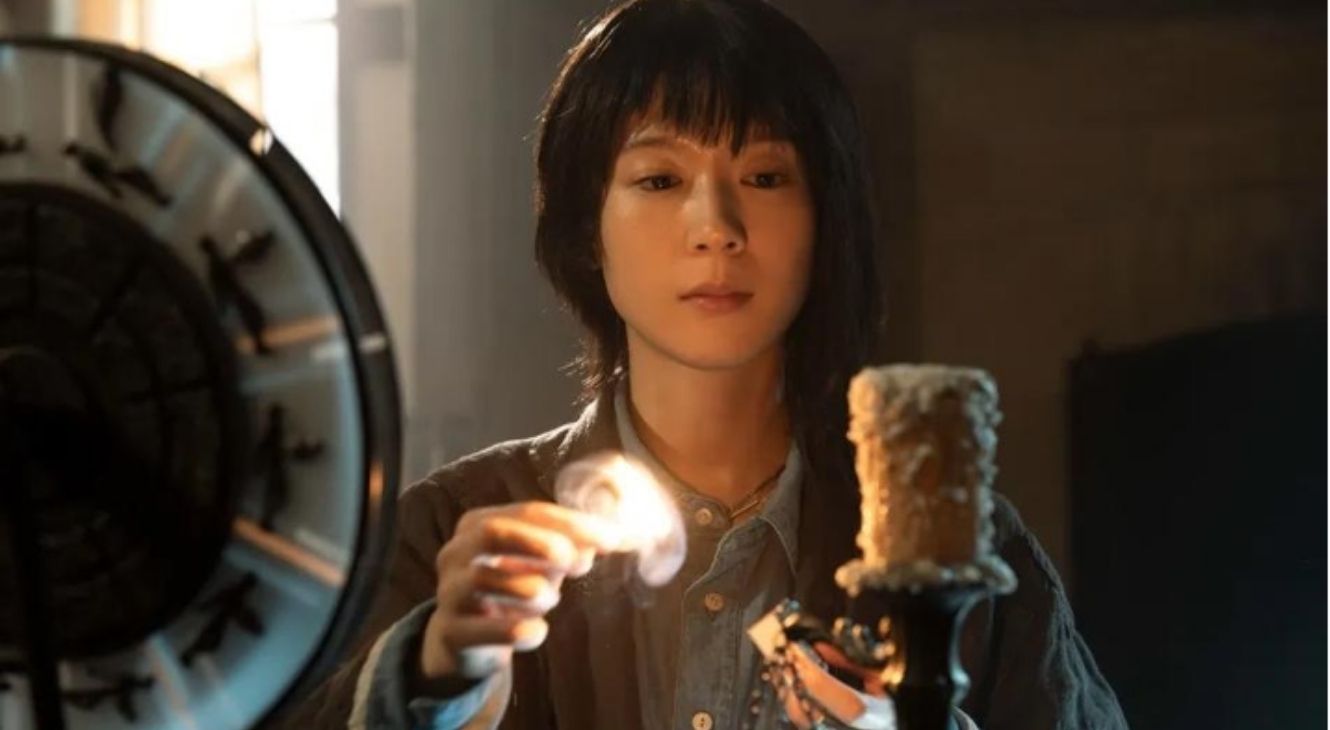
Never After Dark proves that there is still life yet in the supernatural realm of medium horror. Set in Japan, this smart screenplay, led by the charismatic Moeka Hoshi as the medium Airi, leads us down a winding mystery as Airi tries to crack open the latest haunting. The blending of genres comes together in a nice package, but it’s not just the haunting that grips the soul, but the sisterly love that lingers after the credits roll.
Opening in medias res to a ritualistic scene gone awry, Never After Dark quickly cuts to Airi journeying with her sister, Miku (Kurumi Inagaki), to an isolated inn in the countryside to address a potential haunting. Teiko (Tae Kimura) has hired Airi after experiencing numerous haunting occurrences throughout, with a strange man at the center of most of them. Teiko’s brother, Gunji (Kento Kaku, who also produced the film), is rightfully skeptical, particularly after Airi emphasizes that they should not be there while she attempts her ritual.
But, as will be discovered, Airi’s ritual is not for the faint of heart. Each element requires precision for her to achieve a specific state of vulnerability. With each ritual, Airi gets one step closer to finding out the mystery behind the man (Mutsuo Yoshioka) haunting the countryside inn. And once she realizes that there is something she has to fear more than the dead, it is a race against time to eradicate the evil or risk losing everyone’s lives.
Never After Dark holds an incredibly smart story within, making the mystery well worth unraveling.
Writer/director Dave Boyle‘s screenplay wastes no time in peeling back the multiple layers baked into this story. There’s no guessing game about the medium’s credentials in Never After Dark, and the decision to reveal something so big and essential so soon cuts down on any potential plot bloat that could have festered.
It also introduces one of the many intriguing visual effects elements used between the sisters onscreen. This paves the way for Airi’s most vulnerable moments onscreen, when she doesn’t have to placate her clients who refuse to follow her instructions.
While some answers arrive more instinctively and others surprise (like Airi’s lopsided hairstyle), part of the fun is watching Airi try to figure out the mystery. Moeka Hoshi infuses her Airi with a confidence that is wholly believable. This should be a haunting like any other, and she rightfully treats it as such, even at times coming across as dismissive and flippant. One scene in particular demonstrates this with a humorous, drunken dance sequence throughout the inn, offering levity before the proverbial shoe drops.
Yet, Airi is a woman who has known loss. She knows how fragile life is, and once this haunting shifts into something that threatens what little she has left, Moeka Hoshi pushes her performance to new depths of vulnerability. Underneath that confidence is someone deeply afraid, and that fear drives her until she finally regains some control. That control and fear are essential to the narrative and the character’s arc.
This haunting has layers and opportune jump scares that will have you shake a fist.
Stoking the fear in Never After Dark is The Man. The special effects team really knocked it out of the park with the design of The Man’s gaping mouth; the distorted proportions are unnerving, and the way Mutsuo Yoshioka moves embodies an otherworldly strength and speed reminiscent of the slasher-villain greats. Coupled with the angles and lighting, particularly in the spiritual realm segments, it’s easy to imagine the haunting spectre to appear at any turn. Even when you expect a pop-up scare, it still catches you off guard.
The location where the haunting takes place in Never After Dark contributes much to the atmosphere. It is large and isolated from everyone, making it all the more perfect for a haunting. The downstairs interior is spacious, and, like Airi, you can assume it denotes safety. Yet, with an open space, you can never easily hide, and once the action moves upstairs to the inn’s tighter corridors, escape is nearly impossible.
With the idea of escape comes the emergence of looping in Never After Dark that feels relevant. It’s not just the dead that find themselves trapped in an unbreakable cycle. So too does the living, inadvertently trapping themselves in the process. But the process of breaking that cycle is different for everyone. How Boyle plays with this in Airi’s journey is fascinating, and upends everything we might think of this process.
Never After Dark is a near-perfect haunting. While a couple of lingering questions remain unaddressed, the film’s ending is emotionally resonant. And as the realization dawns of what the film’s opening moments meant all along, it’s too late to turn back. Like Airi, we must tread forward and embrace what happens next. Cue credits and the lingering darkness that follows.
Never After Dark world premiered as a part of the 2026 SXSW Film Festival.
Never After Dark
-
Rating - 9/109/10
TL;DR
Never After Dark is a near-perfect haunting. While there might be a couple of lingering questions left unaddressed, the film’s ending is emotionally resonant.