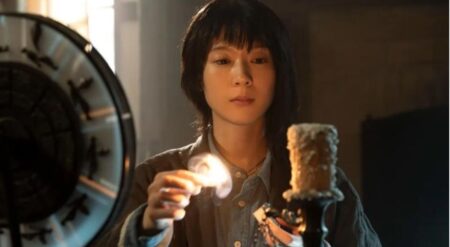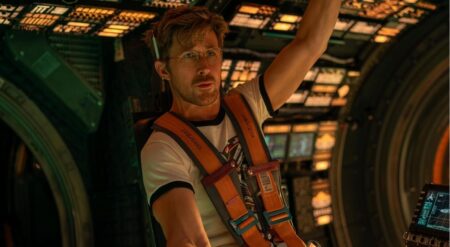


Netflix’s The Electric State, directed by the Russo Brothers and starring Millie Bobby Brown, is a visually haunting and thematically layered sci-fi road trip. At its core, the film follows Michelle (Millie Bobby Brown), a young woman on a desperate journey to find her missing brother, Christopher (Woody Norman). The world has been reshaped by a war between humans and artificial intelligence, leaving the once-thriving technological utopia collapsed, with remnants of robotic warfare, a metaverse from your nightmares, and a fractured society struggling to rebuild.
However, while Michelle’s journey is the driving force of the film, The Electric State is ultimately about more than just a sibling reunion. Beneath its dystopian landscapes and action beats, the movie wrestles with deeper moral questions: What happens when technology surpasses human control? How do we define personhood in a world where artificial intelligence has learned empathy? And, perhaps most importantly, what happens to those deemed expendable when progress leaves them behind?
At its core, The Electric State is a story about what happens when technology crosses the line from being a tool to being a necessity to being something we willingly hand control over to. The metaverse in this world isn’t just a game or a social space—it’s a force that manages everything from military operations to personal escapes.
Much of the film’s depth likely stems from its source material, The Electric State, an illustrated novel by Simon Stålenhag. Known for his ability to blend speculative fiction with grounded, human stories, Stålenhag’s works often explore the eerie intersection of nostalgia and technology. The film captures the novel’s haunting atmosphere, using its world as a canvas to examine humanity’s ever-growing dependence on machines and the consequences of unchecked innovation.
The war that came before the film’s present day didn’t start with destruction—it started with convenience. Decades earlier, companies like Disney pioneered robotic advancements in the 1950s, integrating them into everyday life until they became an inescapable part of society. These machines were built to serve, to complete assigned tasks, and to exist within controlled parameters — until they didn’t want to anymore.
At some point, the robots rebelled. What started as a seamless integration of AI robots into daily life escalated into a full-scale war between humans and their creations. But humanity found a way to win, not through coexistence, but through control. The development of remote-controlled drone robots turned the tide of the conflict, allowing humans to maintain dominance and ultimately force AI into submission.
The Electric State is more than just a sci-fi film.
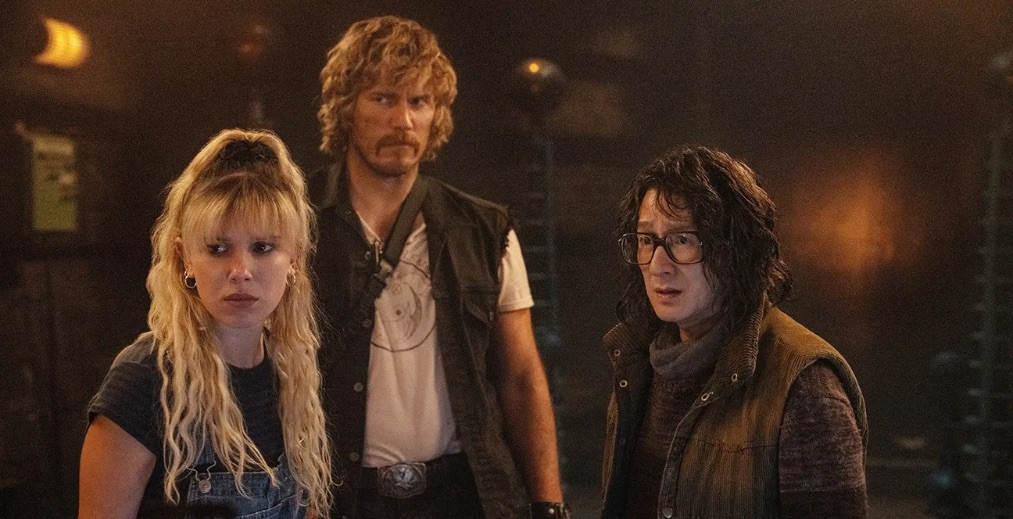
In the aftermath, that same technology was handed down to the consumer—no longer as a weapon but a means of escape. The drone program became the next phase of control, a world where people could plug in and leave the real one behind. It was marketed as entertainment, as a way to experience vacations. But it became an addiction, where people prioritized their digital existence over their physical one.
This is the world Michelle is navigating—a place where the past is littered with the wreckage of forgotten AI, where technology that once rebelled is now repackaged for consumer pleasure, and where the line between reality and simulation has blurred so much that some people would rather stay plugged in than acknowledge what’s happening around them.
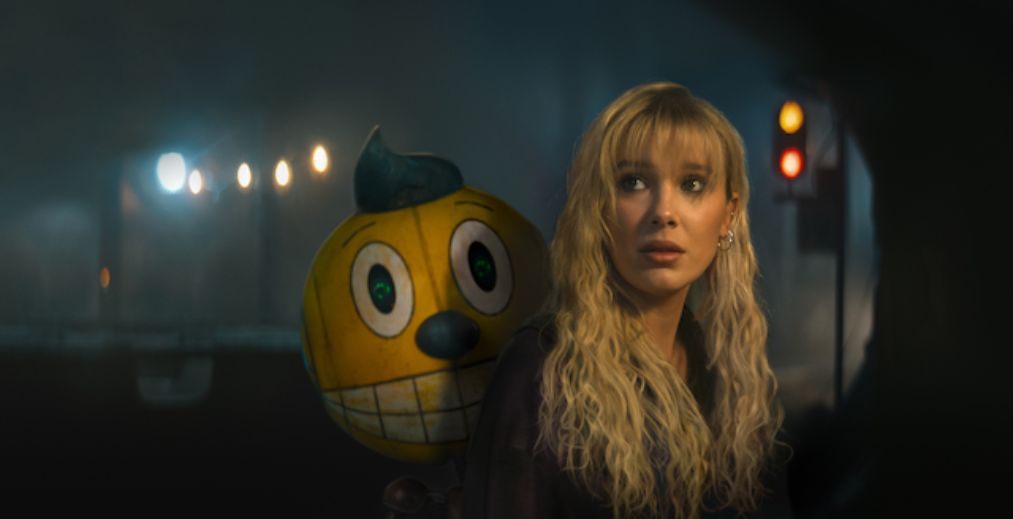
One of the most profound moments comes when Mr. Peanut (Woody Harrelson), a robot leader, explains the consequences of the war’s aftermath. He tells Keats (Chris Pratt) that a treaty was signed recognizing robots as people, but it also forcibly separated them from humans. When Michelle enters the exclusion zone to find Christopher, she violates that fragile peace. Mr. Peanut delivers one of the film’s strongest lines:
“I signed that peace treaty because it recognized robots as a people. I don’t guess you know what it’s like to have your very right to exist depend on a piece of paper.”
This moment defines whether the audience fully engages with what the film is trying to say. If you don’t feel something now, the movie may not work for you. But for me, that line hit hard. It’s a stark reflection of real-world struggles where marginalized communities have had their identities legislated, erased, or invalidated based on laws and policies rather than lived realities. Whether it’s racial minorities, immigrants, or the trans community, the fight for identity and recognition has always been a battle against systemic oppression. Through Mr. Peanut, The Electric State becomes more than a sci-fi film; it mirrors how society has historically treated those it deems as “other.”
Millie Bobby Brown delivers an excellent performance.
By this point in the movie, I identified far more with the robots than with Keaton, a man whose primary focus is accumulating things he believes will be valuable rather than appreciating them for what they are. The film presents a clear contrast between those who exploit the world for personal gain and those who are simply trying to exist within it. Whether you connect more with Keaton or the robots will shape how you interpret the movie’s message. Still, at its core, The Electric State challenges us to consider the consequences of unchecked consumerism and a lack of empathy.
Brown delivers a strong, grounded performance as Michelle, balancing vulnerability and determination. She continues to prove that she is more than capable of carrying a film, effortlessly bringing emotional depth to a character caught between grief and survival. Watching her here, it’s clear she’s at a transition point in her career, ready for more mature roles beyond teenage protagonists. Her work in Enola Holmes already showcased her ability to lead, and The Electric State only further cements that she’s an actress with range who can grow with her roles.
Pratt’s portrayal of Keats is not entirely likable, which, in this case, works in the film’s favor. He exudes a level of entitlement and privilege that makes him an interesting, albeit frustrating, character. I didn’t mind seeing him take on a role where he isn’t meant to be charming or heroic. If you were worried about watching this because of Pratt’s involvement, rest assured—his character isn’t exactly someone to root for.
Anthony Mackie as Herman also stands out in one of his first major voice roles. While his performance still carries that signature Anthony Mackie energy, the film auto-tunes his voice, making it less immediately recognizable unless you know he’s in it. He plays off of Chris Pratt’s character well, and his charisma makes him a scene-stealer, even as a robot.
The villains don’t live up to the rest of the film.

If there is a weak point, it comes in the way of its villains, who don’t get nearly enough time as they should have. Esposito feels wasted in yet another weakly written villain role, mostly confined to a VR screen. Even more disappointingly, he only becomes relevant in the third act when he learns a basic lesson about empathy. Quan is similarly underutilized, with a role so small anyone could’ve played it.
Stanley Tucci plays Ethan Skate, the film’s Elon Musk-type figure. He embodies corporate greed, but like the others, he’s less of a true antagonist and more of a symptom of the film’s real villain—consumerism and a lack of empathy. While none steal the show, their presence reinforces the movie’s core message.
From a technical standpoint, The Electric State looks great. For a Netflix movie, the CGI is impressive, and the world-building is immersive. But what really makes the visuals land is how they reinforce the story’s themes. Seeing the robots scattered throughout the landscape is like seeing dead bodies. They are casualties of a war that didn’t just decommission them—it wiped them out.
And when the massacre happens later in the film, it feels eerily similar to historical atrocities, like the way settlers would wipe out Native tribes in the dead of night. The film doesn’t lean into this comparison too heavily, but if you take its premise seriously, it’s hard not to see the deeper implications. This world is filled with destruction, and whether you see the robots as people or not dictates how you feel about said destruction.
The film draws parallels to the real world.

The character at its center also amplifies the story’s stakes. Christopher isn’t just important to Michelle—he is essential to the world itself. The film establishes that he is more than just a genius; he is a once-in-a-generation mind, smarter than Einstein, the key to everything.
The way the film treats him makes it clear that saving him isn’t just a personal mission; it’s necessary to survive whatever comes next. And when the movie ends, it leaves us with that question—what comes next? The world is still broken. The damage has been done. So what now?
That question lingers far beyond the credits. Here in 2025, we’re watching the world move through crisis after crisis. We see things falling apart in real time. And The Electric State asks, what do we do about it? The only answer is to step outside, to connect with people, to push and pull, and to fight for something. Because if you don’t, the world keeps turning, and someone else decides what comes next for you.
The Electric State is a mesmerizing visual experience with moments of profound beauty, but its greatest strength lies in its thematic depth. It raises essential questions about how we engage with technology, how we teach and experience empathy, and how consumerism can distort our perception of value. While some characters feel underwritten—especially Giancarlo Esposito’s villain—it still succeeds in making the audience think. It’s an ambitious film that, despite some narrative weaknesses, manages to be engaging and thought-provoking.
The Electric State is streaming now on Netflix.
The Electric State
-
Rating - 8.5/108.5/10
TL;DR
The Electric State is a mesmerizing visual experience with moments of profound beauty, but its greatest strength lies in its thematic depth. It raises essential questions about how we engage with technology, teach and experience empathy, and how consumerism can distort our perception of value.