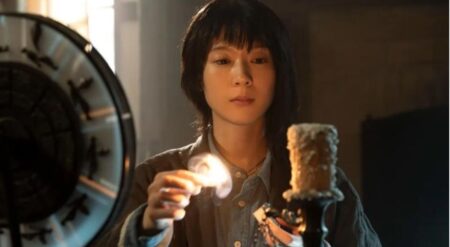

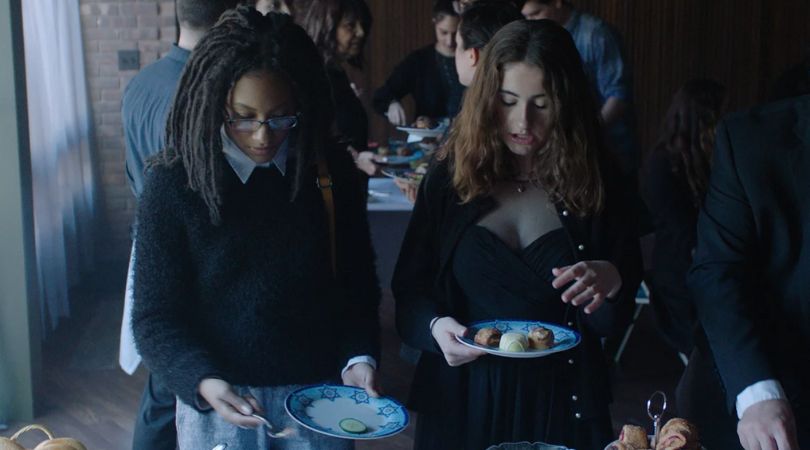
Tahara is a queer, Jewish coming-of-age film from director Olivia Peace and writer Jess Zeidman. Carrie (Madeline Grey DeFreece) and Hannah (Rachel Sennott), best friends, are attending the funeral of a fellow Hebrew school classmate. Hannah can only think about herself and how badly she wants to hook up with Tristan (Daniel Taveras). Carrie can only think about the kiss she and Hannah just had.
The movie opens as the funeral begins, shot in the gorgeous synagogue where Zeidman’s parents belong outside of Buffalo, NY where I at once feel like I was transported to every synagogue I’ve ever felt at home in. It’s led by the synagogue’s actual cantor and his chanting supplies the eery backdrop to Carrie and Hannah’s hilarious, wordless conversation as they dish gossip via pantomime and scribble chicken-scratch notes back and forth during the whole service. They get the requisite shush from an older congregant that any young person who has ever been to a Conservative shul knows well while using a Sim Shalom siddur to lean on. It’s some impeccable scene-setting and character introduction at once.
I’ll come back around to the scene-setting, but, at its most basic, Tahara is a story of self-discovery. It’s a story about a teen awakening to her sexuality while recognizing the value she places in different friendships. DeFreece plays the struggle of teenagedom so well as Carrie navigates the social constructs of her religious school class. Those in attendance at the funeral include a queen bee in Elaina (Shlomit Azoulay), a toady in Mellisa (Jenny Lester – director and star of one of my favorite films of 2021), and other similarly one-note characters. And both Carrie and Hannah, who clearly haven’t seen most of them in some time, are sucked right back into the familiar dynamic of trying to impress those at the top of the Hebrew school food chain.
While this is happening, Hannah and Carrie are each struggling with their own comings of age. For Hannah, it manifests in a struggle for attention, particularly from a boy, and for Carrie, it manifests in her newly awakened feelings for Hannah. But Hannah is also a horrendous friend to Carrie, which adds another layer to this already complex ladder of emotions. I really admire Zeidman’s scaffolding of these layers to their relationships as well as their individual journies at once.
Hannah is certainly an easily hatable character, but it’s Sennott’s acting, especially in her constant facial expressions, that is what makes her so. This movie is perhaps similar to her recent outing in Shiva Baby if you read their descriptions side by side, but the character she plays and the context she plays it in could not be more opposite from one another, which made my admiration for her acting here that much greater.
Tahara is shot in a 1:1 aspect ratio, giving it an Instagram-esque quality that early on made sense. The movie literally stops to freeze-frame on characters and show their names like Instagram tags early on. And certainly, the movie’s premise feels like it’s depicting life as filtered through the judgemental and assumptive lens of Instagram. This theme does kind of stop making much sense as the movie goes on and it abandons those aspects for other ones though. There are also a few specific moments where the live-action cuts away to brief animated segments or a few moments where animation is drawn over the scene by Mighty Oak, whenever Carrie is experiencing a particular emotion. These moments are brief but add a strong character to the movie and give fleeting moments of extra gravity to this otherwise odd aspect ratio.
All of the character aspects and direction/cinematography/editing of Tahara are excellent, but what absolutely enamors me and harrows me about the movie is the way it so incredibly depicts some of the ugliest and more deeply upsetting parts of Jewish teenage life in America. The Jewish institutional world has been undergoing a reckoning in recent years for its culpability in and perpetuation of cultures of sexual violence, among other abhorrent things that are by no means unique to these institutions, but have been increasingly documented and condemned of late.
I have no idea whether Zeidman sought to make a movie about this subject specifically, but as a person who grew up in and is now a professional who works in Jewish institutions, particularly with youth and teens, the depictions of the over-sexualization and compulsory heteronormativity pervasive in communal Jewish spaces could not have been more apparent to me. Their own writing about the creation of this movie makes it clear that Tahara is a work of deep personal passion as a queer Jew, and while certainly, my own experience in Jewish life differs from her’s, Zeidman’s experience is clearly ingrained into the fabric of his movie and it is so painfully recognizable, if not relatable.
The first chord was struck, unbeknownst to me at the time, when I couldn’t even figure out how old the characters were meant to be. The actors are obviously all much older than high-school age, and they mention that their classmate who died was only 18, but I assumed they were at least in college given they very clearly haven’t seen each other recently. I of course later came to realize based on some further dialogue, which is also so wittily written with laugh-out-loud teenage awkwardness (delivered perhaps most perfectly by Taveras) that they were all high school seniors. When the movie continuously refers to their participation in religious school and the synagogue’s youth group as having happened in the past, it became more clear that in fact, they were just all disconnected from Jewish life at this point. And some of the reasons why are quite apparent.
Most obviously is that their synagogue is just terribly unengaging for kids their age. They’re weirdly forcing them to participate in this hours-long talkback session held in a classroom decorated for 3rd graders after their classmate’s funeral, for starters. And the teacher who is leading it is so terribly out of touch with teens, droning on, using awkward worksheets to lead the conversation, and referring to them by arbitrary Hebrew names they probably were assigned 10 years ago instead of respecting them as the people they are now. I’d probably have dropped out of there too if it was that unengaging.
But what’s more damning and upsetting creeps in at first and becomes an overwhelming factor as the movie continues on. While in the bathroom blowing off the talkback, Hannah gets to mentioning at one point how her only fond recollections of participation in their synagogue’s youth group were the time she was hooking up with people there. This is not to say that hooking up at youth group is a bad thing inherently by any means, but it’s astutely emblematic of the fact that this is a central factor in participants’ experiences, whether they like it or not.
It’s all described in awkward teenage ways, which again, kudos to the writing for that. And it does have this taboo about hooking up in the synagogue implied as being the correct opinion, which I don’t necessarily agree with. But what starts as an awkward conversation becomes clearly the only purpose that Hannah can derive from her time in that synagogue, especially as she continues to pursue Tristan and the upsetting ways that she drags Carrie into that.
The over-sexualization and compulsory heterosexuality of Jewish teenage life that Tahara depicts is, unfortunately, the pervasive reality of so many of these types of young, formative Jewish spaces. It’s upsetting to see on display not because of the subject itself, which is so powerfully exemplified here, but because it is real. But, what’s also real is the opportunity that the movie just as well depicts for creating Jewish spaces, and any spaces for that matter, that are open and safe and welcoming and empowering and formative in all of the ways this community is clearly not.
For all the pettiness and awkwardness of the teens in this movie, racism is not one of their faults. Which is far from the reality of many, many non-white Jewish experiences in the U.S. The congregation is shown to have more than just one token Black member for starters, and at no point is Carrie’s race, her parentage, or anything of the sort so much as remarked on. The movie’s conclusion also sees things end in a markedly different place for both her and Hannah than where they began. It left me hopeful for the future both because of the movie’s conclusion itself and because it was made by a real person in Jess Zeidman who is using her art to criticize the world as it is and demonstrate the world as it can be in ways that not enough of our community’s leaders are doing often enough.
On several levels, Tahara is excellent. As a movie with interesting characters coming of age in the least likely of scenarios, it works quite well and was totally enjoyable. As a reflection of the young Jewish experience, it was harrowing, upsetting, and devastatingly real. I can’t imagine a more artistic yet direct way of depicting exactly the consequences of our institutions’ failures to both adequately protect and nurture their youth than the ways Tahara does. Yet, it remains an aspirational film that I will carry with me as inspiration to make Jewish futures better just as well as a reminder of where we have been and what we went through before now, especially as queer Jews.
Tahara is playing now in select theaters.
Tahara
-
Rating - 9/109/10
TL;DR
On several levels, Tahara is excellent. As a movie with interesting characters coming of age in the least likely of scenarios, it works quite well and was totally enjoyable. As a reflection of the young Jewish experience, it was harrowing, upsetting, and devastatingly real.