
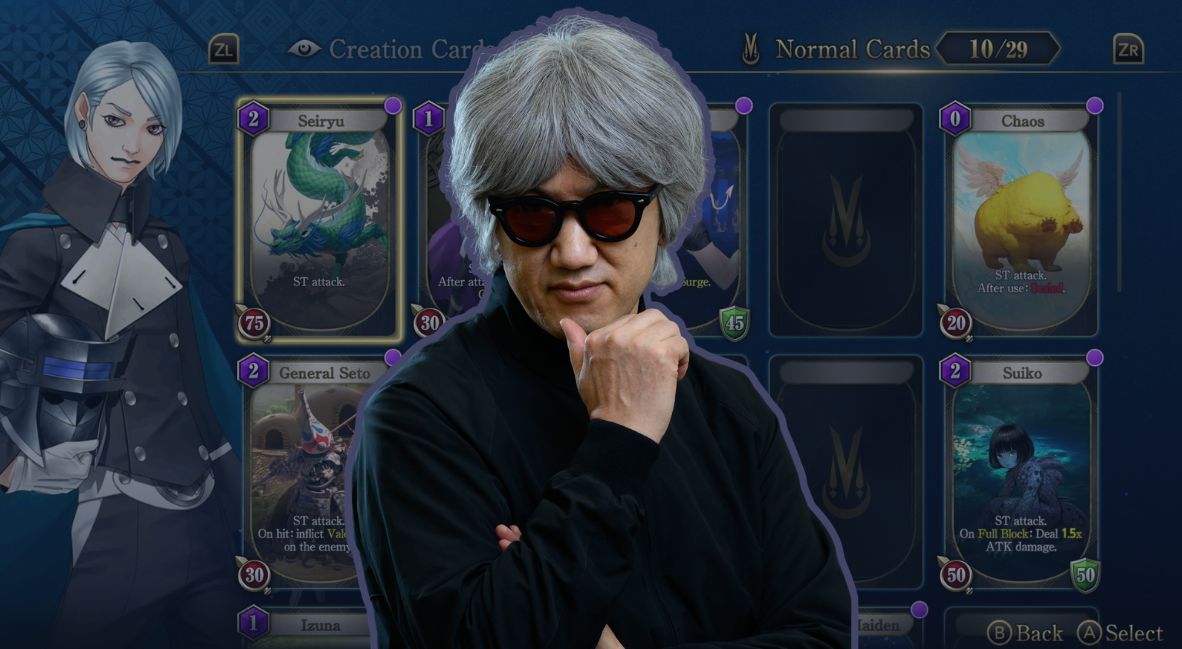
When I first accepted the invite to interview Kazuma Kaneko and Jiro Taoka from COLOPL about Kazuma Kaneko’s Tsukuyomi, I didn’t know that their original mobile deckbuilder title (Tsukuyomi: The Divine Hunter) included a generative AI mechanic (though they did not disclose the AI model used).
More than anything, I jumped at the chance to interview the father of both Shin Megami Tensei and Persona’s art. It was Kaneko’s name that pulled me in. With the title of this Switch edition of the game officially being Kazuma Kaneko’s Tsukuyomi, COLOPL’s marketing is hoping his legacy will do the same for players.
For their Switch version of the game, the genAI mechanic has been removed, but the art that it generated remains, chosen by Kaneko himself. It’s a fact that the development team at COLOPL wore proudly, and something I have to admit felt awkward. But as I began researching the use of AI in Japan and other Asian countries (of which generative AI is a small part), the reality of cultural differences in how the subject is approached emerged.
In the United States, generative AI specifically is a bet that doesn’t pay off. Whether it’s Oracle laying off 30,000 workers or the many thousands of game developers who have lost their jobs thanks to the company’s investment in a technology focused on replacing the spark of humanity that makes art, well, art.
But the lens that views the decimation of employment and art as the core function of AI is not in place when you speak to Asian developers. In fact, whether you’re watching variety shows and reality TV like Japan’s The Boyfriend or Korea’s Ready or Not: Texas, AI chatbots are used.
In notable dramas from Japan and Korea, AI chatbots are integrated into narrative scenarios in a routine way that doesn’t focus on their downsides or even align with the dystopian narratives we see in the United States. It is easy to say that from watching media from China, Japan, and Korea, I have seen more normalization of GenAI than damnation. And that trend hasn’t stopped.
And in a global world, we have to note the differences in approach. Not kowtow or bend to them, but understand that one view is not the whole. Especially as Asian developers increasingly and genuinely question the American media’s reaction to the technology. And if you don’t want the anecdotal thoughts, gameindustry.biz published a study on the uses of AI in Japan (and not just by turning on a transcription companion).
GenAI and AI in general aren’t viewed the same way in Asia as in the United States.
So, in my interview with Kazuma Kaneo and Jiro Taoka, I asked about it. Ultimately, their pride and embrace of the community that sprang up around their game (which was mostly outside the US) seemed like a core guiding principle. And so did the pride in their use of generated images, which they saw as something they created hand in hand with their community.
This isn’t a piece justifying AI (anything but), and, more specifically, isn’t looking to sway any reader toward accepting it in the use of genAI in Tsukuyomi or beyond. But it is a piece meant to broach the subject that cultural specificity in this discussion isn’t something to ignore. And that comes from one of RPG’s most prolific artists.
When you think about the tentpole RPG’s from Japan, you think of the Persona series, and more recently, you think of the cultural phenomena that Metaphor: Refantazio was. All of which Kazuma Kaneko worked on. More recently, though, his name has become synonymous with generative art.
To kick off the conversation, we asked Kazuma Kaneko and Jiro Taoka about the choice to use genAI in this title. The answer started with the mobile version, Tsukuyomi: The Divine Hunter. “That was a corporate decision,” Kaneko said, “COLOPL wanted to create a mobile game with a genAI function, like a tool. And then [I] wanted to contribute [my] art to train AI so that we can explore new art. Those were the initial steps.”
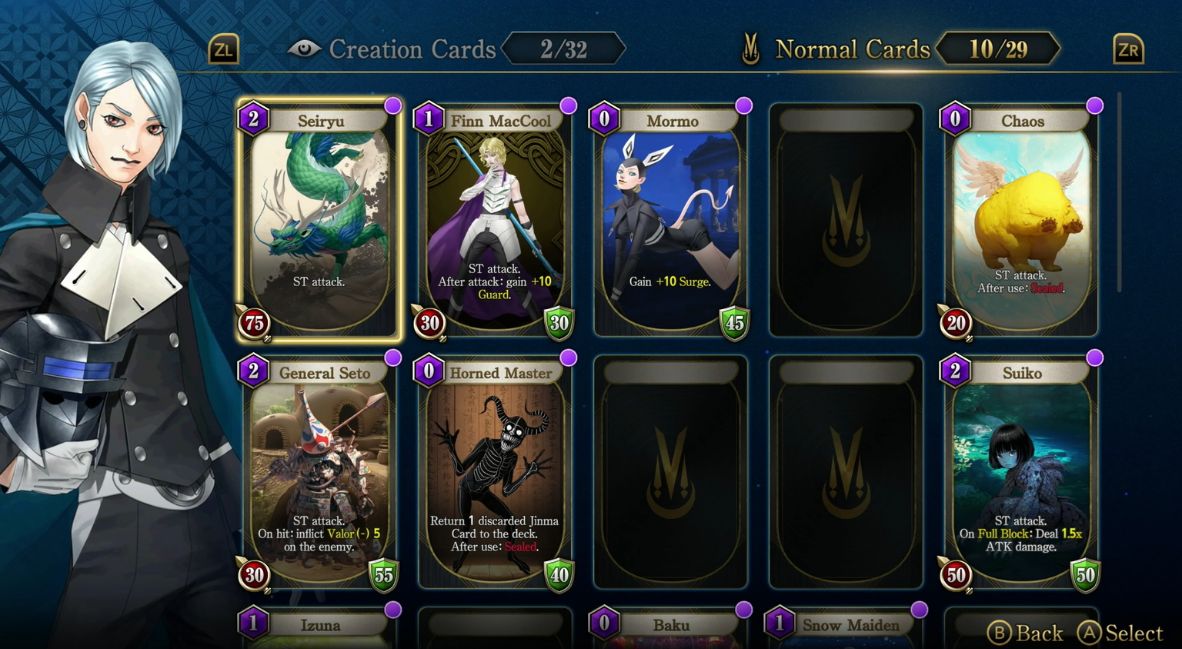
In the interview, there seemed to be a general understanding of the well-deserved Western stigma toward genAI art. When it came to porting the game to Switch, the team at COLOPL, and more specifically, Kazuma Kaneko, hand-picked around 3600 cards that had been generated by their community in the year since Tsukuyomi: Divine Hunter launched.
More interestingly, the idea that it is generative art, not made by Kaneko, seems to have also been tightly woven into the game’s narrative. When asked about other genAI-based assets in the game, the team assured me that it was only the cards, while the AI statement on the game’s product page does allude to more: “This game uses generative AI in the creation of images, videos, and music, based on the following guidelines.”
“[I] wanted to contribute [my] art to train AI so that we can explore new art.” – Kazuma Kaneko
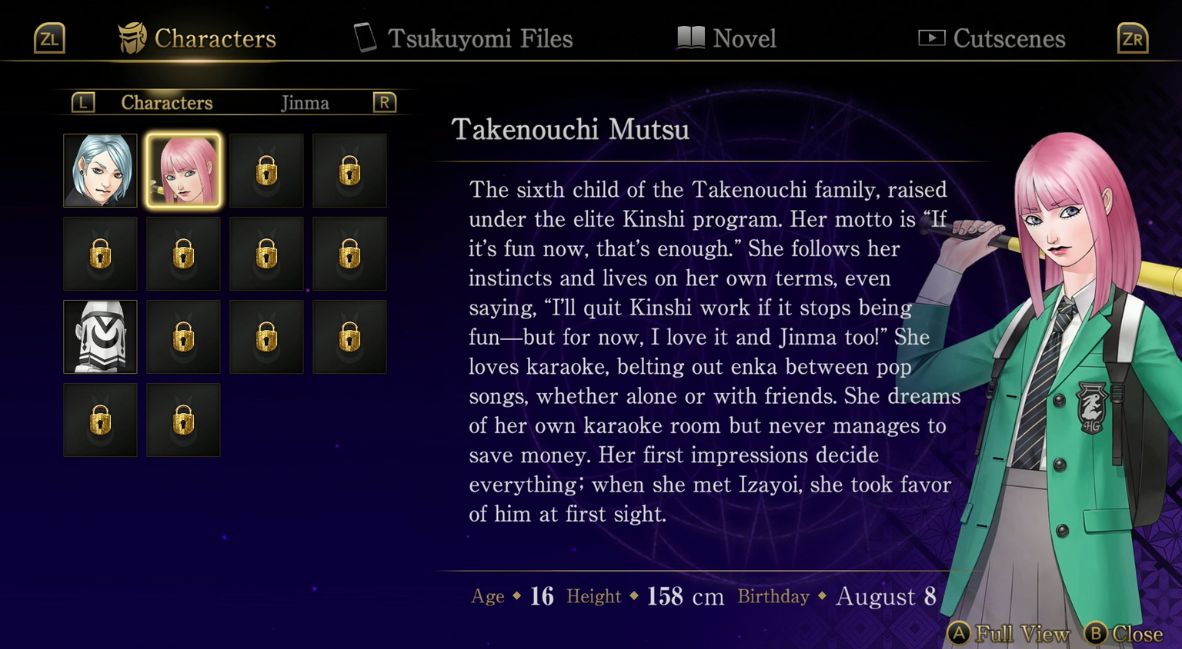
While we understand why the initial choice was made, we also needed to understand why, even after removing the genAI mechanic, generated art remained a feature of the game. Kaneko responded, “So first of all, we wanted to keep this good feature of the game in the console version, so we didn’t lose any of the the positive side of the game, which includes the community and, you know, strong fan base and gameplay,” he said, referencing the generated art assets that players had “created.”
He continued, “So that was that. Then, because consoles do not always have an internet connection, we didn’t need [the mechanic]. Instead, we wanted to hand-pick all the cards that are very interesting, high-quality, and that [I] like for the console game, plus some of the original artwork [I] made. Our focus was [about] how we maintain the good gameplay experience on console, but adding a little bit more of a premium feature.” The premium feature of the course was Kazuma Kaneko’s art and his hand in guiding what assets made it into the final Switch version of the game.
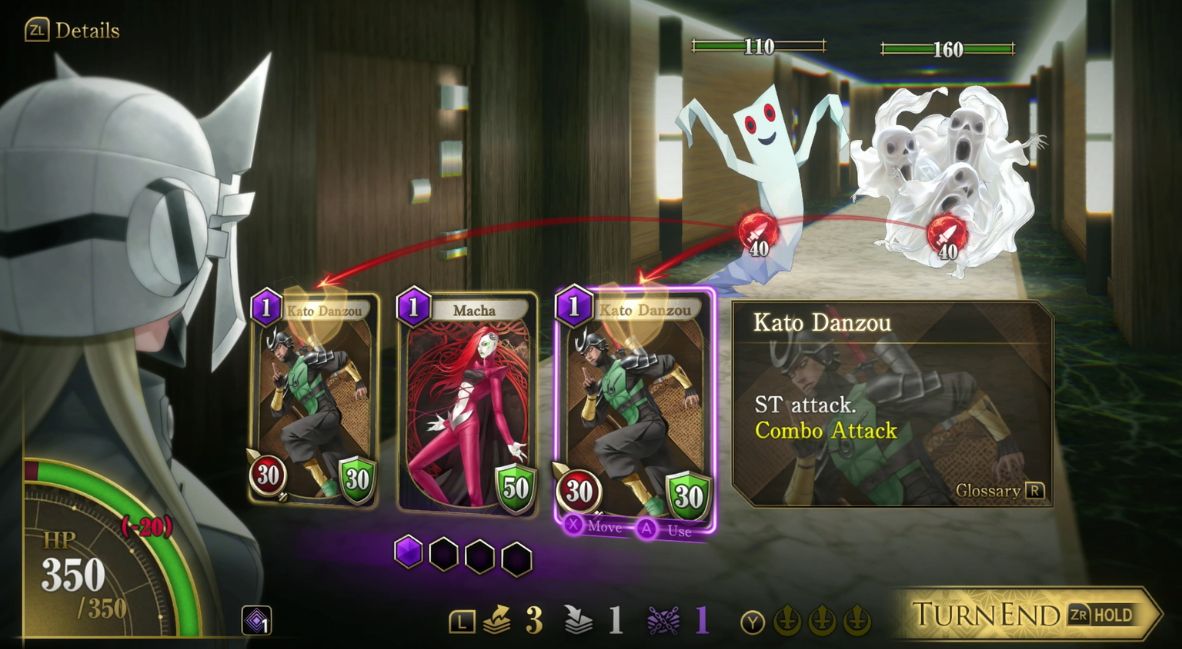
In the game, the generated cards are presented as gifts from the False God and, narratively, as a false representation of Kazuma Kaneko’s work. On the one hand, the team was careful to highlight that this is only a small part of the game and that it actually includes Kazuma’s human touch from story to character designs, and many of the cards themselves, scattered within the 3600 you can collect.
They also included a slide in the presentation stating that the generative mechanic is not in this new Switch version of the game, which also includes an expanded narrative from their team and is not generated by any AI.
At the same time, Kaneko spoke lovingly about the cards that had been generated in his art style, “So if we convert this way, there are a lot of original designs for a card as a base when you start the game. As you get new cards as a bonus or gift, those are the ones that [were] made by previous players and gamers created with the help of the AI in the previous game.”

It has to be noted that Kazuma Kaneko has consented to training the AI model on his own work, and enthusiastically shared messages about genAI as a “step forward,” which is featured above. However, the process of image creation, known as stable diffusion, cannot operate in a vacuum.
Ultimately, AI models are trained on every piece of information fed into them, including the work of any artist someone has entered, with or without consent. It is what makes the publisher COLOPL’s AI integrity stance, listed on their website, impossible, given the current way genAI functions.
COLOPL’s statement:
COLOPL, Inc. values the originality of creators and will create new entertainment experiences through the power of AI technology. Based on this policy, we pursue harmony between technology and creativity and continue our challenges for the future. While always being conscious of social responsibility and fairness, we will establish an environment where creators can utilize AI with confidence, thereby fulfilling our mission of “Entertainment in Real Life.”
Still, the team highlighted that Kaneko chose the cards from the millions generated that met his quality standards and best represented him as an artist.
Outside of the studio’s approach to AI, the most interesting part of the interview was learning about how involved Kazuma Kaneko is involved in the development process. It’s not just creative direction or art; it’s even social media. For Kaneko, the focus of the interview and the game was not the generative elements but the story he helped craft.
He explained, “So from his point of view, he walked on mainly the story setting, like background, the world setting, including characters, of course. [I] am expecting the community to get super excited about those areas to look for, you know, hidden story, the relationship with the characters, and the deep side of the story, yeah, and that’s what he thinks. And he’s expecting the community will enjoy more of this game.”
Adding, “The mobile version was a lot more gameplay-driven experience for the users and players, but we wanted to focus on more world in the story-driven game, which is his part, which [I] think he’s going to talk about more, but so that is, that was another motivation. And then the tuning process, like adjusting from an app game to a console game.”
Jiro Taoka responded, “[I] think since we added more bosses to this game, [I] think that the relationship with your cards, with the bosses, is very different from the last one. So [I] think that’s what people look for more, especially people who play through the previous version. This version on the Switch is going to be quite different.”
Kazuma Kaneko’s Tsukuyomi is different from COLOPL’s mobile title, but it still features generated art.
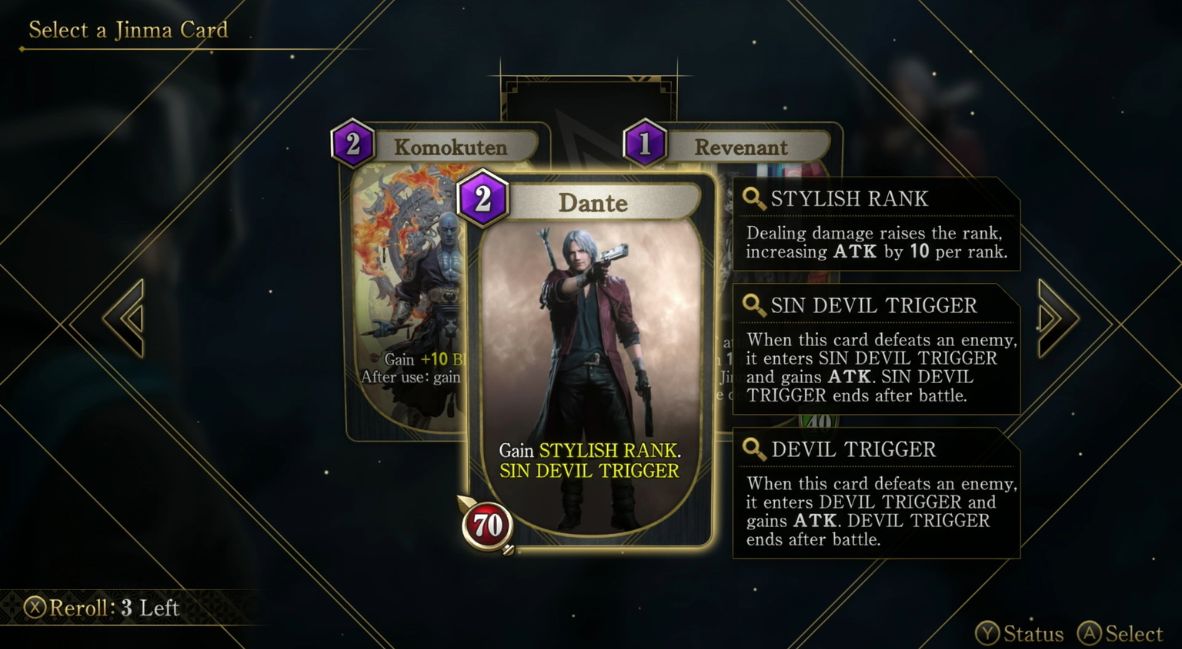
As I asked more questions about the development process, and more specifically, Kaneko’s part in the development process, it became clear that despite the dense narrative and enough terms to fill pages of a glossary, the connection between mechanic and story was all impacted by Kazuma Kaneko.
He explained the development process by highlighting the feedback loops that he was a part of. “This game is very unique, because this is not just a game designer or planner coming up with the concept and asking [me] to create the art,” Kaneko said.
“Because [I] am getting involved in all those aspects of development, including design, [I] come up with the concept of the game, create the connection with the chapters in the world, and give it to the team. And then when the team works on it, they could come back and say, ‘Hey, [we] want to expand this section.’ And then if some of the characters don’t work anymore, [I] understand why, because [I] have created the [feedback] structure.”
To put it simply, from tip to tail, this is Kazuma Kaneko’s game, which makes the use of generated assets stand out even more starkly.
One of the other announcements that the COLOPL team shared during the interview and demo was that a popular video game character would also be making an impact on the game, or rather, three. At launch, Dante, Virgil, and Nero from the Devil May Cry series will be available as a part of the game, a clear nod to Jiro Taoka’s longtime work on the series at Capcom.
For Jiro Taoko, who has had a long career in console business development at studios like Capcom, this Switch addition of Tsukuyomi is like “coming back home.” When asked about adapting the game to a new platform, he said, “[I] did work on quite a few mobile games in the past few years, and what [I] learned from this game is that because [I] worked back-to-back, on an app game and then a console game,[I] clearly saw the different target audience for different gameplay and different features. So [I] think that was a great experience working on back-to-back under the same game, which was quite unique and interesting and challenging, of course.”
Connectivity, not audience aversion to AI, seems to be the reason behind removing the genAI mechanic.
It was this comment that seemed to skirt the elephant in the room: the adaptations made from Divine Hunter, a mobile genAI-first title, into a more story-driven, refined version of the game on Switch. Whether it was the conversation in the demo presentation, the demo itself, or the interview, it was pretty clear that the team understood that the audience between mobile and console was inherently different.
But the acceptance of AI usage in asset creation seemed to be standing in the room looking at us, without any of the developers recognizing it. While I could connect the dots, maybe with my own assumptions, when asked, that wasn’t the reason; connectivity on the console was.
Kazuma Kaneko’s Tsukuyomi isn’t for me, and as someone who has pretty much been laid off every 18 months since 2021, I find it even harder to trust it in any capacity. But the unfortunate reality is that my refusal to spend money on GenAI products ignores how synonymous it is becoming in Asian game development.
While this discussion is with a Japanese studio, and one that has not shied away or hidden its AI assets as others like other international game studios from across the globe, like Nexon with Arc Raiders, Pearl Abyss’s Crimson Desert, or even the French indie darling, Clair Obscur: Expedition 33, it’s clear that we’re stuck on this ride.
Ultimately, while the United States games industry is being cratered and gutted to chase AI, other international studios just aren’t, and it’s fostered a different reaction toward genAI. The COLOPL team takes pride in their work, and that highlights the divide is worth discussing, at the very least, from a cultural perspective. Throw it all out, or listen to Kaneko; it’s up to you as a player to put your money where you choose.
This interview was conducted via translator and edited for clarity, switching the responses from third to first person.