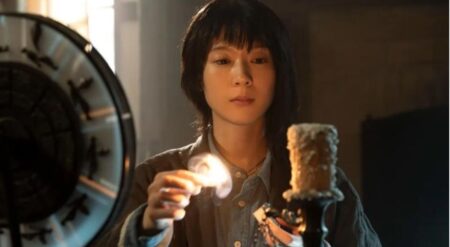

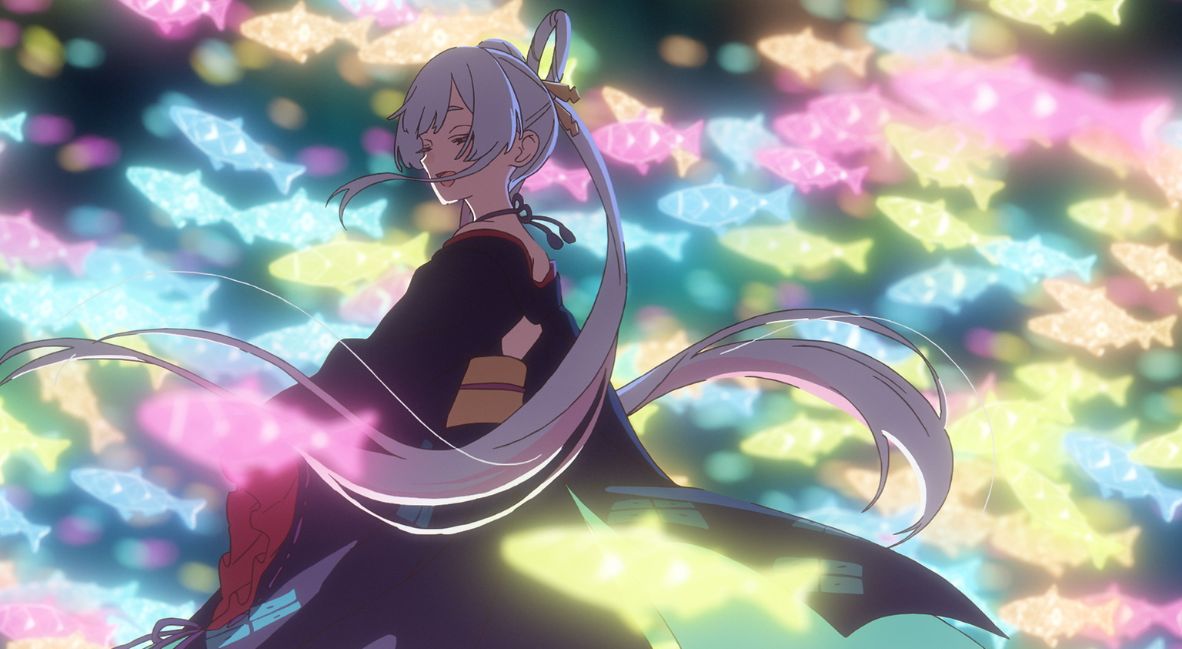
In the midst of the dizzying spectacle of the latest anime film from Netflix, Cosmic Princess Kaguya, there’s one half of a really spectacular movie. Anchored by an all too relatable mess of a protagonist and some truly fantastic animation that highlights the details of character movement, and a play on one of the first known folktales, there’s a lot to love and admire. There’s also a lot of film, period, something that director Shingo Yamashita struggles to rein in in his feature directorial debut.
An updated, extremely modernized reinterpretation of the monogatari folklore story The Tale of the Bamboo Cutter, adapted by Yamashita and Saeri Natsuo for Studio Colorido (My Oni Girl), the film has indisputable flair. It takes just the opening moments to understand the caliber of artistry on display here, specifically in the character acting and the writing for the lead as she determinedly struggles through her day-to-day life. But while there’s charm and magic in how characters interact and move through the scenes, it struggles to sustain that engagement over nearly two and a half hours.
When we first meet the 17-year-old high school student Iroha Sakayori (Anna Nagase), she’s barely keeping her life together. She presents a strong front as her friends and teachers commend her skills both in academia and music. However, she’s worked to the bone, estranged from her mother, living on her own, and forced to make ends meet by working part-time. Through the clever, bubbling, over-energized animation of her movements, we quickly get a sense of who this character is.
Iroha is proof that we can always actually be doing more. (We shouldn’t, though.)
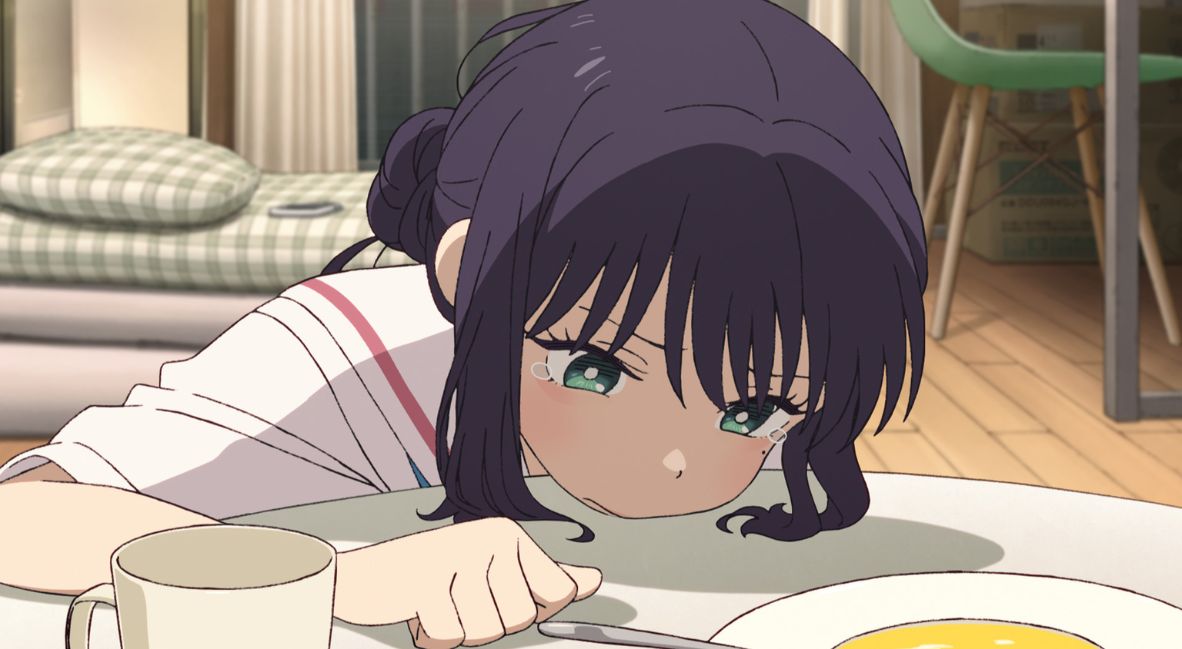
She’s kind of obsessed with an AI Vtuber, dreams of blissful six hours of sleep, is plagued by eye bags and stress ulcers, and, due to her exhaustion, sometimes cries herself to sleep. All of which paints a picture of a miserable character leading the charge on what is, visually, sugar-enhanced vibrancy. But Iroha is the heart of this film and why it works. Because, against all odds due to the near-future setting, she’s relatable in her efforts to keep her life intact through sheer stubborn willpower.
Her life changes one night when, stumbling home towards that sweet, sweet six hours, she finds an abandoned baby in the hollow inside a telephone pole (adorned with bamboo handles, a reference to the original story). Iroha takes her home, seeing no other option, and begins caring for her. Only for the baby to grow and grow until she becomes Iroha’s peer.
Kaguya (Yūko Natsuyoshi) tells Iroha that, like the myth, she is in fact from the moon, having run away due to boredom in search of greater adventure and food she can actually taste. Through their burgeoning friendship and the adventures in the streamer space, Tsukuyomi, where they compete to win a challenge that would allow them to perform with their favorite Vtuber, Yachiyo Runami (Saori Hayami), the two grow impossibly close. Even if they know that, based on the story Kaguya is born from, their time together has a shelf life.
The real world is just as vibrant as the virtual in Cosmic Princess Kaguya.
And while Cosmic Princess Kaguya thrives in the virtual space, with whiffs of the work of Mamoru Hosoda, such as Belle and Summer Wars, it’s in the real world where the animation and writing truly flourish. The limitless possibilities of a digital space where you get to pick your skins and compete in various mini-games and musical challenges seem tailor-made for the anime medium. It is!
The sequences are enhanced by Hechima’s character illustrations and Naoya Nakayama’s direction. But it’s in these beats of real life that we get to know Iroha and Kaguya, where the story and its heart soar.
Because we care about them, Kaguya knows that she has a cosmic, star-written fate that she is to leave earth and forget everything – and everyone – she came to love. She is determined to seek out her own happy ending. And it would seem, throughout, that it’s with Iroha.
Iroha and Kaguya are the undisputed heart of the film.
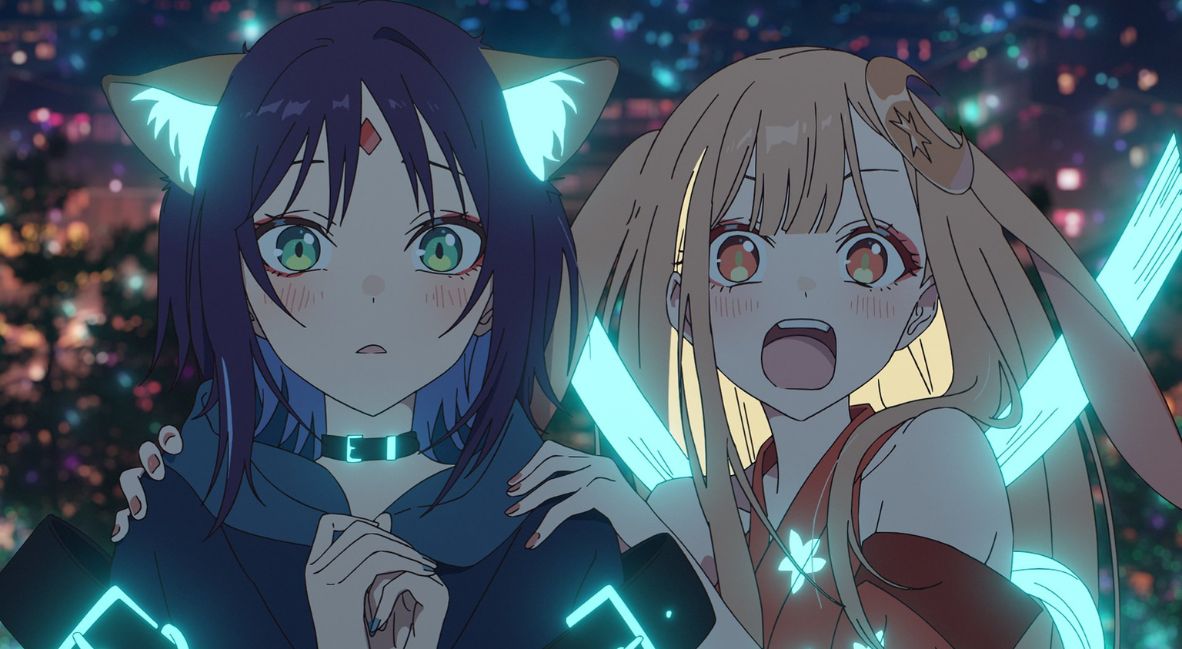
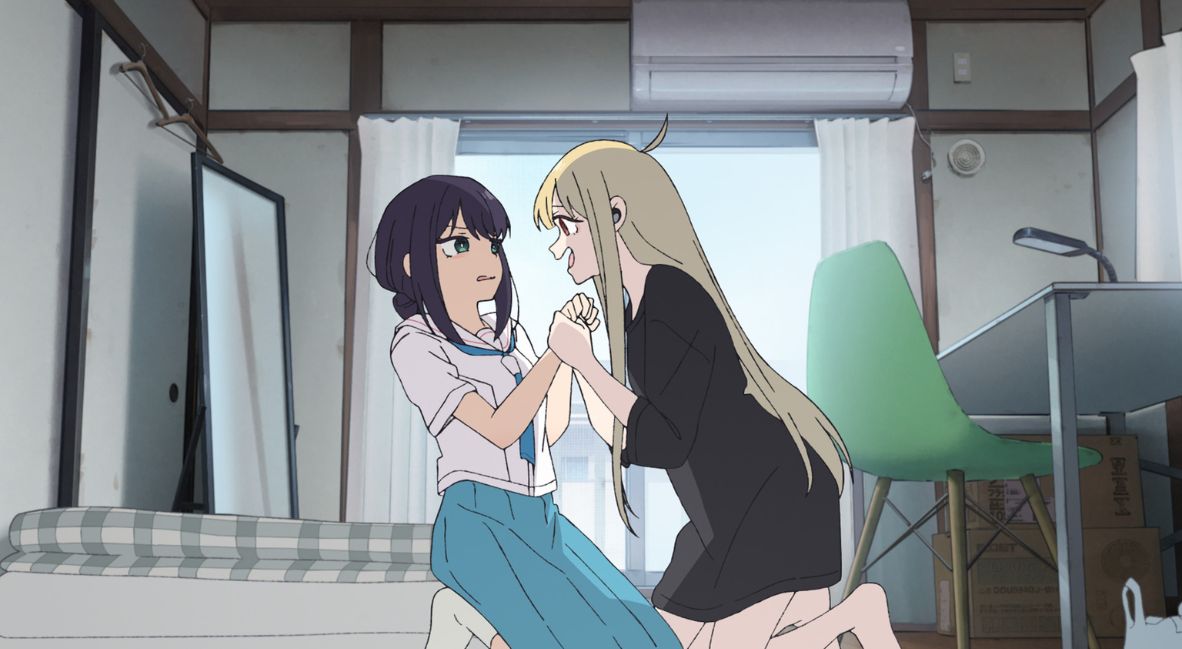
Cosmic Princess Kaguya hardly tampers down the sapphic undertones of their relationship. From declarations of love to sweet, understated moments when they hold hands amid blossoming fireworks, their relationship and how they operate in one another’s lives are what make the film work. It isn’t so much about cyberspace, epic showdowns, or even the ins and outs of the world. It’s about these two girls who come to care about one another, and the celestial wills they’re willing to fight to maintain the happiness they both desire.
Even the animation itself excels, finding clever, subtler ways to highlight their distinctive personalities. Iroha stomping is accompanied by puffs of smoke, while Kaguya is nearly never seen standing still, all flailing limbs and bursts of enthusiasm. The real world is almost more vibrant than the virtual one, thanks to expansive blue skies and colorful cityscapes that lend it tactility without detracting from the subtle plays on futurism.
Unfortunately, Cosmic Princess Kaguya needed another edit. And another ending. The film has multiple endings, none of which truly satisfy, and it comes across as a filmmaker who didn’t know how they wanted the story to end. Or, somewhat, just how far that could deviate from the original text’s most crucial element.
The final product needed a final edit and a better ending.

Some subplots are only softly resolved, and characters, such as Iroha’s brother and her friends, who are introduced but don’t get enough time to leave an impact. And by the time the major third-act reveal takes place, we’ve already been overwhelmed by shallow climactic moments and exposition, taking away from the authentic emotional beats that ground the story.
There’s clear ambition here as the film tackles everything and anything it can in a fit of cinematic glee. And there’s plenty to celebrate because of it as we watch the director and writer take big swings to show off the incredible landscapes of this universe and the endless possibilities they’re capable of. But by highlighting those possibilities, it limits itself. Because, regardless of the potential present and the evident skill and artistry on display, by trying to have it all, it comes across as insecure in the story itself.
Cosmic Princess Kaguya is tremendous for the first 90 minutes. But it’s dragged down by a slog of a third act and a messy, poorly articulated ending. There’s such an abundance of heart at the core, along with genuinely stunning animation that speaks to the distinct personalities of the lead characters. It’s just a shame that the overarching story couldn’t maintain the level of confidence of the first act. Possessed by frenetic, electrified visuals and heartfelt emotional beats, it’s not a miss, but it’s a shame it comes close to being one.
Cosmic Princess Kaguya is out now in select theaters and streaming on Netflix.
Cosmic Princess Kaguya
-
Rating - 7/107/10
TL;DR
Cosmic Princess Kaguya is tremendous for the first 90 minutes. Possessed by frenetic, electrified visuals and heartfelt emotional beats, it’s not a miss, but it’s a shame it comes close to being one.