

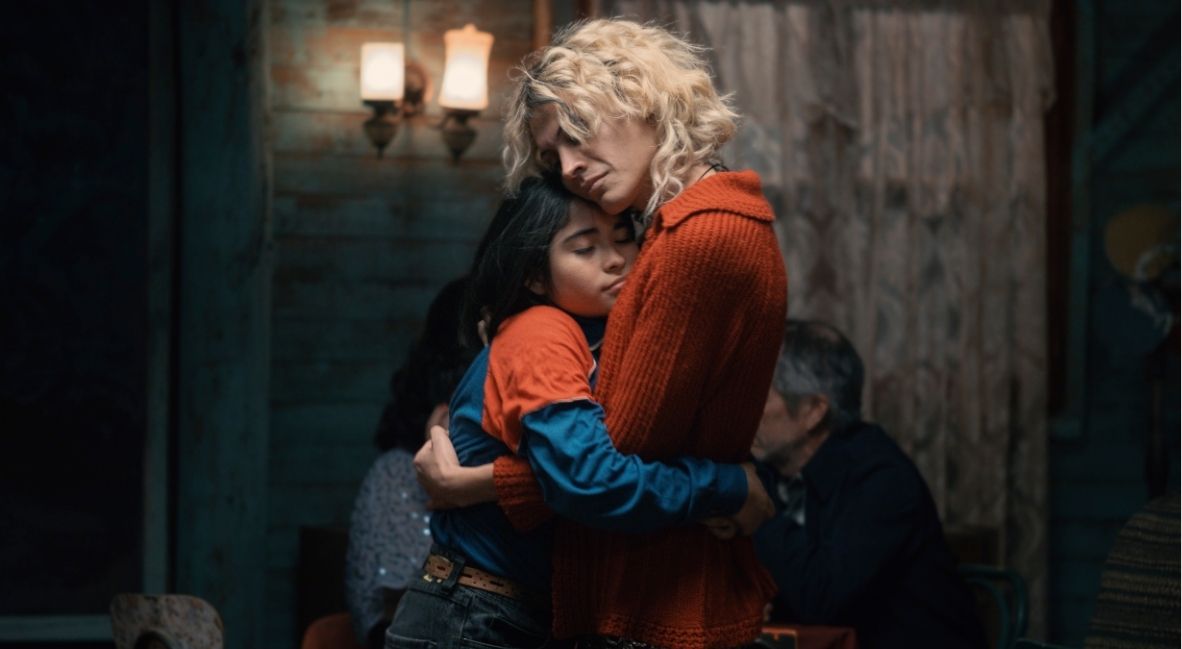
In Diego Céspedes’ award-winning film The Mysterious Gaze of the Flamingo, joy, community, and tenderness emerge as acts of political resistance. It’s a story set in a Chilean desert in the 1980s, but its themes are timeless and remain deeply resonant today.
The film follows Lidia (Tamara Cortes), a 12-year-old girl living with a queer family in a canteen on the edge of a small, lonesome mining town. Lidia was adopted by a transvestite performer nicknamed Flamenco (a spellbinding Matías Catalán) who, along with other members of her chosen family, has fallen victim to a mysterious plague. Miners believe that this plague, which has spread through the town, is transmitted through a single gaze, and this queer community is to blame for it.
Through a coming-of-age lens, a warm direction, and fantastic performances, The Mysterious Gaze of the Flamingo paints a cocoon of communal support in the middle of the AIDS panic. It’s a movie more about resistance, love, and family than about the illness itself.
“It has to do with many other things that interested me beyond the illness itself: this chosen family, how all human beings ultimately search for a kind of family to feel love and tenderness, to have a sense of purpose,” explained director Diego Céspedes in an interview with But Why Tho? “We try to find our people so we can feel part of a clan and feel that we belong somewhere.”
Diego Céspedes tells a timely story about surviving violent times in The Mysterious Gaze of the Flamingo.
In our current landscape—where politicians try to restrict bathroom access for transgender people, where citizens face criminal charges for organizing pride parades, where migrants endure brutal persecution and abuse, where elected officials label Muslim civil rights organizations as terrorists—the empathy of Céspedes’ message carries a particular universal urgency. It’s a story that expands beyond the LGBTQ+ community; it speaks to the dignity and rights of marginalized communities everywhere. The Chilean director always had this universality in mind when crafting the movie.
“It’s a story about people who are different, trying to survive violent times,” Céspedes said in the interview. “Showing how these people resisted, how they created family, how they managed to bloom like a flower in the desert during such brutal times that we now see repeating, was always central to the film.”
The Mysterious Gaze of the Flamingo won the Un Certain Regard award at Cannes 2025; it’s Chile’s submission for the 2026 Best International Feature Oscar race; and is available to buy or rent as part of Letterboxd’s inaugural Video Store “Unreleased Gems” collection.
To learn more about the movie, you can read our conversation with director Diego Céspedes about the tender resistance of his film, the use of a girl’s perspective to tell his story, the casting process, the current relevance of its themes, and much more.
BUT WHY THO: You’ve mentioned that your parents ran a hair salon and, during your childhood, they told you about how their gay employees were dying of AIDS. That became the starting point for this story, but what inspired you to tell it through the perspective of a young girl and to set it in a mining town?
Diego Céspedes: I don’t think a film comes from one single big idea; in the end, it’s the subconscious that keeps working through the things that interest you and the inspirations you carry. So I’d say this family story did spark something in my subconscious, but it’s not the idea that directly created the film. I tend to believe that film ideas come from different places and slowly take shape over time. For me, this particular story is like an important thread in the film, but not the central idea behind it.
Telling it from a girl’s point of view isn’t only about how I saw the illness from a more distant, more childlike place, with emotions more on the surface. It also has to do with many other things that interested me beyond the illness itself: this chosen family, how all human beings ultimately search for a kind of family to feel love and tenderness, to have a sense of purpose. We try to find our people so we can feel part of a clan and feel that we belong somewhere.
That comes from my personal experience, not only connected to this story, but to how I see families and how I see communities in general. And I don’t want to use the word queer because I feel it’s been overused; I feel that people who are different, people whom society considers different, are more similar to one another than we think. And I believe—and I include myself in this—that in the end all human beings are searching for more or less the same thing, and that’s what this film is about.
BUT WHY THO: What does Lidia represent in the story and in your personal life? How does this character relate to you?
Diego Céspedes: First, it has to do with wanting to tell the story from an unprejudiced point of view. I think that when we tell a story from the perspective of a child, we have the chance to speak from a place of purity. Not from a character shaped by the violent, darker parts of the adult world. So when you have a character like that, they’re guided much more by primary emotions—feeling affection, feeling love—without paying so much attention to the façade of who people are.
Diego Céspedes: So, getting to know this family, which might seem strange to others, felt completely natural to her because she follows her emotions. I think that’s really where the idea of telling it from a child’s perspective comes from. And the fact that she’s a girl is because it’s simply easier for me to write girls.
When I was little, I lived in a small house surrounded by my cousins and my sisters. So this character, Lidia—who is very clearly a girl, but with adult ideas, an adult’s sense of irony, a slightly ironic view of the world—was something I had seen a lot in my own family. Writing her came very naturally to me.
BUT WHY THO: How was the casting process to find Tamara Cortes (Lidia), and what was the directing process like, considering she’s a first-time child actor?
Diego Céspedes: The casting process took a long time—about a year or so. We saw many, many girls because I wanted someone who matched the character as I had written her. When Tamara appeared—about three-quarters of the way through the casting—you immediately felt that special quality: a certain lightness in front of the camera, a kind of beautiful lack of self-consciousness.
She already had that. She had no experience in film or anything audiovisual. She had the talent, but we refined it together during a pre-shoot process. We also worked with a coach, Claudia Cabeza, and the three of us built our own system to bring out the naturalness she already carried. She’s incredibly talented and learned very quickly. By the middle of the shoot, she was probably one of the most professional actors I’ve ever worked with.
BUT WHY THO: And the rest of the cast, how did they come to the film? There’s a mix of professional and non-professional actors. Matías Catalán and Paula Dinamarca are incredible.
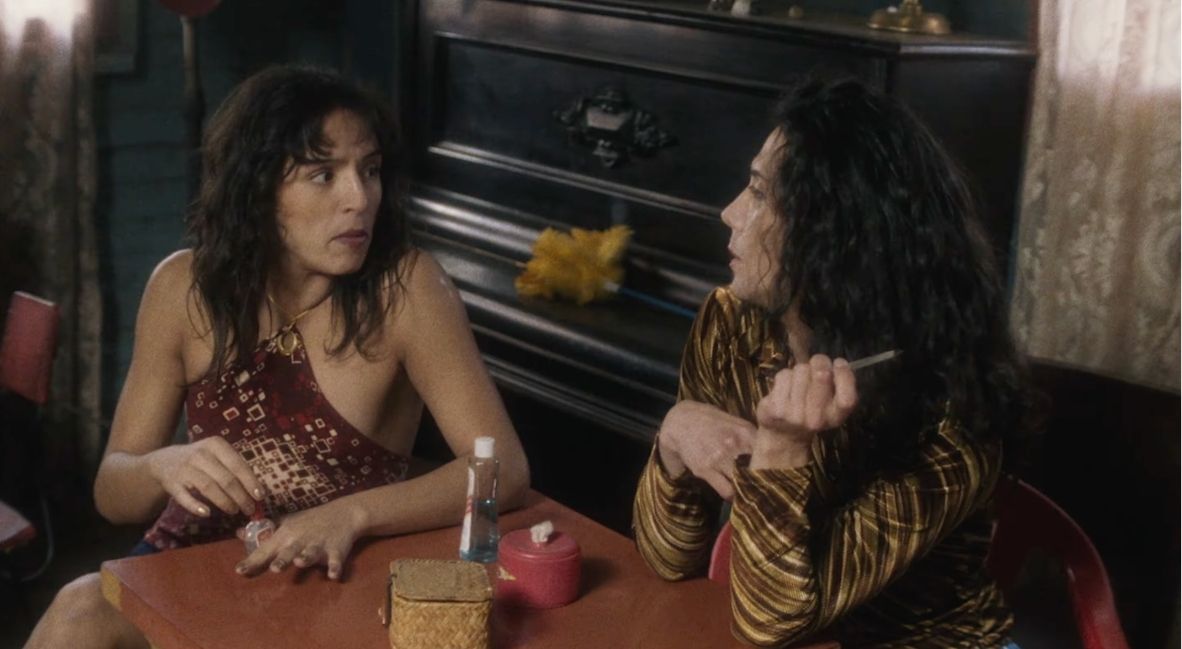
Diego Céspedes: The cast was one of the film’s biggest challenges, and an area we focused on from the very beginning, because it’s made up of professional actors, non-professional actresses, and children. It seemed like it would be a huge challenge, but once you find the right person, everything flows more easily. It was a long process in which they contributed a lot of their own lives, especially the non-professional actresses.
I had already worked with Paula on a short film. She’s a natural actress, but has plenty of experience, and we know each other well, so it’s a very close and somewhat undefined way of working, because I think the directing style has to adapt to how they act, to whatever feels most natural for them. And that’s important to me, because when you’re working with such a diverse group, with such different backgrounds, you have to adjust.
BUT WHY THO: There’s a very important setting in the film: the pond where bullying happens, where there are beautiful moments of connection, but also tragic ones. Why did you choose this pond as the place where all these emotions converge?
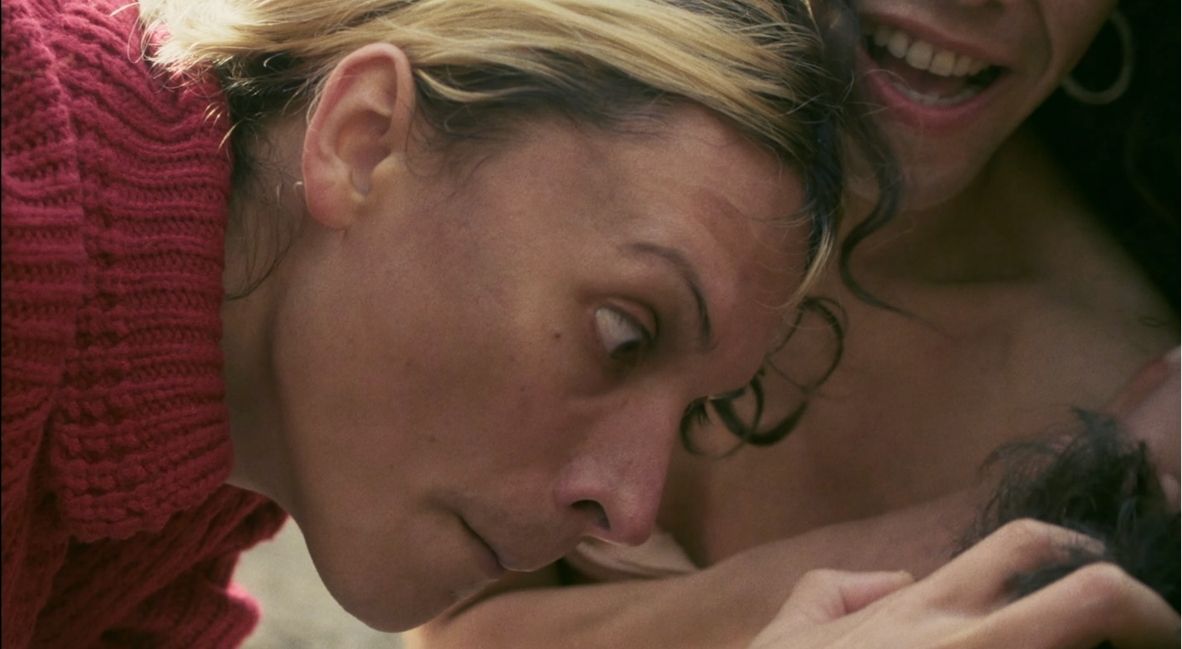
Diego Céspedes: The idea of this mysterious lagoon was always there from the beginning. In the script, it was always described as a lagoon dirty with oil, very dark. You can see how dark it is, and you can’t see the bottom. I liked the idea that the mystery comes from below—from something that’s there, on this unstable ground, damp and absorbing, but always underneath. So behind those gray waters, there’s a truth. And I think that’s very much a representation of the film as a whole.
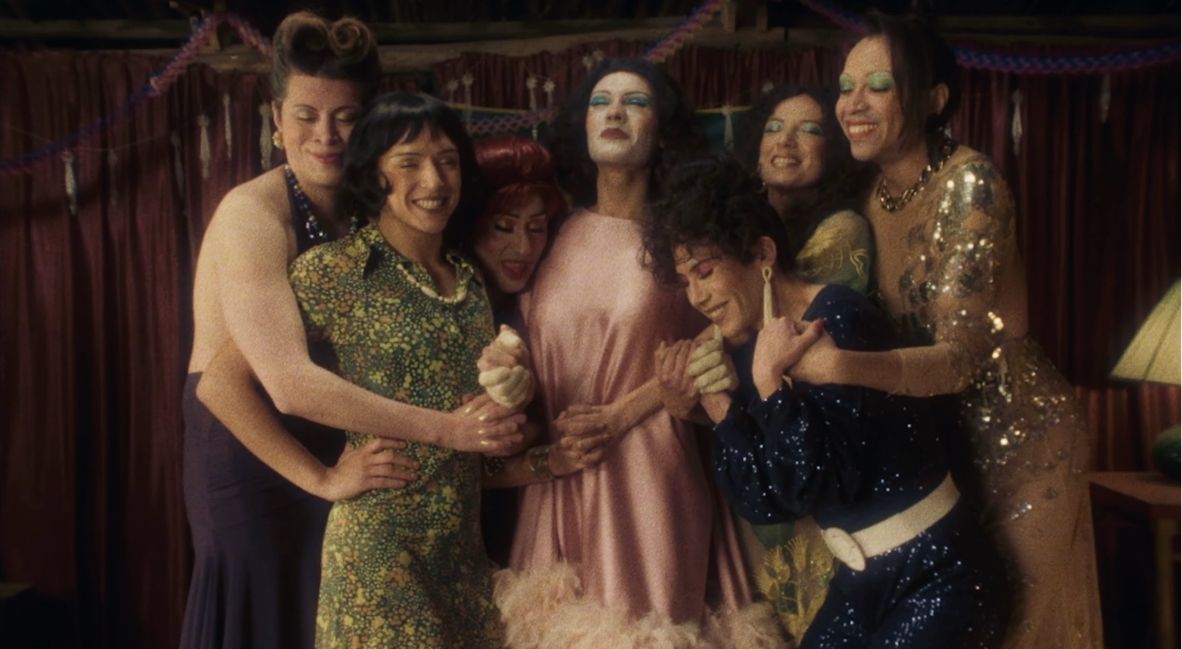
BUT WHY THO: Tell me about the Miss Alcazar scene. There’s a tremendous authenticity to it, you can see everyone is truly having a great time. What was it like to direct those scenes?
Diego Céspedes: It was a very intense day because we filmed for a long time, but it was also incredibly fun. There’s a mix of improvisation, but also tasks I gave the girls, like asking what their real talent was. Some moments were more them, and some were more me, and the film in general works that way. It’s my direction, but with a lot of them in it. And just as the film feels fun, it was fun to shoot in real life too. I think a lot of that reality comes through on screen, because I remember that day we were all cracking up. That’s really how it was.
BUT WHY THO: The Western has traditionally been a deeply masculine and patriarchal genre. I find it interesting that two of the films that most radically upend it in recent years come from Chile —yours and The Settlers. In your case, you put the genre through a kind of demystification. How did you decide to rely on the Western to tell this story? Which elements of the genre did you feel needed to be dismantled to make it work in your world?
Diego Céspedes: Honestly, it wasn’t a very academic process. I think there’s something unconscious that happens when we see certain images; two or three elements are enough for us to immediately associate them with a genre, a filmmaker, or a style.
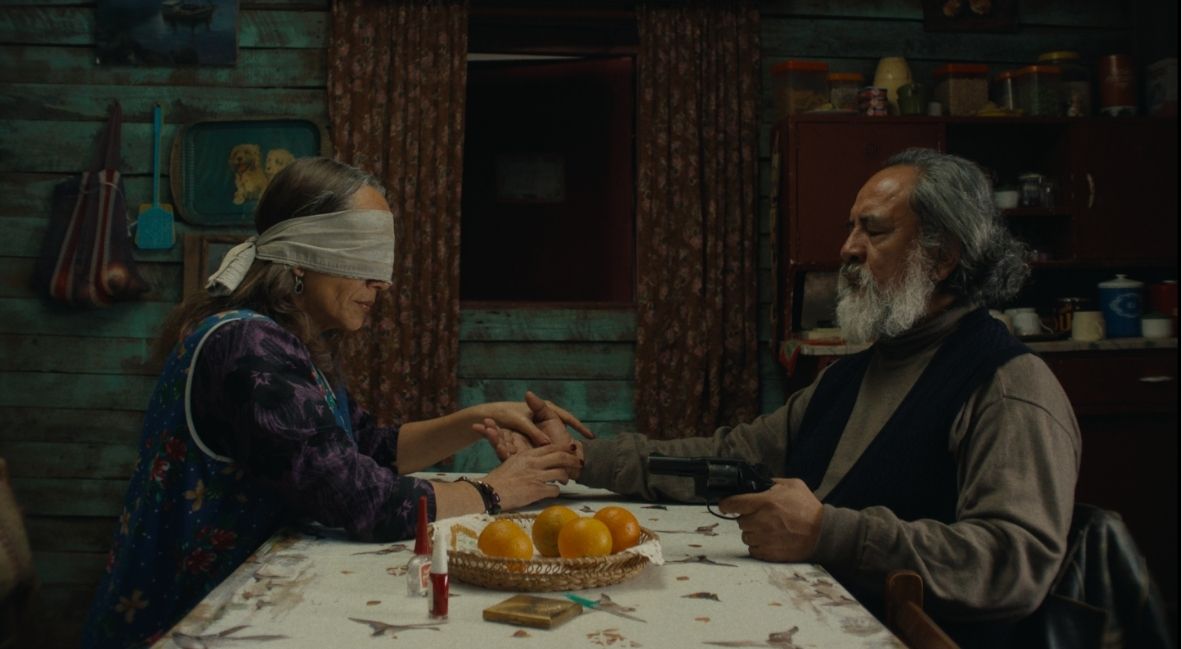
But in our case, a lot of these choices simply came from reality. The Atacama Desert and the presence of guns have always been part of life in northern Chile; the landscape itself feels inherently western. So it wasn’t a theoretical decision so much as something that emerged naturally. In fact, the most overtly western moment only appeared very late in the process.
The way we decided to shoot the scene where Lidia confronts Yovani —which is the clearest western sequence— and the music, which came in during the third stage of editing. From there, the western began to spill into other parts of the film, because the characters’ own reality, their environment, and their sometimes violent ways of relating made space for it.
BUT WHY THO: Your film portrays a community in resistance, one that doesn’t hide, that resists through tenderness, humor, and collective work. And while this has always existed, today, in these increasingly fascistic times, it feels even more universally resonant. Was that sense of universality something you had in mind from the beginning, or did it emerge as the project evolved?
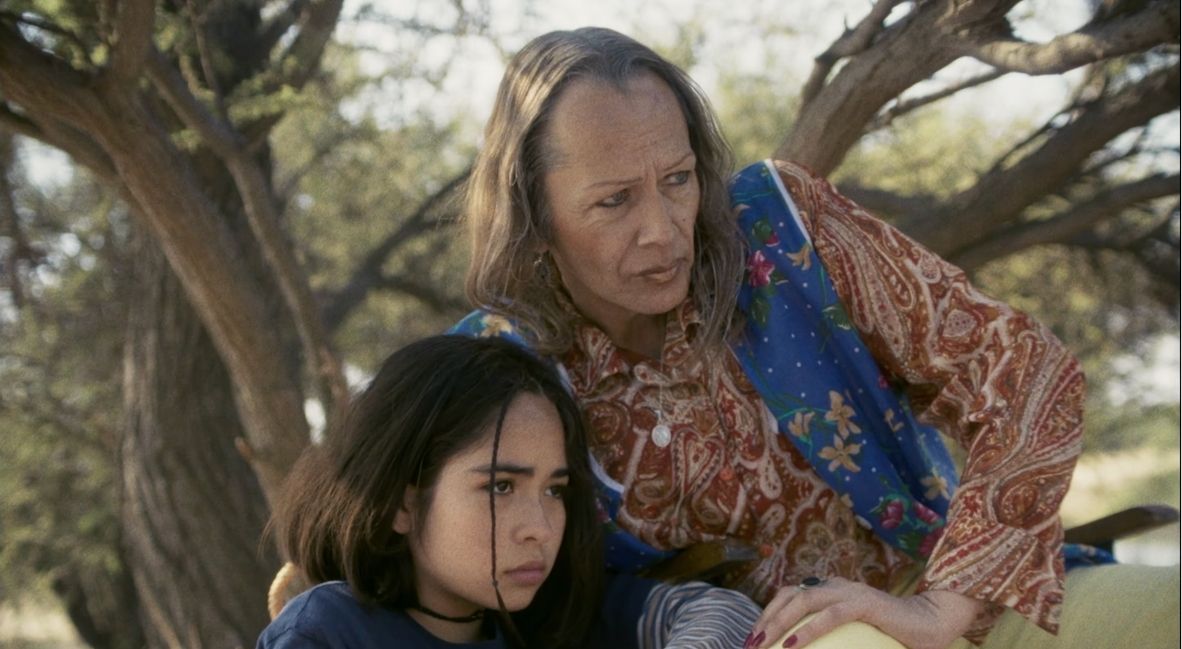
Diego Céspedes: To me, the film is quite universal. I don’t fully identify with the idea that it’s a film about AIDS, nor do I see it solely as a film about dissident communities. I think it’s a story about people who are different, trying to survive violent times.
And unfortunately, that’s something we can easily place in today’s context, where, as you say, fascism has returned and is growing stronger. So showing how these people resisted, how they created family, how they managed to bloom like a flower in the desert during such brutal times that we now see repeating, was always central to the film.
Choosing not to explicitly mention AIDS doesn’t deny that history; on the contrary, it strengthens the universality of the resistance we’re portraying. That was something we discussed from the very beginning. In the end, the film reflects on our own history and on what it means to survive in times marked by ignorance, fear, and brutality.
BUT WHY THO: How was the reception in Chile? How did that feel for you?
Diego Céspedes: We’ve only shown the film at festivals in Chile so far, and every single screening has been incredible. Honestly, we’ve had full theaters, people crying, applauding. There’s been a very beautiful connection between the cast and the audience, and between the film itself and the audience.
I think it resonates deeply. It’s not something I had planned or expected, even knowing how emotional the film is—but not to this extent. And I keep receiving messages of affection, connection, and reflection. That makes me very happy, especially because you spend so many years with the film on your own that now I feel it has truly become a collective project, and that makes me proud.
BUT WHY THO: If we could show this film to those communities in resistance of the ’80s or even the ’90s, what do you think they would say about the way you portrayed them?
Diego Céspedes: I can’t say exactly, but I can tell you what I would like: I’d like them to feel moved by the love they built, by the message that managed to transcend time. That message of love that, despite the constant hatred directed at them, survived across the years. That’s what matters.
The Mysterious Gaze of the Flamingo is distributed by Altered Innocence in the United States and opens on December 12 at Roxy Cinema New York. It’s also available on Letterboxd Video Store.