

Who We Are: A Chronicle of Racism in America is a documentary directed by Emily and Sarah Kunstler written by Jeffery Robinson showing at SXSW Film Festival. The film is a 118-minute that follows Jeffery Robinson’s groundbreaking talk on the history of U.S. anti-Black Racism is interwoven with archival footage, interviews, and Robinson’s story, exploring the enduring legacy of white supremacy and our collective responsibility to overcome it.
Jeffery Robinson (Producer/Writer) is the director of The Who We Are Project and a deputy legal director and the director of the ACLU Trone Center for Justice and Equality, which houses the ACLU’s work on criminal justice, racial justice, and reform issues. Since graduating from Harvard Law School in 1981, Jeff has four decades of experience working on these issues and has tried over 200 criminal cases to verdict.
As a public defender in Seattle, he represented indigent clients in state and federal court and has represented a broad range of clients in private practice. Robinson was one of the original members of the John Adams Project, where he worked on behalf of one of five men held at Guantanamo Bay charged with carrying out the 9/11 attacks. He has traveled the country speaking hard truths in a groundbreaking talk on racism in America in recent years. Who We Are: A Chronicle of Racism in America is based on this talk.
Emily Kunstler (Producer/Director/Editor) and Sarah Kunstler (Producer/Director) are the founders of Off Center Media, a documentary production company dedicated to racial justice and social change. Their film, William Kunstler: Disturbing the Universe (Sundance ’09, POV/PBS), was shortlisted for the Best Documentary Academy Award.
I had the pleasure of speaking to the creators of the documentary ahead of their film’s debut at the 2021 SXSW Film Festival. In this interview, they discuss how they came together to make this film, discuss the production planning that went into making this film, and more.
For the full, more in-depth discussion with the creators of Who We Are: A Chronicle of Racism in America, you can listen to the full audio interview here.
BUT WHY THO: How did the three of you come together to make this film?
Sarah: I am a lawyer, and I went to a continuing legal education seminar, where Jeff was the speaker. And his topic was a condensed version of his talk on 400 years of anti-black racism in America. And hearing Jeff’s talk changed my life. And I couldn’t look at the world the same after kind of learning the history that he presented. And I left the courthouse where I took the CLE. I called Emily and I, and I said, we have to, we have to film this. We have to, you know, make this into a movie. We have to share it with people, and that’s how it started.
Jeffery: It was also eye-opening to meet Sarah and Emily and, you know. I knew them by reputation, but then I got to know them personally. And this was quite an odyssey, and I don’t know, well, what I do know, I don’t know who else I could have done it with, but what I can say is that I could not have done it with people that I didn’t come to trust completely. And that is why it’s one of the main reasons why the film is as powerful as it is.
BUT WHY THO: Your film feels so very different from any other documentary about American racism that I have ever seen. Was that what you all set out to do initially?
Emily: Our goals are, really, Jeff’s goals. I mean, Sarah saw this presentation; she had this experience; when I saw it for the first time, I had the same experience, and we wanted to share that experience with as many people as possible. We wanted to make a film that mimicked that experience, that was a really eye-opening experience where the next day of your life, you can’t walk down the same streets and look at them in the same way, you know, where you’re more inclined to commit yourself to having a greater understanding, and a greater commitment to justice. So, that was our, that was our goal. And to try to, to reach the greatest audience possible, to reach educated and reach an audience through education, through, you know, sort of general media consumption any way we possibly could. It was just to get Jeff’s message out there.
Jeffery: Well, I don’t know that I had any expectations because I never planned on making a movie and when they came to me, and we talked about it, I think for a while, it was just like, Oh yeah, that’s, we’re doing this thing. And that’s what they call it. And when we did the presentation and in Allen Hall, in New York, on June 18th of 2018, that’s when it really became real. And from that moment, I think, I think it was better for me not to know anything about the film industry or to not that I didn’t know anything about the road we were about to embark on because I would have been more intimidated, I think had I known I still would’ve done it, but I would have been more intimidated, but I think I came into this with no expectations except that I wanted the largest number of people possible to see this. And we are going down that road.
Sarah: Well, Emily and I are white, and Jeff is black, and one of the things that pulled me into it from the start was the way Jeff presents. His history is a history that has been stolen from all of us. He says our history has been stolen from all of us, and it is our job, all of us, black and white, and people of all races, to get this American history back. It’s not the history of anti-black racism in America is not just a history of the oppression of black people. There was the resistance of black people. It’s also a history of white supremacy. And as a history of white supremacy, it’s a history that white Americans need to own as much as it’s; it’s a history that black Americans need to own.
BUT WHY THO: The film feels like it is a culmination of so much. From recounting historical events, referencing current events involving police altercations to breaking down how white supremacy is embedded in our country’s foundations and laws with vibrant storytelling. What all went into the planning and production for this film?
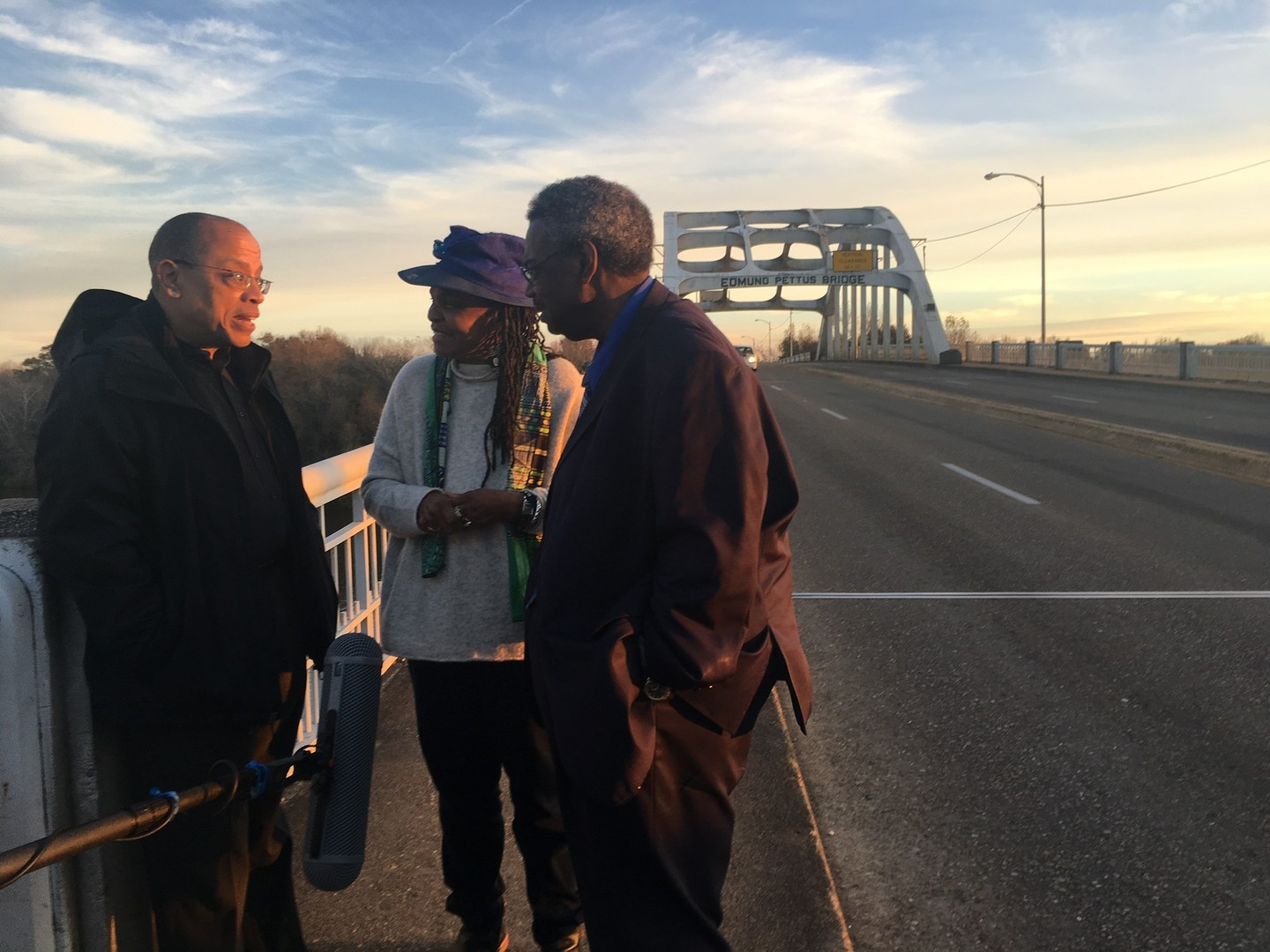
Emily: Well planning, so Jeff travels around the country giving this presentation. After we filmed the seven camera shoot, in the Town Hall, we started traveling with him. So we would bring us a very small crew and try to track down interviews with people from real-life historians or people whose lived experience was relevant to Jeff’s presentation. So the film came together rather organically. It wasn’t so much planning, but chance and luck and just, you know, sort of magic happening at every place we landed, we would find these amazing stories an after every trip, we’d say that trip was the best one we’ve taken yet. I can’t believe we’re going to have another trip.
It was three years of that, and then when the pandemic hit, we stopped shooting. So that was, that was the end of our traveling. And we put the film together from the stories we had collected, but we really, you know, we were very lucky with the people we met and the trust that they had in us.
Sarah: We also had Jeff and the talk that he’s been honing for almost 10 years at this point. And he’s given over a hundred times. So that was, that talk is the backbone of the film. So really, the talk informs everything else. Everything else is built around. Jeff’s words, Jeff’s work, just presentation.
Jeffery: And I think it’s just the significant thing is a timeline. That’s, that’s how I was trained as a criminal defense lawyer. If you have a complex set of facts, put them into a timeline and just see what the timeline tells you. And when you start doing that and just saying what people said and what they did, and putting those things together in a timeline, all of a sudden, you get very different answers to questions.
Like, why are there so many black people in prison? Why is there a wealth gap between black and white people in America? And you get very different answers when you understand that history. So I think we always had the time and at least in my mind, and this is why I say it was easier for me not knowing how difficult it was. You know, this was, we always had the timeline, what Sarah and Emily had to do once the filming was done and putting together the timeline and the presentation and the interviews. That’s something that I just saw different stages of it as it was produced that you’ll have to. I still don’t know how they did that.
BUT WHY THO: What or how do you want audiences to feel after they see your film?
Jeffery: So one way I’d like them to feel is described in a verse from one of my favorite bands, Electric Blue by Arcade Fire. “I can’t get my head around it. I thought I’d found it. But I found out; I don’t know shit” That’s what I’d like people to feel is I thought I knew, and I did. I want them to feel like I felt. I felt humiliated. I felt angry. I felt ignorant. And I’m not saying that in a bad way, but those are, those are emotions that I think, you know, this is not tea and crumpets that we’re talking about here. This is an ugly history. And once I forgave myself for not knowing it, I wanted to blame somebody else, but everybody else, I would try and blame my teachers, their teachers. I kept thinking, well, if they’d never got taught it, then who do, who do they blame? And so it just went from there to, you know, I wonder how many people don’t know, and that’s, so I want people to have that feeling. And if they walk out with that feeling, then as Sarah said, and as Emily has said, it sets the table for difficult conversations going forward.
Who We Are: A Chronicle of Racism in America premieres Wednesday, March 17 at the SXSW Film Festival.