


Set in the 1970s, the new Netflix Original series made in partnership with Viz Media, Seis Manos, focuses on three Mexican siblings after the murder of their adoptive father and kung fu seifu. On their path to find the killer, the siblings, Jesús, Isabela, and Silencio are pulled into a world of the cartel, magic, and monsters. While Seis Manos’s story is well-executed, it’s the ability of the showrunners to blend together Mexploitation, Kung Fu cinema, and Mexican identity.
Exploitation cinema is hallmarked by exploiting current trends, niche genres, and often rests on a foundation of violence, nudity, blood, and all of the things most would like to keep out of the cinema. As the genre that has brought us countless B-movies, it also is a space with many subgenres like Blaxploitation, Mexploitation, Spaghetti Westerns, and more. The grindhouses of the 1970s and 1980s were theaters that made their names showcasing exploitation cinema and became havens for genre lovers.
Exploitation cinema in Seis Manos happens at different levels, the easiest of which to identify is the 1970s setting focused on Mexican Narcos and of course kung fu. The characters, namely the DEA agent named Brister and the Mexican police officer, Officer Garcia work to embody the leads of Exploitation films, often law enforcement or adjacent working to . Through Brister, we also see an attempt to distill the Blaxploitation genre into a single character. Sadly, this doesn’t work as smoothly as the creators would have liked.
As the only American in the series, put there to be a stand-in for the audience, he detracts from the story with his jokes made at the expense of the characters and ultimately, their culture. His inclusion was an obvious way to pay homage to the large collection of the Blaxploitation genre that was formative in the grindhouses but doesn’t come off as well-executed as the other elements of Seis Manos. That said, the heart of Mexploitation cinema is beating within almost every shot of Seis Manos. By positioning the antagonist El Balde as a cartel leader, the genre defined by narcos and extreme violence is alive and well.

Running parallel to Blaxploitation in the United States, Mexploitation movies were close to their American exploitation film counterparts, with low-budget science-fiction films that often starred Mexican luchadores such as the revered El Santo. Seis Manos, despite its 1970s setting, finds its life in the Mexploitation of the early 1980s and 1990s when the genre switched to focusing on the cartel and branching into Narco-cinema. That said, it is perhaps Mexican American writer-director Robert Rodriguez’s style of Mexploitation that is most present throughout the series.
Credited as a pioneer of Mexploitation in the United States, influences from Rodriguez’s films from El Maraichi to Machete find a place in this series. It is perhaps his action-horror romp From Dusk Till Dawn that most exists in Seis Manos, as the members of the cartel turn to monsters upon coming into contact with the magic of Santa Nucifera. The series drips with blood, mutilated bodies, and the worship of death.
Sies Manos also follows the long tradition of American Exploitation blending with elements of Kung Fu cinema, namely the fight choreography and story structure. Our main characters, adopted by Chui, who serves as both their loving father and Sifu, are each adept in different forms of Kung Fu, all custom fit to their personalities.
Jesús uses the most recognizable form of Kung Fu for Western audiences, Drunken Boxing (Zuì Quán), made famous in the United States by Jackie Chan. Isabela is a master of Hung Gar, a style that originates from the “fighting monks” of the first Shaolin Temple in Henan province and with five variations based on five animals: tiger, crane, snake, leopard, and dragon. And finally, Silencio uses Bak Mei, also known as the White Eyebrow, a name worked into his character. The style itself is a lethal style not modified for competition and known as the most explosive of styles.
The use of King Fu cinema is present even beyond the use of the martial art itself and the featuring Chinese characters on the title screens. The revenge structure of the series works like many in the Kung Fu genre: Master is killed, students avenge master, student grows. By adding the brutality of grindhouse gore into the fluid movements of martial arts, the show executes a storyline that thrives on both.
In addition, every episode begins with a line from Daoist texts, the guiding moral code by which Chui taught his children. Even beyond that, there are references to Bruce Lee’s teachings and advice as Isabela is told to be like water in order to conquer the bruja who has taken over her body.
I’m Mexican American, which means that I can talk on the superb use of Mexico and folklore in the series. But, it also means that I can’t speak to how well Chinese representation in the show outside of the king fu cinema tropes Seis Manos pulls from. What I can speak on, however, is that while some may see Mexico and China as an unlikely pairing, this couldn’t be further from the truth. This isn’t just because of the pervasive nature of Kung Fu cinema, which was beautifully covered in the documentary Iron Fists and Kung Fu Kicks, it’s also because, in some areas of Mexico, there is no difference between Chinese and Mexican identity, it’s one in the same.
Starting in the 19th century, Chinese migrations to Mexico were consistent until the 1940s. The series itself touches on one of the ways in which Chinese migrants came to Mexico, similar to the United States, to work on the railroads. Also similar to the United States, Seis Manos shows the violence some faced and doesn’t only look at kung fu. While done to move the story, it’s important to note that anti-Chinese sentiment was and is real in Mexico, leading to the blocking of immigration.
With that being said, much of Mexico’s northern states and norteño culture is influenced by Chinese migrants to the country, making Sifu’s life in Mexico more commonplace than someone without knowledge of history would think. While the series effortlessly uses Kung Fu cinema, it has work to do in exploring the perspective in this series is not from Chinese-Mexicans. Raised by Chui, one of the only moments of exploring this blended family comes in episode two, “Grief.”
If you know anything about Mexicans, you know how we see death. It’s just another part of life. We sometimes celebrate it and the traditions, while having routes in indigenous religions, have been mixed to be predominantly celebrated through Catholicism. In a flashback, Isabela is dealing with the death of her bird, and instead of grieving in a way familiar to Mexican viewers, she seeks guidance from Chui’s book and begins to perform Dao funeral rites for her pet. It’s small, but it points to a part of the siblings’ identities that can be furthered explored if the series gets a second season.
Through the grindhouse aesthetics and Kung Fu action, the connective tissue of the series is Mexican folk religion and the magic of curanderismo and brujeria that surrounds it. From communicating with the saints to astral planes, and more, the series uses the world of the supernatural that is real to many Mexicans to tie every aspect of itself together and create a story that is Mexican before all else. By grounding the majority of the magical choices in either the healing magic of the curandera or the death magic of the Santa Muerte replicant Santa Nucifera, the story is blended in a way I have never seen before.
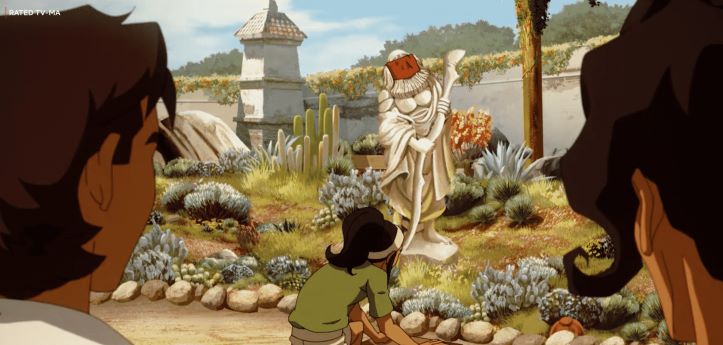
Beyond the magic, the animation style replicates that of old films, bubbling ever so slightly as streaks go through the scene as if recorded on 35mm and played for us. It feels like a period piece, played alongside grindhouse greats. Blood, magic, martial arts, and replicating 35mm film all push Seis Manos into a unique category of anime that isn’t easily described genre-wise.
While not everything lands perfectly, specifically Brister, Seis Manos is an anime that looks to do more than just tell a one-dimensional story or highlight kung fu. By layering on different cinema stylings, the series is able to tell a story that most wouldn’t expect. Beyond that, the series crafts a visual and stylistic identity that uplifts a Mexican story while also crediting two genres, Exploitation and Kung Fu, both of which have a big impact on Mexican filmic storytelling.
Seis Manos is streaming exclusively on Netflix.