
Check out our exclusive card reveal for Riftbound Unleashed.
Riftbound has been out in the wild for at least a year now, but my first time getting my hands on it was this year at PAX East 2026. Like everyone who would end up at a convention like this, I’ve done my fair share of time in the Magic: The Gathering mines, and even though Riftbound has become a popular game in its own right, it’s still nowhere near as ubiquitous as the biggest card game in the world. It, like its UVS Games counterpart Universus, isn’t in any of my local hobby shops. I couldn’t stroll in and buy some packs out of curiosity if I tried. Senior Designer Jon Moormann knows the struggle.
“I know for Origins when we did our first print run, we had a certain idea of where we were going to go. We needed way more than that.” But with the releases of follow-up sets like Spiritforged and the upcoming Riftbound Unleashed, working to get cards into as many hands as possible is just as high of a priority as bringing the high-stakes tension of the Jungle in League of Legends to the card game.
Riftbound Unleashed introduces several new keywords and legends that thrive when you plan ahead and spring traps on unsuspecting opponents. Players can now gain XP, which unlocks features of cards when you clear their thresholds, or can be spent to gain immediate effects. For example, a card like the 2/1 Mister Root gains XP when he moves to a battlefield, whereas the 6/6 Megatusk can spend XP to give all units Ganking, which allows them to attack between battlefields.
This mimics the Jungling process of League of Legends, where units roam through the zones between lanes to kill NPCs and gain power, to eventually strike without warning and help lane allies overwhelm their foes to get quick advantages.
Units with Hunt gain XP equal to their Hunt value when they conquer or hold battlefields, like the 3/3 Mosstomper, could net you a steady stream if it can stay alive at a location. Creatures with Ambush can be played directly into battlefields you control as a reaction to attacks, a powerful tool to control your opponent’s aggression.
New legends Kha’zix and Rengar take great advantage of these tools to really embody what it’s like to play a Jungle in the MOBA, while the Unstoppable Master Yi takes full advantage of the XP mechanic, getting cheaper and cheaper to play the more XP you have.
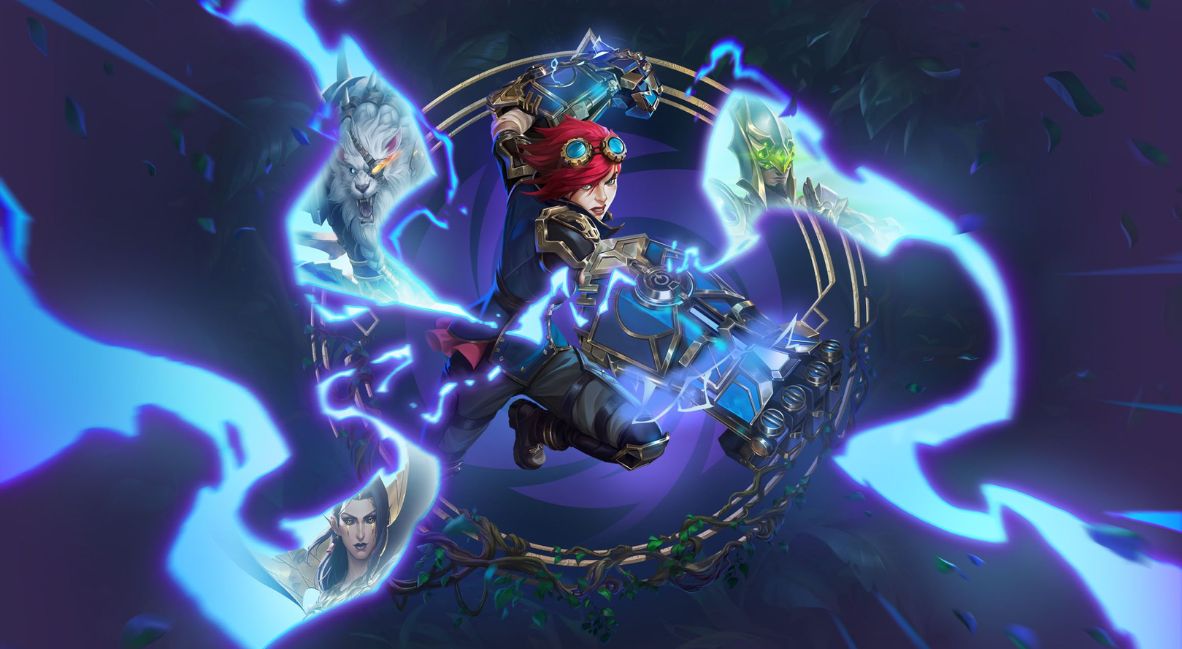
We sat down to play with two decks featuring new legends coming to the game in Riftbound Unleashed, him playing Vi, and me playing Vex. After taking a few minutes to simply learn the ropes, I hopped right into spending runes and slinging spells, fighting back and forth over the two battlefields in front of me.
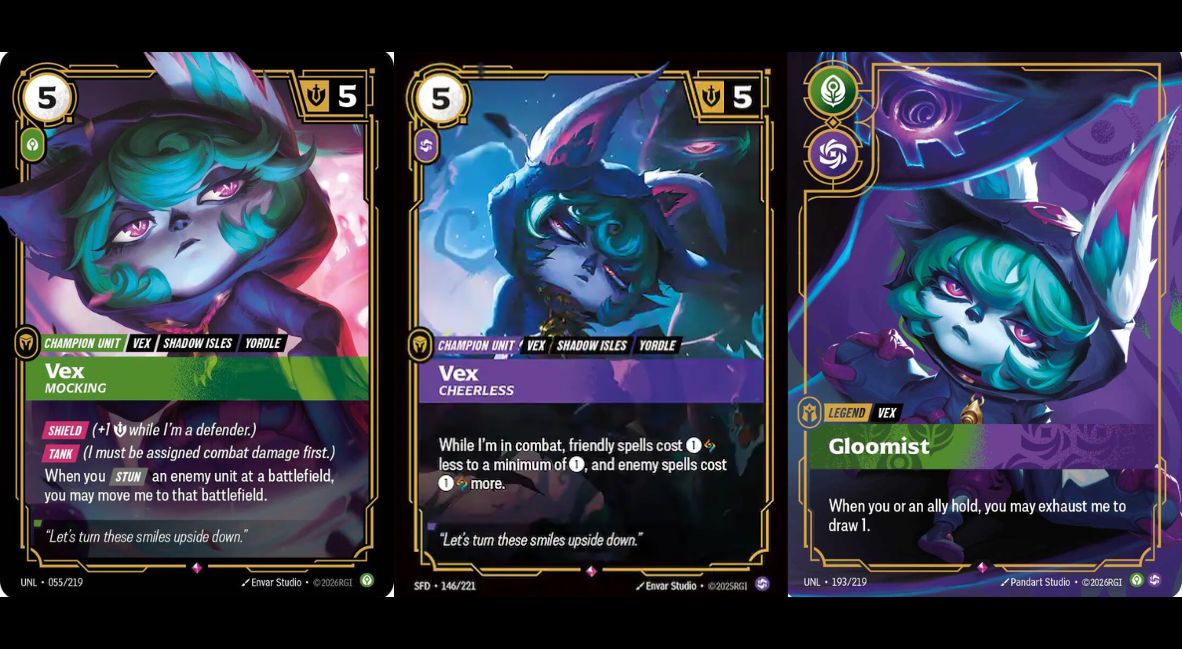
I picked up on the power of my legend card, Gloomist Vex, a bit too late in the game, but her ability to exhaust to draw a card every time you hold a location would have helped me get through my deck way faster, a thing I really needed to do early, as my draws were not looking great for me.
“In a lot of ways, we’ve learned from all of [the TCGs we play] and tried to make the game stand out from them.”
I picked up on the synergy between the legend version and the champion version of Vex, Apathetic, too late as well. Besides deflecting (opponents have to pay extra runes to target her with spells), if any opponent tries to play a unit while she’s on the battlefield, those units are stunned, meaning they can’t move and can’t do damage that turn. In hindsight, that would have been a great card to play earlier to cover some later game gambits, but I find comfort in the fact that everyone is probably as bad as me in their first game.
On the other side of the table everything seemed to be coming up Vi, whose legend ability, Piltover Enforcer, let her exhaust herself to ready creatures if Jon had overkilled anything by 3 or more damage, which he was finding great ways to do with his bevy of assault creatures that gain strength when they attack in conjunction with a champion Vi who could double her might in any given turn. By turn three, my fate of being run over by hordes that get exponentially stronger when they attack was sealed.
It’s easy to see the ways that Riftbound is similar to Magic: The Gathering, but it was enlightening to hear some of the games Jon and his team reference that aren’t the 800-pound gorilla of TCGs. His experience with other TCGs like Netrunner, and also board games like Catan or Teamfight Tactics, really informs his design goals. “One of our last standing meetings was just the team telling each other how far we got in Slay the Spire 2” Jon joked. “In a lot of ways, we’ve learned from all of them and tried to make the game stand out from them.”
I got exposed to a lot of mechanics early, but it was tough to get a handle on the best way to use them out of the gate. Jon recognizes that the balance between creating a game that a new player can get their hooks in quickly, while also having lots of avenues for depth and complexity, is a tricky one to strike.
“Obviously, there’s a lot of cards face up at any point in the game, and interactions between them can go any number of different directions,” he said while we cleaned up our match. He described that even though a lot of new players are like me, people who would definitely return for more, there are plenty who bounce off immediately.
That initial barrier to entry is a bit higher than they want it to be, and though disappointing, he chalks that up to the strength of Riftbound’s identity in comparison to other games on the market. What makes them different is also what can make them difficult.
“Its surreal to see entire rooms full of people playing the game.”
Despite its challenges, Riftbound has been seeing a great deal of growth since its official launch back in October. Especially in its competitive scene. “[Event] Turnouts have been great,” Jon said of the myriad tournaments and Nexus Nights springing up at hobby shops and conventions all over the country.
“Its surreal to see entire rooms full of people playing the game.” Being a new pillar of Riot’s current gaming empire comes with its own pressures, but Jon credits Riot’s immense faith in the product (and that much of the Riftbound team was involved with Riot’s last attempt at TCGs, Legends of Runeterra) and the freedom they get to make the game they want as a key to their success.
Ironically, the team announced their first-ever competitive ban list just days after my sitdown with him, so even though he and the team are proud of the work they’re doing to keep the sweatiest among us coming back, there’s clearly some tinkering still to be done.
Riftbound Unleashed is available in China on April 10, 2026, and in English-language regions on May 5, 2026.