


Lupin III returns for another thrilling adventure film in Lupin III: The Movie – Immortal Bloodline. Directed by Takeshi Koike, written by Yûya Takahashi, and produced by TMS Entertainment, the film has made its North American debut through GKIDS distribution. The film’s English dub voice cast features the talents of Keith Silverstein as Arsene Lupin III, accompanied by Dan Woren as Jigen, Lex Lang as Goemon, Cristina Valenzuela as Fujiko and Salifa, Richard Epcar as Inspector Zenigata, and Michael Orenstein in a reprising role.
In Lupin the III The Movie – The Immortal Bloodline, following a series of deadly assassins, Lupin and his crew make their way to a mysterious island to unveil the mastermind behind these hitman attacks. However, what starts as an adventure to confront their mysterious foe and steal their fortune quickly turns into a fight for survival.
Lupin, Jigen, Goemon, Fujiko, and Inspector Zenigata become stranded and separated on the treacherous, uncharted island, covered in poisonous fog and strewn with clues and the remains of past enemies. As his friends fight for survival, Lupin’s wits are pushed to his breaking point by the island’s immortal ruler, Muom.
Lupin III: The Immortal Bloodline is good but doesn’t reach the heights of the best of the franchise.

Lupin III: The Immortal Bloodline is the culmination of Takeshi Koike’s work within the Lupin III cinematic franchise. The film connects Koike’s previous films, Jigen’s Gravestone (2014), Goemon’s Blood Spray (2017), Fujiko’s Lie (2019), and, most recently, Zenigata and the Two Lupins (2025). Each of the films centers on Lupin, Jigen, Goemon, and Fujiko, respectively, in storylines that focus on them individually as they confront deadly assassins.
Lupin III: The Immortal Bloodline is a good, quality Lupin III story, but it is not the best film in the series. Although the film possesses many qualities of a classic Lupin III adventure, it has some flaws. Storytelling-wise, the film is solid, but it does require some prior knowledge of Koike’s other Lupin III films, and it relies heavily on flashbacks and exposition to help viewers follow along.
Some fans may or may not have an issue with these storytelling decisions. Still, they serve a purpose in helping establish the film’s plot and characters, as well as providing a satisfying wrap-up to Koike’s Lupin III cinematic works.
The Immortal Bloodline splits the main group up.
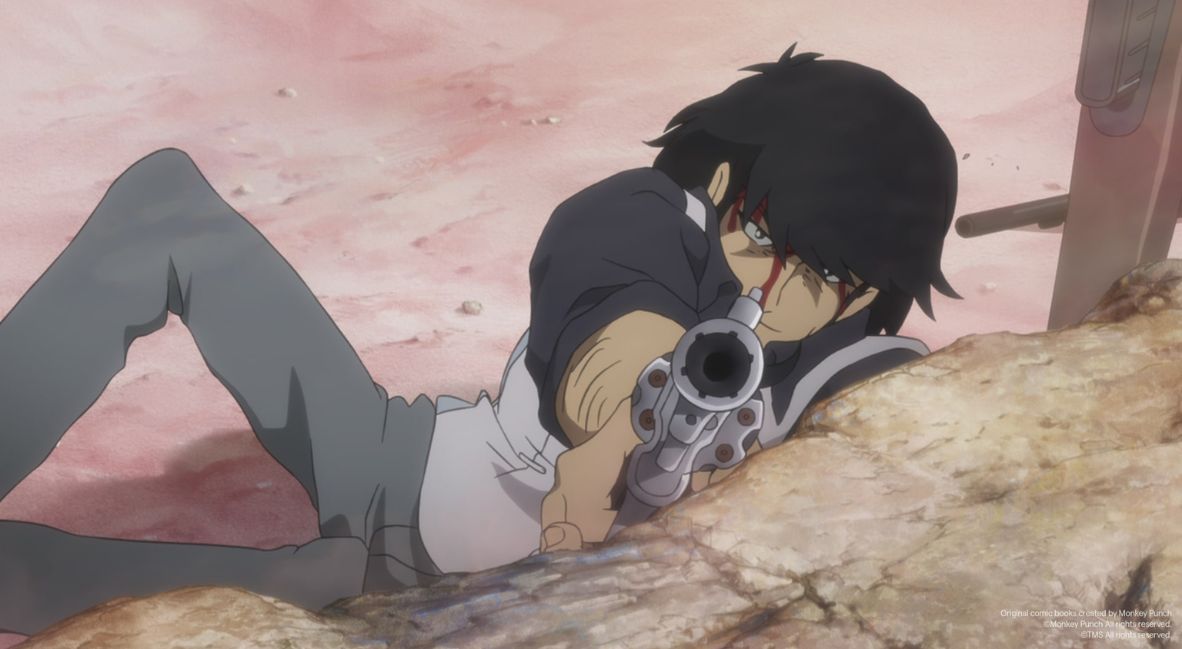
One of the film’s missed opportunities is that it lacks the flair of the entire Lupin gang coming together to work as a cohesive group. Most of the film has Lupin, Goemon, Jigen, and Fujiko separated, with Lupin alone facing the film’s antagonist. Since the previous Koike projects placed a lot of emphasis on each member of Lupin’s gang, it seemed like The Immortal Bloodline would have been an excellent point for everything to collide. While it is a bit disappointing not to see Lupin and his gang come together, it is not a deal breaker.
Nonetheless, Koike’s decision to separate Lupin and the team serves a larger and more introspective purpose for the film’s plot. Ultimately, The Immortal Bloodline is not about Lupin and his comrades and situational allies like Inspector Zenigata, working together, but rather having enough faith in one another to survive and play their parts even if they are not physically together. A prime example of the theme of trust is how Lupin willingly takes on the burden of facing Moum alone and entrusts Inspector Zenigata with a vital part of his plan to beat Moum.
Moum is a major standout due to how the character uniquely challenges Lupin physically, mentally, and even philosophically. For example, Moum is an immortal being who has the power to decide when lives end and what history is erased. Moum essentially does not fear death or see the meaning and value in life because of his immortality.
The latest Takeshi Koike entry has Lupin exploring the meaning of life.

In contrast, Lupin, who also does not fear death, refuses to accept life without meaning. To Lupin, the treasures and items he steals have never been about their monetary value; instead, they are about the stories, feelings, and emotions connected to those treasures.
Through Lupin and Moum’s clashing of ideals, the film beautifully explores what motivates Lupin to steal and what it truly means to live life. As much as Lupin loves the challenge of a good heist, it is not about greed and fame; instead, it is about memory and emotion. In the end, the idea of immortality disgusts Lupin as it would make life itself meaningless. Koike and Takahashi capture this wonderfully with their version of Lupin, as he truly embodies ideals reminiscent of Monkey Punch’s original Lupin III, with their own unique spin.
By the film’s end, it becomes clear that this story is not the end for Koike’s Lupin III saga. Without giving any spoilers, it is revealed that Moum, although the mastermind behind the assassination attempts, is not the final boss. Instead, there is an even greater threat and adversary who has been pulling the strings. An adversary whom Lupin has faced off against before. Longtime fans of Lupin III will be thrilled to return for another face-off with the master gentleman thief.
A thrilling penultimate entry to a decade spanning story.

Visually speaking, Lupin III: The Immortal Bloodline is gorgeous. The animation is visceral and fluid in every scene, showcasing the animators’ exceptional work. For example, the island’s design and inhabitants are some of the most impressive animations. The island’s unique terrain, littered with aircraft carriers, seemingly ancient-looking temples, and the grotesquely reanimated inhabitants, adds to the island’s dangerous environment.
The Lupin III franchise is no stranger to embracing the suspension of disbelief through science fiction and supernatural elements. The Immortal Bloodline continues this tradition while still keeping the story and characters grounded in brutality, similar to Koike’s previous works. This helps to significantly raise the stakes for Lupin and his friends even more, as no one is guaranteed to walk away from the island completely unscathed.
Lupin III: The Immortal Bloodline is a visual treat that fittingly brings together the threads of Koike’s other cinematic Lupin III films in an exciting penultimate culmination that spans a decade. Despite some shortcomings, the film is a thought-provoking exploration of themes such as trust, immortality, and what it means to truly live. The film’s philosophical depth provides a more introspective look into Lupin’s character, highlighting what makes him so endearing. The ambiguous ending and surprise reveals suggest that Takeshi Koike isn’t with Lupin III just yet.
Lupin III: The Movie – Immortal Bloodline is out now in theaters.
Lupin III: The Movie - Immortal Bloodline
- Rating - 7/107/10
TL;DR
Lupin III: The Immortal Bloodline is a visual treat that fittingly brings together the threads of Koike’s other cinematic Lupin III films in an exciting penultimate culmination that spans a decade.