
This is how you deploy heavy exposition. While Hell’s Paradise Season 2 Episode 3 teeters on being too much of a lore dump as we learn about the origin of the Tensen, it overcomes it with shocking reveals and significant scenes or interactions for nearly all the featured characters. Despite its obvious popularity and the boxes it ticks that appeal to wide swaths of viewers, there’s still a sense that, for whatever reason, this Twin Engine and MAPPA-produced adaptation of the work by Yuji Kaku remains an outlier to series such as Jujutsu Kaisen or Demon Slayer.
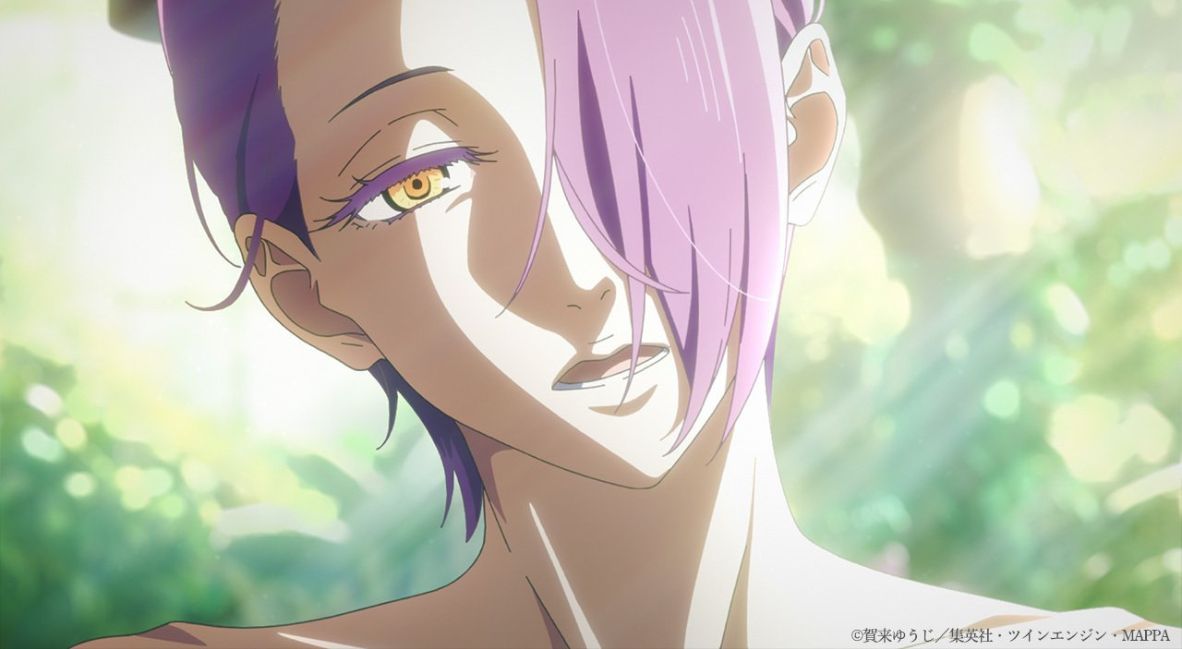
And it’s hard not to wonder if it’s the overt queer undertones that are present throughout all of Hell’s Paradise: Jigokuraku. It’s hard even to call them undertones, as they might undersell the point, especially when introducing the gender fluidity of the Tensen, explicitly demonstrated by Rien (Junichi Suwabe and Yūko Kaida).
Regardless, it’s that fluidity and the embracing of queer narratives and characters that make the series stand out, especially in an installment like Hell’s Paradise Season 2 Episode 3. Because the characters and the world they inhabit are so rich in detail and subtlety, making them worthwhile and watchable.
Gabimaru trains to find ways to defeat Tensen.
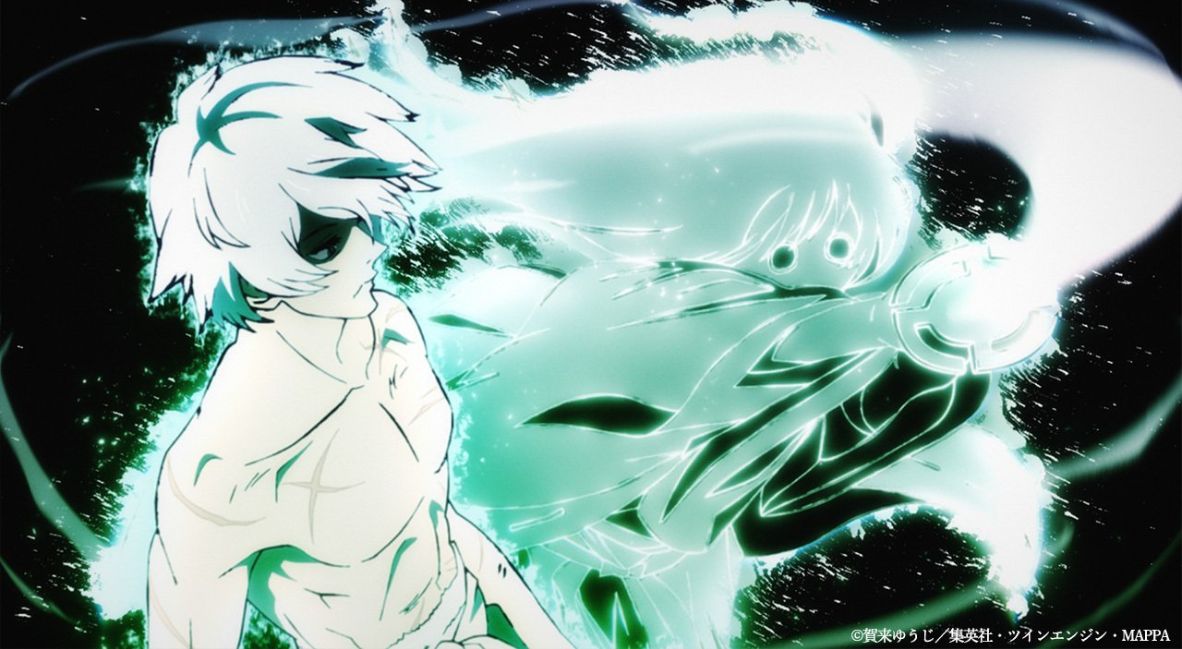
Hell’s Paradise Season 2 Episode 3 is essentially broken up into three segments. The first takes place as Gabimaru (Chiaki Kobayashi) looks to train. He’s regained his memories but worries his fighting skills have been dulled. As he asks Toma (Kensho Ono), Tamiya Gantetsusai (Tetsu Inada), Nurugai (Makoto Koichi), and Shion (Chikahiro Kobayashi) to attack him with everything they’ve got, he’s able to isolate their tao and determine how best to fight them, even if his sheer power isn’t up to snuff.
And, in doing so, he’s able to realize a way in which they might be able to consider defeating the Tensen. It’s not about using their own tao against theirs, but about using the tao of the world around them to create a massive deterrent. But it’s not just about thinking through tactical advantages. More than anything, it helps redefine the characters as they move into a position to become a more unified team than they were before.
It’s little things, like Gantetsusai’s teasing of Gabimaru and Toma, or of Gabimaru’s humanity shining through, be it in his thanks to the group for their help or his grabbing Nurugai out of the way. More than anything, though, it’s Toma and his asking Gantetsusai to train in order to survive long enough to be reunited with his brother, Chōbei (Ryōhei Kimura). His declaration, which includes cutting his hair off and braiding a loose piece in clear emulation of his brother, is a moment of surprising sincerity.
The sequence also highlights fantastic, fluid animation, maintaining an engrossing cohesion as we follow Gabimaru’s movements and thought process. It’s a wordy fight, but not one where we’re so distracted by what’s being deliberated that we miss the gorgeous, kinetic way his physicality is engaged in this sequence.
Chōbei stands out as one of the best, morally gray characters.
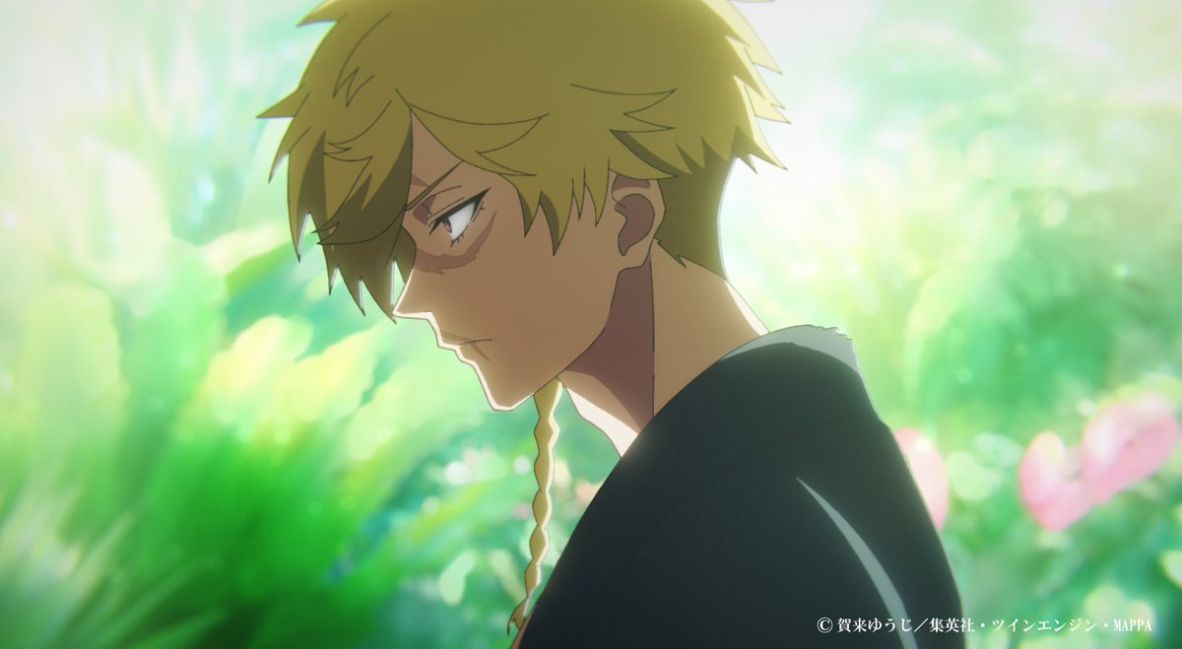
That said, the big battle of Hell’s Paradise Season 2 Episode 3 takes place with Chōbei as he fights off against Rien, first in their Yang (Jun’ichi Suwabe) form. Rien is intrigued by Chōbei and how he’s been able to incorporate parts of the island – parts that were meant to kill him – to become a stronger, seemingly immortal version of himself. His Tao and the Flower Tao came together due to his strength and undeterred, relentless will to survive.
But despite his power, Chōbei is no match for the 1,000-year-old Rien, who uses smoke and mirrors as a means to distract before bringing him to the Tensen fortress. It’s there that Rien, now in their Yin (Yûko Kaida) form, plans to seduce through Bōchū Jutsu as a means to both heal Chōbei, blend their Yin and Yang energies, and demonstrate the cultivated power they’ve amassed. In doing so, Rien tells Chōbei that they don’t just plan to steal the life force of the humans on the island, but to harvest the entire mainland as well.
Chōbei is a wonderful character. From the start, he’s fit a very specific, light antagonistic role. He’s not the big bad, but he’s not one of the easy-to-quantify heroes or even antiheroes either. He has one objective: to save Toma, and anything else is brushed off. He’s single-minded but cunning, making him a formidable foe as well as a fantastic character, with layers of multitudes as he seeks power that would benefit him and Toma alone.
Family drives the narrative of “Immutability and Change.”
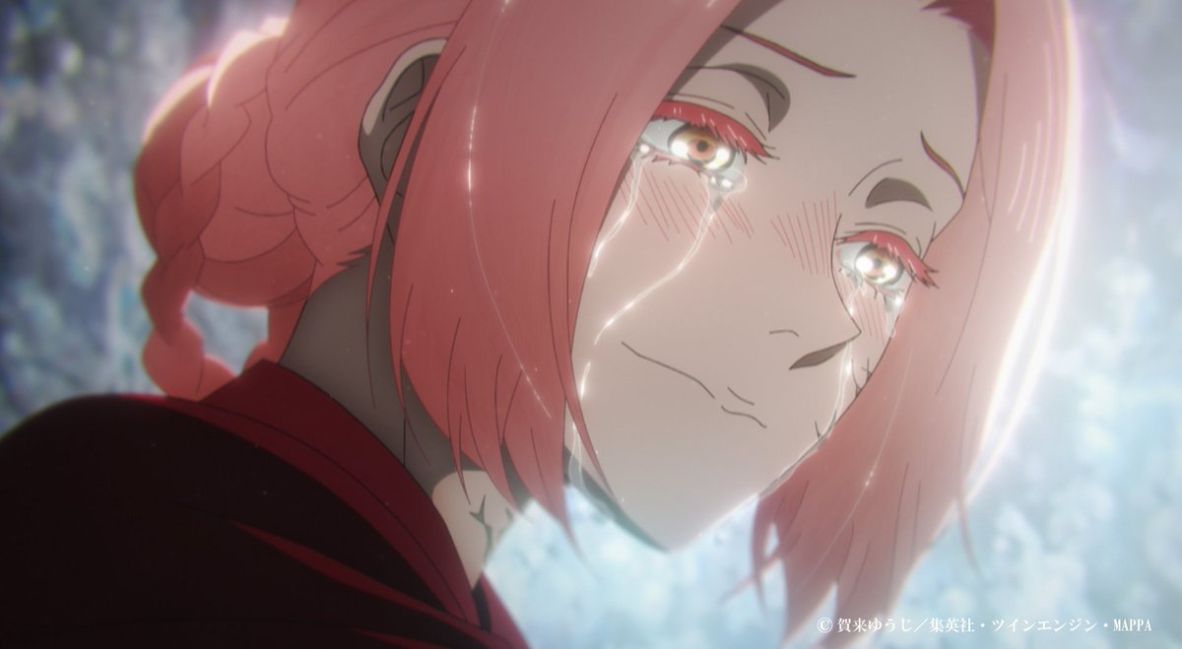
It’s what makes his interaction with Rien so fascinating. Because we think we know him, have him figured out, and he still manages to surprise us. The writing is simply superb, along with the character animation that captures the moment Rien’s plan begins to shock even him. He clearly doesn’t want to go along with the Bōchū Jutsu, but tells himself to adapt and charge ahead. He will continue to walk the path that gains him the most intel, the most power, to be reunited with Toma, no matter the cost. That unease grows due to the unsettling and discordant score by Yoshiaki Dewa.
Hell’s Paradise Season 2 Episode 3 is big on families. From Toma and Chōbei to Fuchi (Aoi Ichikawa), the pointed reminder of the interwoven relationships driving each character’s plot is clear. But it’s Mei, her lore, and her father-daughter dynamic with Hōko (Chō) that drives the episode to its emotional conclusion.
It’s also where we get the most information, as Fuchi heals her in return for intel. Having used her tao, she’s slowly undergoing the same arborification process that one consumed all of Hōko’s village, including his wife and daughter, her arm transforming into a bark-like structure. Regardless, she tells Fuchi and the others that the Tensen were created by one man who came to the island and, through centuries of abusing power and corruption, created a means to prolong life through the theft of others. They essentially managed to create the elixir of life that the shogun is so determined to steal for himself.
Hell’s Paradise Season 2 Episode 3 is a strong reminder of exposition done well.
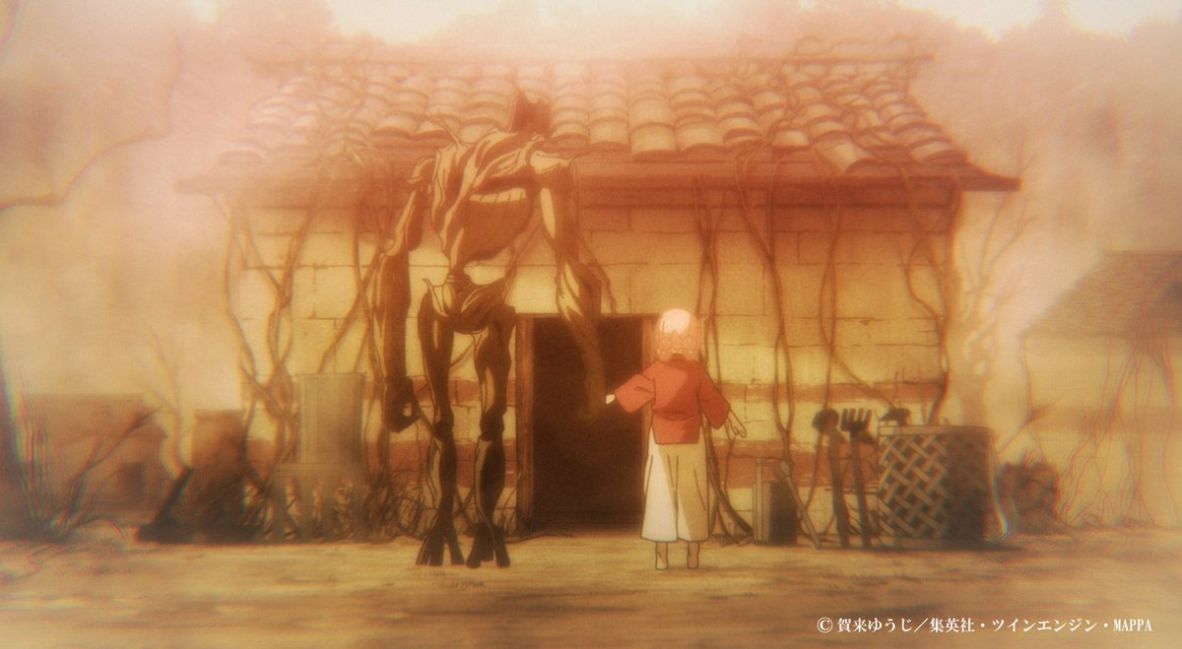
The depth of depravity wrought against centuries of humanity, all for the sake of the desire of a few to prolong their lives, is already a shock. But the moment grows further heightened when Hōko announces that, to survive, Mei can absorb his tao. He’s at the end of sentient life, about to become a tree, and tells Mei this is his atonement. His time to face the fact that he saw Mei, at least at first, as a daughter figure to project his lingering grief onto.
It’s a deeply emotive scene, aided greatly by Chō’s tremendous, heartbreaking performance. Despite being largely absent from the plot so far in Season 2, his character is still able to make a definite impact due to the performance and the reminder of how great the inhabitants of the island have suffered at the hands of such unstoppable greed.
Ending on a cliffhanger as the newest group of the shogun’s forces arrive on the island, Hell’s Paradise Season 2 Episode 3 rallies the remaining group as they contend with the latest in a long run of threats. Gorgeous and well-structured to ensure we consume an enormous amount of information without being consumed by it, “Immutability and Change” pivots the story in a new direction while fortifying each character’s strength and directives.
Hell’s Paradise Season 2 Episode 3 is available now on Crunchyroll.
Previous Episode | Next Episode
Hell's Paradise Season 2 Episode 3
-
Rating - 8/108/10
TL;DR
Gorgeous and well-structured to ensure we consume an enormous amount of information without being consumed by it, “Immutability and Change” pivots the story in a new direction while fortifying each character’s strength and directives.