

Octopath Traveler, the turn-based RPG from Square Enix, hit the ground running since its original reveal back in 2017. Even with an odd title, it pioneered a new graphic style of HD-2D, giving us the classic SNES era RPGs with a cleaner, modern look and feel. Next in the series, the mobile game Octopath Traveler: Champions of the Continent is being brought to consoles as Octopath Traveler 0. This isn’t just a prequel; it redefines why this series is so grand.
Octopath Traveler 0 starts off quite differently from the first two games. Instead of picking one of eight defined travelers to start your journey, you create your own. Your traveler is from the small town of Wishvale. On one unfortunate day, Wishvale’s secret is revealed, and a greedy warlord attacks this sleepy town. Wishvale is burned down, and its residents have scattered to the wind.
All because a magical ring was learned to be in the town; a ring that you have found has attuned to you. You take it upon yourself to not only rebuild Wishvale but also bring justice to those who have played a part in your home’s destruction. Through this quest, you also unite many under your leadership, ideals, and goals. But this quest will not be easy. And it will discover darker corners of Orsterra.
Octopath Traveler 0 is all about the importance of community in fighting oppression.

At first, the story of Octopath Traveler 0 wasn’t hitting as hard as the first two games. It felt generic. There were no immediate personalities to latch on to. Yet quickly, that all changes. Having the story center on a “blank slate” player insert opens up more possibilities, allowing many of the characters you interact with to shine.
The many side characters become overwhelming, particularly when every main storyline is more about the oppression faced by a different community. Yet so many more characters stand out than not. And that comes from the game’s main story, which emphasizes the importance of community in fighting oppressions. You are traveling from community to community, not just to avenge Wishvale but to rebuild it.
You are drawn to each of these communities facing hardships. To those who want to change their material conditions. Your influence is like a catalyst for change. This is shown time and again as you recruit more allies. Regrowing and evolving Wishvale feels like it’s only happening because you’re helping so many people fix their own surroundings.
Each storyline follows a similar pattern but delivers a distinct narrative.

The Wishvale-centered story of the nine different storylines reinforces the community-focused approach since it cannot be completed right away. Chapters of Wishvale’s storyline get locked out until advancing other main stories meet certain milestones. Thankfully, every storyline is absolutely fantastic. Switching between each story was never an issue. Particularly with every chapter starting with a recap of what’s happened up till that point.
Each of the nine storylines is great, particularly because they each feature an excellent, unique villain. Every villain demonstrates a different way society can be exploited to gain power. They are even better paced by dividing the story into four segments: three storylines first, then one, then three again, and finally the final storyline, with the Wishvale storyline running throughout.
Every storyline has a similar naming scheme, with the core being about a pillar of corruption: Fame, Power, Wealth. Each villain exemplifies one of those pillars masterfully. The game then highlights all of this with a “… of All” story that brings each part together with a new, more intimidating foe who takes what the first three represented and shows what all of them could do together.

Take the first four stories, or the “Master of…”, for instance. The Fame, Power, and Wealth villains are a greedy heiress who hoards wealth, a warrior warlord seeking more power, and an actor trying to create his ultimate piece of art. These three stories converge in the “Master of All” fight to overthrow a tyrannical king who seeks to control all of Orsterra, using military might and his people’s love for endless conquest.
The second half of the game, the “Bestower of…” series, takes these same bases and escalates them further. Each introduces an even more complex villain. Those who have been wronged and use either Fame, Power, or Wealth to arrive at a different conclusion.
Without spoilers, the final storyline is stellar. It’s gut punch after gut punch, wrapping up everything in a tear-jerker, satisfying package that you may not expect based on how different the story is told when compared to the first two games. In other words, the story is of Orsterra’s growth, which was only possible because Orsterra came together, instead of eight strangers helping each other overcome each other’s hardships.
Gameplay is much different in Octopath Traveler 0 than in its predecessors.

Like the differences in storytelling, the gameplay has also kept its core from its predecessors, but has also changed significantly. The basic features, like turn-based combat, Battle Point usage to perform higher skill attacks during a turn, and path actions, are all still there. Other features, like role changing, how path actions work, and party upkeep, are very different from 1 and 2.
The gameplay also takes a more pulled-back, continent-specific approach. Firstly, you can recruit over 30 party members. These aren’t random common folk. Each one is a fully voice-acted, unique character that you meet either through the story or by completing specific side quests flagged as “encounters”. And unlike the eight previous travelers you used in the first two games, the recruited members’ customization options are very limited.
They each come with set skills and attributes, set classes, and are locked to two usable weapon types. The only one that’s job you can actively change is your character. Many are based on the eight Octopath archetypes, like Dancer, Merchant, Cleric, etc., but there are more than a handful that stray from those jobs. What could be annoying quickly adds an incredibly in-depth level of customization for your party. You’re not building your eight usable party members to fit each challenge; you’re choosing who is best to complete the job.
Plenty of factors allow you to build your party the way you want it built.
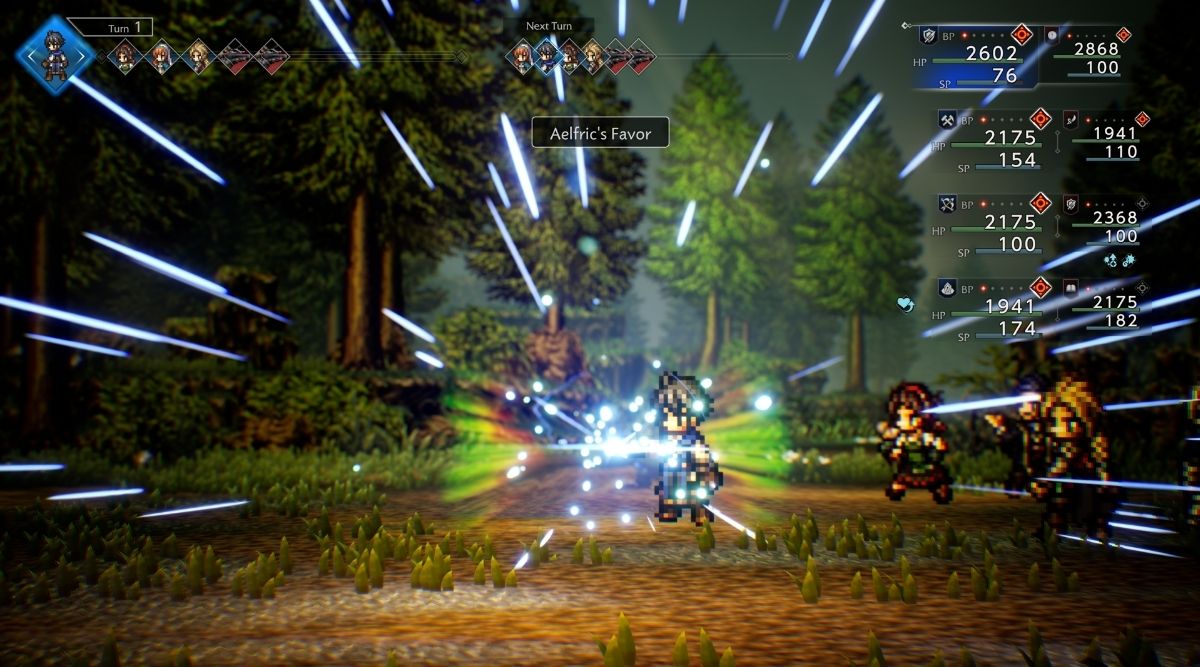
Additionally, bringing eight members instead of four brings its own flavor to the combat. You select who to be front line and back line in rows of four. You can even switch between the two during a specific character’s turn. This comes with a lot of survivability and ways to blast through enemies. Characters can be equipped with skills that heal the front-line character, buff your party, and more while in the back line, even while they cannot be controlled. Only the front four can act in a turn.
That doesn’t mean the party members aren’t completely uncustomizable, though. After unlocking every skill with job points earned from battle, you can master several skills and attributes of that character. Mastering these allows you to equip them to other party members in their three skill slots and two attribute slots.
You could theoretically make every character a healer, or allow the higher damage dealers to overcome the 9,999 damage cap when equipped with the right skills. This is on top of the armor, weapons, and accessories you could give to any one character. Skills are limited, though, to only allow you to equip attacks that are specific to that character’s usable weapon types. Like a bow-and-axe user cannot equip a lance skill, for example.
Combat is exciting and challenging as mechanics change throughout the game.
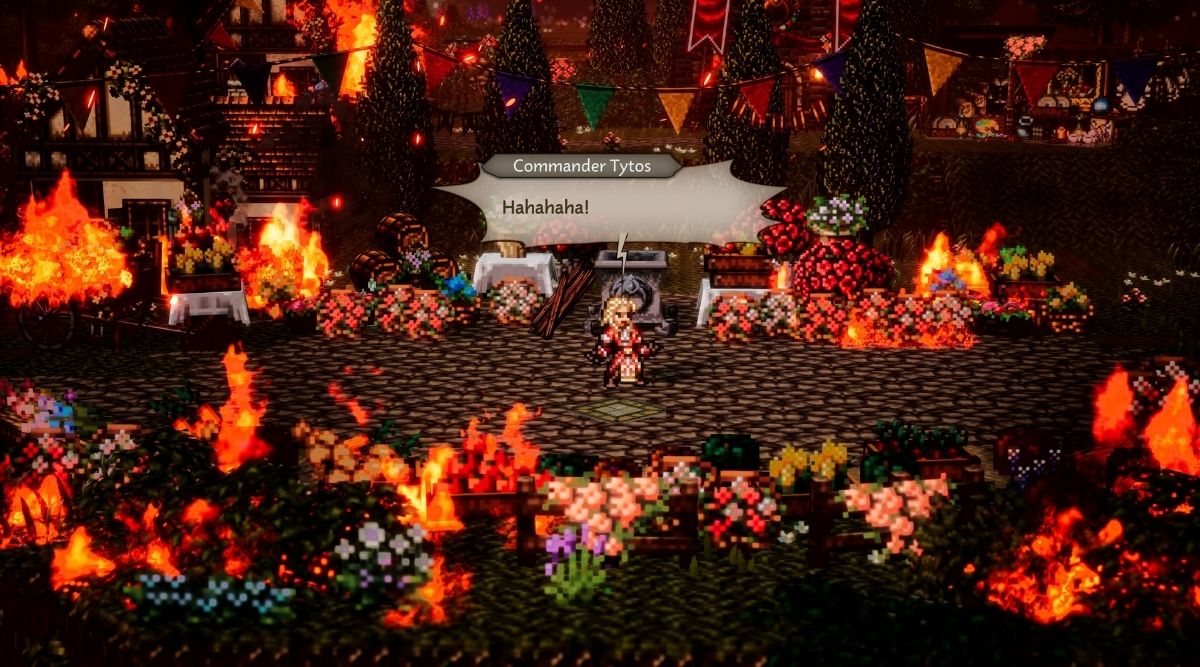
What is really great about this system is how every single character has a distinct ultimate ability. Some deal damage, others provide buffs or debuffs. Every one of them is highly effective and crucial in deciding who to bring. What can be cumbersome is making sure every party member is viable. You do unlock a way to level non-used characters, but it is not nearly as effective as adding them to the eight-person roster.
Through townbuilding, one of the unlockable buildings is a training ground. When fully upgraded, you can assign 12 party members to it to earn about 80–90% of the experience and JP. The other 12+ members, if you unlock every single one, are kind of out of luck. Regularly switching who you bring and who is assigned to the training ground isn’t just crucial to overcoming the game’s challenges, but to ensure that you can bring anyone at any time as you reach newer, tougher foes.
Even with an already excellent-feeling combat, Octopath Traveler 0 has found ways to make it feel even better and more challenging. Later fights and bosses, especially, mess with the party-switch mechanic. For example, one fight will silence your front line every turn. So you’ll need to replace the front four every turn to ensure you can keep casting spells, buffs, and heals. Another inflicts and speeds up Doom, causing the front four to die after a certain amount of time.
This specifically is why party switching and maintaining so many members is key to overcoming the game’s harder fights. Switching isn’t only fun and adds flavor to the fights, but also helps with survivability. Most impressively, for a game that was at first a mobile game, the fights look like they are an evolution from 2. They’re as, if not more, flashy, look fantastic in the HD-2D style, and have stellar-looking bosses.

An amazing soundtrack supports all of this. Octopath Traveler is known for a great score, and 0 elevates it to a whole new level. Combat songs are full of stings that can’t help but make you feel hyped, or that you’re slowly turning the tides of battle. Town music is always peaceful, with each area having its own unique tune that feels like it fits perfectly in that setting. Really, just a stellar job once again by the Square Enix team on creating a top-five soundtrack.
Granted, with the simplification of party members, the path action mechanic has been simplified as well. There are now only three actions you can really choose from, with two of the three changing based on who you’re talking to. One investigates, which helps with gathering information and finding secrets in an area.
The second allows you to either buy/haggle items with an NPC or fight them for their stuff. The third is the recruit option, either as a limited-use NPC that performs an action during combat or recruits them to be a member of the town.
Townbuilding is shockingly fun.
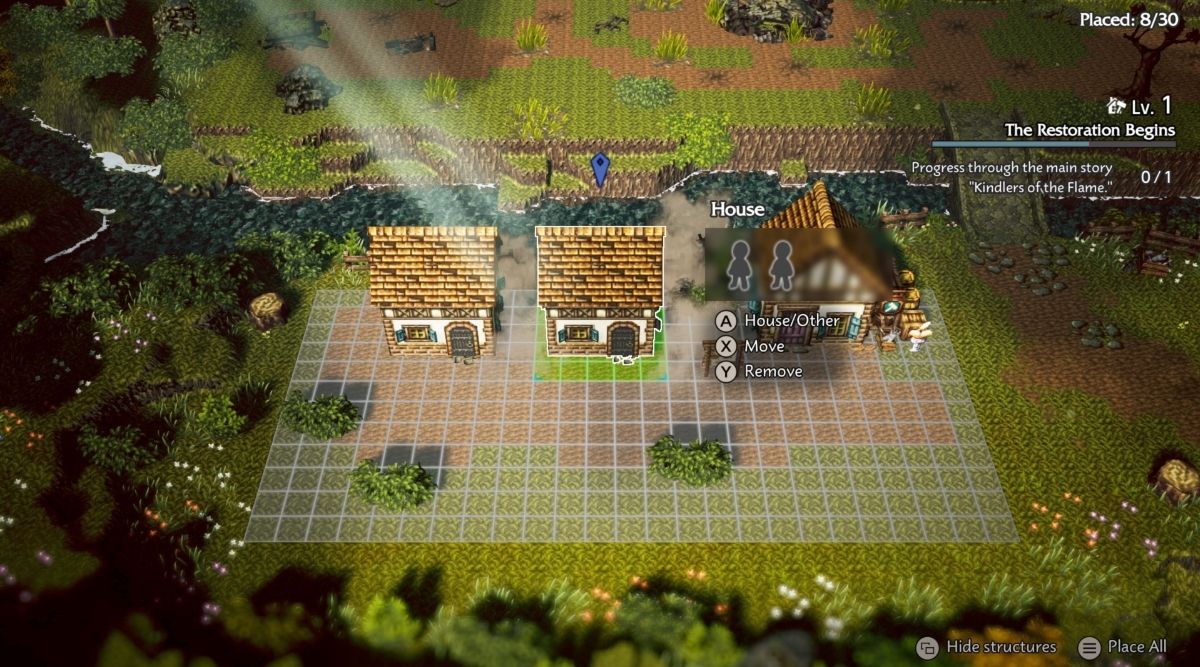
Even being much more limited, you can still do quite a lot when interacting with the world. Especially when it comes to improving Wishvale through townbuilding. The townbuilding is much more crucial than it seems at first glance. Many buildings give bonuses outside of Wishvale, like opening locked chests, improving your town store’s wares, and late-game things, too, like a monster-fighting arena.
The townbuilding is also very closely tied to the Wishvale story. You can only advance the story by achieving certain town levels or building specific buildings. This is a great way to recruit some of the best party members, by the way.
Gathering resources is never tedious to keep up with the housing, either. They’re everywhere and very easy to find in the world. Plus, they are cheap to buy from the town store once you build it. What is key is fighting rare monsters. Each one drops a piece of building material needed to upgrade the key buildings. They’re not only a great way to get quick experience, but also help you with long-term improvements to the town.
The soundtrack, voice acting, and artwork bring the game over the top.

Even designing the town is shockingly fun. It just becomes an issue at times with finding doors and interacting with your townsfolk if you put a large building in front of a smaller one. That highlights one of the very few flaws of the HD-2D graphic system that only really is an issue in this specific circumstance.
Honestly, there really is only one minor issue with 0, and that’s the voice acting. Every character, as part of the story, is fully voiced and voiced very well to fit the character model. But the side quests aren’t voice-acted. It’s jarring to switch between how thoroughly a scene is voiced and mere plain text.
It’s even more jarring when you’re doing a party recruitment quest, and only after recruiting that person do they start talking. Granted, your character never actually says anything, just selectable options occasionally during a scene. Given how cinematic and grand an experience 0 is, the supplementation of the side quests also all being fully voice-acted would’ve helped bring Orsterra even more to life. However, it doesn’t take away from an already stellar experience.
Octopath Traveler 0 is the new best entry in Square Enix’s HD-2D line of games.

Octopath Traveler 0 is another stellar entry in Square Enix’s HD-2D series. It’s way more than just a prequel or a mobile game port. Even with its differences from its predecessors, 0 shows that there are many more ways to tell compelling stories with great turn-based gameplay.
Add on fun townbuilding, lots of great characters, excellent voice acting, and some of the best music Square Enix has produced, and you have a game that rivals not only the wonders of 2, but some of the best 2D turn-based RPGs out there. Most importantly, it shows the importance of community and how, when we all come together, anything is possible.
Octopath Traveler 0 is available December 4th on Nintendo Switch, Nintendo Switch 2, Xbox Series X|S, PlayStation 4, PlayStation 5, and PC.
Octopath Traveler 0
-
Rating - 9.5/109.5/10
TL;DR
Octopath Traveler 0 is another stellar entry in Square Enix’s HD-2D series that rivals not only the wonders of 2, but some of the best 2D turn-based RPGs out there.