


Making a film takes a village, and in director Chris Foggin’s latest Tinsel Town, one could argue it took an entire theater troupe to bring things together. Juggling action with British pantomime, equipped with musical numbers wrapped in holiday trim, this ambitious holiday venture wears its heart on its sleeve and its joy on its chest. And, in our latest interview with Foggin, the spirit of collaboration could be felt throughout the entire conversation.
In Tinsel Town, the spirit of collaboration can be felt all over the screen.
Tinsel Town follows Brad Mac (Kiefer Sutherland), a full-of-himself action star who is rapidly fading into irrelevance. His only hope of keeping him afloat? Pursuing a theatrical run in the UK. The idea alone is lofty enough, but the reality quickly crashes down on him (and his hopes of Shakespearean pursuits) when he is carted off to a northern town for a British pantomime. Whether he survives with his ego and dignity intact is part of the journey of Tinsel Town.
We spoke with Chris Foggin about juggling the different genre elements Tinsel Town plays with in the film, his openness to collaborating not just with above-the-line talent but also with below-the-line talent, and what ultimately proved to be the biggest challenge in shooting Tinsel Town.
BUT WHY THO: There are a couple of different genre elements playing around here. You have the action element at the beginning, then later in the film, with coordinated street fighting. You have British pantomime, aka Panto, which most Americans aren’t super familiar with, and then you have the holiday of it all.
Can you talk a little bit about playing with those genres on set, finding the right balance between these elements, and the challenges you might have faced in doing so? There’s a lot to juggle.
CHRIS FOGGIN: That’s a good point. There was quite a lot in it. Well, thankfully, I was very fortunate with Kiefer being so great at, well, everything, especially action stuff in the opening sequences. Whereas when we were doing anything panto-related, I could say, “Hey Kiefer, so these are, you know, this is why, or this is what we’re thinking.” He would go along with it, and it would be me telling him, tonally, where we needed to be.
But in those fight sequences, he was very much like, This is my wheelhouse. Where do you want me to go? What do you want me to do? And I’ll do it. And it was brilliant. Amazing sport. Didn’t have his own stunt person. He was just ready to be involved at any point, driving that car as fast as he could.
It was a bit of a challenge. But thankfully, because of the likes of Kiefer and the rest of the cast, I made sure we cast people here who had done panto or been around it, or just understood…I wanted people who understood these Christmas films, or just wanted to be a part of a Christmas film. I wanted to do something where, every day they came on set, they bought into the idea of making a family-feel-good film. And I couldn’t have asked for anything more from the cast. They were lovely. Absolutely great.
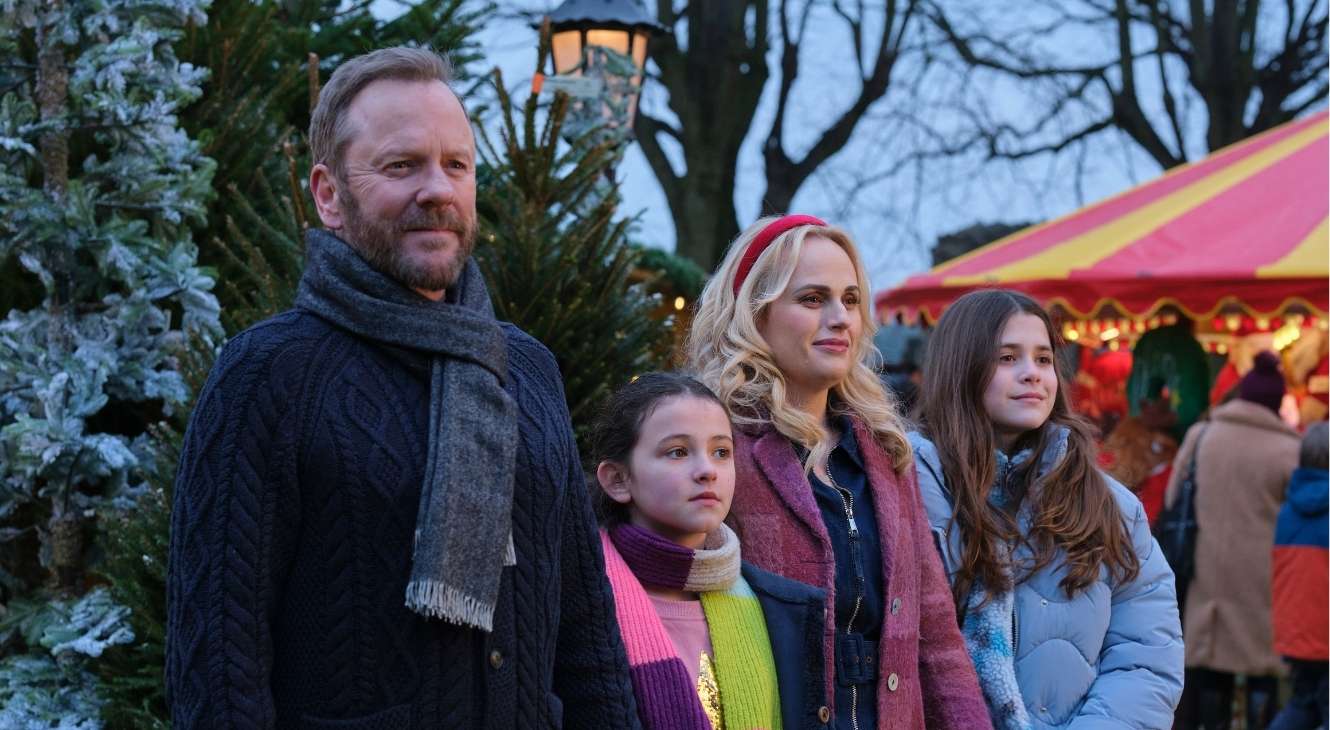
BUT WHY THO: It shows in the delivery of the comedy on screen, with several moments where, especially with Kiefer, he’s playing almost like a straight comedy role. If you winked-winked, nudged-nudged it, it wouldn’t have necessarily worked. So, the direction you guys took worked well for the moments that required it.
CHRIS FOGGIN: Honestly, that makes me feel so good that you say that. Because I still think about how I’m so lucky that Kiefer was in this film, when it was sent to him, and he responded to it, he just got it straight away. He knew how he was going to play it. He knew he was going to play it straight, but find the comedy and the straightness.
Even a little bit with Rebel [Wilson too], I think. Rebel’s amazing at improving and going off, but I think even she was kind of, ‘I’m going to play this a little bit more straighter.’ It was almost allowing the panto characters, like the Ugly Sisters, to have some scope to go off and be a little bit silly and daft. When it wasn’t Panto, and we were away from Panto, we tried to keep it not serious but straight and to the point.
But you’re right. That analogy about the wink-wink is absolutely amazing. Yeah, we didn’t want to do that, but that’s a great way of looking at it. So, I’m very grateful that you’ve picked up on that.
BUT WHY THO: Generally, when you’re doing live theater, there’s a different acting approach, whereas, versus on camera, you kind of have to be a little bit more restrained. In terms of adjusting the direction for the live theatre component with the on-camera component, how do you do that? Because that’s such an interesting sort of clash of disciplines.
CHRIS FOGGIN: I personally blocked it in a way that felt as though it was going to be, as you would see in a panto. There was an actor in it called Jason Manford, who he’d done panto with before, so he was very much like, ‘I’ll give you any guidance and all this.’ And then we just made sure we had enough cameras to film it as though we were doing it in real time.
So, we tried to make sure the comedy was in the right places, but in terms of the blocking and theater production, we just tried to present it as though it were happening in real time, almost as if we were filming a live performance. That was the kind of setup with it.
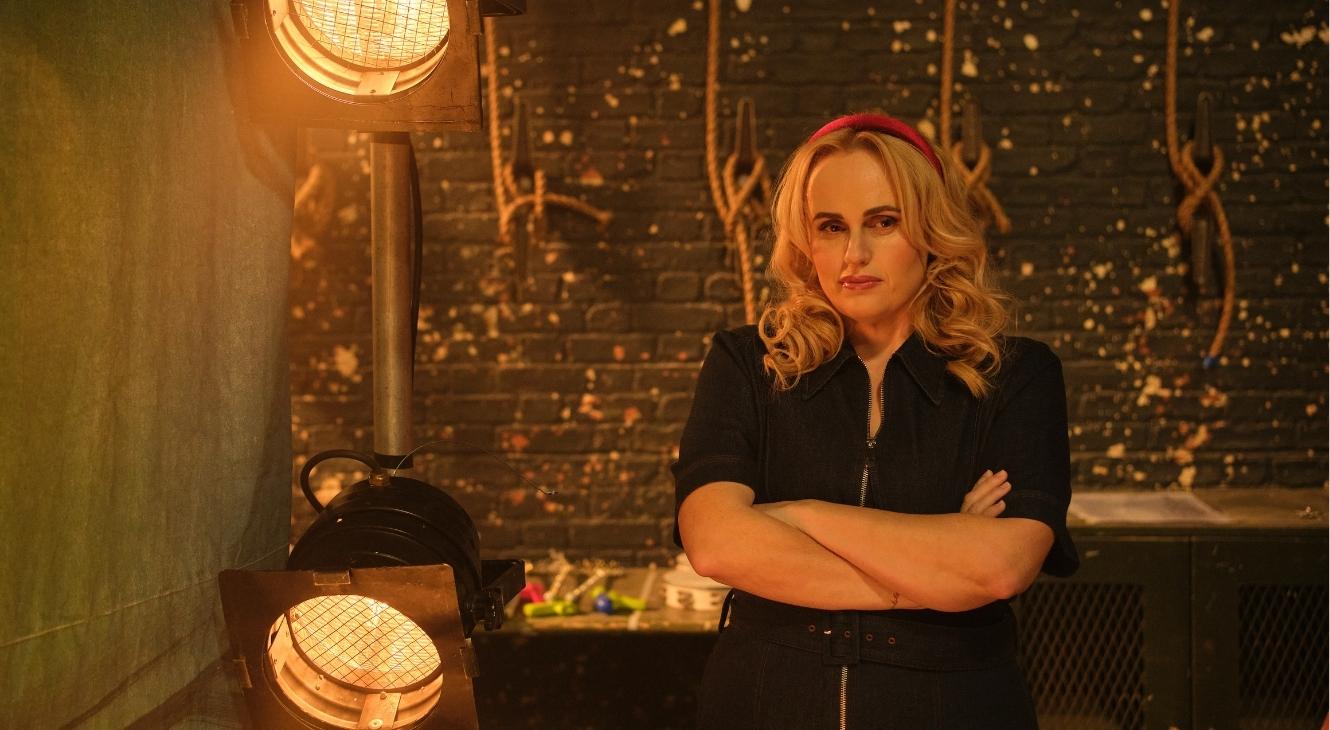
BUT WHY THO: This was a super collaborative environment. What weren’t you planning for that was sort of born from that sense of collaboration, whether it was with the producers or with the cast or what have you?
CHRIS FOGGIN: I was fortunate from a director’s point of view. I had great producers and a great studio that, after I pitched the film I wanted to make, were very understanding and allowed me to go and make it. And the only reason I wanted to be in this industry, and the only reason I want to do this job, is just purely because of the collaboration. I’m not singular, I’m not like ‘you stand here and don’t move.’ I have a plan and an idea.
[For example,] when Kiefer comes on set. I’m saying, Oh, morning, Kiefer, you’re sitting here, and then Rebel will come across, and he might say, ‘Oh, that’s interesting. I read it as though I would be the one coming in.’ And if he’s seen it like that, I want to give the actor the respect that they’ve seen it slightly differently.
We might try it one way, but I’m also here to facilitate what the actor sees, reads, and all that. That’s the joy of it for me—a pure collaboration from start to finish. But obviously, it needs somebody to have an idea to begin with, which I do. That’s the enjoyment for me in working and challenging myself from morning until night.
BUT WHY THO: That’s super cool that you’re so open to being able to pivot and adjust like that, if someone has something else to input.
CHRIS FOGGIN: Before I started directing, I was a third assistant director and a runner, so I spent about eight years on different film sets and watched amazing directors. So, I stole bits from everyone that I learned with, and I know where my strengths lie. I might not be the most visual director. I might not be able to say, ‘All right, this is what’s happening.’
But, if I have a good team of people, like my DP for example, David Mackie, he’s so great that I’ll often just block a scene with no shot lists, no storyboards, I’ll block it there how I see it and how I feel it. And then I’ll turn around to him, and he’ll say, ‘Alright, let’s cover this, or we’ll cover it this way and cover it that way.’ So, yeah, collaboration.
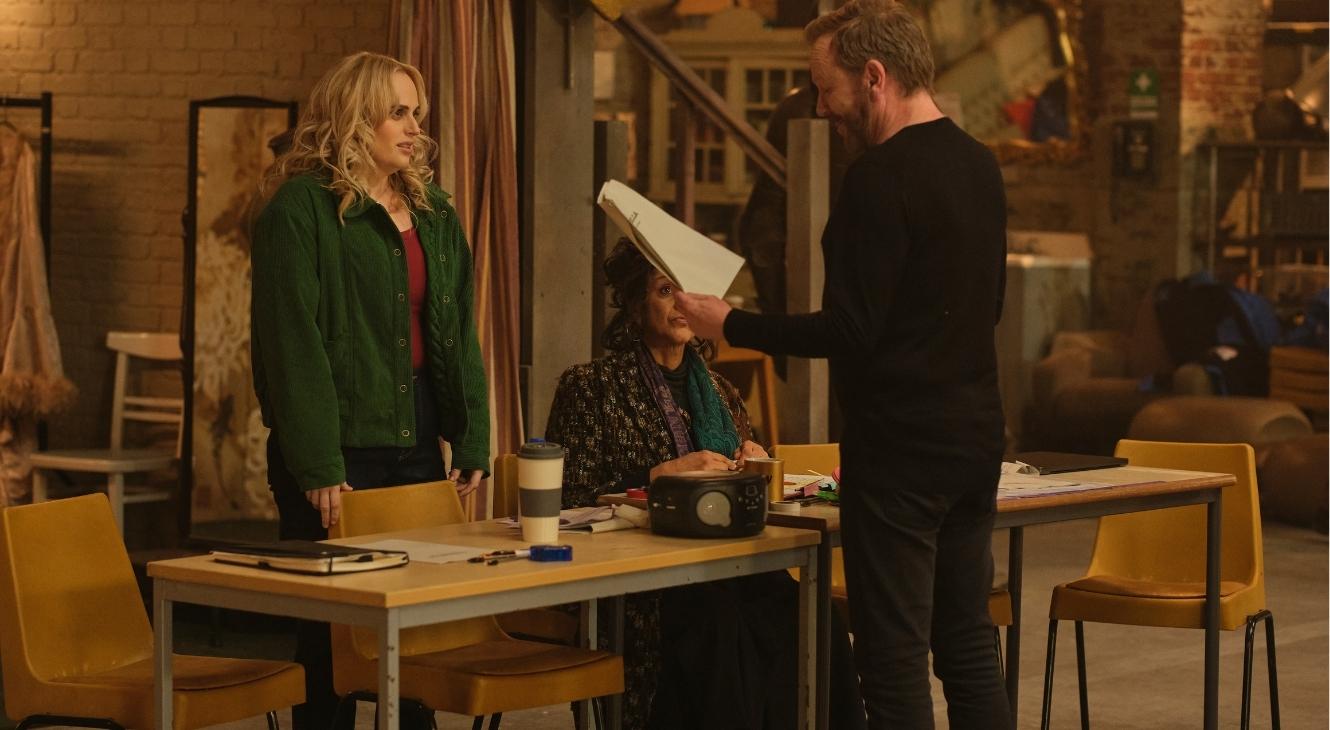
BUT WHY THO: Of the entire experience, what was the biggest challenge for you, whether shooting or having to pivot on set once you were there?
CHRIS FOGGIN: I’m grateful for the time I got, but we had 25 days to film this, so I probably would say the time. You’re shooting in February, when you don’t have much daylight. You’ve only got 25 days to film it. So sometimes you’re doing two musical numbers a day. Sometimes you’ve got five or six pages of dialogue to shoot. Sometimes you’re doing five or six scenes.
So, I think just the schedule, really. The musical sequence where Kiefer dances with the canes…That was half a morning. You’ve got to move quickly. So I would say that side of things is probably just the time you’ve got to film it. I’d love more time, but I’m grateful for the time I had as well.
Tinsel Town is in theaters and available on VOD now.