
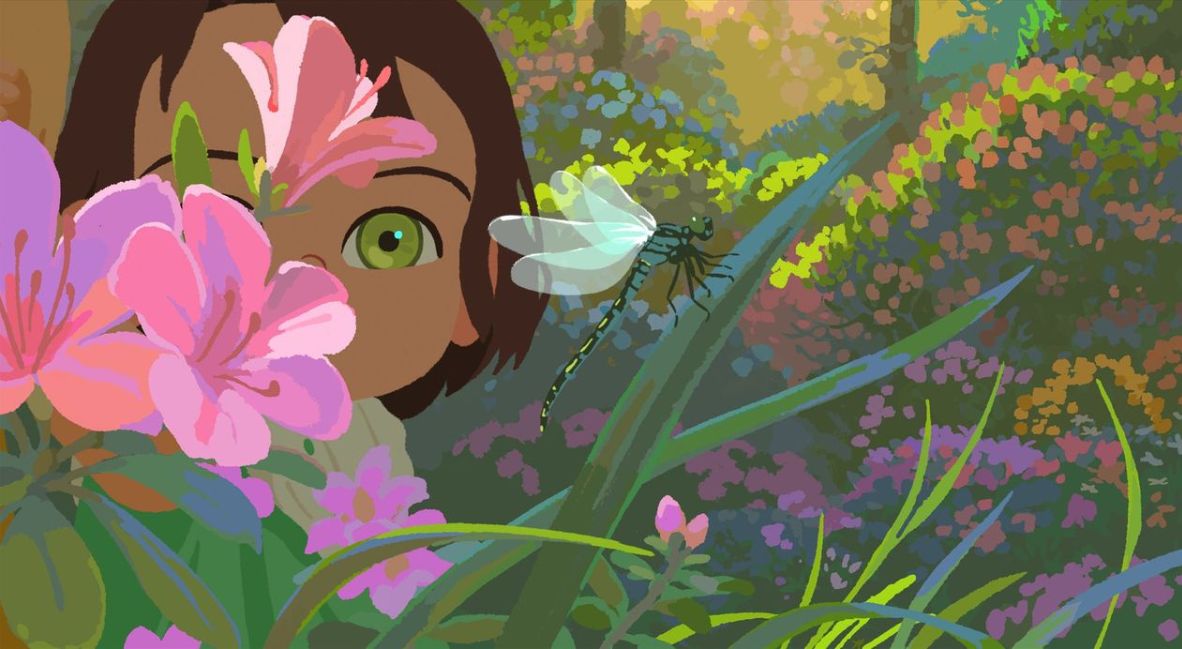
In the early stages of the contemplative, astonishingly visualized Little Amelie or the Character of Rain, our titular, chubby-cheeked protagonist introduces herself as a vegetable, then a god, working her way slowly and surely up to human mortality. With a striking understanding of how to capture the magnitude of childlike curiosity and wonder, the animated film touches on notes both subtle and sublime as a three-year-old girl seeks to blow down doors possessing the secrets of the universe. She is more than a vegetable, perhaps not quite a god, but “invincible,” “perilous,” and “brilliant” for the sheer fact of her existence.
There’s a sweet simplicity to the narrative structure of Little Amelie or the Character of Rain, directed by Maïlys Vallade and Liane-Cho Han and based on the novel The Character of Rain by Amélie Nothomb. A Belgian girl born in Japan, Amélie’s (Loïse Charpentier) story is essentially an internal one, touched by the ephemeral nature of the world around her and the overwhelming emotions she cannot comprehend or articulate.
Her inner monologue wanders off a bit, however, upon the arrival of two central figures in her life. First, her Grandmother (Cathy Cerdà), who introduces white chocolate and joy into the little girl’s life, and later, her nanny, Nishio (Victoria Grosbois), who provides sunlight. Amélie experiences the loss of a loved one, the cozy warmth of comfort, days at the beach, and witnessing the grief of a parent, all through the prism of someone who, in her words, sees everything and understands nothing.
The relationship between Amélie and Nishio is the heart of the film.
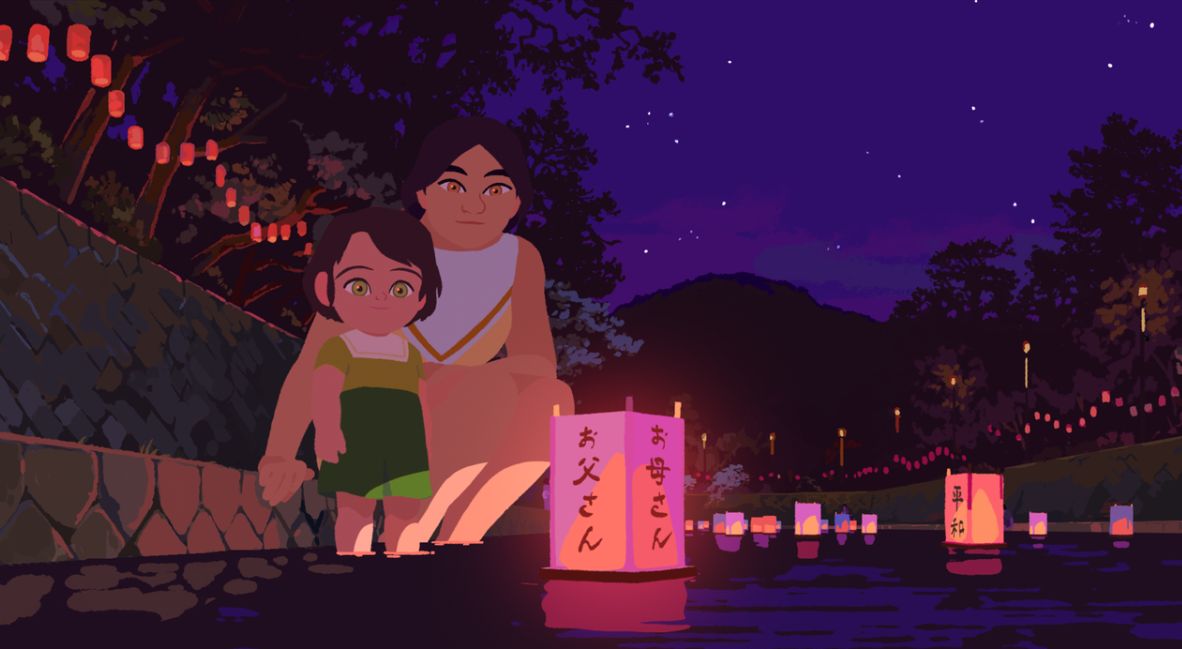
At just 78 minutes long, the film allows us to experience all the wonders of Amélie’s world as she goes through monumental firsts in a mildly surreal fashion. From her first long-lasting tantrum to the treat above, to seeing her Japanese name, Ame, written in kanji for the first time, to visits with carp and a confrontation with the unyielding, unforgiving power of nature, each new experience is as eye-opening as it is either frustrating or delightful.
But the crux of Little Amelie or the Character of Rain is the relationship between Amélie and her nanny, Nishio. Nishio’s radiant warmth is evident from her first sequence, and the film takes care to show just that towards the characters, as Nishio shares pieces of her life with the precocious toddler.
It’s through their interactions that we see the blend of cultures as Nishio shares her story and experiences to the point where, through sheer youthful naivety, Amélie begins to believe she, too, is Japanese. That divide in understanding and mutual fondness also proves to be the film’s only minor source of tension, as the landlord believes that any love Nishio feels for Amélie is wrong and a disgrace against their past. Set in 1969, we catch glimpses of the way post-war Japan haunts the narrative, even though it has been decades since the war.
Little Amelie or the Character of Rain highlights the natural world with stunning animation.
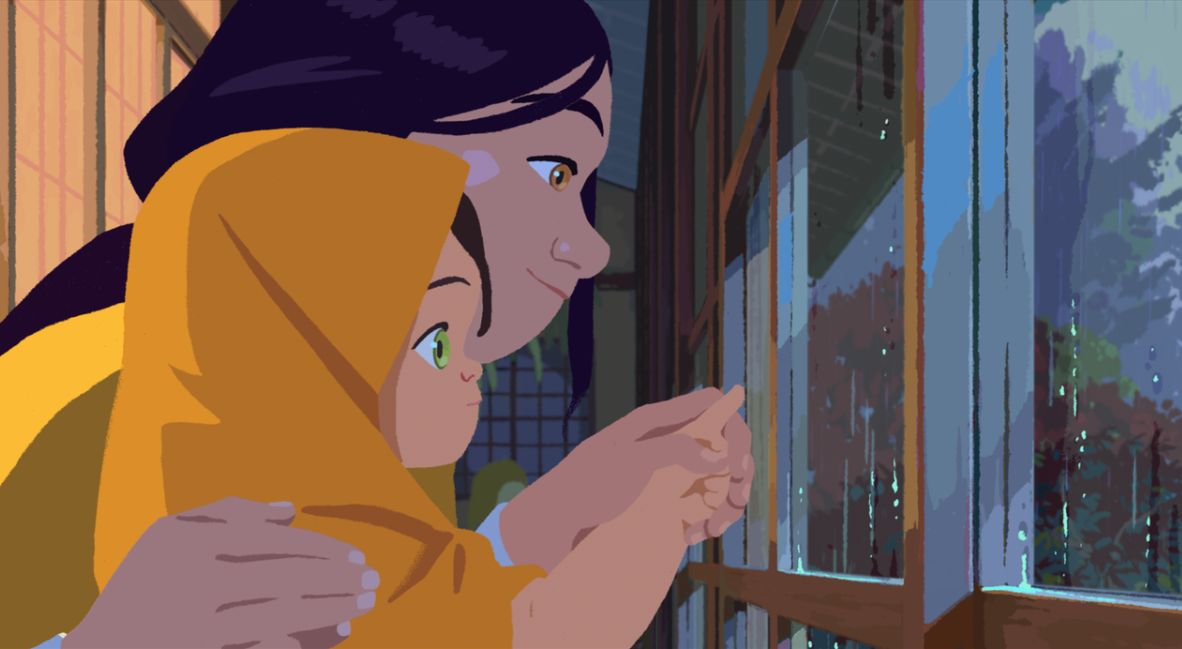
However, these conflicts all occur on the periphery, since much of the film is told from Amélie’s vantage point. We are at her eye level, taking in the world through her perspective and witnessing the fresh grandiosity of each passing day.
The animation is spellbinding in its greatest moments. With 2D digital animation, the film achieves a timeless, picture-book aesthetic that helps blend reality with a sense of childlike, fairy-tale-esque fantasy. The lines of the characters are diluted, with broad swaths of color evoking the tactile effect of brushstrokes. But while the characters and interiors are charming in their rendering, it’s the exteriors and landscapes that truly come alive.
Fitting, then, that sequences in the rain are the most stunning. A scene at a carp pond is one early instance, even before the floodgates release from the skies above. The contrast of colors in a single frame—from the red and white of the fish to the pink cherry blossoms overhead and the limitless mountain range in the background—creates an expansive world rich in texture and differing planes of life.
The film might be short, but it brings the work of Amélie Nothomb to vibrant life.
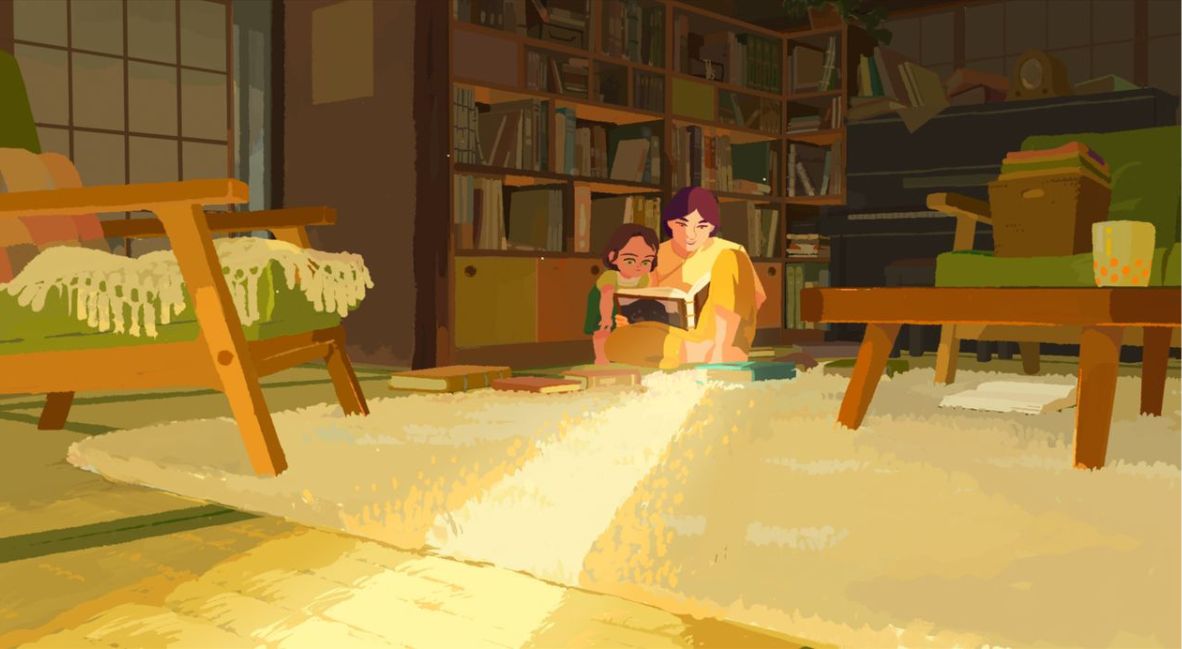
Similarly, a later sequence on the drive home from the beach is stunning. The lighting is a key feature in the film, and it floods this moment with warmth as the sun peeks out from behind the storm clouds and past the drops of rain striking the window through which Amélie looks. The way light filters through and highlights certain moments and patches of the world she can see helps solidify the direction of her gaze.
Due to its brevity, some moments feel unfinished or rushed, though they have no impact on the emotionally conclusive moments that ring true. And while the score by composer Mari Fukuhara is undoubtedly beautiful, it’s almost distracting in its swelling, interrupting the film’s melancholy.
Little Amelie or the Character of Rain is a gorgeously adapted animated film that highlights the natural world and our place in it through its diminutive protagonist. Through her wandering, wonderful, perplexed eyes, the film captures the transfixing nature of the world, its mighty contrasts, and inexplicable miracles. For what it lacks in narrative, it makes up for with explosive, emotional depth.
Little Amélie or the Character of Rain is out now in theaters.
Little Amélie or the Character of Rain
-
Rating - 7.5/107.5/10
TL;DR
Little Amélie or the Character of Rain is a gorgeously adapted animated film that highlights the natural world and our place in it through its diminutive protagonist.