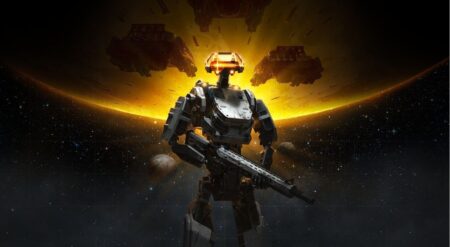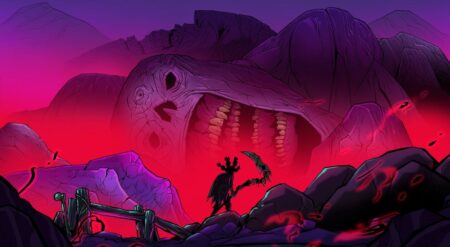


For a while now, exploration in games has felt like a guided tour: quest markers pointing the way, glowing objects signaling what matters, and checklists keeping players from ever truly getting lost. But Rogue Factor’s Hell is Us throws all of that out. And in doing so, it offers something rare: a game that asks players to trust themselves again.
Set in the fictional, war-torn country of Hadea, Hell is Us blends grounded political unrest with surreal, metaphysical horror. Hadea is a hermit nation, cut off from the rest of the world and fractured by a brutal civil war that stretches back decades. It’s 1993 in the world of the game, but Hadea feels trapped in a much older era. Religious zealotry, authoritarian control, and military suppression have left scars across the population, shaping not just the factions that control its regions but the very soul of the place.
And then the calamity hits. Otherworldly entities known as the Haze begin to appear—manifestations of extreme human emotions like rage, grief, terror, and ecstasy. They tether themselves to Hollow Walkers, empty shells of people who once felt something so powerful, so overwhelming, that it detached from them entirely. The result is a world haunted not just by war, but by the raw, unprocessed feelings it leaves behind.
Hell is Us doesn’t glamorize war.

This isn’t just a backdrop. Emotion is central to everything in Hell is Us: the story, the mechanics, the combat, and even the music and art direction. Rogue Factor has crafted a game about emotional weight in the face of violence and power. As players step into the role of Rémi, a man searching for answers about his family and the role he plays in Hadea’s chaos, they’re forced to confront that emotional landscape firsthand.
From the ground up, Hell is Us is built around three core pillars: player plattering, exploration, and combat. These aren’t buzzwords. They’re a design framework meant to push players into discomfort, autonomy, and reflection.
Player plattering is the game’s foundation. There are no quest markers, mini-maps, or objective lists. Instead, Rogue Factor encourages players to engage with the world through context clues, visual design, and audio cues. The term “player plattering” refers to the idea that nothing is served on a silver platter. Players must gather ingredients, choose their direction, and make sense of things themselves.
Environmental storytelling, brief yet potent dialogue, and a minimalist UI ensure that players are always paying attention. Information isn’t repeated or summarized—it’s layered into the spaces, the architecture, and the people. Every moment of clarity must be earned.
Exploration in Hell Is Us is about survival.

This commitment to ambiguity isn’t just mechanical. It mirrors the world itself. Hadea is defined by secrets, propaganda, and the fragmented narratives of its warring factions. In a place where truth is hard to come by, the player’s ability to parse meaning from silence becomes essential.
Exploration in Hell is Us isn’t just about navigation; it’s about unraveling a society at war with itself. The game encourages players to move slowly, to observe the environment, and to question the assumptions embedded in the structures they pass by. Religious shrines, fallen banners, scorched military vehicles: each speaks to an ongoing conflict, lived in and deeply human.
The preview featured three areas: Senedra Forest (a grim, intimate introduction), Areasa Marshes (a semi-open world region), and Lymbic Forge (a deeper dungeon filled with lore and combat depth). Each location is haunted by the war in different ways. Some are sites of spiritual reckoning. Others, battlefields. Others still are inhabited by survivors trying to endure amidst chaos: NPCs who may only speak a few words, but carry the weight of what they’ve lived through.
Secrets are woven throughout. Some are visual. Some audio. Some are mechanical. Some are emotional. Players are encouraged to follow threads not because they’re told to, but because they want to. It’s a return to the kind of exploration that feels personal, one where discovery matters more than destination.
Hell Is Us isn’t a soulslike, but it was designed to be punishing by nature.

While Hell is Us isn’t a soulslike, it is punishing by design. Combat revolves around facing Hollow Walkers: emotionally hollowed-out humans whose minds and bodies have been fractured by trauma. These enemies come in distinct types, each with their own abilities and behavior patterns. Some rush, some linger, some confuse. They may be disconnected from emotion, but they’re far from mindless.
The real threat emerges when a Hollow Walker becomes tethered to the Haze—a raw emotional entity manifested through overwhelming grief, rage, ecstasy, or terror. These pairs are bound by an umbilical cord-like tether, visually and mechanically linked.
Haze enemies don’t just look disturbing. They are disturbing, and each emotion alters their combat behavior. Understanding what you’re fighting becomes as important as how you fight it.
Combat is melee-focused, driven by parrying, dodging, and a finite self-healing system. Weapon glyphs can be aligned to specific emotions and upgraded through narrative progression, encouraging experimentation as enemy encounters become more complex. And while the challenge can be steep, Hell is Us smartly includes adjustable difficulty sliders, like enemy health, damage, and other parameters, that can be modified without losing the core tension the game is built on.
Rogue Factor even made combat emotional in Hell Is US.

But what elevates combat beyond mechanics is the emotional context. These aren’t random monsters. They’re the echoes of what people couldn’t bear. The game forces players to ask: What happens when society ignores emotion, suppresses grief, or feeds rage without reckoning? The battlefield becomes a place of both survival and meaning.
Hell is Us isn’t trying to be everything for everyone. It’s a bold, often unsettling game that’s unafraid to challenge players in how they move, how they fight, and how they think. Built on the pillars of player-plattering, exploration, and combat—and grounded in a world scarred by war and emotion—it offers an experience that is just as much about feeling as it is about playing.
Rogue Factor isn’t just making a game where players get lost. They’re making a game where getting lost matters. If the final release delivers on what this preview teased, Hell is Us won’t just be one of the boldest games of 2025, it’ll be one of the most emotionally resonant.
Hell is Us is set to release on September 4, 2025, for Windows, PlayStation 5, and Xbox Series X/S.